Vol. 26 (2019): Oblicza glottodydaktyki polonistycznej. Powiązania i inspiracje
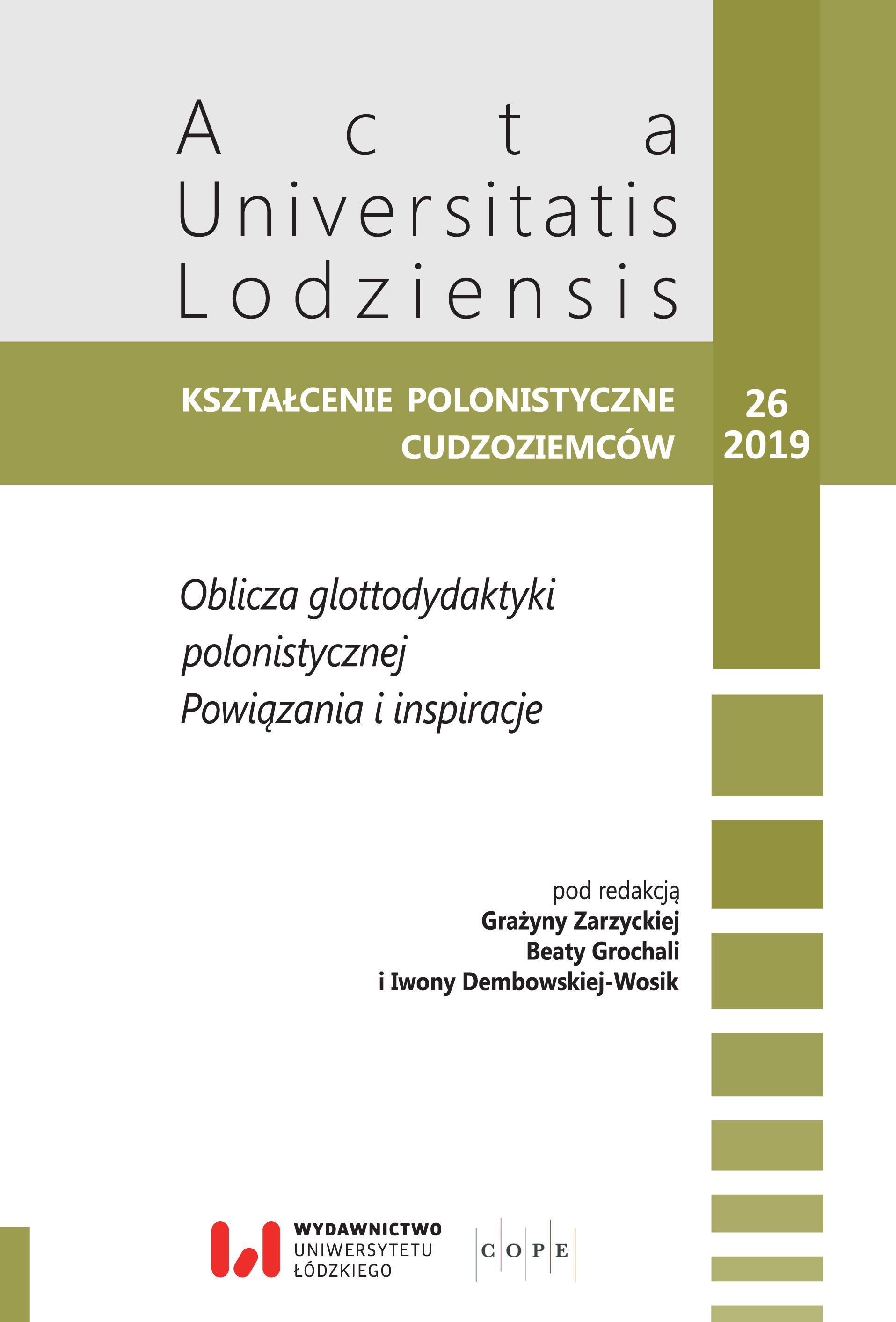
					View Vol. 26 (2019): Oblicza glottodydaktyki polonistycznej. Powiązania i inspiracje

editwd by Grażyna Zarzycka, Beata Grochala, Iwona Dembowska-Wosik

This task is supported by the Ministry of Science and Higher Education funds based on contract No. 302/WCN/2019/1 of 28.08.2019 r. as part of the Support for Scientific Journals program (WCN).

Published: 2019-12-31
Full Issue

Other

  • The faces of teaching Polish as a foreign language variety and interdependence

    Iwona Dembowska-Wosik
    9-26
    DOI: https://doi.org/10.18778/0860-6587.26.01

Articles

  • Teaching Polish as a foreign language within the history of the Polish language

    Anna Dąbrowska
    26-48
    DOI: https://doi.org/10.18778/0860-6587.26.02
  • Non-verbal communication in the teaching of Polish as a foreign language using the example of Asian groups. The difficulties, challenges and solutions

    Barbara Morcinek-Abramczyk
    49-64
    DOI: https://doi.org/10.18778/0860-6587.26.03
  • Initiating and maintaining contact with students on the Polish as a foreign language lesson

    Kamila Kubacka
    65-80
    DOI: https://doi.org/10.18778/0860-6587.26.04
  • Communications strategies as a means to effective communication despite language deficiencies

    Edyta Wojtczak
    81-96
    DOI: https://doi.org/10.18778/0860-6587.26.05
  • Contemporary linguistic politeness theories and their influence on research in Polish language glottodidactics area

    Emilia Sztabnicka-Gradowska
    97-119
    DOI: https://doi.org/10.18778/0860-6587.26.06
  • Foreign language teacher education in Germany, Iran and Poland – a comparative study

    Przemysław E. Gębal, Monika J. Nawracka
    121-137
    DOI: https://doi.org/10.18778/0860-6587.26.07
  • Metalinguistic awareness of the (prospective) teachers of polish as a foreign language – some remarks on the knowledge of declension

    Magdalena Karasek, Mateusz Gaze
    139-148
    DOI: https://doi.org/10.18778/0860-6587.26.08
  • Social media in foreign language teaching and learning – a review

    Natalia Tsai
    149-159
    DOI: https://doi.org/10.18778/0860-6587.26.09
  • Digital technologies in the development of linguistic competences

    Jolanta Laskowska
    161-170
    DOI: https://doi.org/10.18778/0860-6587.26.10
  • What role do electronic resources play in learning Polish as a foreign/second language? The results of a survey

    Natalie Kosch
    171-182
    DOI: https://doi.org/10.18778/0860-6587.26.11
  • Glottodidactic error within the phonic subsystem – a voice in the discussion

    Michalina Biernacka
    183-196
    DOI: https://doi.org/10.18778/0860-6587.26.12
  • Why and how (not) to teach Polish phonetics to foreigners?

    Ewa Badyda
    197-208
    DOI: https://doi.org/10.18778/0860-6587.26.13
  • Polish pronunciation for Non-Polish speakers handling articulation difficulties in an international group during the one year preparatory course

    Anna Majewska-Tworek
    209-220
    DOI: https://doi.org/10.18778/0860-6587.26.14
  • Genre competence in teaching Polish as a foreign language

    Beata Grochala
    221-229
    DOI: https://doi.org/10.18778/0860-6587.26.15
  • The cover letter as a genre of speech in teaching Polish as a foreign language

    Anna Dunin-Dudkowska
    231-243
    DOI: https://doi.org/10.18778/0860-6587.26.16
  • The structure of descriptive essay about a person and its realization in compositions written by students learning Polish as a foreign language at the A2 level

    Justyna Sochacka
    245-257
    DOI: https://doi.org/10.18778/0860-6587.26.17
  • TOC logical branch as a tool in teaching Polish as a foreign/second/heritage language to children

    Magdalena Smoleń-Wawrzusiszyn
    259-270
    DOI: https://doi.org/10.18778/0860-6587.26.18
  • Inflection in a bilingual child. A case study

    Maria Wtorkowska
    271-286
    DOI: https://doi.org/10.18778/0860-6587.26.19
  • Heritage language and bilingualism – the necessity of comparative research studies

    Ewa Lipińska, Anna Seretny
    287-300
    DOI: https://doi.org/10.18778/0860-6587.26.20
  • Polish as a foreign language for the deaf – in search of a good term

    Małgorzata Januszewicz
    301-310
    DOI: https://doi.org/10.18778/0860-6587.26.21
  • Specification of selected honorifics in relation to the general Polish standard in the written Polish as a heritage language in Ukraine (using the material of the Polish-language Gazeta Polska Bukowiny periodical)

    Ałła Krawczuk
    311-328
    DOI: https://doi.org/10.18778/0860-6587.26.22
  • Collocations of dimension adjectives with the names of human body parts in Polish and Korean

    Emilia Szalkowska-Kim
    329-358
    DOI: https://doi.org/10.18778/0860-6587.26.23
  • Prepositional phrases and their lexicographical description in German and German-Polish dictionaries – glottodidactic perspective

    Hanna Burkhardt, Alina Jurasz
    359-372
    DOI: https://doi.org/10.18778/0860-6587.26.24
  • Materials for teaching Polish word order to foreigners: methodological and practical problems revisited

    Małgorzata Gębka-Wolak, Aleksandra Walkiewicz
    373-386
    DOI: https://doi.org/10.18778/0860-6587.26.25
  • Zrobię to bez zwłok… the category of number in the teaching of Polish as a foreign language to Ukrainian-speaking people

    Iryna Bundza
    387-397
    DOI: https://doi.org/10.18778/0860-6587.26.26
  • Is Russian more “English” than Polish? About English borrowings in the language of information technology from the perspective of teaching Polish as a foreign language

    Viktoriia Hudy
    399-411
    DOI: https://doi.org/10.18778/0860-6587.26.27
  • Category of grammatical gender in the Polish language system, discourse and glottodidactics

    Edyta Pałuszyńska
    413-423
    DOI: https://doi.org/10.18778/0860-6587.26.28
  • Polish culturemes – points of view, techniques for their selection and negotiation. Applying ethnolinguistic perspective in Polish language glottodidactics

    Grażyna Zarzycka
    425-441
    DOI: https://doi.org/10.18778/0860-6587.26.29
  • Can I grasp hygge if Polish lacks the term? The (un)translatability of emotions in foreign language teaching

    Anna Rabczuk
    443-470
    DOI: https://doi.org/10.18778/0860-6587.26.30
  • What do we call the children? Familial terms of address in Polish and English

    Katarzyna Dziwirek
    471-485
    DOI: https://doi.org/10.18778/0860-6587.26.31
  • From Japanese Schulz to Polish Parnicki – around the year 1974

    Tokimasa Sekiguchi
    487-500
    DOI: https://doi.org/10.18778/0860-6587.26.32
  • Polish studies and their discourses in Seoul about the 6th international academic conference from the series: “The Polish Studies’ meetings of three countries – China, Korea, Japan”

    Grażyna Zarzycka
    501-514
    DOI: https://doi.org/10.18778/0860-6587.26.33

