Vol. 20 (2013): Glottodydaktyka – media – komunikacja. Kształtowanie kompetencji komunikacyjnej
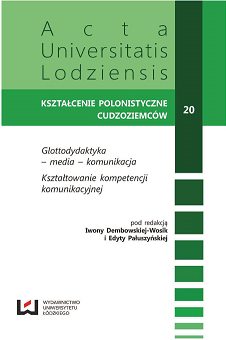
okładka

pod redakcją Iwony Dembowskiej-Wosik i Edyty Pałuszyńskiej
Published: 2013-01-01

Other

Articles

  • The characteristics of a scientific discourse conducted in “Studies in Teaching Polish to Foreigners” in 1987–2013

    Grażyna Zarzycka
    11-21
    DOI: https://doi.org/10.18778/0860-6587.20.02
  • The role of vocabulary in developing the communicative competence in foreigners (in Polish and Slovene)

    Bożena Ostromęcka-Frączak
    23-31
    DOI: https://doi.org/10.18778/0860-6587.20.03
  • Czy potrzebujemy nowej definicji języka dla potrzeb glottodydaktycznych?

    Piotr Garncarek
    33-39
    DOI: https://doi.org/10.18778/0860-6587.20.04
  • Remarks on onomastic grammar (on the example of selected foreign and Polish toponyms)

    Wiesław Tomasz Stefańczyk
    41-50
    DOI: https://doi.org/10.18778/0860-6587.20.05
  • Polish and Slovene devil is not as black…

    Maria Wtorkowska
    51-65
    DOI: https://doi.org/10.18778/0860-6587.20.06
  • The minimum vocabulary for a tourist in Łódź

    Grzegorz Rudziński
    67-74
    DOI: https://doi.org/10.18778/0860-6587.20.07
  • The phonological vel phonetic competence – terminological deliberations

    Michalina Biernacka
    75-82
    DOI: https://doi.org/10.18778/0860-6587.20.08
  • The competence of native speakers of Polish and foreigners (Ukrainians) in using Polish temporal phraseology

    Krystyna Nikołajczuk
    83-92
    DOI: https://doi.org/10.18778/0860-6587.20.09
  • Onomatopoeia in interactions between advanced students of English. A corpus based study

    Anna Jaskólska
    93-101
    DOI: https://doi.org/10.18778/0860-6587.20.10
  • Teaching phraseology in the communicative method

    Kamil Szafraniec
    103-110
    DOI: https://doi.org/10.18778/0860-6587.20.11
  • Family vocabulary (in Halina Zgółkowa’s lists and the Hurra!!! Textbook series)

    Paula Góralczyk
    111-118
    DOI: https://doi.org/10.18778/0860-6587.20.12
  • Referential structures with words pan / pani in the Polish language press in Ukraine: politeness or impoliteness?

    Ałła Krawczuk
    119-130
    DOI: https://doi.org/10.18778/0860-6587.20.13
  • Testamentary genres as a mirror of cultures Polish-American reflections

    Anna Dunin-Dudkowska
    131-140
    DOI: https://doi.org/10.18778/0860-6587.20.14
  • Poles and Poland in selected Polish as a foreign language textbooks in comparison with their perception by the Slovenes

    Maria Magdalena Nowakowska
    141-147
    DOI: https://doi.org/10.18778/0860-6587.20.15
  • Errors made by German learners of Polish caused by cultural interference

    Marta Skura
    149-158
    DOI: https://doi.org/10.18778/0860-6587.20.16
  • Teaching the Polish polite request formulas to Russian-speaking students: the issues of the mother tongue structural and cultural influence in teaching Polish as a second language

    Helena Borysiewicz
    159-166
    DOI: https://doi.org/10.18778/0860-6587.20.17
  • Texts of pre-election political propaganda

    Marta Pančíková
    167-176
    DOI: https://doi.org/10.18778/0860-6587.20.18
  • The influence of the Czech language on the Polish texts published in “Glos Ludu” from Zaolzie

    Maria Witkowska-Gutkowska
    177-186
    DOI: https://doi.org/10.18778/0860-6587.20.19
  • Interactional analysis as a tool in media discourse description

    Edyta Pałuszyńska
    187-198
    DOI: https://doi.org/10.18778/0860-6587.20.20
  • Polish as a foreign language image analysis based on examples from online media sphere

    Miłosz Babecki
    199-208
    DOI: https://doi.org/10.18778/0860-6587.20.21
  • How foreign celebrities speak Polish in the television programmes (interpersonal competence)

    Katarzyna Sitkowska
    209-218
    DOI: https://doi.org/10.18778/0860-6587.20.22
  • Extending the borders of a genre on the example of TV news programmes

    Natalia Sosnowska
    219-228
    DOI: https://doi.org/10.18778/0860-6587.20.23
  • The perception of radio documentary

    Paulina Czarnek
    229-237
    DOI: https://doi.org/10.18778/0860-6587.20.24
  • Linguistic humor in Tomasz Olbratowski’s radio segments on text not for anyone

    Mateusz Gaze
    239-248
    DOI: https://doi.org/10.18778/0860-6587.20.25
  • Multimeida game „I SPY” in the light of an action-oriented approache to teaching and learning foreign languages’ assumptions

    Grażyna Zarzycka, Sławomir Rudziński
    249-259
    DOI: https://doi.org/10.18778/0860-6587.20.26
  • From A to C – problems with the communicative language teaching method in teaching Polish as a foreign language outside of Poland the cultural programme as an alternative to the task-based approach

    Jerzy Kowalewski
    261-270
    DOI: https://doi.org/10.18778/0860-6587.20.27
  • Didactic value of a hybrid text in foreign language teaching: a survey based on Russian and Polish language material

    Halina Kudlińska
    271-280
    DOI: https://doi.org/10.18778/0860-6587.20.28
  • Journalistic texts in Polish language course curriculum for economy group

    Grażyna Balkowska
    281-292
    DOI: https://doi.org/10.18778/0860-6587.20.29
  • Audiovisual media in foreign language classroom on the example of a television documentary

    Agnieszka Wolak
    293-301
    DOI: https://doi.org/10.18778/0860-6587.20.30
  • Communicative competence and the genre – on online live broadcasts

    Beata Grochala
    303-311
    DOI: https://doi.org/10.18778/0860-6587.20.31
  • Polish-language press in Italy as an educational material in teaching Polish as a foreign language and Polish culture

    Maria Rółkowska
    313-321
    DOI: https://doi.org/10.18778/0860-6587.20.32
  • Teaching communications skills in economic groups

    Dorota Wielkiewicz-Jałmużna
    323-327
    DOI: https://doi.org/10.18778/0860-6587.20.33
  • In black and white. Concrete poetry in foreign language classroom

    Natalia Tsai
    329-338
    DOI: https://doi.org/10.18778/0860-6587.20.34
  • Suggestions of using of the internet in teaching Polish as foreign language

    Janusz Bomanowski
    339-348
    DOI: https://doi.org/10.18778/0860-6587.20.35
  • Pop music as teaching material and its possible uses in teaching and learning Polish as a foreign language

    Paweł Pałasz
    349-356
    DOI: https://doi.org/10.18778/0860-6587.20.36
  • The image of the Polish culture refected by the street names in the city of Lodz

    Iwona Dembowska-Wosik
    357-365
    DOI: https://doi.org/10.18778/0860-6587.20.37
  • Criminal riddles in Polish as a foreign language classroom as texts developing the skill of reading and lexical competence

    Aneta Strzelecka
    367-376
    DOI: https://doi.org/10.18778/0860-6587.20.38
  • The language of politicians as teaching materials for the Polish as foreign language

    Karolina Fastyn
    377-383
    DOI: https://doi.org/10.18778/0860-6587.20.39
  • Teacher's corretion and the speaking abilities of students learning Polish as a second language

    Kamila Kubacka
    385-396
    DOI: https://doi.org/10.18778/0860-6587.20.40