Vol. 23 (2016): Specjalistyczne odmiany języka. Koncepcje badawcze i praktyka glottodydaktyczna
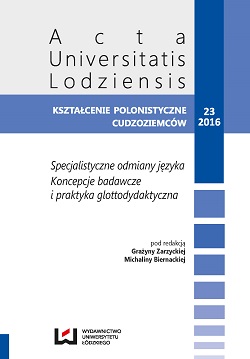
					View Vol. 23 (2016): Specjalistyczne odmiany języka. Koncepcje badawcze i praktyka glottodydaktyczna
Published: 2017-07-10

Full Issue

Other

Articles

  • Teaching foreign languages and the Polish language for specific purposes. New approaches and research perspectives

    Grażyna Zarzycka, Michalina Biernacka
    9-17
    DOI: https://doi.org/10.18778/0860-6587.23.01
  • From the didactics of specialist texts to the didactisation of communication needs and actions. A synthesis of directions and concepts of specialist glottodidactics

    Przemysław E. Gębal
    19-33
    DOI: https://doi.org/10.18778/0860-6587.23.02
  • Mental representation of terms: implications for methodology of teaching languages for specific purposes

    Dorota Gonigroszek
    35-45
    DOI: https://doi.org/10.18778/0860-6587.23.03
  • Polish terminology in Hungarian reserch and language teaching

    Anna Seretny, Wiesław Tomasz Stefańczyk
    47-57
    DOI: https://doi.org/10.18778/0860-6587.23.04
  • Tsk-based learning versus teaching specialist terminology at translation post-graduate studies

    Anna Dunin-Dudkowska
    59-71
    DOI: https://doi.org/10.18778/0860-6587.23.05
  • Metalanguage in selected Polish as a foreign language textbooks

    Beata Grochala
    73-82
    DOI: https://doi.org/10.18778/0860-6587.23.06
  • The knowlege of the world and reading comprehension in Spanish as a foreign language

    Ana Ćavar
    83-96
    DOI: https://doi.org/10.18778/0860-6587.23.07
  • Knowledge transfer. On teaching languages for specific purposes in the context of CLIL pedagogy

    Małgorzata Rzeszutko-Iwan
    97-113
    DOI: https://doi.org/10.18778/0860-6587.23.08
  • Taching Polish as a foreign language in the school of Polish for foreigners at the University of Lodz. Examples of correlations between courses

    Iwona Wilhelms (Słaby-Góral)
    115-125
    DOI: https://doi.org/10.18778/0860-6587.23.09
  • Teaching Polish as a foreign language in mathemathics. Charactristics of the teaching-learning process and learning contents

    Danuta Wróbel, Alicja Zielińska
    127-140
    DOI: https://doi.org/10.18778/0860-6587.23.10
  • Polish for less and more advanced humanists

    Ewa Sabela-Dymek
    141-154
    DOI: https://doi.org/10.18778/0860-6587.23.11
  • Pop-history, pop-politics, and poli-entertaiment as a part of humanities' training for foreigners

    Piotr Kajak
    155-162
    DOI: https://doi.org/10.18778/0860-6587.23.12
  • Teaching specialized lexis at the international centre of education of the Cracow University of Technology to the groups of elementary level A1 and A2 (based on the architecture and history of art vocabulary)

    Edyta Gałat, Michalina Rittner
    163-180
    DOI: https://doi.org/10.18778/0860-6587.23.13
  • Teaching the Polish-Slovak and Polish-Czech terminology

    Marta Pančíková
    181-189
    DOI: https://doi.org/10.18778/0860-6587.23.14
  • Teaching the aspect of the Polish verbs by examples from other Slavonic languages

    Maria Magdalena Nowakowska
    191-197
    DOI: https://doi.org/10.18778/0860-6587.23.15
  • Specialist medical language and multimedia course of professional language for nurses

    Mirosława Magajewska
    199-213
    DOI: https://doi.org/10.18778/0860-6587.23.16
  • Medical Polish in selected didactic materials of the last quarter century

    Magdalena Ławnicka-Borońska, Kamila Kubacka
    215-235
    DOI: https://doi.org/10.18778/0860-6587.23.17
  • Learning Polish as a foreign language at the Medical University of Lodz. The needs of students in the light of the survey

    Edyta Wojtczak
    237-248
    DOI: https://doi.org/10.18778/0860-6587.23.18

