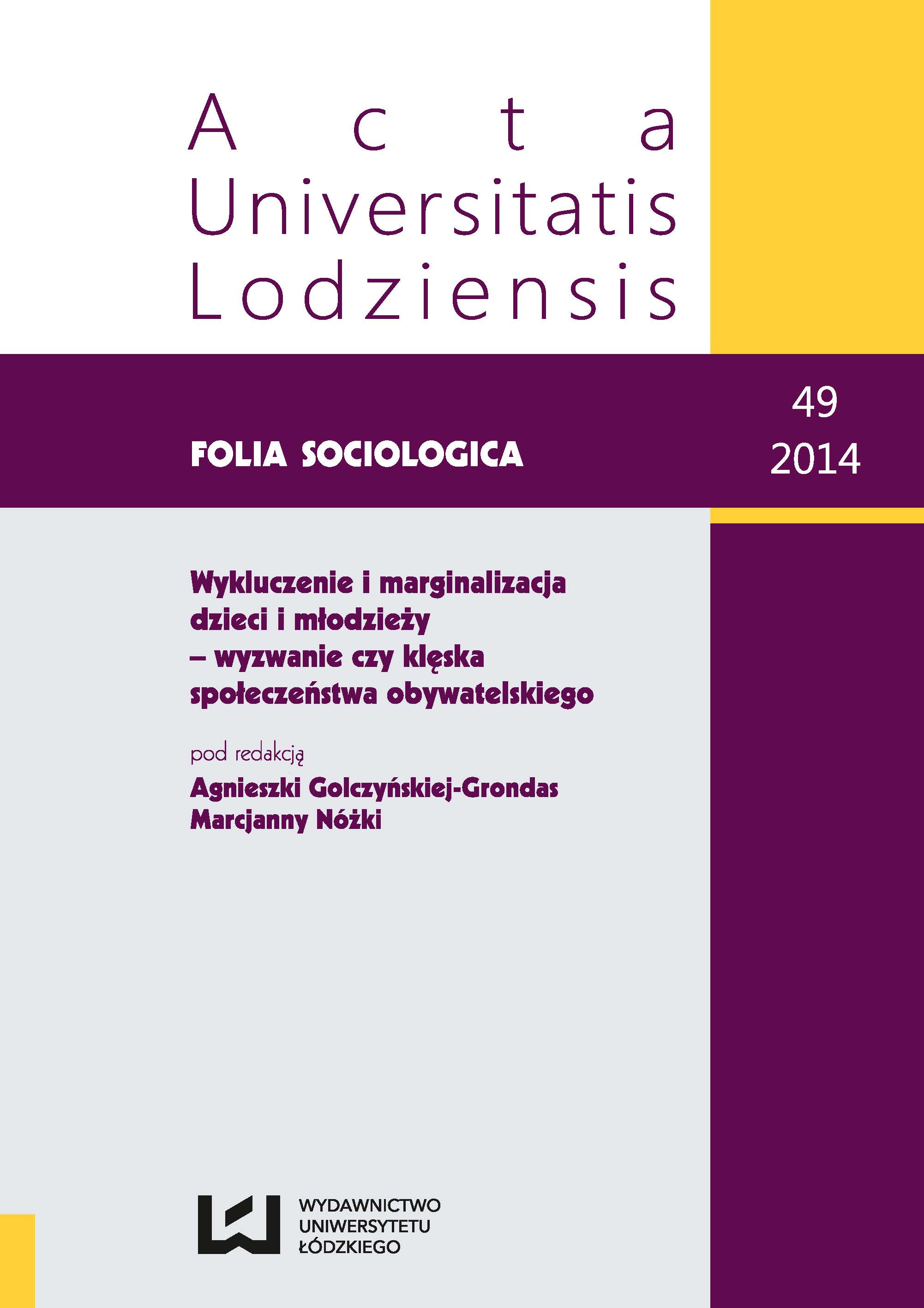
Włączeni jako konsumenci – wyłączeni jako obywatele. Nastolatki w przestrzeni miasta
DOI:
https://doi.org/10.18778/0208-600X.49.03Słowa kluczowe:
nastolatki, obywatelskość, przestrzeń miejska, sąsiedztwo, centrum, galeria handlowaAbstrakt
W artykule podjęto temat wykluczenia społecznego nastolatków w przestrzeni miejskiej, w tym możliwości korzystania z tej przestrzeni i wpływania na nią. Dane z badań empirycznych na temat postaw młodych mieszkańców wobec trzech rodzajów przestrzeni miasta (miejsca zamieszkania, centrum miasta i galerii handlowej) zostały przeanalizowane w kontekście koncepcji obywatelskości, konsumpcjonizmu oraz konstruktywistycznych teorii przestrzeni. Próbę badawczą stanowiło 838 uczniów gimnazjów z Krakowa i Katowic ‒ miast porównywalnych pod względem wielkości i funkcji metropolitarnych, ale odmiennych pod względem struktury urbanistycznej i symboliki przestrzeni. Analiza danych umożliwia sformułowanie wniosku, że specyfika przestrzeni miast ma związek z postrzeganiem i waloryzowaniem poszczególnych miejsc oraz sposobem ich „używania”, ale nie ma ona związku z poczuciem sprawstwa u nastolatków. Miasto jest mechanizmem generującym postawy konsumpcyjne, ale nie stymuluje postaw aktywnych i zorientowanych na sprawy publiczne.
Bibliografia
Anthony K. H. (1985), The Shopping Mall: A Teenage Hangout, „Adolescence”, Summer, Vol. XX, No. 78, (Libra Publishers, San Diego (CA)), s. 307‒311.
Google Scholar
Barber B. (2008), Skonsumowani. Jak rynek psuje dzieci, infantylizuje dorosłych i połyka obywateli, Muza, Warszawa.
Google Scholar
Bauman Z. (2007), Płynne życie, Wydawnictwo Literackie, Kraków.
Google Scholar
Bauman Z. (2009), Konsumowanie życia, Wydawnictwo Uniwersytetu Jagiellońskiego, Kraków.
Google Scholar
Benjamin W. (2005), Pasaże, Wydawnictwo Literackie, Kraków.
Google Scholar
Bierwiaczonek K., Lewicka B., Nawrocki T. (2012), Rynki, malle i cmentarze. Przestrzeń publiczna miast śląskich w ujęciu socjologicznym, Zakład Wydawniczy Nomos, Kraków.
Google Scholar
Biuletyn Statystyczny Miasta Krakowa. Informacje i opracowania statystyczne (2013), Urząd Statystyczny w Krakowie, Kraków.
Google Scholar
Bourdieu P. (2009), Rozum praktyczny. O teorii działania, Wydawnictwo Uniwersytetu Jagiellońskiego, Kraków.
Google Scholar
Brzozowska-Brywczyńska M. (2013), Partycypacja publiczna dzieci, ser. „Analizy i Opinie”, Instytut Spraw Publicznych, Warszawa.
Google Scholar
Frysztacki K., Nóżka M., Smagacz-Poziemska M. (2011), Dzieci ulicy. Studium szczególnego problemu miejskiego, Wydawnictwo Uniwersytetu Jagiellońskiego, Kraków.
Google Scholar
Hobin E. P., Leatherdale S., Manske S., Dubin J. A., Elliott S., Veugelers P. (2013), Are Environmental Influences on Physical Activity Distinct for Urban, Suburban, and Rural Schools? A Multilevel Study Among Secondary School Students in Ontario, Canada, „Journal of School Health”, Vol. 83, No. 5, s. 357‒367.
Google Scholar
DOI: https://doi.org/10.1111/josh.12039
Lewis G. H. (1989), Rats and Bunnies: Core Kids in an American Mall, „Adolescence”, No. 24, s. 881‒889.
Google Scholar
Lister R. (2007), Inclusive Citizenship: Realizing the Potential, „Citizenship Studies”, Vol. 11, Issue 1, pp. 49‒61; Special Issue: Celebrating Ten Years of Citizenship Studies, Engin F. Isin, Peter Nyers, Bryan S. Turner (eds.), DOI: 10.1080/13621020601099856.
Google Scholar
DOI: https://doi.org/10.1080/13621020601099856
Lofland L. H. (1998), The Public Realm. Exploring the City’s Quintessential Social Territory, Aldine de Gruyter, New York.
Google Scholar
Makowski G. (2004), Świątynia konsumpcji. Geneza i społeczne znaczenie centrum handlowego, Wydawnictwo Trio, Warszawa.
Google Scholar
Makowski G. (2009), Cetrum handlowe ‒ przestrzeń aktywna czy reaktywna?, [w:] Społeczeństwo i codzienność, S. Rudnicki, J. Stypińska, K. Wojnicka (red.), Wydawnictwa Akademickie i Profesjonalne, Warszawa, s. 163‒182.
Google Scholar
Matthiews M. H., Taylor M., Percy-Smith B., Limb M. (2000), The Unacceptable Flaneur: The Shopping Malls as a Teenage Hangout, „Childhood”, No. 6, s. 279‒294.
Google Scholar
DOI: https://doi.org/10.1177/0907568200007003003
Miś L., Nóżka M., Smagacz-Poziemska M. (2011), Nasze problemy. Bezrobocie i bieda we współczesnym społeczeństwie polskim, Universitas, Kraków.
Google Scholar
Nawrocki T. (2011), Przestrzeń publiczna w krajobrazie śląskich miast, „Przegląd Socjologiczny”, vol. LX, nr 2-3, s. 229‒254.
Google Scholar
Oldenburg R. (1997), The great good place: Cafes, coffee shops, bookstores, bars, hair salons, and other hangouts at the heart of a community, Da Capo Press, Chicago.
Google Scholar
Pluta J. (2011), Jakość życia a kwestia społecznej partycypacji mieszkańców w sferze publicznej miasta, [w:] M. Nowak, P. Pluciński (red.), O miejskiej sferze publicznej. Obywatelskość i konflikty o przestrzeń, Korporacja Ha!art, Kraków, s. 223‒237.
Google Scholar
Rocznik Statystyczny Województwa Śląskiego (2013), Urząd Statystyczny w Katowicach, Katowice, http://www.stat.gov.pl/katow/69_848_PLK_HTML.htm, 20.01.2014.
Google Scholar
Röhrborn B., Żylicz P. (2013), Dziecko ma głos! Raport z badań, Fundacja Rozwoju Dzieci im. J. A. Komeńskiego, Warszawa.
Google Scholar
Romaniszyn K. (red.) (2011), Nowa droga do zniewolenia? O życiu w społeczeństwie konsumpcyjnym, Wydawnictwo Uniwersytetu Jagiellońskiego, Kraków.
Google Scholar
Sennett R. (2009), Upadek człowieka publicznego, Wydawnictwo MUZA, Warszawa.
Google Scholar
Simmel G. (2006), Mentalność mieszkańców wielkich miast, [w:] Idem, Most i drzwi. Wybór esejów, Oficyna Naukowa, Warszawa, s. 114‒134.
Google Scholar
Smagacz M. (2009), Upublicznianie komercyjnej przestrzeni miejskiej, [w:] M. Dymnicka, A. Majer (red.), Współczesne miasta. Szkice socjologiczne, Wydawnictwo Uniwersytetu Łódzkiego, Łódź, s. 91‒102.
Google Scholar
Stillerman J., Salcedo R. (2010), Es mucho más que comprar... Discursos y prácticas espaciales cotidianas en Malls de Santiago, „Estudios Avanzados”, nú. 13, s. 79‒103.
Google Scholar
Stillerman J., Salcedo R. (2012), Transposing the Urban to the Mall: Routes, Relationships, Resistance in Two Santiago, Chile, Shopping Centers, „Journal of Contemporary Ethnography”, Vol. 41, No. 3, DOI: 10.1177/0891241611434551, s. 309‒336.
Google Scholar
DOI: https://doi.org/10.1177/0891241611434551
Szafraniec K. (2011), Młodzi 2011, Kancelaria Prezesa Rady Ministrów, Warszawa.
Google Scholar
Szlendak T. (2008), Supermarketyzacja. Religia i obyczaje seksualne młodzieży w kulturze konsumpcyjnej, Wydawnictwo Uniwersytetu Wrocławskiego, Wrocław.
Google Scholar
Ubóstwo dzieci. Najnowsze dane dotyczące ubóstwa dzieci w krajach rozwiniętych (2012), UNICEF, http://www.unicef.pl/Co-robimy/Prawa-dziecka/Biezace-dzialania/Biezace-dzialania/Ubostwo-Dzieci-Raport-UNICEF, 10.04.2014.
Google Scholar
Vanderbeck R. M., Johnson J. H., Jr. (2000), That’s the only place where you can hang out: Urban young people and the space of the mall, „Urban Geography”, Vol. 21, No. 1. s. 5‒25.
Google Scholar
DOI: https://doi.org/10.2747/0272-3638.21.1.5
Warunki życia rodzin w Polsce (2014), Główny Urząd Statystyczny, Warszawa.
Google Scholar
Zukin S. (2010), Naked City. The Death and Life of Authentic Urban Places, Oxford University Press, Oxford.
Google Scholar
DOI: https://doi.org/10.1093/oso/9780195382853.001.0001
Pobrania
Opublikowane
Jak cytować
Numer
Dział
Licencja

Utwór dostępny jest na licencji Creative Commons Uznanie autorstwa – Użycie niekomercyjne – Bez utworów zależnych 4.0 Międzynarodowe.