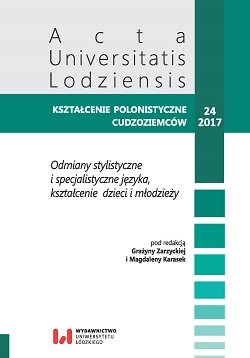
Vol. 24 (2017): Odmiany stylistyczne i specjalistyczne języka, kształcenie dzieci i młodzieży

					View Vol. 24 (2017): Odmiany stylistyczne i specjalistyczne języka, kształcenie dzieci i młodzieży
Published: 2017-12-08

Full Issue

Other

Articles

  • New Dimensions of Glottodidactics: the Problems of Teaching Stylistic and Specialized Variants of Polish and other Languages and Education of Children and Adoloscents

    Magdalena Karasek
    9-16
    DOI: https://doi.org/10.18778/0860-6587.24.01
  • Scientific Language and Ssientific Terms Against the Background of Language Diveristy in Poland and Abroad

    Edyta Pałuszyńska
    17-26
    DOI: https://doi.org/10.18778/0860-6587.24.02
  • Scientific and Official Styles in Preparatory Courses of Polish as a Foreign Language for Persons Planning to Study in the Polish Language

    Maria Czempka-Wewióra
    27-43
    DOI: https://doi.org/10.18778/0860-6587.24.03
  • Administrative and Law Language Challenges for Immingrants

    Samanta Busiło
    45-60
    DOI: https://doi.org/10.18778/0860-6587.24.04
  • Colloquial Lexis in "Polski, Krok po Kroku", a Handbook for Learning Polish as a Foreign Language (A1 Level ) – Selected Issues from Statistical Perspective

    Konrad Kazimierz Szamryk
    61-75
    DOI: https://doi.org/10.18778/0860-6587.24.05
  • Is the Contemporary Colloquial Polish Well Reflected in the Use of Questions in Polish as a Foreign Language Textbooks?

    Rafał Maćkowiak
    77-95
    DOI: https://doi.org/10.18778/0860-6587.24.06
  • About Teaching an Informal Style in a Class of Polish as a Foreign Language at a Basic Level

    Justyna Sochacka
    97-108
    DOI: https://doi.org/10.18778/0860-6587.24.07
  • The Art of Street Language – Polish Youth Slang

    Anna Rabczuk
    109-126
    DOI: https://doi.org/10.18778/0860-6587.24.08
  • On Stylistic Marked Vocabulary in Teaching Belarusians the Polish Language

    Radosław Kaleta
    127-134
    DOI: https://doi.org/10.18778/0860-6587.24.09
  • Polish for Academic Purposes. A Proposition of a Course Programme Addressed to the Foreigners who are Planning to Study at Polish Universities

    Grażyna Zarzycka
    135-148
    DOI: https://doi.org/10.18778/0860-6587.24.10
  • Lexis in Teaching Language for Specific Purposes – Academic and Occupational Requirements

    Anna Seretny
    149-166
    DOI: https://doi.org/10.18778/0860-6587.24.11
  • The Learner of Polish as a Foreign Language in a Business Context Motivations, Problems and Needs

    Ewa Komorowska
    167-181
    DOI: https://doi.org/10.18778/0860-6587.24.12
  • About Sme Problems in Translation of Company Documentation and Teaching Bulgarian and Polish as a Foreign Language

    Steliana Aleksandrova
    183-189
    DOI: https://doi.org/10.18778/0860-6587.24.13
  • Teaching Aviation English Standard Phraseology

    Anna Borowska
    191-203
    DOI: https://doi.org/10.18778/0860-6587.24.14
  • Teaching Specialist Vocabulary at the Linguistics for Business Specialization

    Katarzyna Bednarska
    205-212
    DOI: https://doi.org/10.18778/0860-6587.24.15
  • Polish Language as an Environment of Teaching Mathematics to Foreigners in the Light of Experience of Working on the Manual for Foreigners

    Grzegorz Rudziński
    213-227
    DOI: https://doi.org/10.18778/0860-6587.24.16
  • Move Beyond the Text

    Urszula Swoboda-Rydz
    229-241
    DOI: https://doi.org/10.18778/0860-6587.24.17
  • During the Breaks and in Class: Specialist Language in the Education of Children and Young People

    Urszula Majcher-Legawiec
    243-259
    DOI: https://doi.org/10.18778/0860-6587.24.18
  • Reading as a Key Skill in Content-based Language Learning of Bilingual Children

    Agnieszka Rabiej
    261-273
    DOI: https://doi.org/10.18778/0860-6587.24.19