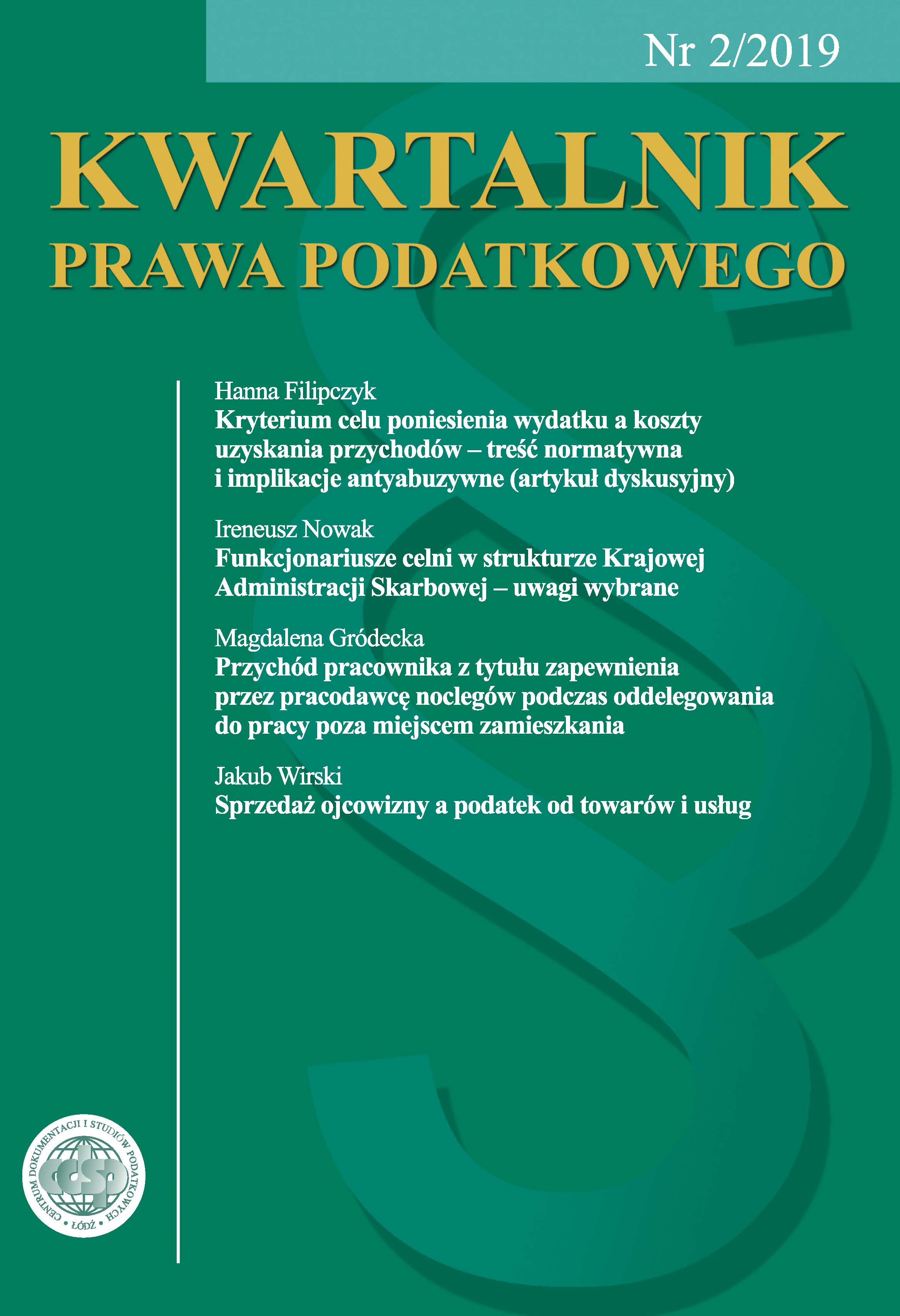
Employee revenues arising from accommodation ensured by employer for the duration of posting away from place of residence
DOI:
https://doi.org/10.18778/1509-877X.2019.02.03Keywords:
free-of-charge benefit, employee revenues, accommodation costs, principle of legal system coherenceAbstract
Free-of-charge employee benefits are becoming an increasingly common phenomenon in employment relationships. In fact, they are often a significant non-cash incentive system. Despite numerous rulings of the Supreme Administrative Court and the judgment of the Constitutional Tribunal, the issue of income taxation of such benefits still raises considerable doubts. There is no definition of this concept included in the Tax Act and its grammatical interpretation does not provide an unambiguous answer as to which of benefits offered to employees by an employer should be considered as taxable pursuant to Article 12 (1) of the Personal Income Tax Act.
The article is aimed at demonstrating, on the example of taxation of employer-financed accommodation of employees posted to work away from their place of residence, that in a situation when the legislator does not create (and does not define) institutions and concepts specific to tax law – concepts and principles developed in other branches of law should be used. Tax law is an element of the legal system and solutions resulting therefrom should be harmonized with standards of other branches. The legal system should be coherent (free from inconsistencies) and complete (free from gaps). Revenues from an employment relationship comprise all benefits that an employee receives from an employer in relation to being in an employment relationship. In this situation, it is therefore practical to interpret tax law in connection with relevant labor law regulations.
Downloads
References
Bartosiewicz A., Kubacki R., PIT. Komentarz, Warszawa 2015.
Bielska-Brodziak A., Interpretacja tekstu prawnego na podstawie orzecznictwa podatkowego, Warszawa 2009.
Bosak M., Majka P., Wpływ regulacji podatkowoprawnych na stosunek pracy w świetle funkcji ochronnej prawa pracy, referat wygłoszony podczas XIX Zjazdu Katedr i Zakładów Prawa Pracy i Ubezpieczeń Społecznych zorganizowanego przez Katedrę Prawa Pracy i Prawa Socjalnego na Wydziale Prawa i Administracji Uniwersytetu im. Adama Mickiewicza w Poznaniu, 15–17 maja 2013 r.
Brejdak P., Glosa do wyroku Trybunału Konstytucyjnego z dnia 8 lipca 2014 r., sygn. akt K 7/13, „Roczniki Nauk Prawnych” 2016, t. 26, nr 1. DOI: https://doi.org/10.18290/rnp.2016.26.1-8
Brzeziński B., Podstawy wykładni prawa podatkowego, Gdańsk 2008.
Brzeziński B., Prawo podatkowe a prawo cywilne, [w:] Prawo podatkowe. Teoria. Instytucje. Funkcjonowanie, red. B. Brzeziński, Toruń 2009.
Brzeziński B., Wstęp do nauki prawa podatkowego, Toruń 2003.
Brzeziński B., Nykiel W., Zasady ogólne prawa podatkowego, „Przegląd Podatkowy” 2002, nr 3.
Gomułowicz A., Małecki J., Podatki i prawo podatkowe, Warszawa 2002.
Grabarczyk J., Opodatkowanie przychodów z nieodpłatnych świadczeń, Warszawa 2009.
Karwat P., Obejście prawa podatkowego. Natura zjawiska i sposoby przeciwdziałania mu, Warszawa 2002.
Mariański A., Nowak-Piechota A., Konstytucyjność opodatkowania pozapłacowych świadczeń pracowniczych, „Przegląd Podatkowy” 2014, nr 11.
Mastalski R., Autonomia prawa podatkowego a spójność i zupełność systemu prawa, „Przegląd Podatkowy” 2003, nr 10.
Mastalski R., Stosowanie prawa podatkowego, Warszawa 2008.
Nykiel W., Autonomia prawa podatkowego (wybrane zagadnienia), [w:] Konstytucja, ustrój, system finansowy państwa. Księga pamiątkowa ku czci prof. Natalii Gajl, Warszawa 1999.
Ostrowski K., Prawo finansowe. Zarys ogólny, Warszawa 1970.
Skibińska M., Sokołowska A., Delegowanie pracowników za granicę, Warszawa 2016.
Strzelec D., Pozapłacowe świadczenia na rzecz pracowników – aspekty podatkowe, „Prawo i Podatki” 2010, nr 9.
Strzelec D., Świadczenia na rzecz pracowników. Aspekty podatkowe, Warszawa 2011.
Downloads
Published
Issue
Section
License

This work is licensed under a Creative Commons Attribution-NonCommercial-NoDerivatives 4.0 International License.
How to Cite