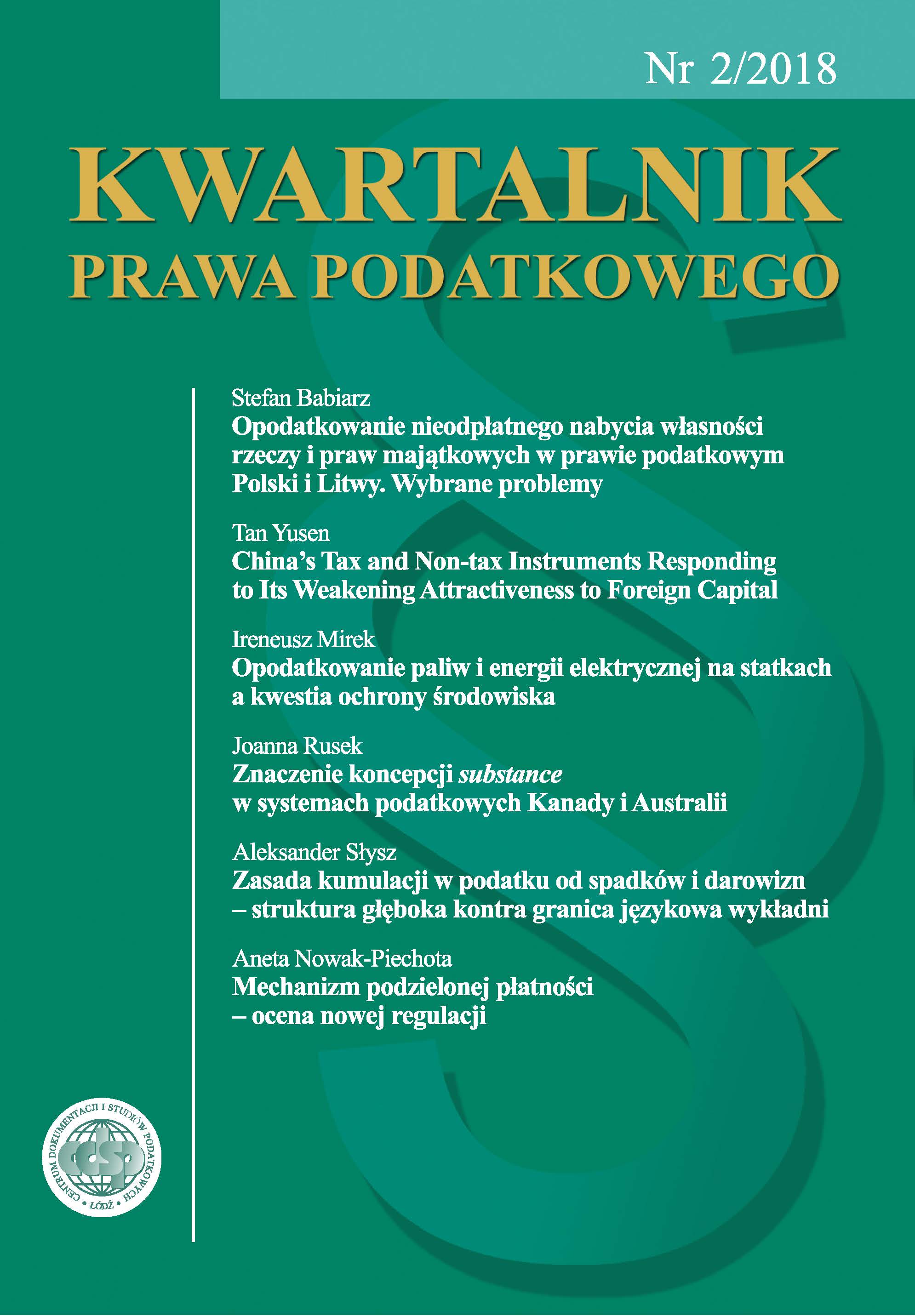
The principle of cumulation in the inheritance and donation tax – deep structure versus language limit of interpretation
DOI:
https://doi.org/10.18778/1509-877X.2018.02.05Keywords:
the principle of cumulation, language limits of interpretation, interpretation of tax law, inheritance and donation tax, coherence, deep structureAbstract
The principle of cumulation in the inheritance and donation tax, as a legal concept, is an institution with a hundred-year history. Due to law changes and changes in law structure, proper interpretation is very difficult. Obeying the literal interpretation border necessarily leads to an unacceptable result. The solution ensuring the proper functioning of the cumulation rule is to transgress the limits of linguistic interpretation, so that the result of the interpretation would be in accordance with the deep structure of the tax act. In breaking the language border, a specific method of law interpretation can be helpful, method thats taking into account contextualism as well as the coherence of law and the legal and economic structure.
Downloads
References
Araszkiewicz M., Koherencyjny model rozumowań prawniczych, „Archiwum Filozofii Prawa i Filozofii Społecznej” 2010, nr 11.
Brzeziński B., Wykładnia prawa podatkowego, Gdańsk 2013.
Brzeziński B., Zasady wykładni prawa podatkowego w krajach anglosaskich, Warszawa 2007.
Chustecka K., Krawczyk I., Kurasz M., Ustawa o podatku od spadków i darowizn. Komentarz, LEX/el. 2007.
Cockfield A., Purism and contextualism within international tax law analysis: How traditional analysis fails developing countries, „eJournal of Tax Research” 2007, no. 5.
Filipczyk H., Postulat pewności prawa w wykładni operatywnej prawa podatkowego, Warszawa 2013.
Kingson C.I., The deep structure of taxation: Dividend distributions, „The Yale Law Journal” 1976/77, vol. 85.
Kotowski A., Językowa granica wykładni a reguła słuszności. Glosa do postanowienia SN z dnia 2 lutego 2012 r. (IV KK 273/11), „Przegląd Sądowy” 2010, nr 10.
Kurzac M., Unikanie opodatkowania a uchylanie się od opodatkowania, „Studia Prawno-Ekonomiczne” 2017, t. 105, cejsh.icm.edu.pl/cejsh/element/bwmeta1.element.desklight-b23d0373-f073-4e09-9926-b2e8c8c1a611/c/01_Kurzac.pdf (dostęp: 3.03.2018).
Mastalski R., Miejsce wykładni językowej w procesie stosowania prawa podatkowego, „Przegląd Podatkowy” 2007, nr 8.
Mastalski R., Wykładnia językowa w interpretacji prawa podatkowego, „Przegląd Podatkowy” 1999, nr 8.
Serwacki J., Ustawa o podatku od spadków i darowizn. Komentarz, LEX/el. 2001.
Spyra T., Granice wykładni prawa. Znaczenie językowe tekstu prawnego jako granice wykładni, Kraków 2006.
Tokarczyk R., Komparatystyka prawnicza, Warszawa 2008.
Zelenak L., Thinking about nonliteral interpretations of the Internal Revenue Code, „North Carolina Law Review” 1986, vol. 64.
Downloads
Published
Issue
Section
License

This work is licensed under a Creative Commons Attribution-NonCommercial-NoDerivatives 4.0 International License.
How to Cite