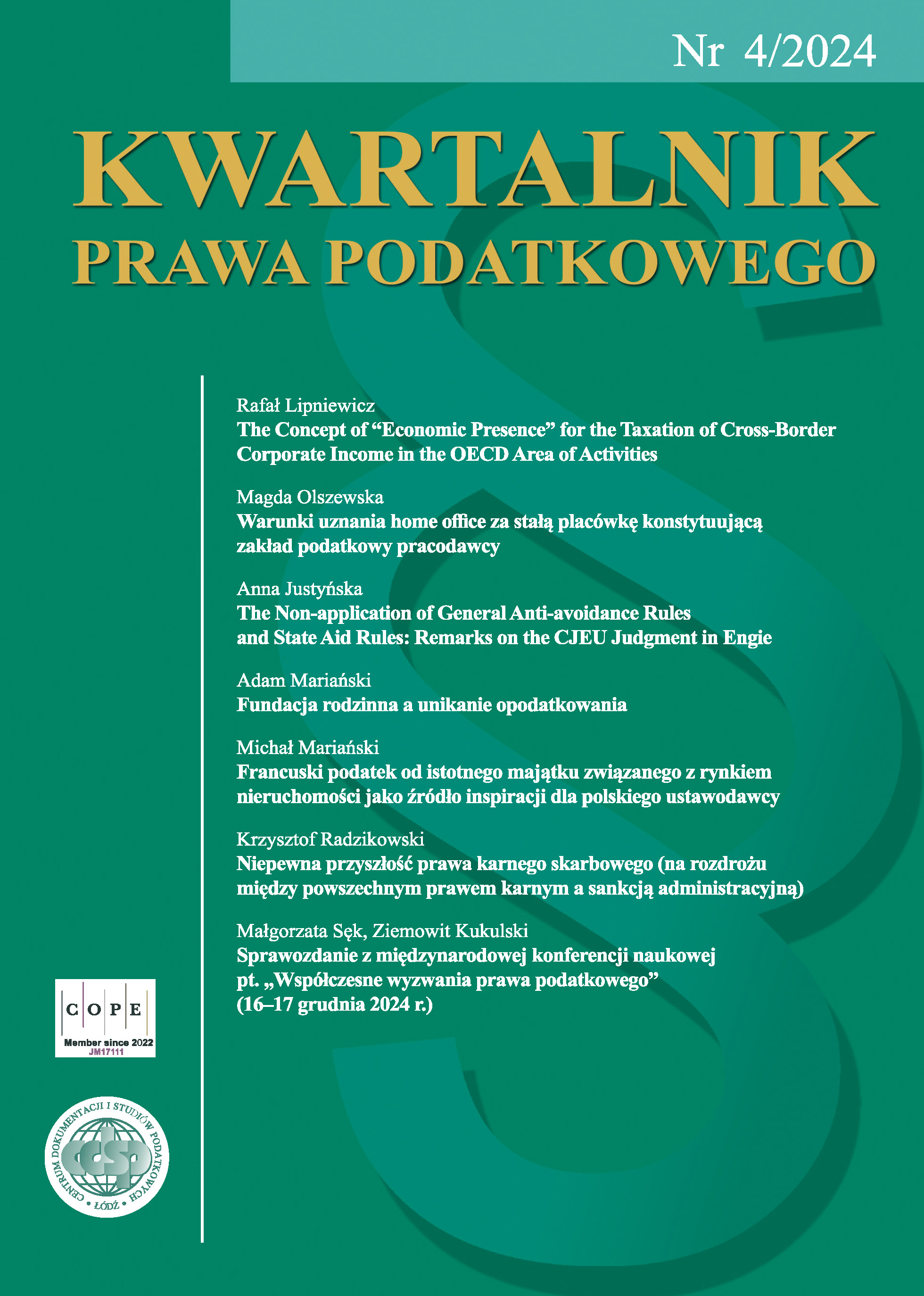
The Conditions for Recognition of the Home Office as Fixed Place of Business Constituting the Permanent Establishment of the Employer
DOI:
https://doi.org/10.18778/1509-877X.2024.04.02Keywords:
permanent establishment, home office, remote work, right of disposal, OECD Model ConventionAbstract
The article raises the issue of the constitution of the permanent establishment through the fixed place of business in the form of the Home Office of the employee. As part of the article, a detailed analysis of the provisions of the OECD Model Convention and the Commentary thereto, views in the doctrine, jurisprudence of the administrative courts and the interpretation practice of the tax authorities were presented. Special attention was paid to the notion “at the disposal” and “effective power to use the location”, as well as the controversies arising from the interpretation of those notions. Subsequently the exclusion from the definition of the permanent establishment for auxiliary activities was discussed, as well as the many doubts it raises. According to the author, the presented subject matter calls into question the premise of having a fixed establishment at the disposal of the taxpayer as a condition for the creation of the permanent establishment in the modern knowledge-based economy. On the other hand, in the circumstances of mobile work gaining popularity, it is necessary to regulate the allocation of income between the states with consideration to the postulate for minimizing of imposing of administrative burdens on the taxpayers.
Downloads
References
Bendlinger S., Steuerlicher Nexus durch „digitale Nomaden“ und der Sinn der Homeoffice-Betriebstätte, „SWI Steuer und Wirtschaft International” 2021, Bd. 9.
Bendlinger S., Bendlinger V., Der VwGH zur Verfügungsmacht und das jähe Ende der Homeoffice-Betriebsstätte, „SWI Steuer und Wirtschaft International” 2022, Bd. 9.
Bendlinger V., Romstorfer J., SWI-Jahrestagung: Homeoffice-Tätigkeit von Arbeitnehmern als Betriebsstätte des Arbeitgebers?, „SWI Steuer und Wirtschaft International” 2023, Bd. 9.
Beretta G., „Work on the Move”: Rethinking Taxation of Labour Income under Tax Treaties, „International Tax Studies” 2022, vol. 5(2), https://doi.org/10.59403/3mgn45y DOI: https://doi.org/10.59403/3mgn45y
Brzeziński B., Lasiński-Sulecki K., Morawski W., Problemy wykładni międzynarodowych umów w sprawie unikania opodatkowania, sporządzonych w dwóch lub większej liczbie języków, „Kwartalnik Prawa Podatkowego” 2023, nr 1, https://doi.org/10.18778/1509-877X.2023.01.01 DOI: https://doi.org/10.18778/1509-877X.2023.01.01
Laskowska M., Niedźwiedzki W., Powstanie zagranicznego zakładu w przypadku agenta zależnego i pracy zdalnej na podstawie orzecznictwa sądowego w Polsce, „Przegląd Podatkowy” 2023, nr 6.
Lipniewicz R., Dysponowanie placówką, [w:] R. Lipniewicz, Podatkowy zakład zagraniczny. Koncepcja i funkcjonowanie, Warszawa 2017, LEX.
Lipniewicz R., Zakład typu podstawowego w polskich umowach podatkowych, [w:] R. Lipniewicz, Podatkowy zakład zagraniczny. Koncepcja i funkcjonowanie, Warszawa 2017, LEX.
Litwińczuk H., Międzynarodowe prawo podatkowe, Warszawa 2020.
Majdańska A., Zastosowanie Modelu Konwencji OECD oraz Komentarza w praktyce polskich organów podatkowych i sądów administracyjnych, „Monitor Podatkowy” 2015, nr 6.
OECD, Interpretation and Application of Article 5 (Permanent Establishment) of the OECD Model Tax Convention, 12 October 2011 to 10 February 2012, Paris 2011, https://web-archive.oecd.org/2012-06-14/91526-48836726.pdf (dostęp: 11.02.2024).
OECD, Model Tax Convention on Income and on Capital 2017, Full Version (as it read on 21 November 2017), Paris 2019, http://dx.doi.org/10.1787/g2g972ee-en DOI: https://doi.org/10.1787/g2g972ee-en
OECD, OECD Transfer Pricing Guidelines for Multinational Enterprises and Tax Administrations 2022, Paris 2022, https://doi.org/10.1787/0e655865-en DOI: https://doi.org/10.1787/0e655865-en
Owoc J., Glosa do wyroku Wojewódzkiego Sądu Administracyjnego w Gliwicach z dnia 31 stycznia 2022 r., sygn. I SA/Gl 1340/21, „Kwartalnik Prawa Podatkowego” 2023, nr 2, https://doi.org/10.18778/1509-877X.2023.03.09 DOI: https://doi.org/10.18778/1509-877X.2023.02.08
Rasch S., Rosenberger F., Brülisauer P., Auswirkungen dezentraler Home-Office Aktivitäten auf die Betriebsstättenbegründung, Gewinnzuordnung und Arbeitnehmerbesteuerung, „Archiv für Schweizerisches Abgaberecht” 2020/2021, Bd. 89(9).
Reimer E., Article 5. Permanent Establishment, [w:] Klaus Vogel on Double Taxation Conventions, red. E. Reimer, A. Rust, Alphen aan den Rijn 2015.
Reimer E., Permanent Establishment in the OECD Model Tax Convention, [w:] E. Reimer, S. Schmid, M. Orell, Permanent Establishments: A Domestic Taxation, Bilateral Tax Treaty and OECD Perspective, Alphen aan den Rijn 2018.
Rohner T., Home Office – Steuerliche Behandlung im grenzüberschreitenden Bereich, „Zeitschrift für Schweizerisches und Internationales Steuerrecht” 2015, Bd. 4.
Schuster R., Verleger T., Wenn das Home zum Office wird – Bedingt jede Tätigkeit im Homeoffice eine Betriebsstätte im abkommensrechtlichen Sinn?, „IWB Internationales Steuer- und Wirtschaftsrecht” 2020, Bd. 21.
Skaar A.A., Permanent Establishment: Erosion of a Tax Treaty Principle, Alphen aan den Rijn 2020.
Wassermeyer H.C.F., Kaeser C., Art. 5, [w:] Doppelbesteuerung. Kommentar, Band 1, red. H.C.F. Wassermeyer, München 2019.
Woźniak T., Powstanie zakładu a unikanie opodatkowania w międzynarodowym prawie podatkowym, Warszawa 2022. DOI: https://doi.org/10.33226/0137-5490.2022.1.4
Downloads
Published
Issue
Section
License

This work is licensed under a Creative Commons Attribution-NonCommercial-NoDerivatives 4.0 International License.
How to Cite