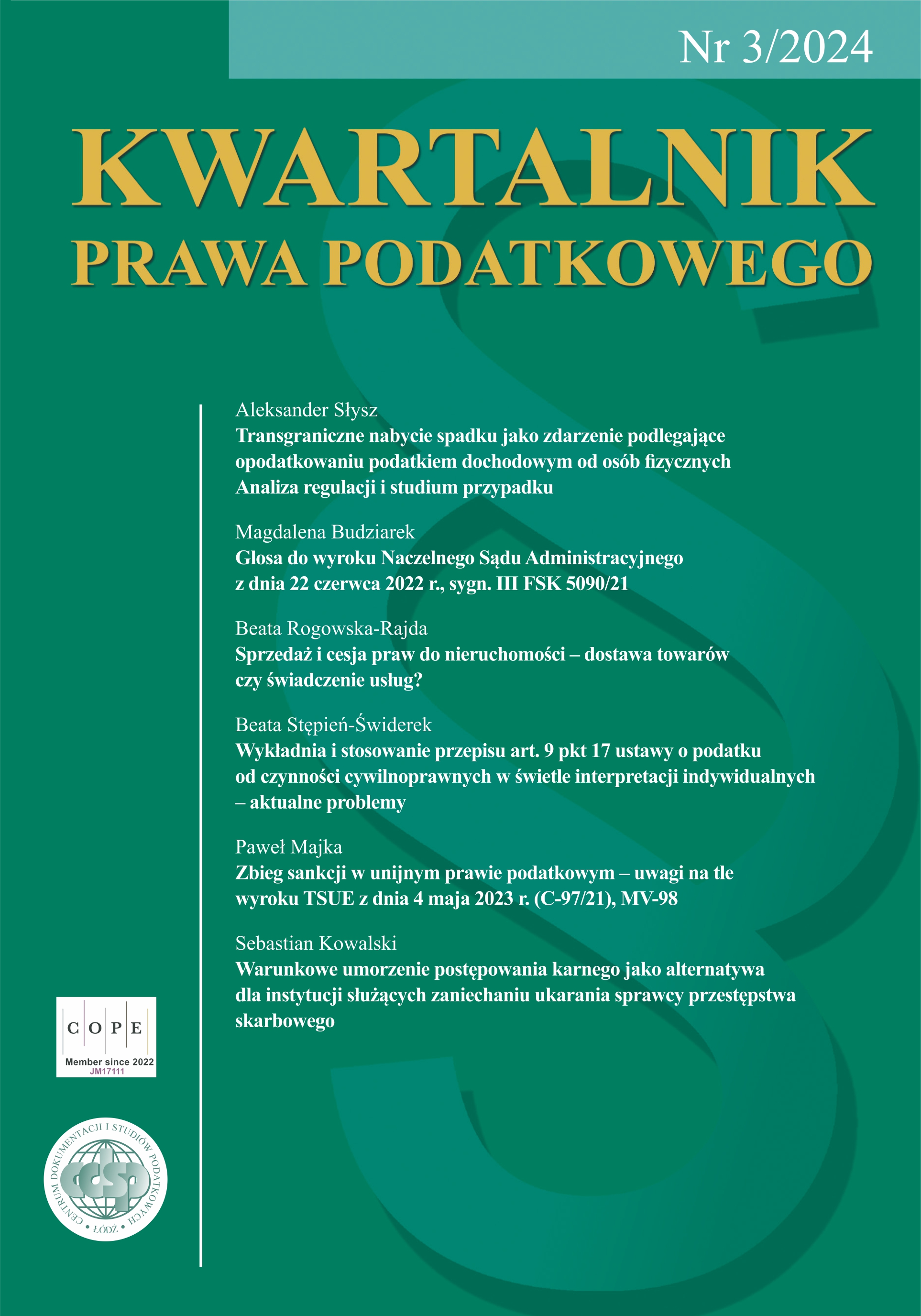
Conditional Discontinuance of Criminal Proceedings as an Alternative to the Institution of Desistance from Punishing the Perpetrator of a Fiscal Crime
DOI:
https://doi.org/10.18778/1509-877X.2024.03.06Keywords:
fiscal crime, probation, conditional discontinuance of criminal proceedings, degression of punishmentAbstract
The article is devoted to the institution of conditional discontinuance of criminal proceedings as an institution of degression of punishment, which may constitute a good alternative to certain measures related to abandonment of punishment of a fiscal crime. The author draws attention to the possibility of applying this institution to any fiscal crime – provided, of course, that the statutory prerequisites for it are met. In addition to the fact that the accused retains the status of an unpunished person, it is of major practical significance that for the conditional discontinuance of riminal proceedings, it is not necessary to pay the public receivables deposited in connection with the offence before a verdict is passed. Irrespective of the perceived advantages of this institution, the study also points to the weaker sides of the current regulation. The author included, above all, the manner in which the negative premise of conditional discontinuance of criminal proceedings is regulated, as well as the scope and content of obligations that may be imposed on the accused in a judgment ending criminal fiscal proceedings.
Downloads
References
Bojarski M., Płońska A., Świda Z., Podstawy materialnego i procesowego prawa o wykroczeniach, Wrocław 2012.
Grzegorczyk T., Kodeks karny skarbowy. Komentarz, Warszawa 2009.
Kardas P., Łabuda G., Razowski T., Kodeks karny skarbowy. Komentarz, Warszawa 2017.
Kowalski S., Glosa do wyroku Naczelnego Sądu Administracyjnego z dnia 1 marca 2022 r., II FSK 1625/19, „Przegląd Ustawodawstwa Gospodarczego” 2024, nr 1.
Kowalski S., Środki probacyjne w kodeksie karnym skarbowym po nowelizacji kodeksu karnego, „Probacja” 2015, nr 3.
Kunicka-Michalska B., Warunkowe umorzenie postępowania karnego, [w:] System prawa karnego. Tom 6. Kary i inne środki reakcji prawnokarnej, red. M. Melezini, Warszawa 2016.
Łabuda G., Razowski T., Glosa do postanowienia Sądu Apelacyjnego we Wrocławiu z dnia 16 maja 2002 r., sygn. II AKo 245/02, „Prokuratura i Prawo” 2003, nr 3.
Michalski J., Komentarz do Kodeksu karnego skarbowego. Tytuł I. Przestępstwa skarbowe i wykroczenia skarbowe, Warszawa 2000.
Morawski L., Wykładnia w orzecznictwie sądów. Komentarz, Toruń 2002.
Nowacki J., „Odpowiednie” stosowanie przepisów prawa, „Państwo i Prawo” 1964, z. 3.
Opałek K., Wróblewski J., Zagadnienia teorii prawa, Warszawa 1969.
Raglewska J., Raglewski J., Dobrowolne poddanie się odpowiedzialności za przestępstwo skarbowe a ustawowy wymóg braku skazania za ten rodzaj czynu zabronionego, „Prokuratura i Prawo” 2015, nr 7–8.
Siwik Z., „Odpowiednie” stosowanie przepisów kodeksu karnego w prawie karnym skarbowym, „Przegląd Prawa i Administracji” 1987, t. XXIII.
Siwik Z., Systematyczny komentarz do ustawy karnej skarbowej. Część ogólna, Wrocław 1993.
Skowronek G., Dobrowolne poddanie się odpowiedzialności jako instytucja konsensualnego zakończenia sprawy, „Forum Polityki Kryminalnej” 2022, nr 1(3). DOI: https://doi.org/10.31261/FPK.2022.03.03
Skwarczyński H., Czynny żal w prawie karnym skarbowym, „Monitor Podatkowy” 2006, nr 2.
Downloads
Published
Versions
- 2024-09-30 (2)
- 2024-09-30 (1)
Issue
Section
License

This work is licensed under a Creative Commons Attribution-NonCommercial-NoDerivatives 4.0 International License.
How to Cite