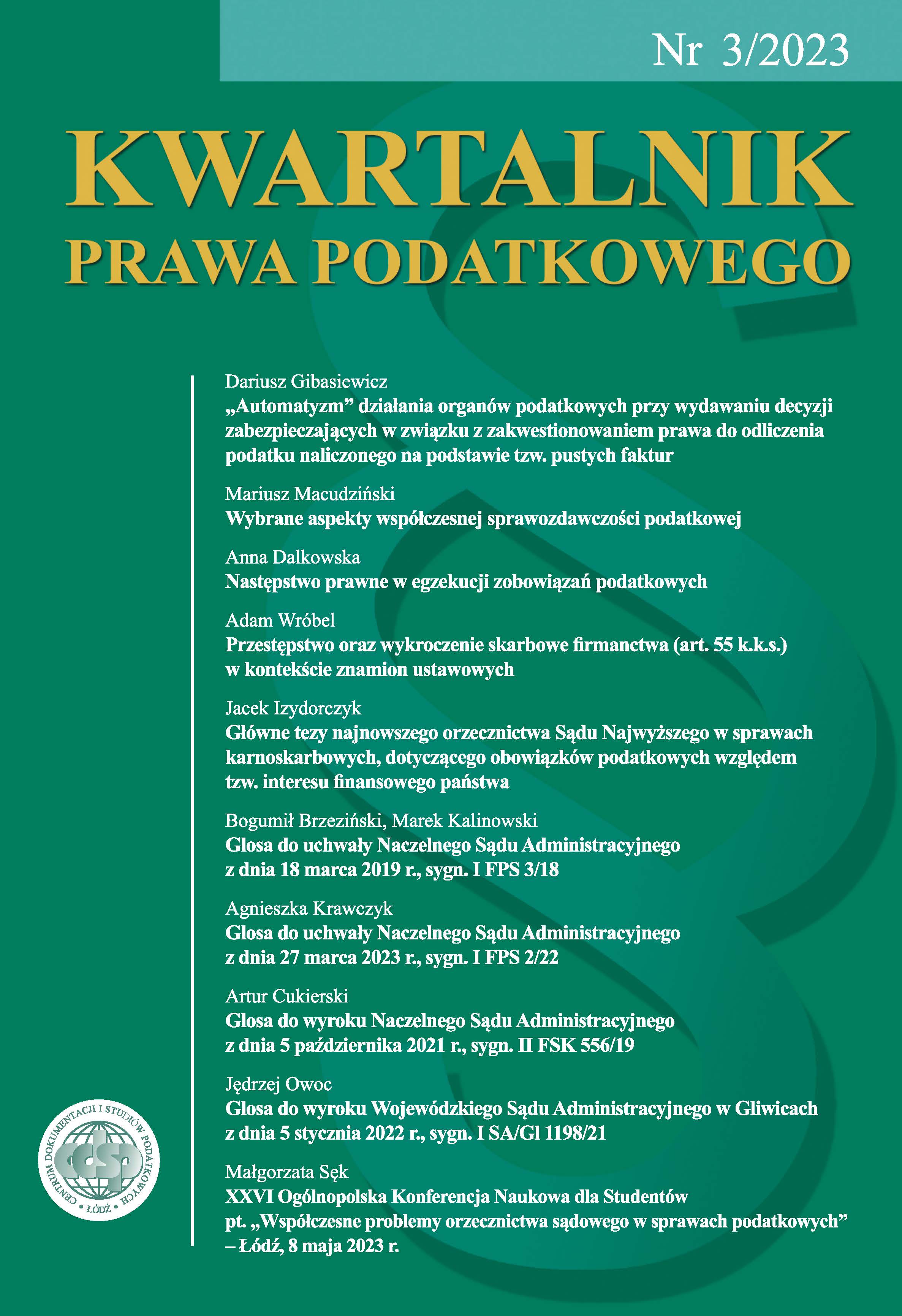
Commentary to the Supreme Administration Court Judgment of 5 October 2021, ref. no. II FSK 556/19
DOI:
https://doi.org/10.18778/1509-877X.2023.03.08Keywords:
alternative investment company, ASI, investment fund, alternative investment fund, AIFAbstract
The subject of this gloss is the judgment of the Supreme Administrative Court of October 5, 2021, ref. II FSK 556/19, in which, examining the cassation appeal of the Director of the National Tax Information against the judgment of the Voivodship Administrative Court on corporate income tax, the Supreme Administrative Court set aside the contested judgment in its entirety, stating that the differences between investment funds explicitly listed in Article 3(1) and (4) of the Act of 27 May 2004 on investment funds and management of alternative investment funds (hereinafter referred to as the Act on Investment Funds or u.f.i.) and alternative investment companies within the meaning of Article 8a(1) of the Act on Investment Companies (hereinafter referred to as ASI) are however so significant that it cannot be assumed that ASIs are investment funds within the meaning of the said Act. At the same time, he admitted that not every alternative investment fund is an investment fund within the meaning of the u.f.i., and the definition of investment funds, specifying the forms of operation of the funds, uses a closed catalog from which alternative investment companies are excluded. Thus, it questioned the taxpayer’s right to benefit from the tax exemption provided for in Article 17(1e)(3) of the Corporate Income Tax Act, (hereinafter referred to as u.p.d.o.p.) in the case of investing income in the participation rights of an alternative investment company. Despite certain ambiguities in the regulations, the ruling of the Supreme Administrative Court should be approved. Considering that the Act on Investment Funds bindingly establishes the meaning of both the alternative investment company and the investment fund, and at the same time introduces a dichotomous division between these collective investment institutions, the use of a linguistic interpretation allows for unequivocal confirmation of the impossibility of applying the tax exemption specified in art. 17 sec. 1e point 3 u.p.d.o.p. for investing income in the participation rights of an alternative investment company.
Downloads
References
Bielska-Brodziak A., Suska M., Węzeł gordyjski, czyli o in dubio pro tributario na tle klasyfikacji dyrektyw wykładni oraz pojęcia momentu interpretacyjnego, „Państwo i Prawo” 2020, nr 8.
Brzeziński B., Prawo podatkowe. Zagadnienia teorii i praktyki, Toruń 2017.
Gomułowicz A., Mączyński D., Podatki i prawo podatkowe, Warszawa 2022.
Kmieć J., Komentarz do art. 1, [w:] Ustawa o funduszach inwestycyjnych. Komentarz. Tom I. Art. 1–157, red. A. Kidyba, Warszawa 2018.
Matusiakiewicz Ł., Rozstrzyganie wątpliwości prawnych na korzyść podatnika, LEX/online.
Popławski M., Komentarz do art. 2a, [w:] Ordynacja podatkowa. Tom I. Zobowiązania podatkowe. Art. 1–119zzk. Komentarz aktualizowany, red. L. Etel, LEX/el. 2023.
Postrzech Ł., Zwolnienia przedmiotowe w podatku dochodowym od osób prawnych dochodów przeznaczonych na działalność preferowaną przez państwo, LEX/online.
Zieliński M., Wykładnia prawa. Zasady – reguły – wskazówki, Warszawa 2017.
Ziembiński Z., Problemy podstawowe prawoznawstwa, Warszawa 1980.
Downloads
Published
Issue
Section
License

This work is licensed under a Creative Commons Attribution-NonCommercial-NoDerivatives 4.0 International License.
How to Cite




PlumX metrics