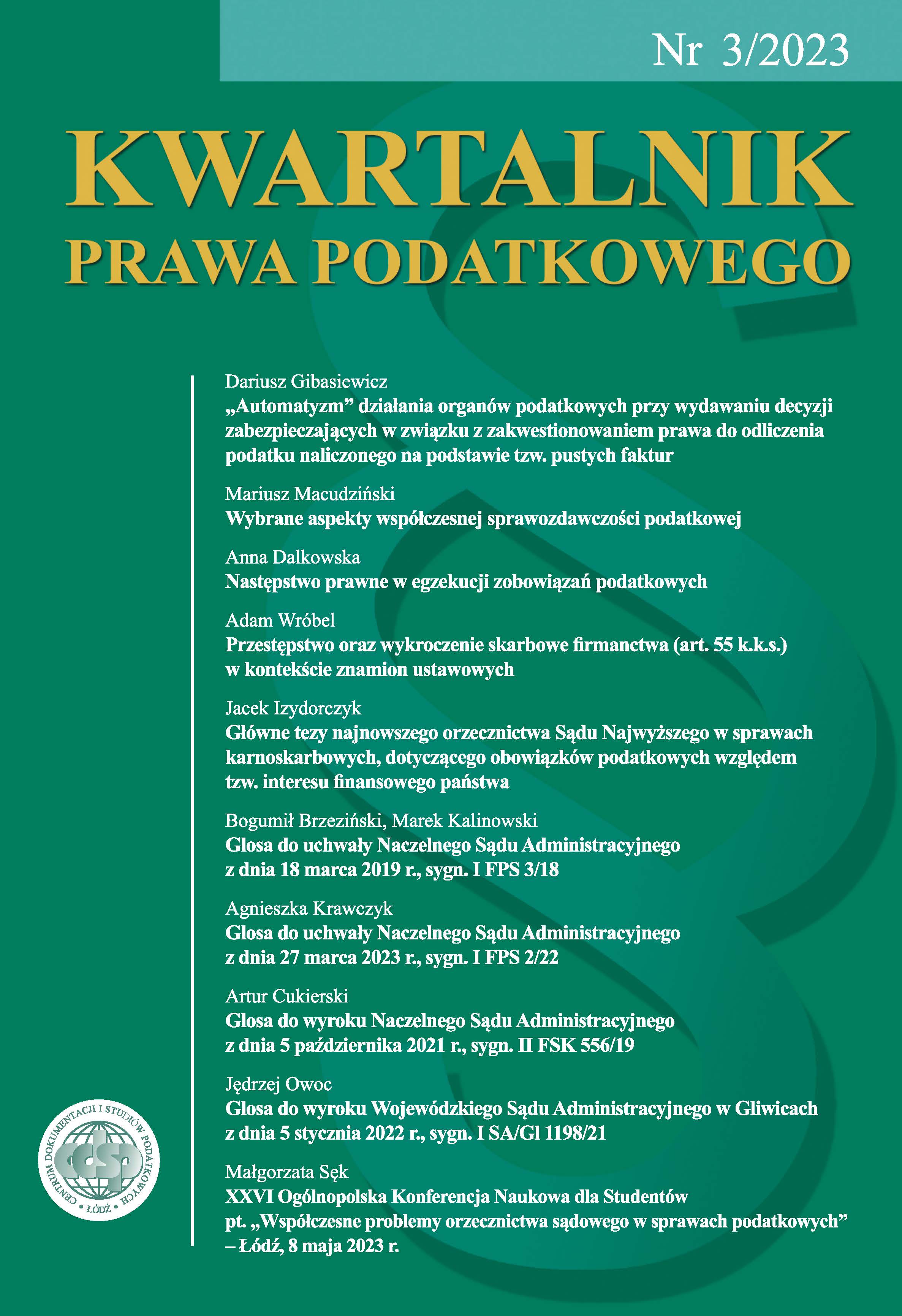
Fiscal crime and fiscal offense of the companying disguising (art. 55 Fiscal Criminal Code) – in the context of statutory features
DOI:
https://doi.org/10.18778/1509-877X.2023.03.04Keywords:
company’s disguise, delict of the companying disguising, polish criminal fiscal law, fiscal offense, fiscal crimeAbstract
The prohibited act of the companying disguising included in the provisions of the Fiscal Criminal Code takes two forms: a fiscal crime (art. 55 § 1 and 2 of the Fiscal Criminal Code) and a fiscal offense (art. 55 § 3 of the Fiscal Criminal Code). In the doctrine exist a view, that the essence of the companying disguising is to conduct business in a camouflaged manner or to hide its actual size with the use of a substituted entity, which exposes the tax to depletion (F. Prusak); the perpetrator realizing the delict defined in art. 55 of the Fiscal Criminal Code, uses the name or surname, name or company name of another entity, exposing the tax to depletion. The subject in the discussed prohibited act in question is the financial interest of the State Treasury, local government units – fiscal interest of the state – and European Union (individual subject of protection), and secondarily as a secondary subject of protection, registration order of entrepreneurs; what can also be derived from the context of views expressed in the literature of the subject. The „main” perpetrator („firmant”), i.e. the perpetrator defined in art. 55 § 1 of the Fiscal Criminal Code, could be only a taxpayer running a business, specified in art. 3 point 9 of the tax ordinance, which is also accentuated in the doctrine and judicature. The fiscal crime or offense in question is individual in nature, it may be committed only intentionally, in the form of an action (on the side of the „firmant”), with a direct intention. On the consideration is given the postulate, that in the case of a lesser importance if the amount of tax exposed to depletion is small value, the art. 55 § 1 of the Fiscal Criminal Code was classified as a fiscal offence.
Downloads
References
Bartosiewicz A., Komentarz do art. 55, [w:] A. Bartosiewicz, R. Kubacki, Kodeks karny skarbowy. Przestępstwa i wykroczenia podatkowe oraz dewizowe, Warszawa 2010, Legalis/el.
Gardocki L., Prawo karne, Warszawa 2017.
Grzegorczyk T., Kodeks karny skarbowy. Komentarz, Warszawa 2009, LEX/el.
Hasło imię, [w:] Słownik języka polskiego PWN, https://sjp.pwn.pl/sjp/imie;2465811.html (dostęp: 25.07.2023).
Hasło posługiwanie, [w:] Słownik języka polskiego PWN, https://sjp.pwn.pl/slowniki/posługiwanie.html (dostęp: 25.02.2023).
Kotowski W., Kurzępa B., Kodeks karny skarbowy. Komentarz, Warszawa 2007, LEX/el.
Łabuda G., Komentarz do art. 55, [w:] P. Kardas, T. Razowski, G. Łabuda, Kodeks karny skarbowy. Komentarz, Warszawa 2017, LEX/el.
Michalski J., Komentarz do kodeksu karnego skarbowego. Tytuł I „Przestępstwa skarbowe i wykroczenia skarbowe”, Warszawa 2000, LEX/el.
Piaseczny A., Komentarz do art. 55, [w:] A. Wielgolewska, A. Piaseczny, Kodeks karny skarbowy. Komentarz, Warszawa 2012, LEX/el.
Praktyczny słownik współczesnej polszczyzny, t. 31, red. H. Zgółkowa, Poznań 2001.
Prusak F., Kodeks karny skarbowy. Komentarz. Tom II (art. 54–191), Kraków 2006, LEX/el.
Radzikowska D., Firmanctwo jako nielegalny sposób zmniejszenia zobowiązań podatkowych, [w:] Prawo karne skarbowe – wybrane zagadnienia teorii i praktyki, red. R. Dziembowski, M. Pieńkowska, A. Opalska, Olsztyn 2016.
Skowronek G., Kodeks karny skarbowy. Komentarz, Warszawa 2020, Legalis/el.
Słownik języka polskiego PWN, t. 2, red. L. Drabik, E. Sobol, Warszawa 2007.
Wilk L., Firmanctwo – art. 55 kodeksu karnego skarbowego, „Prokuratura i Prawo” 2001, nr 6.
Wilk L., Komentarz do art. 55, [w:] L. Wilk, J. Zagrodnik, Kodeks karny skarbowy. Komentarz, Warszawa 2018, Legalis/el.
Współczesny słownik języka polskiego, t. 2, red. B. Dunaj, Warszawa 2007.
Zgoliński I., Komentarz do art. 55, [w:] Kodeks karny skarbowy. Komentarz, red. I. Zgoliński, Warszawa 2018, LEX/el.
Downloads
Published
Versions
- 2023-11-23 (2)
- 2023-09-30 (1)
Issue
Section
License

This work is licensed under a Creative Commons Attribution-NonCommercial-NoDerivatives 4.0 International License.
How to Cite