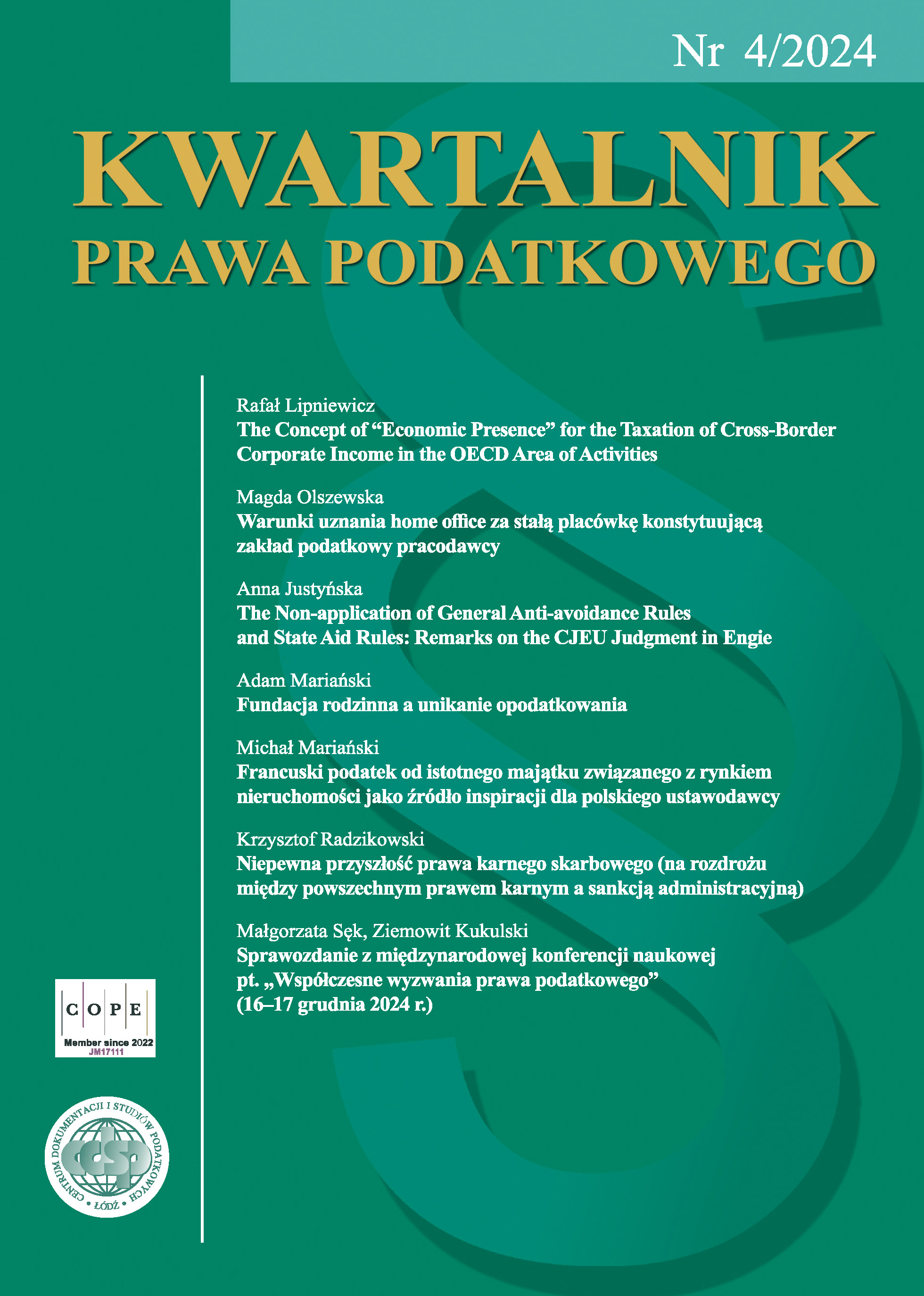
Koncepcja „obecności ekonomicznej” dla opodatkowania transgranicznych dochodów przedsiębiorstw w działaniach OECD
DOI:
https://doi.org/10.18778/1509-877X.2024.04.01Słowa kluczowe:
stały zakład, cyfryzacja, obecność ekonomiczna, filar I, kwota AAbstrakt
OECD od kilkunastu lat prowadzi prace analityczne mające na celu dostosowanie modelu opodatkowania transgranicznych dochodów przedsiębiorstw w warunkach zmieniających się strategii wejścia na rynki zagraniczne, które – zwłaszcza w przypadku tzw. przedsiębiorstw gospodarki cyfrowej – nie wymagają w wielu przypadkach „fizycznej” obecności na terytorium państwa ekspansji rynkowej. W artykule poddano analizie założenia nowego łącznika (nexus) opartego na koncepcji „obecności ekonomicznej” w świetle erozji koncepcji stałego zakładu w warunkach gospodarki cyfrowej. Zasadniczym celem artykułu jest ocena możliwych konsekwencji wprowadzenia do modelu opodatkowania międzynarodowego mechanizmu umożliwiającego państwu źródła opodatkowanie dochodów zagranicznej spółki, w przypadku braku tradycyjnych, „fizycznych” przejawów obecności takiej spółki w danym państwie.
Pobrania
Bibliografia
Avi-Yonah R., Kir A., Building the Gateway: Why the Two Pillars Need Each Other, “U of Michigan Public Law Research Paper” 2024, no. 24-023, https://doi.org/10.2139/ssrn.4766111
Google Scholar
DOI: https://doi.org/10.2139/ssrn.4766111
Bardopoulos A.M., eCommerce and the Effects of Technology on Taxation, Cham–Heidelberg–New York–Dordrecht–London 2015, https://doi.org/10.1007/978-3-319-15449-7
Google Scholar
DOI: https://doi.org/10.1007/978-3-319-15449-7
Bunn D., Response to the United States Treasury Department’s Request for Public Input on Pillar One, 2023, https://taxfoundation.org/research/all/federal/treasury-public-input-pillar-one-response/ (accessed: 11.02.2024).
Google Scholar
Bunn D., Testimony: The OECD’s Pillar One Project and the Future of Digital Services Taxes, March 7, 2024, https://taxfoundation.org/research/all/federal/pillar-one-digital-services-taxes/ (accessed: 11.02.2024).
Google Scholar
Cooper G.S., Building on the Rubble of Pillar One, “Bulletin for International Taxation” 2021, no. 11/12, https://doi.org/10.59403/q2700q
Google Scholar
DOI: https://doi.org/10.59403/q2700q
Dourado A.P., Would Pillar One Fix the Broken System?, “Intertax” 2023, no. 12, https://doi.org/10.54648/TAXI2023083
Google Scholar
DOI: https://doi.org/10.54648/TAXI2023083
Gravelle J.G., The OECD/G20 Pillar 1 and Digital Services Taxes: A Comparison, “Congressional Research Service”, 1 April 2024, R47988.
Google Scholar
Hongler P., Pistone P., Blueprints for a New PE Nexus to Tax Business Income in the Era of the Digital Economy, “IBFD Working Paper”, 20 January 2015, https://doi.org/10.2139/ssrn.2586196
Google Scholar
DOI: https://doi.org/10.2139/ssrn.2586196
Jamroży M., Majdowski F., Permanent Establishment in Digital Business, “Studia Prawno-Ekonomiczne” 2022, vol. 122, https://doi.org/10.26485/SPE/2022/122/1
Google Scholar
DOI: https://doi.org/10.26485/SPE/2022/122/1
Kamiya T., NexusPillar 1: The Aim of “Fair” Distribution of Profits and Taxing Rights among Countries, [in:] Justice, Equality and Tax Law, eds. N. Čičin-Šain, M. Riedl, Wien 2022.
Google Scholar
Laskowska M., Nowe międzynarodowe reguły podziału dochodu w gospodarce cyfrowej według OECD, “Przegląd Podatkowy” 2020, no. 12.
Google Scholar
Laskowska M., Nowy mechanizm administrowania CIT na poziomie globalnym. Nowe podejście do administrowania globalnym rozliczaniem podatku dochodowego w świetle projektu OECD Filar I, 2023, https://casp.sgh.waw.pl/blog/nowy-mechanizm-administrowania-cit-na-poziomie-globalnym (accessed: 11.02.2024).
Google Scholar
Lipniewicz R., Jurysdykcja podatkowa w cyberprzestrzeni. Model międzynarodowego opodatkowania dochodu, Warszawa 2018.
Google Scholar
Lipniewicz R., Podatkowy zakład zagraniczny. Koncepcja i funkcjonowanie, Warszawa 2017.
Google Scholar
Litwińczuk H., Międzynarodowe prawo podatkowe, Warszawa 2021.
Google Scholar
Michel A.N., Bold International Tax Reforms to Counteract the OECD Global Tax, Policy Analysis no. 968, Cato Institute, Washington, 13 February 2024.
Google Scholar
Mirembe R., Filar pierwszy: jest porozumienie! Kto na nim skorzysta?, “Analizy i Studia CASP” 2023, no. 1.
Google Scholar
Schaefer B., International Taxation of Electronic Commerce Income: A Proposal to Utilize Software Agents for Source-Based Taxation, “Santa Clara High Technology Law Journal” 2000.
Google Scholar
Singh M.K., Taxing E-Commerce on the Basis of Permanent Establishment: Critical Evaluation, “Intertax” 2014, no. 5, https://doi.org/10.54648/TAXI2014034
Google Scholar
DOI: https://doi.org/10.54648/TAXI2014034
Skaar A.A., Permanent Establishment: Erosion of Tax Treaty Principle, Alphen aan den Rijn 1991.
Google Scholar
VanderWolk J., Digital Business and Corporate Income Taxation: Is Value Creation’s Role Overstated?, “Tax Notes International”, 8 October 2018.
Google Scholar
Woźniak T., Powstanie zakładu a unikanie opodatkowania w międzynarodowym prawie podatkowym, LEX/2022, https://doi.org/10.33226/0137-5490.2022.1.4
Google Scholar
DOI: https://doi.org/10.33226/0137-5490.2022.1.4
Pobrania
Opublikowane
Jak cytować
Numer
Dział
Licencja

Utwór dostępny jest na licencji Creative Commons Uznanie autorstwa – Użycie niekomercyjne – Bez utworów zależnych 4.0 Międzynarodowe.




PlumX metrics