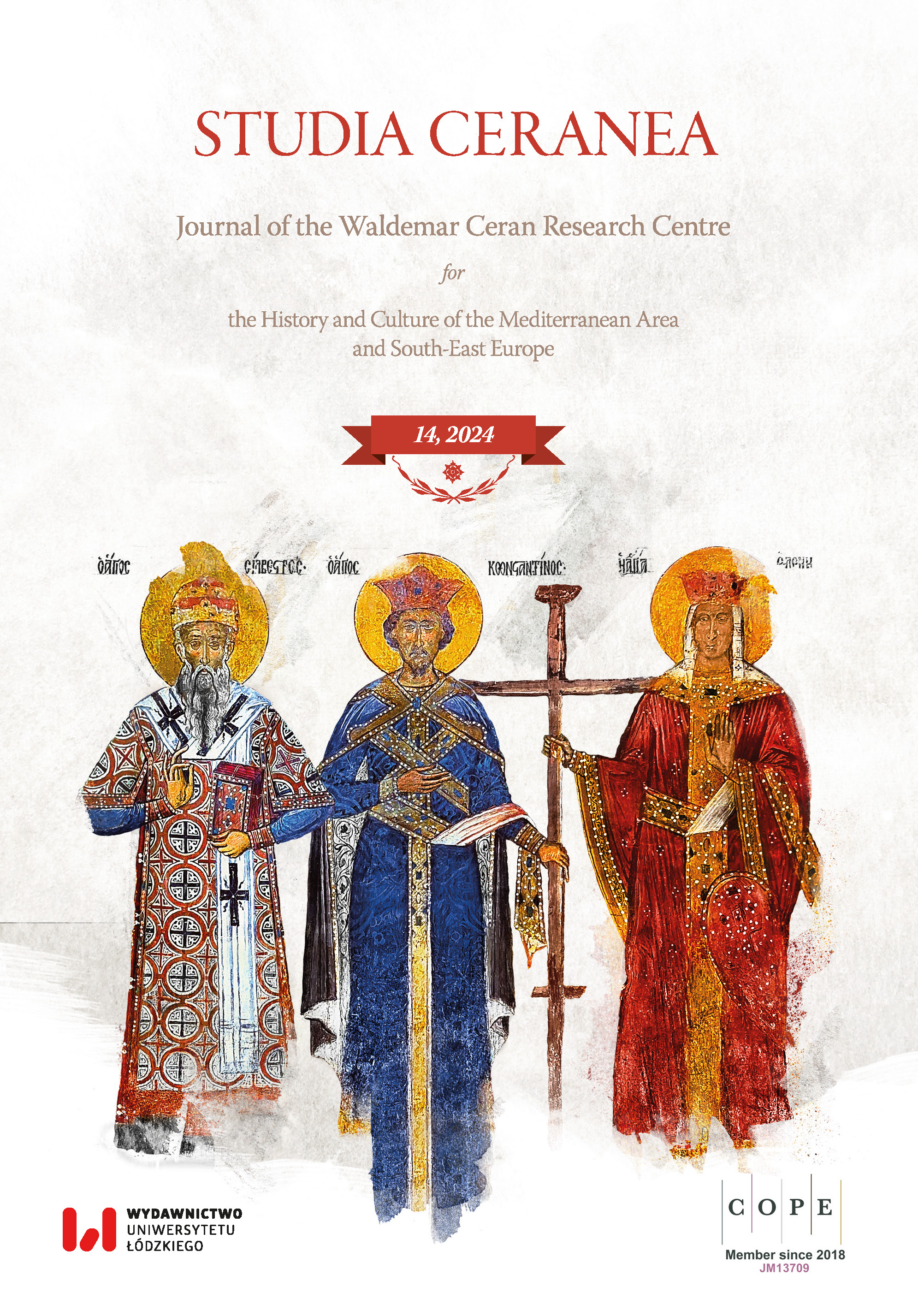
The Theme of the First Muslim Women in Chronographia of Theophanes the Confessor
DOI:
https://doi.org/10.18778/2084-140X.14.16Keywords:
Byzantine historiography, Theophanes the Confessor, Byzantine-Muslim relations, Theophanes the Confessor’s ChronographiaAbstract
This article concerns itself with a small fragment of Chronographia by Theophanes the Confessor. The fragment is devoted to the role of women in the rise and spread of Islam. Although generally considered to express anti-Islamic propaganda, upon closer examination, it is quite consistent with some Muslim traditions. The author interprets the fragment in a way that takes those traditions into account.
Downloads
References
Bartholomaeus Edessenus, Elenchus et confutatio Agareni, [in:] Patrologiae cursus completus, Series graeca, vol. CIV, ed. J.-P. Migne, Paris 1857, col. 1384A–1385A.
Bartholomaios Von Edessa, Confutatio Agareni. Kommentierte griechisch-deutsche Textausgabe von Klaus-Peter Todt, Würzburg 1988.
Georgios Monachos, Chronicon, vol. II, ed. C. de Boor, Lipsiae 1904 (= Patrologiae cursus completus, Series graeca, vol. CX, ed. J.-P. Migne, Paris 1863, col. 41A–1285D).
Theodorus Abucara, Opuscula ascetica [vel] Contra haereticos, Iudaeos et Saracenos varia opuscula, [in:] Patrologiae cursus completus, Series graeca, vol. XCVII, ed. J.-P. Migne, Paris 1865, col. 1461–1601.
Theophanis Chronographia, еd. C. G. De Boor, Lipsiae 1883.
Abbott N., Women and the State in Early Islam, “Journal of Near Eastern Studies” 1.1, 1942, p. 106–126, https://doi.org/10.1086/370632 DOI: https://doi.org/10.1086/370632
Abbott N., Women and the State on the Eve of Islam, “American Journal of Semitic Languages and Literature” 58.3, 1941, p. 259–284, https://doi.org/10.1086/370610 DOI: https://doi.org/10.1086/370610
Abbou Hershkovits K., Women Converts and Familial Loyalty in the Tine of the Prophet Muhammad b. Sa‘d (d. 230/845), [in:] Conversion to Islam in the Premodern Age. A Sourcebook, ed. N. Hurvitz, Ch.S. Sahner, U. Simonsohn, L. Yarbrough, Berkeley 2020, p. 54–57, https://doi.org/10.2307/j.ctv1b742qw.11 DOI: https://doi.org/10.2307/j.ctv1b742qw.11
Ahmed L., Women and Gender in Islam. Historical Roots of a Modern Debate, New Heaven 1992.
Akhmetova E., Women in Islamic Civilisation. Their Rights and Contributions, “Islam and Civilisational Renewal” 7.4, 2016, p. 474–491, https://doi.org/10.12816/0035218 DOI: https://doi.org/10.12816/0035218
Akhmetova E., Women’s Rights. The Qur’anic Ideals and Contemporary Issues, “Islam and Civilisational Renewal” 6.1, 2015, p. 58–75, https://doi.org/10.12816/0009897 DOI: https://doi.org/10.12816/0009897
Anthony S. W., The Conversion of Khadīja bt. Khuwaylid Muḥammad b. Isḥāq (d. 150/767), [in:] Conversion to Islam in the Premodern Age. A Sourcebook, ed. N. Hurvitz, Ch.S. Sahner, U. Simonsohn, L. Yarbrough, Berkeley 2020, p. 46–50, https://doi.org/10.2307/j.ctv1b742qw.9 DOI: https://doi.org/10.2307/j.ctv1b742qw.9
Baugh C., Revolting Women? Early Kharijite Women in Islamic Sources, “Journal of Islamic and Muslim Studies” 2.1, 2017, p. 36–55, https://doi.org/10.2979/jims.2.1.03 DOI: https://doi.org/10.2979/jims.2.1.03
Boras L., A Prophet has appeared coming with the Saracens. The Non-Islamic Testimonies on the Prophet and the Islamic Conquest of Egypt in the 7th–8th centuries, MA Thesis, Radboud University, Nijmegen 2017.
Brzozowska Z., Boginie przedmuzułmańskiej Arabii (Al-Lat, Al-Uzza, Manat), [in:] Bizancjum i Arabowie. Spotkanie cywilizacji VI–VIII wiek, ed. T. Wolińska, P. Filipczak, Warszawa 2015, p. 64–89.
Bukhari S.A.Gh., Role of Women in the Development of Islamic Civilization, “Jihat al-Islam” 5.2, 2012, p. 7–18.
Coakley J. F., Mushe bar Kipho, [in:] Gorgias Encyclopedic Dictionary of the Syriac Heritage: Electronic Edition, ed. S. P. Brock, A. M. Butts, G. A. Kiraz, L. Van Rompay (Gorgias Press, 2011; online ed. B. Mardutho, 2018), https://gedsh.bethmardutho.org/Mushe-bar Kipho [10 V 2024].
Conterno M., La “descrizione dei tempi” all’alba dell’espansione islamica. Un’indagine sulla storiografia greca, siriaca e araba fra VII e VIII secolo, Boston–Berlin 2014, https://doi.org/10.1515/9783110330953 DOI: https://doi.org/10.1515/9783110330953
Cook D., Women Fighting in Jihad?, [in:] Female, Terrorism and Militancy, Agency, Utility and Organisation, ed. D. Cook, New York 2008, p. 375–384, https://doi.org/10.1080/10576100500180212 DOI: https://doi.org/10.1080/10576100500180212
Daniel N., Islam and the West. The Making of an Image, Edinburgh 1966.
Debié M., Theophanes ‘Oriental Source’. What Can We Learn from Syriac Historiography?, “Travaux et mémoires” 19, 2015, p. 365–382.
Dziekan M., Ḫadīğa, żona Proroka Muḥammada w Usd al-ḡāba fī ma῾rifat aṣ-ṣaḥāba ῾Izz ad-Dīna al-Aṯīra i innych klasycznych źródłach arabskich, [in:] Kobiety Bliskiego Wschodu, ed. M. Dziekan, I. Kończak, Łódź 2005, p. 11–23.
Elius M., Islamic View of Women Leadership as Head of the State. A Critical Analysis, “Arts Faculty Journal” 4, 2010–2011, p. 195–205, https://doi.org/10.3329/afj.v4i0.12941 DOI: https://doi.org/10.3329/afj.v4i0.12941
Hoyland R., The Earliest Christian Writings on Muhammad. An Appraisal, [in:] The Biography of Muḥammad. The Issue of the Sources, ed. H. Motzki, Leiden–Boston–Köln 2000, p. 276–297, https://doi.org/10.1163/9789004452909_012 DOI: https://doi.org/10.1163/9789004452909_012
Koehler B., Female Entrepreneurship in Early Islam, “Economic Affairs” 31.2, 2011, p. 93–95, https://doi.org/10.1111/j.14680270.2011.02074.x DOI: https://doi.org/10.1111/j.1468-0270.2011.02074.x
Maksimov Ju., Prp. Feofan Ispovednik Sigrianskij ob islame, “Богословский Вестник” / “Bogoslovskij Vestnik” 4, 2004, p. 312–335.
Mechert Ch., Whether to Keep Women out of the Mosque. A Survey of Medieval Islamic Law, [in:] Authority, Privacy and Public Order in Islam. Proceedings of the 22nd Congress of L’Union Europeenne des Arabisants et Islamisants, ed. B. Michalak-Pikulska, A. Pikulski, Leuven 2006, p. 59–69.
Nawab S., The Contribution of Women to Muslim Society. A Study of Selected Autobiographical and Bibliographical Literature, MA Thesis, Faculty of Arts Rand Afrikaans University 1997.
Osman G., Pre-Islamic Arab Converts to Christianity in Mecca and Medina: An Investigation into the Arabic Sources, “The Muslim World” 95, 2005, p. 67–80, https://doi.org/10.1111/j.1478-1913.2005.00079.x DOI: https://doi.org/10.1111/j.1478-1913.2005.00079.x
Qasmi S. Z., Salafi M. T., Question and Answers on the Mothers of Believers, Darussalam–Riyadh–Lahore–Houston [s.a.].
Qazi F., The Mujahidaat. Tracing the Early Female Warriors of Islam, [in:] Women, Gender and Terrorism, ed. L. Sjoberg, C. E. Gentry, Athens, Ga. 2011, p. 29–56, https://doi.org/10.2307/j.ctt46nnjp.6 DOI: https://doi.org/10.2307/j.ctt46nnjp.6
Saadi A.-M., Ninth Century Syriac Exegete and Apologist. Moshe bar Kepha’s Commentary on Luke, “Hugoye. Journal of Syriac Studies” 20.1, 2017, p. 231–256, https://doi.org/10.31826/hug-2018-200106 DOI: https://doi.org/10.31826/hug-2018-200106
Sechzer J. A., Islam and Woman. Where Tradition Meets Modernity. History and Interpretations of Islamic Women’s Status, “Sex Roles” 51, 2004, p. 263–272, https://doi.org/10.1023/B:SERS.0000046610.16101.e0 DOI: https://doi.org/10.1023/B:SERS.0000046610.16101.e0
Smith J. I., Women, Religion and Social Change in Early Islam, [in:] Women, Religion and Social Change, ed. Y. Yazbeck Haddad, E. Banks Findly, New York 1985, p. 19–35.
Sulaimani F. A.A., The Changing Position of Women in Arabia under Islam during the Early Seventh Century, MPhil., University of Salford 1986.
Wiebke W., Woman in Islam, Princeton 1993.
Wolińska T., Elity chrześcijańskie wobec islamu (VII–X wiek), “Vox Patrum” 35, 2015, p. 529–567, https://doi.org/10.31743/vp.3730 DOI: https://doi.org/10.31743/vp.3730
Downloads
Published
Issue
Section
License
Copyright (c) 2024 Błażej Cecota

This work is licensed under a Creative Commons Attribution-NonCommercial-NoDerivatives 4.0 International License.
How to Cite