About the Journal

The task that the Editorial Council of Studia Ceranea has set before itself is the gradual creation of a scientific journal, interdisciplinary in character, which will offer specialist articles, reviews and notes on newly published monographs. Along these lines, we will attempt to cross the limits of the narrow specializations restricted to Byzantine or Slavic studies; the papers contributed would represent various aspects of the Late Ancient, Byzantine and Slavic culture of the eastern Mediterranean Area largissimo sensu and South-East Europe, which – we claim – forms an integrity, for all its diversity. Consequently, the journal, based on previous models of other respectable journals devoted to similar subject matters,  utilizes the methodology and achievements of disciplines used in the study of Late Antiquity, Middle Ages and early Modern Era and is ready to face the new challenges posed by contemporary humanist thought.

Announcements

Current Issue

Vol. 15 (2025)
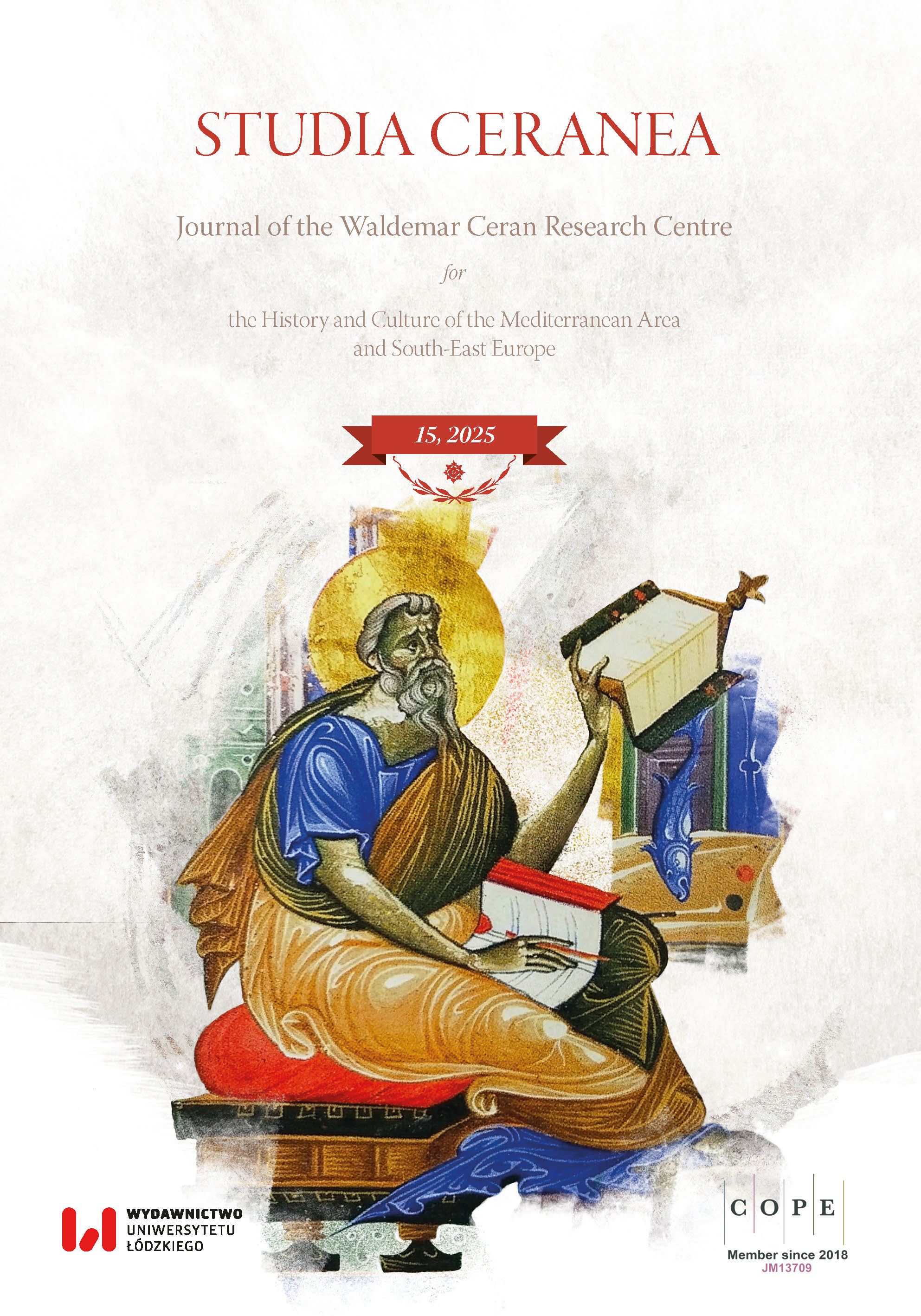
okładka
Published: 2025-12-30

Full Issue

Articles

  • Gone Like Smoke or Mist – the Beauty and Wonders of Constantinople in Vernacular Laments on its Fall in 1453

    Michał Bzinkowski
    11-30
    DOI: https://doi.org/10.18778/2084-140X.15.26
  • Magic, Demons, and Heretics: Three Puzzling Cases in The Letter of Euthymius of Akmonia

    Mirena Slavova
    31-41
    DOI: https://doi.org/10.18778/2084-140X.15.20
  • The 722 Slavic Manuscript from the Library of the Romanian Academy in Bucharest and the Polish Chronicle

    Ivan Biliarsky
    45-58
    DOI: https://doi.org/10.18778/2084-140X.15.16
  • Beautiful and ‘Fiery in Spirit’? The Complexity of the Image of Emperor Isaac II Angelos in the History by Niketas Choniates

    Ana Cagić
    59-77
    DOI: https://doi.org/10.18778/2084-140X.15.19
  • The Image of Caliph ‘Ali in the Chronography of Theophanes

    Błażej Cecota
    79-89
    DOI: https://doi.org/10.18778/2084-140X.15.13
  • The Octopus as a Literary Figure in Imperial-Era Literature

    Marta Czapińska-Bambara
    91-105
    DOI: https://doi.org/10.18778/2084-140X.15.22
  • Some Alternative Translations of the Chronicle of Al-AnṬākī

    Maciej Czyż
    107-147
    DOI: https://doi.org/10.18778/2084-140X.15.25
  • Text-Critical Notes to Constantine of Preslav’s Didactic Gospel

    Ekaterina Dikova
    149-166
    DOI: https://doi.org/10.18778/2084-140X.15.10
  • The Relations between the Komitopules and the Peoples of the Steppes of Eastern Europe. A Vain Hope for an Alliance

    Jarosław Dudek
    167-187
    DOI: https://doi.org/10.18778/2084-140X.15.17
  • How to Justify a Murderer: Ancient Rhetorical Echoes in Alexandre Sylvain Van den Bussche’s Épitomes de cent histoires tragiques

    Justyna Giernatowska
    189-212
    DOI: https://doi.org/10.18778/2084-140X.15.23
  • The Translation of Medieval Sources and Historical Reconstruction: a New Perspective on the Problem of the Birth Year of the Bulgarian Tsar John II Assen (1218–1241)

    Kiril Gospodinov
    213-236
    DOI: https://doi.org/10.18778/2084-140X.15.07
  • Art of Tradition: The Armenian Gospel Books (Seventeenth Century) in the Gulbenkian Collection

    Hermine Grigoryan, Maria Adelaide Miranda, Lusine Sargsyan, Jorge Rodrigues, Karen Matevosyan, Maria João Melo
    237-259
    DOI: https://doi.org/10.18778/2084-140X.15.15
  • Premodern Armenian Medicine, Tsaghik and Potential New Evidence for the Early History of Smallpox

    Naira Hambardzumyan, Vardanush Postajyan, Barbara Zipser
    261-284
    DOI: https://doi.org/10.18778/2084-140X.15.08
  • Two Unrecognized Hydronyms on the Island of Crete

    Elwira Kaczyńska
    285-296
    DOI: https://doi.org/10.18778/2084-140X.15.14
  • Representing the Ideal: The Portrait of the Sanguine in Cesare Ripa’s Iconologia

    Magdalena Koźluk
    297-318
    DOI: https://doi.org/10.18778/2084-140X.15.11
  • Celibacy, Priesthood, Marriage, Puberty and Popular Culture in the Works of 14th Century Tarnovo Authors

    Hristo Saldzhiev
    319-342
    DOI: https://doi.org/10.18778/2084-140X.15.24
  • The Evolution of Ottoman Night Operations: From Emirate to Empire

    Husamettin Simsir
    343-361
    DOI: https://doi.org/10.18778/2084-140X.15.09
  • Assessing the Demographic and Economic Parameters that Determined the Residential History of Medieval Central Greece: the Case of Western Sterea Hellas

    George Terezakis
    363-393
    DOI: https://doi.org/10.18778/2084-140X.15.12
  • Once Again About the Short Slavic Redactions of Zonaras’ Chronicle

    Anna-Maria Totomanova
    395-409
    DOI: https://doi.org/10.18778/2084-140X.15.21
  • The Autocephalous Structure of the Orthodox Church in a Historical – Canonical Perspective

    Ivan Yovchev
    411-430
    DOI: https://doi.org/10.18778/2084-140X.15.18
  • Byzantine and Post-Byzantine Canons of the Matins in Honour of Saints Constantine and Helena

    Anastasia Nikolaou
    433-477
    DOI: https://doi.org/10.18778/2084-140X.15.06

Book reviews

View All Issues

Publication of the English version of the yearly “Studia Ceranea. Journal of the Waldemar Ceran Research Centre for the History and Culture of the Mediterranean Area and South-East Europe” – financed under Agreement No. 605/P-DUN/2019 12.06.2019 with funds provided by the Ministry of Science and Higher Education for activities popularising science