The Sky of Stanisław Władysław Reymont. Reflections after reading Chłopi
DOI:
https://doi.org/10.18778/1505-9057.71.19Keywords:
observation, seasons, sun, earth, sky, color, sound, movement, light epic, cathedral, CreatorAbstract
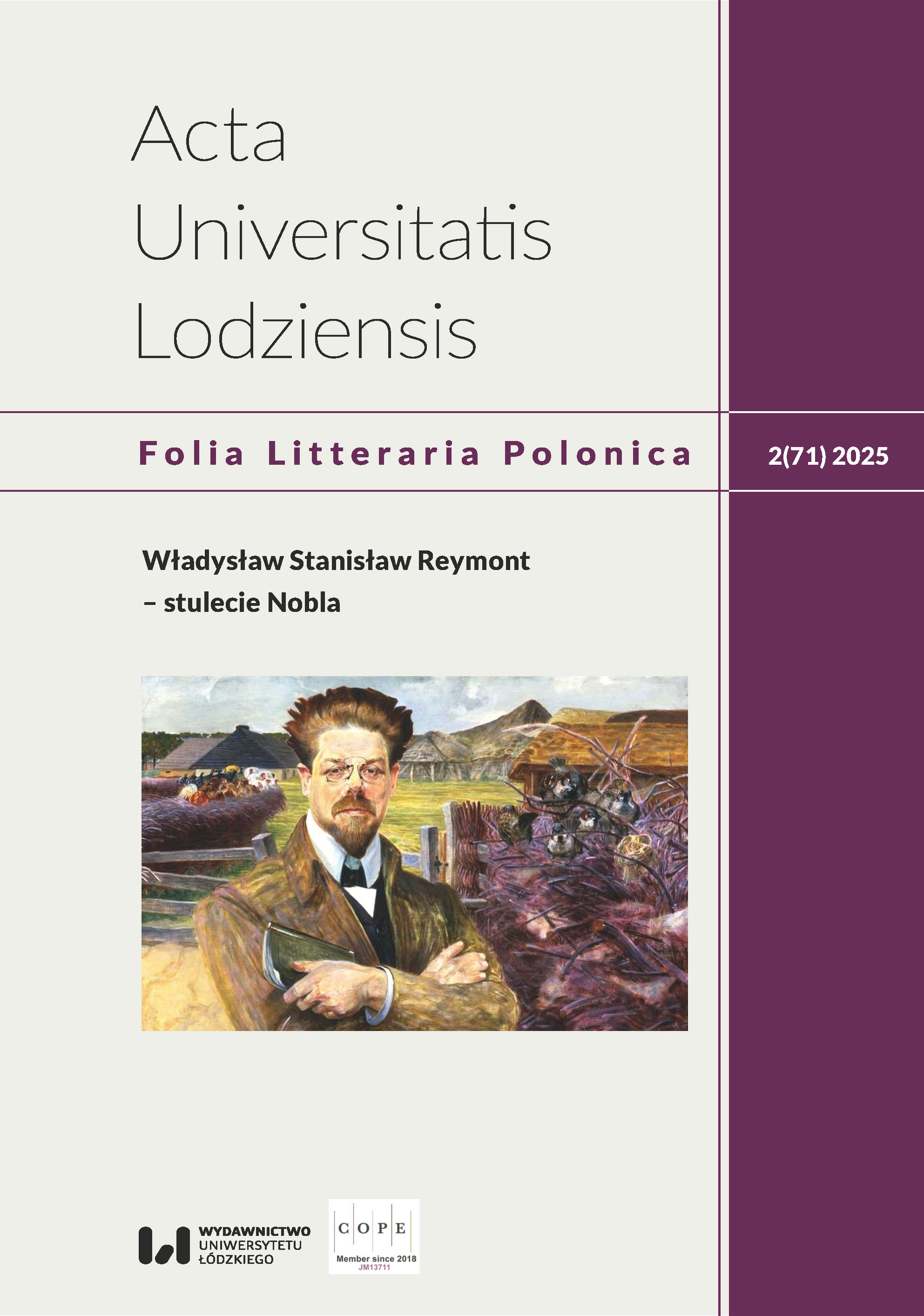
Władysław Stanisław Reymont was an artist who distinguished himself with a special gift of observation. He was sensitive to colours, light, sounds and movement. This gave a special dimension to his writing, far from the influence of fashionable artistic trends of the era. This is particularly visible in Chłopi, which has the form of an epic. The action of the novel takes place in the rhythm of the changing seasons. Although the image of Lipiec is realistic in nature, the writer went beyond the narrow framework of naturalism and the related view of the world from the perspective of biological and social determinism. The life of the inhabitants of Lipiec takes place at the intersection of the earth and the sky. They are strongly attached to the earth, which gives meaning to their entire life. However, it turns out that its source is the sky together with the sun. Depending on the seasons, its position in the sky changes and, consequently, the intensity of light. It is this that determines existence on earth. Autumn is the time of nature dying, winter of its freezing, spring of awakening to life, and summer of slowly getting ready for sleep. But without death there is no rebirth of life. Reymont brings out the symbolic aspect of light and the colors and sounds that depend on it. The sun in the novel transfigures into a great Host. At its feet lies the earth. The sky is not empty, but it is the place of God’s presence. In this way, the world of Lipiec is sanctified, and human existence takes on ethical and religious dimensions. It turns out that the idea of a cathedral is inscribed in the structures of the peasant epic. This gives the novel a universal dimension.
Downloads
References
Bajda Justyna, Kazimierz Przerwa-Tetmajer – znawca i krytyk sztuki, „Prace Literackie” 1995, nr 34, s. 103–116.
Google Scholar
Bukowski Kazimierz, Władysław St. Reymont. Próba charakterystyki, Zakład Narodowy im. Ossolińskich, Lwów 1927.
Google Scholar
Czachowski Kazimierz, Obraz współczesnej literatury polskiej 1884–1933, t. 1: Naturalizm i neoromantyzm, Nakładem Państwowego Wydawnictwa Książek Szkolnych, Warszawa–Lwów 1934.
Google Scholar
Dąbrowska Alicja, Kolorystyka w „Chłopach” Władysława Stanisława Reymonta, w: Polscy nobliści literaccy. Materiały konferencji naukowej, Wyższa Szkoła Pedagogiczna, 31 maja 2000, red. D.T. Lebioda, Wydawnictwo Akademii Bydgoskiej im. Kazimierza Wielkiego, Bydgoszcz 2003, s. 79–112.
Google Scholar
Falkowski Zygmunt, Władysław Reymont. Człowiek i twórca, Fiszer i Majewski. Księgarnia Uniwersytecka, Poznań 1929.
Google Scholar
Feldman Wilhelm, Piśmiennictwo polskie, t. 2, wyd. 3, Nakładem Księgarni H. Altenberga, Lwów 1905.
Google Scholar
Grzymała-Siedlecki Adam, Ludzie i dzieła, wybór A. Okońska, wstęp J. Krzyżanowski, Wydawnictwo Literackie, Kraków 1967.
Google Scholar
Grzymała-Siedlecki Adam, Niepospolici ludzie w dniu swoim powszednim, Wydawnictwo Literackie, Kraków 1962.
Google Scholar
Knysz-Tomaszewska Danuta, Krajobrazy impresjonistyczne w wybranych nowelach Reymonta, w: W kręgu Młodej Polski: studia i szkice, seria III, red. J. Sztachelska, Wydawnictwo Uniwersytetu w Białymstoku, Białystok 1998, s. 107–122.
Google Scholar
Kołaczkowski Stefan, Portrety i zarysy literackie, oprac. S. Pigoń, t. 1, Państwowy Instytut Wydawniczy, Warszawa 1968.
Google Scholar
Krzyżanowski Julian, W.S. Reymont twórca i dzieło, Zakład Narodowy im. Ossolińskich, Lwów 1937.
Google Scholar
Lange Antoni, Pochodnie w mroku, Biblioteka Domu Polskiego, Warszawa 1926.
Google Scholar
Lichański Stefan, „Chłopi” Władysława Stanisława Reymonta, Wydawnictwa Szkolne i Pedagogiczne, Warszawa 1987.
Google Scholar
Linkner Tadeusz, Zainteresowanie Młodej Polski epopeją a „Chłopi” Reymonta, „Słupskie Prace Filologiczne. Seria Filologia Polska” 2002, nr 1, s. 87–109.
Google Scholar
Liszka Aleksandra, Tryptyk preekspresjonistyczny. Ucięty. (Ave Patria, morituri te salutant… Władysława Stanisława Reymonta, „Ruch Literacki” 2022, z. 4, s. 612– 635, https://doi.org/10.24425/rl.2022.142986
Google Scholar
Markiewicz Henryk, Przekroje i zbliżenia: rozprawy i szkice historycznoliterackie, Państwowy Instytut Wydawniczy, Warszawa 1967.
Google Scholar
Matuszewski Ignacy, „Chłopi” Reymonta, „Tygodnik Ilustrowany” 1904, nr 49, s. 934.
Google Scholar
Matuszewski Ignacy, „Chłopi” Reymonta, „Tygodnik Ilustrowany” 1904, nr 50, s. 954–955.
Google Scholar
Mazanowski Antoni, „Chłopi” Reymonta, „Przegląd Powszechny” 1909, t. CIII, s. 317–333.
Google Scholar
Miller Jan Nepomucen, Reymont jako poeta pracy, „Wiadomości Literackie” 1925, nr 7, s. 1.
Google Scholar
Nycz Ryszard, Dwa pejzaże Reymonta, „Pamiętnik Literacki” 1974, z. 3, s. 65–81.
Google Scholar
Pomirowski Leon, Na marginesie twórczości Reymonta, „Wiadomości Literackie” 1925, nr 59, s. 4.
Google Scholar
Popiel Magdalena, Impresjonizm i ekspresjonizm w „Ziemi obiecanej” W.S. Reymonta, „Zeszyty Naukowe UJ – Prace Historycznoliterackie” 1980, z. 39, s. 105–120.
Google Scholar
Reymont Władysław Stanisław, Chłopi. Dzieła wybrane, t. VIII–IX, Wydawnictwo Literackie, Kraków 1957.
Google Scholar
Reymont Władysław Stanisław, Chłopi, oprac. F. Ziejka, Zakład Narodowy im. Ossolińskich, Wrocław 1999 [BN I, 279].
Google Scholar
Reymont Władysław Stanisław, Chłopi, Świat Książki, Warszawa 1999.
Google Scholar
Reymont Władysław Stanisław, Oko w oko, w: W.S. Reymont, Nowele, Wydawnictwo Tygodnika Ilustrowanego, Warszawa 1930, s. 67–94.
Google Scholar
Rurawski Józef, Władysław Reymont, Wiedza Powszechna, Warszawa 1977.
Google Scholar
Wallis Mieczysław, Przeżycie i wartość, Wydawnictwo Literackie, Kraków 1968.
Google Scholar
Wyka Kazimierz, Próba nowego odczytania „Chłopów” Reymonta, „Pamiętnik Literacki” 1968, nr 2, s. 57–105.
Google Scholar
Zieliński Tadeusz, Włościaństwo w literaturze polskiej, „Wiedza i Życie” 1927, nr 7, s. 478–479.
Google Scholar
Downloads
Published
How to Cite
Issue
Section
License

This work is licensed under a Creative Commons Attribution-NonCommercial-NoDerivatives 4.0 International License.









