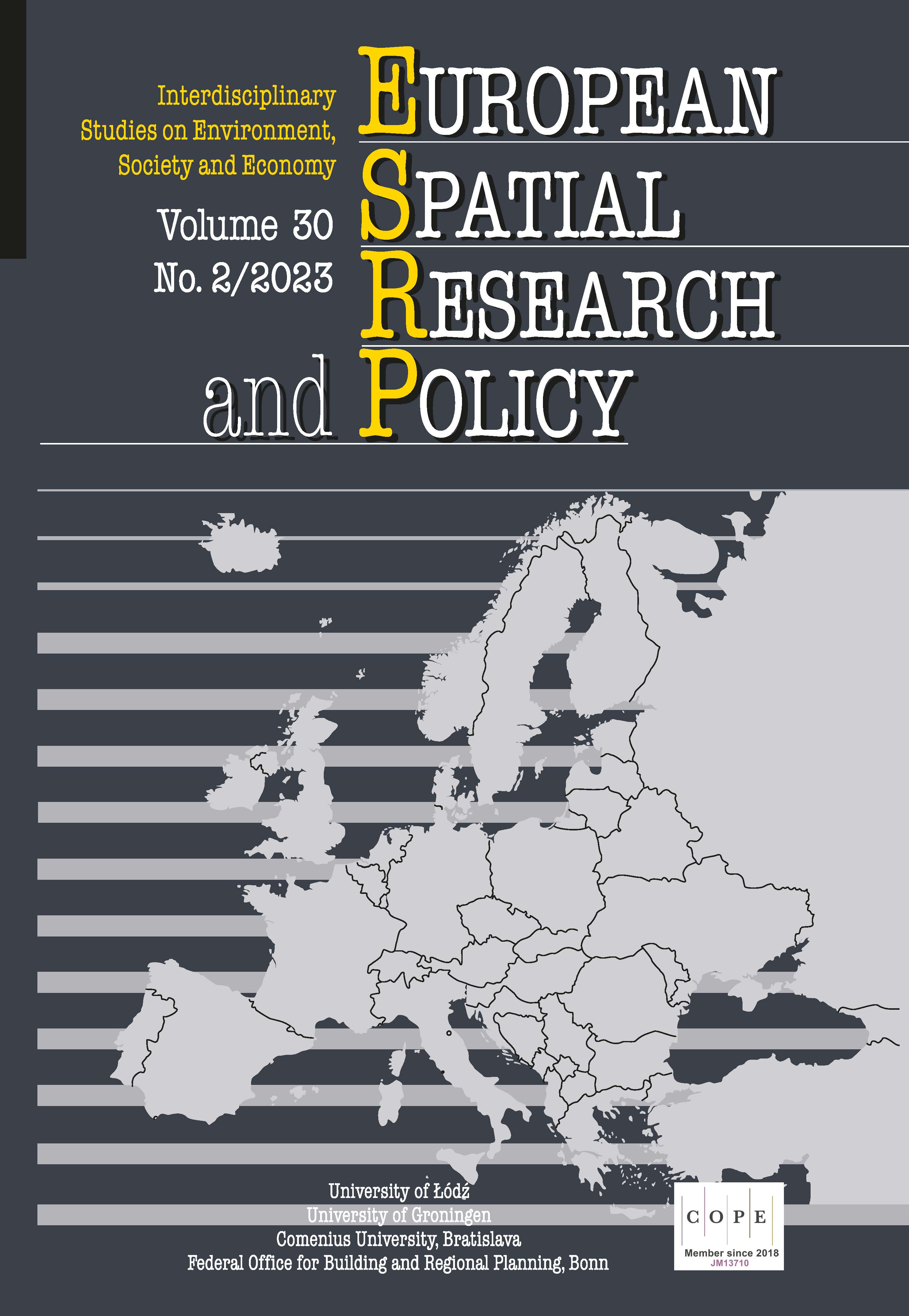
Spatial planning needs towards Copernicus Land Monitoring Services: Case studies from Poland and Norway
DOI:
https://doi.org/10.18778/1231-1952.30.2.13Keywords:
CLMS, spatial planning, Poland, NorwayAbstract
The objective of this study is to identify the needs related to geospatial LC, LU, and LCLUC information for spatial planning in Poland and Norway, and examine the usefulness of CLMS products in the context of these planning systems. The research has conducted based on a comparative analysis of two planning systems, to indicate areas where CLMS can improve or supplement national spatial data. The study shows that CLMS can provide information on up-to-date spatial data showing actual LC/LU/LCLUC, but that the degree of detail and the accuracy may be insufficient. CLMS data is harmonised across Europe and thus meets the need expressed by international organisations, for data that are consistent at a continental level. This is not a requirement in national planning systems in Poland and Norway, where the needs are regulated by national legislation. The thematic and geometric accuracy of national data sources are usually better than the data provided by CLMS, but CLMS might fill gaps when specific topics are missing in national mapping programs.
Downloads
References
AARSÆTHER, N., FALLETH, E., NYSETH, T. and KRISTIANSEN, R. (2012), Utfordringer for norsk planlegging: Kunnskap, bærekraft, demokrati, Oslo: Cappelen Damm Høyskoleforlaget.
APICELLA, L., QUARATI, A., GORNI, S., MOLINA, R. and De MARTINO, M. (2021), ‘Copernicus users uptake: an overview of downstream applications’, [in:] Italian Conference on Geomatics and Geospatial Technologies, pp. 3–14, Cham: Springer International Publishing. DOI: https://doi.org/10.1007/978-3-030-94426-1_1
APICELLA, L., De MARTINO, M., and QUARATI, A. (2022), ‘Copernicus user uptake: From data to applications’, ISPRS International Journal of Geo-Information, 11 (2), 121. DOI: https://doi.org/10.3390/ijgi11020121
ASCHBACHER, J. (2017), ‘ESA’s earth observation strategy and Copernicus’, Satellite earth observations and their impact on society and policy, pp. 81–86. DOI: https://doi.org/10.1007/978-981-10-3713-9_5
BALLIN, M., BARCAROLI, G., MASSELLI, M. and SCARNO, M. (2018), Redesign sample for Land Use/Cover Area frame Survey (LUCAS) 2018, Luxembourg.
BEN DHAOU, S., LOPES, N. and NIELSEN, M. M. (2017), Implementing Sustainable Development Goal 11 by connecting sustainability policies and urban-planning practices through ICTs. Geneva.
DRZEWIECKI, W. (2008), ‘Land-Use / Land Cover Monitoring Based On Multitemporal Remote Sensing Images’, Roczniki Geomatyki VI, 3.
EUROPEAN ENVIRONMENT AGENCY (2021), Urban sustainability in Europe — A stakeholder-led process, Copenhagen, Denmark, https://www.eea.europa.eu/publications/urban-sustainability-in-europe-avenues
EUROSTAT (2016), Urban Europe — statistics on cities, towns and suburbs — patterns of urban and city developments, Luxembourg, https://ec.europa.eu/eurostat/documents/3217494/7596823/KS-01-16-691-EN-N.pdf/0abf140c-ccc7-4a7f-b236-682effcde10f?t=1472645220000
EVANS, N. (2007), ‘Using Earth Observation Data in Spatial Planning: The Geoland Project’, European Planning Studies, 15 (7), pp. 985–989. https://doi.org/10.1080/09654310701359344 DOI: https://doi.org/10.1080/09654310701359344
HERSPERGER, A. M., OLIVEIRA, E., PAGLIARIN, S., PALKA, G., VERBURG, P., BOLLIGER, J. and GRĂDINARU, S. (2018), ‘Urban land-use change: The role of strategic spatial planning’, Global Environmental Change, 51, pp. 32–42. DOI:https://doi.org/10.1016/j.gloenvcha.2018.05.001 DOI: https://doi.org/10.1016/j.gloenvcha.2018.05.001
JARZMIK, A. (2020), ‘EGiB – zasady, formy udostępniania oraz jakość danych’, Urban Development Issues, 66, pp. 163–172. DOI: https://doi.org/10.2478/udi-2020-0020
JUTZ, S. and MILAGRO-PÉREZ, M. P. (2020), ‘Copernicus: the European Earth Observation programme’, Revista de Teledetección, (56), V–XI. DOI: https://doi.org/10.4995/raet.2020.14346
KASANKO, M., SAGRIS, V., LAVALLE, C., BARREDO, J. I., PETROV, L., STEINNOCHER, K., LOIBL, W. and HOFFMANN, C. (2007), ‘GEOLAND spatial planning observatory: How remote sensing data can serve the needs of urban and regional planning’, [in:] 2007 Urban Remote Sensing Joint Event, IEEE, pp. 1–10. https://doi.org/10.1109/URS.2007.371805 DOI: https://doi.org/10.1109/URS.2007.371805
KLEINEWILLINGHÖFER, L., OLOFSSON, P., PEBESMA, E., MEYER, H., BUCK, O., HAUB, C. and EISELT, B. (2022), ‘Unbiased Area Estimation Using Copernicus High Resolution Layers and Reference Data’, Remote Sensing, 14 (19), 4903. DOI: https://doi.org/10.3390/rs14194903
KOVÁCS, K. F., SALLAY, Á., JOMBACH, S. and VALÁNSZKI, I. (2013), ‘Landscape in the spatial planning system of European countries’, [in:] Proceedings of Fábos Conference on Landscape and Greenway Planning: Pathways to Sustainability, FÁBOS, J. G., LINDHULT, M., RYAN, R. L. and JACKNIN, M. (eds), MA: Department of Landscape Architecture and Regional Planning, University of Massachusetts, Amherst.
LEFEBVRE, A., SANNIER, C. and CORPETTI, T. (2016), ‘Monitoring urban areas with Sentinel-2A data: Application to the update of the Copernicus high resolution layer imperviousnessdegree’, Remote Sensing, 8 (7), 606. DOI: https://doi.org/10.3390/rs8070606
POLISH MINISTRY OF INVESTMENT AND ECONOMIC DEVELOPMENT (2019), Sustainable urban development in Poland: national urban policy in the context of the 2030 Agenda’s Goal 11 and the New Urban Agenda (National U ed.). Urban Policy Unit, Department for Development Strategy, Ministry of Investment and Economic Development. www.miir.gov.pl
PROBECK, M., RUIZ, I., RAMMINGER, G., FOURIE, C., MAIER, P., ICKEROTT, M. ... and DUFOURMONT, H. (2021), ‘CLC+ Backbone: Set the Scene in Copernicus for the Coming Decade’, [in:] 2021 IEEE International Geoscience and Remote Sensing Symposium IGARSS (pp. 2076-2079). IEEE. DOI: https://doi.org/10.1109/IGARSS47720.2021.9553252
RANNOW, S., LOIBL, W., GREIVING, S., GRUEHN, D. and MEYER, B.C. (2010), ‘Potential impacts of climate change in Germany-Identifying regional priorities for adaptation activities in spatial planning’, Landscape and Urban Planning, 98 (3–4), pp. 160–171. https://doi.org/10.1016/j.landurbplan.2010.08.017 DOI: https://doi.org/10.1016/j.landurbplan.2010.08.017
REBA, M. and SETO, K. C. (2020), ‘A systematic review and assessment of algorithms to detect, characterize, and monitor urban land change’, Remote Sensing of Environment, 242, 111739. https://doi.org/10.1016/j.rse.2020.111739 DOI: https://doi.org/10.1016/j.rse.2020.111739
SÖRENSEN, J., PERSSON, A. S. and OLSSON, J. A. (2021), ‘A data management framework for strategic urban planning using blue-green infrastructure’, Journal of Environmental Management, 299, 113658. https://doi.org/10.1016/j.jenvman.2021.113658 DOI: https://doi.org/10.1016/j.jenvman.2021.113658
STRAND, G. H. (2022), ‘Accuracy of the Copernicus High-Resolution Layer Imperviousness Density (HRL IMD) Assessed by Point Sampling within Pixels’, Remote Sensing, 14, 3589. https://doi.org/10.3390/rs14153589 DOI: https://doi.org/10.3390/rs14153589
SUDHIRA, H. S., RAMACHANDRA, T. V., RAJ, K. S. and JAGADISH, K. S. (2003), ‘Urban growth analysis using spatial and temporal data’, Journal of the Indian Society of Remote Sensing, 31 (4), pp. 299–311. https://doi.org/10.1007/BF03007350 DOI: https://doi.org/10.1007/BF03007350
UNECE (2018), Guidance on Land-Use Planning, the Siting of Hazardous Activities and Related Safety Aspects, UN, Geneva. https://doi.org/10.18356/df07526b-en DOI: https://doi.org/10.18356/df07526b-en
UN HABITAT (2015), International Guidelines on Urban and Territorial Planning. Nairobi.
UN HABITAT (2020a), Monitoring and Evaluating National Urban Policy: A Guide, Nairobi, https://www.urban-response.org/help-library/monitoring-and-evaluating-national-urban-policy-a-guide-un-habitat
UN HABITAT (2020b), World Cities Report 2020, The Value of Sustainable Urbanization, Nairobi, https://doi.org/10.18356/c41ab67e-en DOI: https://doi.org/10.18356/c41ab67e-en
UNITED NATIONS (HABITAT III) (2017), New Urban Agenda (A/RES/71/256), Quito, www.habitat3.org
ZHU, Z., ZHOU, Y., SETO, K. C., STOKES, E. C., DENG, C., PICKETT, S. T. A. and TAUBENBÖCK, H. (2019), ‘Understanding an urbanizing planet: Strategic directions for remote sensing’, Remote Sensing of Environment 228, pp. 164–182. https://doi.org/10.1016/j.rse.2019.04.020 DOI: https://doi.org/10.1016/j.rse.2019.04.020
Downloads
Published
Versions
- 2024-02-07 (3)
- 2023-12-31 (2)
- 2023-12-30 (1)
Issue
Section
License

This work is licensed under a Creative Commons Attribution-NonCommercial-NoDerivatives 4.0 International License.
How to Cite




Funding data
-
Narodowe Centrum Badań i Rozwoju
Grant numbers NOR/POLNOR/InCoNaDa/0050/2019-00