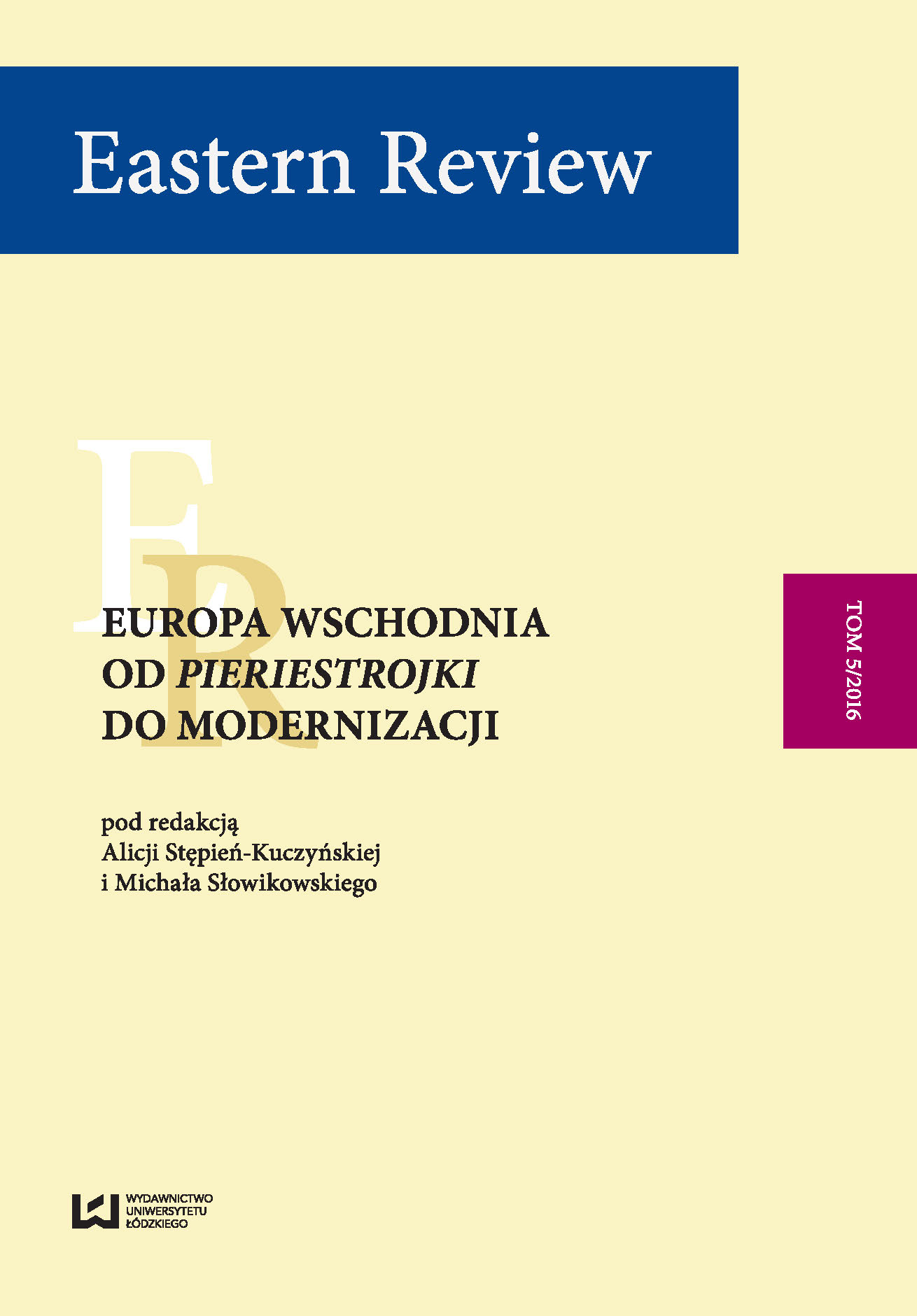
Pieriestrojka znaczy smuta? O mentalno-społecznym kontekście sposobu pojmowania przez Rosjan gorbaczowowskich przemian
DOI:
https://doi.org/10.18778/1427-9657.05.06Słowa kluczowe:
Mikhail Gorbachev, perestroika, Smuta, RussiaAbstrakt
If in the West perestroika and its initiator, Mikhail Gorbachev evoke, almost involuntarily, mostly warm and positive connotations, Russians’ attitude and assessment towards them are, more and more explicitly and unequivocally, strongly negative. Interestingly and symptomatically, in the consciousness of the millions of Russians, the governance of both Gorbachev and Yeltsin – competing leaders who were programmatically in opposition – is regarded in the category of Smuta (the Time of Troubles), meaning, recurring in the Russian history, periods of defiance, feud, disarray, chaos, helplessness and decay. Analyzing and explaining the above, one should remember that the subjective power making history has for centuries been identified with the central national authority seeing in its existence, self-rule, might and efficiency not only the guarantee, but also the basis for existence and creation of the social order, or even the existence of the state itself in the, supposedly, invariably hostile world towards Russia. The presumptions of the similar – consolidated, disseminated, and reproduced for ages – way of experience, conceptualization, assessment and Russians’ problematization of the social reality do not have only a mental-cultural character, but their basis and correlates-counterparts also lie in the institutional-social sphere. Recurring throughout the Russian history periods of the weakening of power – together with the democratization attempts of (self-)limiting its authority – strengthen the processes of mental and social disintegration, create attitudes of life helplessness, destroy the sense of common value, identity and sense of existence. If so, Russian experience of the reformatory-democratic periods in their country’s history in general, and Gorbachev’s perestroika in particular, become something non-coincidental, even self-comprehensive, in the categories of, needing overcoming, the Russian Smuta. Not the first and – probably – not the last.
Bibliografia
Arutynyan A., The Putin Mystique. Inside Russia’s power cult, London 2014.
Bóg Wschodu i Zachodu, red. M. Gwarny, I. Perkowska, Wrocław 2012.
Broda M., Jurija Afanasjewa zmagania z Rosję, Łódź 2015.
Broda M., „Ziemski Bóg”. O rosyjskim sposobie pojmowania władzy, [w:] Bóg Wschodu i Zachodu, red. M. Gwarny, I.M. Perkowska, Wrocław 2012.
Broda M., „Zrozumieć Rosję”? O rosyjskiej zagadce-tajemnicy, Łódź 2011.
Cirlot J. E., Słownik symboli, Kraków 2000.
Faryno J., Ukryty, Niepozorny/Przenikliwy, [w:] Mentalność. Słownik, red. A. de Lazari, Katowice 1995.
Heller M., Dokąd zmierza Rosja?, „Obóz” 1996, nr 30. DOI: https://doi.org/10.2307/2216242
Jack A., Inside Putin’s Russia, London 2004.
Jelcyn B., Prezydencki maraton, Warszawa 2001.
Kara-Murza A., Azjopa czy pop we fraku, „Forum” 1986, nr 50.
Łotman J., Uspienski B., Kultura i eksplozja, Warszawa 1999.
McFaul M., Russia’ Unfinished Revolution. Political Change from Gorbachev to Putin, Ithaca–London 2001.
Mentalność. Słownik, red. A. de Lazari, Katowice 1995.
Migranin A., Czym jest putinizm?, „Gazeta Wyborcza”, 07.10.2004.
Sakwa R., Russian Politics and Society. Third Editions, London–New York 2002. DOI: https://doi.org/10.4324/9780203465660
Sołżenicyn A., Rosja w zapaści, Warszawa 1999.
Truscott P., Putin’s Progress. A Biography of Russia’s enigmatic President, Vladimir Putin, London–Sydney–New York 2004.
Wilk M., Wilczy notes, Gdańsk 1988.
Aхиезер A., Давыдов A., Шуровский M., Яковенкo И., Социокультурныe основания и смысл большевизмa, Новосибирск 2002.
Воровин В., Удар по России. Геопoлитика и предчувстие войны, Санкт-Петербург 2014.
Воронцов В., В коридорах безвластия. Премьеры Ельцина, Москва 2005.
Гайдар Е., Гибель империи. Уроки для современнoй России, Моcква 2006.
Горбaчев M., Понять перестройку… Почемy это важно сейчас, Москва 2006.
Исскуство в контексте цивилизационной идентичности, т. 1, рeд. Н. Хренов, Москва 2006.
Кондаков И., Кризис цивилизационной идентичности в истории России, [в:] Исскуство в контексте цивилизационной идентичности, т. 1, рeд. Н. Хренов, Москва 2006.
Медведев Р., Четыре года в Кремле, Москва 2004.
Mиронова T., Русская душа и нерусскя власть, Москва 2013.
Mясников A., O главной архетипической структyре русского общественногo самосознания, [в:] Oтечественная филосoфия: русская, российcкая, всемирная, рeд. Л. Шапошников, Нижний Новгород 1998.
Oтечественная филосoфия: русская, российcкая, всемирная, рeд. Л. Шапошников, Нижний Новгород 1998.
Рубби A., Ельциняда. Первое десятилетие пoстсоветской России, Мoсква 2004.
Толстых В., Россия епохи перемен, Mосква 2012.
Pobrania
Opublikowane
Numer
Dział
Licencja

Utwór dostępny jest na licencji Creative Commons Uznanie autorstwa – Użycie niekomercyjne – Bez utworów zależnych 4.0 Międzynarodowe.
Jak cytować