
William Shakespeare’s Hamlet: A Novelty on the Ukrainian Puppet Stage
Ivan Franko National University of Lviv, Ukraine https://orcid.org/0000-0003-4434-6647
Graduate of Ivan Franko National University of Lviv; Lviv Puppet Theatre, Ukraine https://orcid.org/0009-0005-9324-186X
Abstract
The article examines the first stage performances of William Shakespeare’s Hamlet in Ukrainian puppet theatres, which appeared as late as the twenty-first century. The authors examine productions by directors Oleksii Kravchuk (Lviv Academic Theatre of Variety Miniatures “Both People and Puppets”, Lviv, 2017), Oksana Dmitrieva (Viktor Afanasyev Kharkiv Academic Puppet Theatre, Kharkiv, 2018) and Nikita Pertsev (Zhytomyr Academic Puppet Theatre, Zhytomyr, 2021), which are characterized by an innovative combination of live action and puppetry. The article analyses the transformation of the performance idea, the construction of Hamlet in these performances, and scenographic solutions that reflect the characters’ internal conflicts and expand the boundaries of the tragedy.
Keywords: Shakespeare in puppet theatre, Hamlet in Ukraine, tragedy adaptation, farce, acting, puppet theatre.
William Shakespeare’s tragedy Hamlet has become an important part of Ukrainian stage culture as it is an integral part of European cultural heritage. The continued popularity of this play among Ukrainian readers and viewers stems from two key factors. First, the universality of the social and political issues raised in the play resonates with audiences. Second, the play’s deep cultural code enables philosophical self-awareness and the articulation of national problems specific to a particular time, all through the lens of Shakespeare’s work. As Ukrainian theatre critic and Shakespeare scholar, Maiia Harbuziuk, has noted, in the history of Ukrainian theatre every reference to Hamlet is symptomatic of significant changes in worldview (Harbuziuk 157–158).
Ukrainian audiences have been familiar with Shakespeare’s works since the late eighteenth century, although only through the mediation of non-Ukrainian theatre. In Lviv, the first Hamlet in German was staged in 1796, and the first-ever production in Polish was staged in 1797 (Harbuziuk 158). These were productions of the Lviv Austrian Theatre and of the Lviv Polish Theatre. In the nineteenth century, Ukrainians also had the opportunity to watch this tragedy in Russian (Vanina 28). Although the first translations of Hamlet into Ukrainian appeared in the 1860s, the first production was not staged until the mid-twentieth century. This was due to the oppression against Ukrainian-language culture by the dominant empires, which many scholars today describe as colonial oppression (Hrytsak and Shapoval).
In the Soviet Union, Shakespeare was allowed to be played on stage, but with(in) certain limits. Even after the Ukrainian premieres of the tragedies Macbeth (1920, directed by Les Kurbas) and Othello (1923, directed by Oleksandr Zaharov), Hamlet failed to make it to the Ukrainian stage. Harbuziuk explains this absence:
The taboo on Hamlet, hidden, not directive, but no weaker for it, was in effect almost throughout the entire first half of the twentieth century. This is quite understandable, because the problems of human existence, the relationship between the individual and the government, and the criminality of the government as such – the leading themes of Hamlet – were ideologically extremely dangerous for the totalitarian [Soviet] state. (Harbuziuk 157–158)
The first Ukrainian-language production of Hamlet was staged outside Soviet influence, namely in 1943 at the Lviv Opera House (directed by Iosyp Hirniak) during the German occupation of Ukraine. In the Soviet space, Hamlet could only be performed after the death of Joseph Stalin, from 1956 onwards. Two productions premiered immediately after 1956: one at the Taras Shevchenko Kharkiv Drama Theatre (1956, directed by Benedikt Nord) and the other at the Maria Zankovetska Lviv Drama Theatre (1957, directed by Borys Tiahno). However, this trend did not develop more widely within the USSR. When Ukraine became an independent state in 1991, theaters’ interest in Hamlet did not increase immediately, but only in the early 2000s (Trykolenko 267–274; cf. Oliynyk; cf. Antipova). Harbuziuk noted in 2012:
This deliberate and well-planned delay in the development of the Ukrainian national theatre by the authorities has had its consequences: to date, there are barely more than ten staged performances of Hamlet in the history of Ukrainian theatre, while the histories of the theatres of our closest neighbors, both to the west and to the east, count in the hundreds. (Harbuziuk 158)[1]
Recent political events catalyzed radical change in Ukraine’s theatrical processes, however. In 2013–2014, Ukrainians took to the streets in what became known as the Revolution of Dignity or the Euromaidan, attempting to end the colonizing influence of Russia and its domination in culture and politics, and create an irreversible turn to Europe and its values of democracy, decentralization of state power, strengthening the role of civil society, protection of human rights, freedom of speech and opinion, openness of data, strengthening of national identity and ability to defend its borders. In reaction to Ukraine’s move towards democracy, Russian aggression began in eastern Ukraine in 2014. These two parallel events fundamentally affected and shifted theatre in Ukraine, opening the door to Hamlet. In 2019, Ukrainian theatre critic and scholar, Hanna Veselovska, stated:
It seems that lately, for the vast majority of Ukrainian directors, staging William Shakespeare’s Hamlet is a matter of honor. Hamlet is staged in various theatres: large, small, dramatic, musical, children’s, in short, in all the theatres that exist. (Vasyliev, Veselovska et al. 185)
By 2024, the range of directorial readings of Hamlet in Ukrainian theatre had become extremely wide. These include productions on the stages of state drama theatres: first of all, the post-apocalyptic vision in the basement of the Ivano-Frankivsk National Academic Drama Theatre (2017), which Michael Dobson called one of the most interesting 2018 Shakespearean stage versions of Hamlet in the modern theatre world (Verhelis, “Навіщо вони мучать Гамлета?” [Why Are They Torturing Hamlet?; Navìŝo voni mučat’ Gamleta?]; cf. Dobson, “Нестерпно, коли з Шекспіра роблять музей” [It’s Unbearable When They Make a Museum Out of Shakespeare; Nesterpno, koli z Šekspìra roblât’ muzej]; cf. Stelmashevska). Yet, there are many other interesting productions throughout the country: from Kyiv to Uzhhorod. Unusual interpretations grace the stages of experimental alternative theatres, such as the Nafta Theatre’s in Kharkiv or the Zaporizhzhia Municipal Laboratory Theatre VIE, among others.[2]
Shakespeare’s Hamlet has also inspired post-dramatic interpretations. For example, this trend can be observed in the Ukrainian director Roza Sarkisian’s projects – the stage production H-effect (2020), created in collaboration with the Polish playwright Joanna Wichowska as part of a Polish-German-Ukrainian co-production, and the documentary film Hamlet Syndrome, directed by the Polish tandem Elwira Niewiera and Piotr Rosołowski. An additional example is Ha*l*t, a co-production of the Theatre on the Left Bank (Kyiv, directed by Tamara Trunova) and the RADAR OST Festival (2023, Deutsches Theatre Berlin, curated by Birgit Lengers) with the support of the Goethe-Institut and Christine Dissmann. Clearly, there have been many Hamlets in Ukraine in the past two decades, yet on the stage of the Ukrainian puppet theatre, Shakespeare’s Hamlet has only begun to take its first steps.
Puppet Hamlets
Performances of Shakespeare’s Hamlet on the stages of puppet theatres began appearing in Ukraine in the 2010s, and these productions brought a new vision of Shakespeare’s tragedy through the use of puppetry as a medium. However, the first Hamlet to appear on the stage of a Ukrainian puppet theatre was not a play by Shakespeare, but a character from Heiner Müller’s Hamletmachine (1977), performed at the Oleksandr Dovzhenko Chernihiv Puppet Theatre in 2016. Director Vitalii Holtsov made a stage adaptation of the German playwright’s radical retelling, which rethinks Shakespeare’s tragedy, focusing on the destructiveness of society and human consciousness (Tomenchuk, “Гамлет-Машина” [Hamlet-Machine; Gamlet-Mašina]). In an interview, the Ukrainian director emphasized:
This is a warning play. A warning about the danger of individuality being absorbed by the mass. A play about a time of catastrophe, ruin that has become commonplace. On the other hand, every destruction is an attempt at rebirth. But you can’t destroy culture, change it endlessly. At some point you have to stop. (“Вистава Гамлет-машина” [Performance Hamlet-Machine; Vistava Gamlet-mašina]
In this sense, the three productions that make the focus of this article map such moments of destruction and rebirth. They reflect a particular period in Ukrainian history, after the war with Russia started in 2014, but before the full-scale invasion in 2022. This period was marked by dynamic changes in theatre, and in particular within Hamlet productions. In 2017, the tragedy premiered at the Lviv Academic Theatre of Variety Miniatures Both People and Puppets under the direction of Oleksii Kravchuk. It is noteworthy that this was the second time Kravchuk addressed Shakespeare’s tragedy: in 2010, he had already staged Hamlet at the Ukrainian Music and Drama Theatre in Luhansk, before the city was occupied by Russia from 2014 onwards. Kravchuk’s second Hamlet, on the puppet stage of the Puppet Theatre in Lviv in 2017, was the first-ever production of Shakespeare’s Hamlet in the history of the Ukrainian puppet theatre.[3]
In 2018, the second Ukrainian puppet stage version of Shakespeare’s Hamlet was staged at the Viktor Afanasev Kharkiv Academic Puppet Theatre. Directed by Oksana Dmitrieva, this production was created in Russian, which reflects the linguistic specifics of the eastern region of the country, where more people spoke Russian than Ukrainian. Despite this choice, which might appear difficult to understand today, it is worth noting that this was a Russian-language premiere in the puppet theatre of Ukraine. After all, even in the Soviet period, the tragedy was inaccessible to the audience in Russian because of the ideological orientation and control of the performing arts at that time. The only puppet theatre production of Hamlet in the entire USSR was a 1981 performance at the Magnitogorsk Puppet Theatre (directed by Mark Bornshtein).
In 2021, the third stage version of Hamlet, and thus the second in Ukrainian, was created at the Zhytomyr Academic Puppet Theatre. Titled Khamlet, it was based on a text by Nikita Pertsev, a student director at the Ivan Kotliarevskii Kharkiv National University of Arts. The production, Pertsev’s graduation thesis, departed from the traditional version of the tragedy. It retained motifs of Shakespeare’s Hamlet, but combined tragedy with farce and contemporary topical humour, as its author claimed (“Нікіта Перцев: «Коли приходить Хамлет»” [Nikita Pertsev: When Khamlet comes; Nìkìta Percev: Koli prihodit’ Hamlet]).
It is noteworthy that these three performances originated in different parts of Ukraine: Lviv in the western region, Kharkiv in the eastern region, and Zhytomyr in the northern region. Chronologically, they appeared within a few years. The third production is currently the most recent stage version of Hamlet and is different because of its radical change in the genre from tragedy to farce. This article will pay closer attention to the first two versions as key productions that reflect the breadth of the new approaches to Hamlet as a tragedy in Ukrainian puppet theatre.
Hamlet Between a Puppet and a Human. Lviv 2017
Sources: Photos kindly supplied by the theatre.
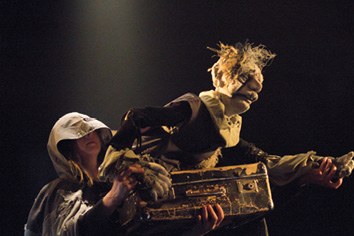
The director of the Lviv Hamlet production, Oleksii Kravchuk, combined the puppet form with live acting, thus creating a special atmosphere for working with the playtext. Kravchuk used a new translation by Yurii Andrukhovych, a contemporary Ukrainian poet, prose writer, translator, and essayist. Andrukhovych completed this translation in 2000 at the request of the Kyiv director Stanislav Moiseev for the legendary production of The Tragedy of Hamlet, Prince of Denmark at the Molodyi Theatre in Kyiv. This translation, based on the English playtext as well as a Polish translation by Stanisław Barańczak, is the most contemporary of the translations that exist in Ukrainian (Bublyk). The text is full of humor and words familiar to people living in the western part of Ukraine. For example, Claudius is addressed by Hamlet with the use of a familiar form, stryjko, meaning father’s brother, or paternal uncle.
In Shakespeare’s play, Hamlet appears as a positive character due to his inner torment, moral dilemmas, and the struggle against betrayal and injustice. However, in this production, he appears in a different light: he is a destroyer who unknowingly does damage to everyone around him, even those whom he seems to love. His actions, aimed at finding truth and exacting revenge, turn out to be destructive for those around him. The key experiment with the role lies in the choice of the performer, Nadia Krat. Although many women have played the role before, her interpretation of Hamlet is different because of her ability to combine traditionally “masculine” traits, such as courage, hot temper, frankness and crude humor, with “feminine” vulnerability, ingenuity and emotionality. Although Krat did not set out to transform herself into a man in her portrayal, she skilfully conveys some of the manners and behavioral characteristics of the male archetype (Verhelis, “Сестра наша – Гамлет” [Our sister – Hamlet; Sestra naša – Gamlet]). This delicate balance between the masculine and the feminine deepens the interpretation of Hamlet’s character, highlighting new aspects of the role. Although initially his Hamlet did not prioritize gender issues, in an interview Kravchuk explained:
In general, there is something feminine about Hamlet. We know that many actresses have also performed Hamlet. These are Sarah Bernhardt and Alla Demidova. There is such an intuition in him. There is one phrase when Horatio says before the duel: “Prince, don’t go.” And he replies: “It’s a woman’s gut feeling.” And there is also a monologue when Claudius is praying. Hamlet says that he could kill him here, now, during his prayer. A warrior man would probably do so. But this one, no, not now. Let him go on, let him go on in festivities, in debauchery, let him go. Only a woman can take revenge like this, if she takes revenge and goes to the end in revenge. (Bublyk)
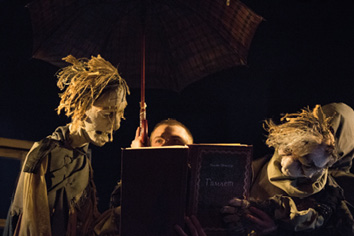
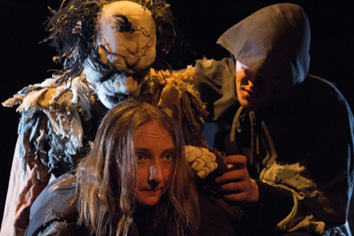
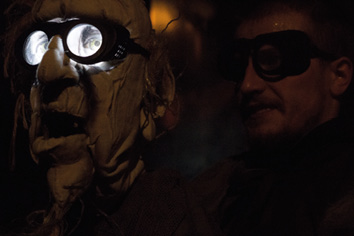
Oleh Verhelis, a Ukrainian journalist and critic, noted that Krat’s performance as the Danish prince resonated neither with the legacy of Sarah Bernhardt nor Alla Demidova, but rather with “Shakespeare’s Twelfth Night, where Viola and Sebastian are lost and found, where the comedy of the Christmas masquerade is about to turn into a tragedy” (Verhelis, “Сестра наша – Гамлет” [Our sister – Hamlet; Sestra naša – Gamlet]). In this production, the central characters in Hamlet appear in two ways: as live actors and their alter-egos as puppets. For Verhelis, this experiment was a great success. This Hamlet wins us over with their childish sincerity, they are horrified to realize that the world is infected with the virus of a “criminal state power” (Verhelis, “Сестра наша – Гамлет” [Our sister – Hamlet; Sestra naša – Gamlet]) but the hero is also infected: their struggle is agony, the male puppet’s face is frozen with an expression that resembles surprise and a mute cry, and the female puppeteer’s voice as well as acting style conveys desperate doom (Vasyliev, Verhelis et al. 145). Together with their puppet characters, the actors create images: they act in a shared/common space. The puppeteers do not hide behind their puppets (they act not only on its behalf), but in a playful manner also present themselves as living people, building communication with one another through short exchanges, meaningful looks. Therefore, they also enter into relationships on stage independently of one another, as the puppets seem to symbolise a different reality beyond the familiar world of the traditional play. This ‘other’ reality can be divided into two dimensions: microcosm and macrocosm, each of which is embodied by puppets of different sizes. The puppets were created by two artists, Oksana Rossol and Oleksandr Serhiienko. They skilfully combined different kinds of puppetry, which allowed them to achieve a visual contrast between large puppets (body puppets, half the height of the actor) and small puppets (rod puppets, half the size of large puppets), emphasizing the ambiguity of the images. The large puppets represent a macro world, symbolizing global and external forces that influence the characters. Meanwhile, small puppets, representing an ‘alter ego’ of the larger ones, reflect inner experiences on a micro level of personal conflicts (Verhelis, “Сестра наша – Гамлет” [Our sister – Hamlet; Sestra naša – Gamlet]; Vasyliev, Verhelis et al. 143–146). This interdependence is achieved through thoughtful visual solutions. The two worlds interact with each other emphasizing the tension between the external and internal life of the characters. The actors’ dialogue with the puppets symbolizes both a general-scale conflict, in which the characters face great challenges in life, and a local conflict that expresses their internal contradictions. The puppets serve as mediators in this dialogue, lending the performance a multi-layered character.
The actors’ costumes were made of ordinary dark grey knitted fabric with hoods in order not to distract the audience’s attention from the puppets. This is also why the actors’ faces are not made up. The puppets have a rather terrifying appearance: hair torn in different directions, ugly facial features, and somewhat shabby clothing. The appearance of the puppets is meant to convey the state of the characters’ souls. The internal vileness of the characters is externally manifested. Only Hamlet and Ophelia were created as more “attractive” puppets. Their faces are rather pale with dark accents, some deep wrinkles, large noses and ears, the corners of their lips downward, furrowed brows, and slightly sagging cheeks. Their appearance directly conveys the disfigurement, flaws, and low morality of a degraded society. In the performance the small puppets repeatedly served as symbols with surprising playful significance, combining different layers of meaning. For example, in the final scene during Laertes’ fight with Hamlet, the actors performed live, but instead of swords, they held small puppet figures: a puppet Laertes and a puppet Hamlet. In another scene, when Guildenstern and Rosencrantz announced the arrival of the travelling actors, a mini-Hamlet puppet was used as a microphone.
The production’s scenography employed dark colors that emphasized the atmosphere of tension and tragedy. The centerpiece of the stage was a large wooden door in the middle of the stage, symbolizing barriers, both physical and metaphorical, that stand in the way of the characters. Near the right side of the stage, there was a fence made of plastic pipes, which can evoke associations with isolation or separation between different spaces of action. On the left side of the stage, there were light plastic barrels and a suitcase, which later transformed into a coffin for Polonius, emphasizing a minimalist but expressive approach to scenography, where each object acquires an additional semantic load.
According to Kravchuk, the leitmotif of this production is organised around a reflexive path that an individual and their puppet’s ‘alter ego’ follow. They have to analyze what they have seen in order to recognize and understand themselves:
The classic “To be or not to be?” – in this interpretation – is acutely perceived as an attempt by a living being to understand at least himself: who am I in a mad world inhabited by monsters-caricatures-werewolves – a mask-puppet or a person; a man or a woman? (Verhelis, “Сестра наша – Гамлет” [Our sister – Hamlet; Sestra naša – Gamlet])
Together with the actors, Kravchuk explores the mechanisms of manipulation that dehumanise humans. After all, a living person can also be controlled just as a puppeteer controls a puppet. Metaphorically, all the characters in the play are puppets because all of them are being pulled by something or someone. The production accurately conveys the political and social tensions in Ukrainian society, portraying its time in a gloomy, critical way, while simultaneously appealing to the lighter side of each viewer’s soul, urging them to consider whether they are themselves or merely hostages of society or the authorities.
The Timeless Hamlet. Kharkiv 2018
The Kharkiv production of Hamlet combines live acting with puppets, similar to the Lviv one; however, the conceptual content of the performance is significantly different. Following the canonical Shakespeare plot, director Oksana Dmitrieva focused not only on the themes of betrayal, power struggle, and exposing the treachery of others, but also on the power of love, which can lead to rash acts. As Hanna Veselovska emphasizes, this production was “about the incredible power of love that pushes people to commit crimes” (Vasyliev, Veselovska et al. 186). The production’s interpretation highlights the tragic nature of human feelings, emphasizing their ambiguity and destructive power (Tomenchuk, “Гамлет” [Hamlet; Gamlet]).
Dark tones, metal barrels, and wooden elements were key in the set design created by Natalia Denysova. However, one of the central images Denysova put on stage was sails, which, on the one hand, indicate a geographical context (Denmark, washed by the sea), and on the other hand, they perform an important metaphorical function (Tomenchuk, “Гамлет” [Hamlet; Gamlet]): the sails symbolize Hamlet’s emotions, his inner storm, which propels the hero towards an inevitable catastrophe, like sails that lead a ship straight into the stormy waves of fate.
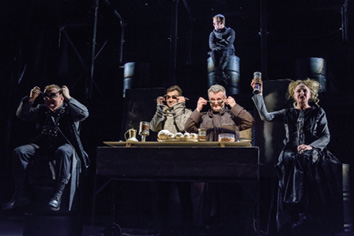
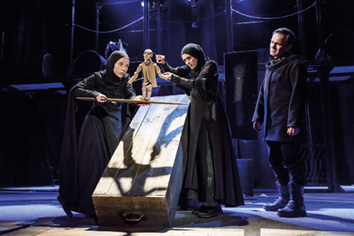
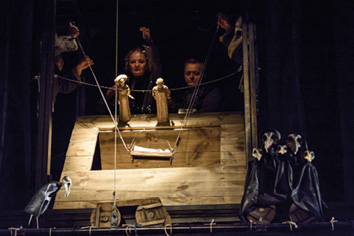
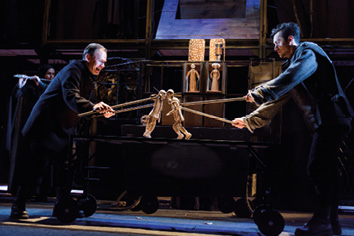
Sources: Photos by Margarita Korniushchenko. Photos kindly supplied by the theatre.
At the center of the stage stood a two-tiered structure that dominated the scene. Its lower part consisted of a panel divided into two rows with cells that evoked associations with a prison. These cells symbolized the traps or restrictions in which the characters were kept. It was in these cells that the puppets were situated at the beginning of the production, and the cell doors opened once the characters began to act. When a character died, their cell was closed again, while the puppet was taken away, emphasizing the fatality of the events and the inevitability of death. One rather abstract feature of the performance was seemingly disembodied women in black who appeared next to each living character a moment before their death, acting as harbingers or guides to the afterlife. These images suggested the inevitability of fate, which consumed each character, underlining as well the fragility of life and the inevitable influence of higher forces.
At first glance, the general design of the stage evokes associations with the traditional form of the seventeenth-century Ukrainian ‘vertep’, the tiny portable puppet theatre scaffold/screen with its typical vertical division of the stage space into upper and lower levels, as in the tradition dividing the universe into the sacred and profane spaces. However, in the production this division is conditional, and in fact, allows for no clear distinction. All the characters acted on different levels, and demonstrated a lack of clarity as to what belongs the world of the sacred and the mundane. For example, in the cemetery scene centring on Ophelia’s grave, the gravediggers were located on the upper tier of the structure, although traditionally they would have been “below”. The same applied to the appearance of the Ghost, who also entered on the upper level though he should appear from purgatory, below. At the same time, such ‘earthly’ characters as Claudius and Gertrude also acted on the same tier, an interpretive decision which completely erased the boundaries between the spiritual and material worlds.
The special feature of the production is the seamless integration of live action with puppetry. The puppets used in the staging were mostly rod puppets made of wood, a choice which emphasized their simplicity and symbolism. In addition to the puppets, the production also featured metal birds that imbued the whole a sense of cold, hard reality (also because of their metallic sound). Sometimes the puppet doubles’ acting turned into a parody or mockery of the actors’ performance. It is interesting that all the characters, with the exception of Hamlet, had their own puppet counterpart. Puppet Hamlet, however, was played by two women in black who accompanied the Ghost and controlled a puppet that repeated the movements of the live Hamlet (Fig. 5). At a certain point, when Hamlet came up with the idea of exposing Claudius through a theatrical performance, this connection reversed: the human Hamlet began to imitate the movements of his puppet, which emphasized his dependence on circumstances and fate (Tomenchuk, “Гамлет” [Hamlet; Gamlet]). Oleksandr Markin played Hamlet as melancholic, though in some scenes he certainly conveyed other emotions. This was reflected in how the puppet was orchestrated: sometimes the puppet Hamlet was moved by two female puppeteers, and sometimes he was led by a man. Hamlet knew that his desire for revenge may prove fatal, but despite his mental anguish, he understood this hopelessness and decided to act. His love for Ophelia turned out to be genuine, and in the end, he confessed it, when – unfortunately – she was already in her grave.
Dmitrieva added new accents that opened up other layers of interpretation for the viewer. The presence of the Ghost was significantly expanded: he appeared in the middle and at the end of the performance, which created a sense of his constant influence on the course of events. The director’s decision to make the actor who initially played the role of the Ghost a member of a traveling players who arrive in Elsinore and, at Hamlet’s request, perform an incriminating play for Claudius was also significant. As such, the character seemed to not only set the beginning of the story, but also accompanied it to the very end. This interpretation opens space for new assumptions and questions. For instance, is the Ghost real? Is it possible that at first only a disguised actor appeared before Hamlet, and due to his emotional shock and grief, Hamlet mistook him for the spirit of his father? This idea prompted the audience to wonder if all the events were merely part of a well-planned scheme to manipulate Hamlet. This directorial decision added depths and mystery to the story. In addition, the emphasis on the figure of the Ghost changes the idea of destructive events in the play. If in the traditional interpretation Hamlet is considered the driving force of the drama, in this version the main responsibility was transferred to his father. It is the Ghost that becomes the starting point of destruction, which then engulfs everyone around him, including Hamlet himself. Hamlet is a puppet in his father’s story of revenge. This reinterpretation allowed for a fresh perspective on the issues of guilt and responsibility, compelling the viewer to reevaluate the Ghost’s motives and impact on the unfolding events.
As reviewer Liudmyla Tomenchuk highlights, the Kharkiv production tells a story about how insignificant and petty people’s efforts seem in the face of eternity, and how eternity – represented by the Ghost cum Commentator/Actor – literally laughs at the characters in this tragedy. The production focused on frozen time, on people who have lost their sense of the passage of time and were effectively stuck in another dimension – in “timelessness” (Tomenchuk, “Гамлет” [Hamlet; Gamlet]).
The appearance of such a play in 2018 symptomatically marked the mood of many citizens of Ukraine, who had been enduring Russian military aggression for five years. It was a feeling of helplessness, of being unable to influence the course of events, which for some reason repeated themselves cyclically like a nightmare.
Hamlet as a Tragicomedy. Zhytomyr 2021
The third version of puppet Hamlet staged at the Zhytomyr Academic Puppet Theatre, demonstrates a radical departure from Shakespeare’s playtext. This leaves more room for improvisation by the production team who added contemporary and local meaning to the plot. The chosen genre of tragicomedy is already evident in the title: Khamlet draws us into a linguistic pun, associating the word “boor, cad” with the word “хам [kham]” in Ukrainian, declaring the de-heroization of the protagonist, bringing him closer to our time and devaluing tragic topoi. In an interview, the play’s director Nikita Pertsev explained his vision of the ‘hero’ of our time:
Khamlet comes from the word “kham (cad)”, “rudeness”. Yes, our hero is becoming one. He was like that before, but in the form of such an intelligent cad. Remember what it was like in the nineties and after, when bandits tried to look intelligent. […] That’s all. And we have quite a few of them. But these people can change for the better! If they understand where they came from, understand their growth – the path from who they were to who they are now, that they have a purpose, not just a simple task of sitting and wiping their pants. (“Нікіта Перцев: «У мене лялька»” [Nikita Pertsev: My puppet; Nìkìta Percev: U mene lâl’ka])
Typical of fairground theatre, the use of hand puppets reinforced the effect of distorted reality, as did the contrast of the live action commentator with caricatured, exaggerated puppets operating behind the screen. The whole production seemed to be structured as a performance of a traveling company, with an open reception at the beginning and at the end of the performance. The actors brought in a chest with puppets, introduced their characters at the beginning, and at the end, they ostentatiously put them back into the chest, which ultimately became a sarcophagus. The metadramatic aspects of the performance were underlined by an added character, the Jester, who communicated with the audience and the puppet characters. He commented on and explained the action. The nature of this conversation was often far from Shakespeare’s playtext, and his way of speaking was close to contemporary spoken Ukrainian.
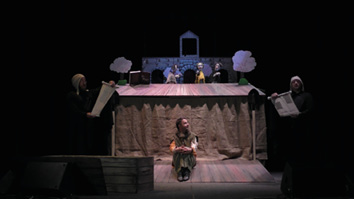
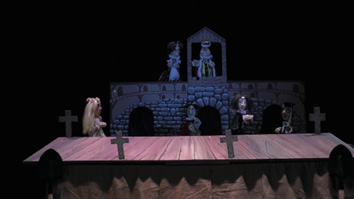
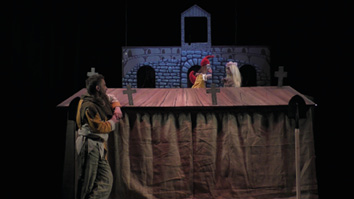
Sources: Photos by Ruslan Moroz. Photos provided by the theatre.
The way in which the actors performed their roles, the way they controlled the puppets, and the constant metadramatic emphasis on the theatricality of the events in the play highlighted the innovative dynamic between puppets and live actors in the production. For example, Hamlet, in a conversation with Horatio about the question whether they are all hostages or only puppets in the mess of an unfair life, suddenly reflected upon their own nature: “I realized that we are all puppets!” (Hamlet’s puppet bangs its head against the stage, making a dull sound to show that it is made of wood).
Pertsev’s use of puppets emphasizes a degradation of society. The actor Oleh Yatsenko, who played Hamlet, describes the power of the puppets in an interview:
There are moments when you realize that an actor on stage will not play that […], there are moments when a puppet can demonstrate this or that emotion much more expressively, because usually in a live performance an actor does not go for such experiments. (Kovalchuk, “У Житомирі” [In Zhytomyr; U Žitomirì])
However, the production extended beyond depicting the grotesque and toxic environment that the protagonist inhabits. In fact, Hamlet himself later turned into an unprincipled and cunning Punch/Pulcinella, the popular fairground theatre character. According to the laws of the farce, he then beat all the other puppets with a huge stick. Perhaps, the production suggests, this is exactly the kind of “hero” – attractive and media-savvy – that modern society needs? After all, he embodies the dubious values of the time, when appearance often prevails over content, and the ability to arouse admiration is the main condition for gaining power and influence. Apart from this social criticism, the director Nikita Pertsev also focused on the degraded people of the imagined country (Kovalchuk, “У Житомирському театрі” [Director Nikita Pertsev; U Žitomirs’komu teatrì]). They were depicted as an unprincipled, declassified crowd ready to serve any new king – e.g., a new Claudius – but also ready to distance themselves and bury him if he suddenly lost his status. It is no coincidence that at the end of the play, when the main characters die, the arrival of Fortinbras was cut. Instead, vulgar, common people reappeared, happy to have a job: “to bury or not to rebury” the corpses of the dead Hamlet, Claudius, Gertrude, and Laertes.
The creators of the production ‘dynamized’ the plot with the help of wordplay, random allusions, eloquent, though not always appropriate, quotes from other famous works: e.g., King Claudius orders to cut down the “cherry orchard” that grew under the walls of Elsinore. The set design by Viktor Datsun was ironic to the core, as the puppets acted against a backdrop of a fake, toy medieval castle painted on plywood; a stage board was ‘propped up’ by shovels. This seems to immediately refer to a cemetery, and yet again, the future fate of most of the characters. Later, this indication was reinforced by another blatant symbol: tombstones appeared on the stage board in place of the cut-down trees.
The metaphor of the cemetery emphasized the diagnosis of a consumerist and unprincipled society: it reflected on its deadness. The technique of double or triple detachment through metadrama, the use of the principle of ‘theatre within the theatre’ allowed the creators of the production to draw an unattractive image of an ‘anti-hero’ of our time and modern society unobtrusively. The de-heroization of Hamlet and his transformation into the image of a cynical hero of our time may seem overly radical, as it pushes the central existential questions in Shakespeare’s tragedy into the background. The use of farcical elements that devalue pathos and turn the action into a game with caricatured puppets reflects social criticism, but risks depriving the production of the depth associated with Hamlet. For those accustomed to the classical understanding of tragedy, this production may look like an exaggerated, ironic reflection, where the important balance between comedy and tragedy is shifted too much towards grotesque and parody. Yet, this adaptation certainly complements the gloomy stage Hamlet in the Ukrainian puppet theatre as depicted above.
Three Hamlets: The Puppet Scene as a Reflection of Social Processes
Although there have been only three productions of Hamlet on the Ukrainian puppet theatre stage to date (2017, 2018, and 2021), they reflect a diversity of interpretations and contexts, while expanding the boundaries of puppet theatre. These three productions offer original solutions to the problems presented by Shakespeare’s Hamlet, using theatrical techniques that are characteristic of puppetry. The combined use of live actors and puppets reveals the characters’ inner worlds more fully, displaying their alter egos. At the same time, this exposes deep-seated traits of their personality and reflects upon their internal and external conflicts.
In particular, the de-heroization of Hamlet is symptomatic of the puppet theatre, it seems, as is the shift of directorial emphasis from the protagonist towards his environment. As a result, these Hamlets allow a broad projection onto their society and a reflection of the people who tolerate or encourage criminal power in a regime. Finally, these productions highlight that the characters in Shakespeare’s tragedy are all puppets: hostages and victims of manipulation by a third force. Such stage readings also make it possible to diagnose the destructive processes that are quietly unfolding in Ukrainian society, involved in a war against its will since 2014, and subjected to war’s destructive influence, sometimes unconsciously.
The Hamlets of the Lviv, Kharkiv, and Zhytomyr puppet theatres convincingly demonstrate the expansion of the puppet medium into the sphere of the ‘adult stage’, overcoming stereotypes that this art form is intended exclusively for children. Contemporary Ukrainian puppet theatre, as exemplified by these productions, is emerging as a fully-fledged platform for thinking through serious existential issues.
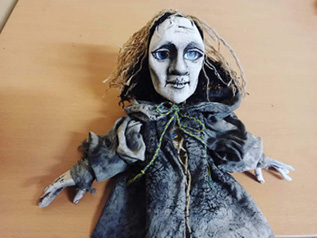
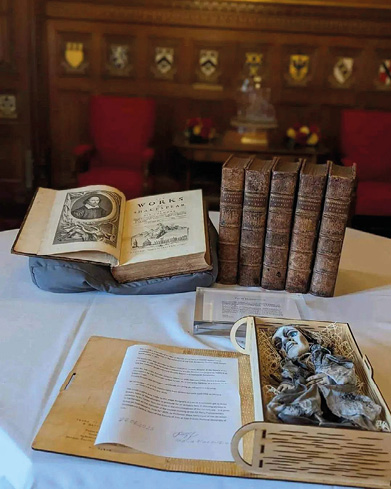
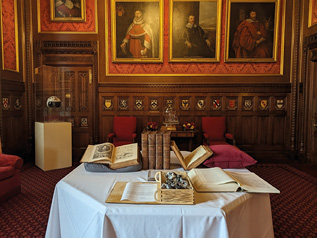
Sources: Photos from the page of the Ivan Franko National University of Lviv.
Autorzy
Works Cited
Antipova, Alla. “U kožnogo pokolìnnâ povinen buti svìj Gamlet”. Golos Ukraïni, 12 November 2010 [“Each Generation Should Have Its Own Hamlet”. The Voice of Ukraine, 12 November 2010] [Antipova, Alla. “У кожного покоління повинен бути свій Гамлет”. Голос України, 12 November 2010]. http://www.golos.com.ua/article/123824. Accessed 14 October 2024.
Bublyk, Mykhailo. “Oleksìj Kravčuk, teatral’nij režiser: Ŝe ne skoro, ale vse vernet’sâ v Ukraïnu. Prosto treba vesti borot’bu ne tìl’ki zbroêû”. Ukrìnform, 30 October 2018 [“Oleksiy Kravchuk, Theatre Director: Not Soon, But Everything Will Return to Ukraine. We Just Need to Fight Not Only with Weapons”. Ukrinform, 30 October 2018] [Бублик, Михайло. “Олексій Кравчук, театральний режисер: Ще не скоро, але все вернеться в Україну. Просто треба вести боротьбу не тільки зброєю”. Укрінформ, 30 October 2018]. https://www.ukrinform.ua/rubric-regions/2569291-oleksij-kravcuk-teatralnij-reziser.html. Accessed 10 October 2024.
Dobson, Michael. “Elsinore’s Star Bullshitter.” London Review of Books 40 (17) (2018). https://www.lrb.co.uk/the-paper/v40/n17/michael-dobson/elsinore-s-star-bullshitter. Accessed 14 October 2024.
Dobson, Michael. “«Nesterpno, koli z Šekspìra roblât’ muzej» (Zustrìč ìz profesorom Majklom Dobsonom, direktorom Šekspìrìvs’kogo ìnstitutu u Stretfordì-na-Ejvonì) / [ìnterv’û v Ìvano-Frankìvs’ku brala Majâ Garbuzûk]”. Proscenìum. Teatroznavčij žurnal 50–51 (2018): 56–60. [“‘It’s Unbearable When They Make a Museum Out of Shakespeare’ (Meeting with Professor Michael Dobson, Director of the Shakespeare Institute in Stratford-upon-Avon) / [Interview in Ivano-Frankivsk conducted by Maiia Harbuziuk.]” Proscaenium. The Theatre Studies Journal 50–51 (2018): 56–60] [Dobson, Michael. “«Нестерпно, коли з Шекспіра роблять музей» (Зустріч із професором Майклом Добсоном, директором Шекспірівського інституту у Стретфорді-на-Ейвоні) / [інтерв’ю в Івано-Франківську брала Майя Гарбузюк]”. Просценіум. Театрознавчий журнал 50–51 (2018): 56–60]. http://publications.lnu.edu.ua/journals/index.php/proscaenium/article/view/2359/1537. Accessed 8 October 2024.
Gamlet. Teatral’na ribolovlâ [Hamlet. Theatre Fishing] [Гамлет. Театральна риболовля]. http://www.t-fishing.co.ua/product/hamlet/. Accessed 12 October 2024.
Harbuziuk, Maiia. “Gamlet V. Šekspìra na ukraïns’kìj scenì: dzerkalo j vìdbitok času (na materìalì l’vìvs’kih postav)”. Renesansnì Studìï 18–19 (2012): 157–180] [“Shakespeare’s Hamlet on the Ukrainian Stage: Mirror and Imprint of Time (Based on Lviv Performances)”. Renaissance Studies 18–19 (2012): 157–180] [Гарбузюк, Майя. “Гамлет В. Шекспіра на українській сцені: «дзеркало й відбиток часу» (на матеріалі львівських постав)”. Ренесансні Cтудії 18–19 (2012): 157–180]. http://nbuv.gov.ua/UJRN/renst_2012_18-19_11. Accessed 14 October 2024.
Hrytsak, Yaroslav and Yurii Shapoval. “Či bula Ukraïna rosìjs’koû kolonìêû?” Ukraïna Moderna. 20 July 2023 [“Was Ukraine a Russian Colony?” Modern Ukraine, 20 July 2023.] [Грицак, Ярослав, Юрій Шаповал. “Чи була Україна російською колонією?” Україна Модерна, 20 July 2023]. https://uamoderna.com/history/chy-bula-ukraina-rosiyskoiu-koloniieiu/. Accessed 14 October 2024.
Kovalchuk, Oksana. “U Žitomirì teatr lâl’ok zaveršuê sezon vistavoû dlâ doroslih Gamlet u sučasnìj obrobcì”. Suspìl’ne. Žitomir, 16 July 2021 [“In Zhytomyr, the Puppet Theatre Ends the Season with a Performance for Adults Hamlet in a Modern Setting”. Social Media. Zhytomyr, 16 July 2021] [Ковальчук, Оксана. “У Житомирі театр ляльок завершує сезон виставою для дорослих Гамлет у сучасній обробці”. Суспільне, Житомир, 16 July 2021]. https://suspilne.media/zhytomyr/148072-u-zitomiri-teatr-lalok-zaversue-sezon-vistavou-dla-doroslih-gamlet-u-sucasnij-obrobci/. Accessed 2 October 2024.
Kovalchuk, Oksana. “U Žitomirs’komu teatrì lâl’ok postaviv debûtnu prem’êru Hamlet režiser Nìkìta Percev”. Suspìl’ne. Žitomir, 24 October 2021 [“Director Nikita Pertsev Staged the Debut Premiere of Hamlet in the Zhytomyr Puppet Theatre.” Social Media. Zhytomyr, 24 October 2021] [Ковальчук, Оксана. “У Житомирському театрі ляльок поставив дебютну прем'єру Хамлет режисер Нікіта Перцев”. Суспільне. Житомир, 24 October 2021]. https://suspilne.media/zhytomyr/174606-u-zitomi. Accessed 11 October 2024.
“Nìkìta Percev: Koli prihodit’ Hamlet, vìn zmušuê smìâtisâ nad tragedìêû! / [ìnterv`û brav] Ruslan Moroz”. 20 hvilin, 19 May 2021 [“Nikita Pertsev: When Khamlet Comes, He Makes You Laugh at the Tragedy! / [interviewed by] Ruslan Moroz.” 20 minutes, 19 May 2021] [“Нікіта Перцев: «Коли приходить Хамлет, він змушує сміятися над трагедією!» / [інтерв’ю брав] Руслан Мороз”. 20 хвилин, 19 May 2021]. https://zt.20minut.ua/kul-tura/nikita-pertsev-koli-prihodit-hamlet-vin-zmushue-smiyatisya-nad-tragedi-11273703.html. Accessed 14 October 2024.
“Nìkìta Percev: U mene lâl’ka zavždi bula živoû / tekst zapisala Oksana Davidenko”. Zhytomyr.Travel, 16 July 2021 [“Nikita Pertsev: My Puppet Has Always Been Alive / Text Recorded by Oksana Davydenko.” Zhytomyr.Travel, 16 July 2021] [“Нікіта Перцев: «У мене лялька завжди була живою» / текст записала Оксана Давиденко”. Zhytomyr.Travel, 16 July 2021]. https://www.zhytomyr.travel/nikita-percev-u-mene-lyalka-zavzhdi-bula-zhivoyu/. Accessed 4 October 2024.
Oliynyk, Yevheniia. “Uvì snì ta v okupacìï: šìst’ najvìdomìših ukraïns’kih Gamletìv”. Radìo Svoboda, 6 May 2014. [“In a Dream and in Occupation: Six Most Famous Ukrainian Hamlets.” Radio Liberty, 6 May 2014] [Олійник, Євгенія. “Уві сні та в окупації: шість найвідоміших українських Гамлетів”. Радіо Свобода, 6 May 2014]. https://www.radiosvoboda.org/a/25374177.html. Accessed 25 January 2026.
Stelmashevska, Olha. “Čim ì kim mi cìkavì svìtovì?” Den’, 12 June 2020 [“Why and Who Are We Interesting to the World?”. The Day, 12 June 2020] [Стельмашевська, Ольга. “Чим і ким ми цікаві світові?” День, 12 June 2020]. https://day.kyiv.ua/uk/article/kultura/chym-i-kym-my-cikavi-svitovi. Accessed 6 October 2024.
Tomenchuk, Liudmyla. “Gamlet-Mašina: ìnterv’û z režiserom Vìtalìêm Gol’covim ì hudožniceû vistavi Olenoû Zagrebìnoû”. Arterìâ tvorčostì, 29 December 2016 [“Hamlet-Machine: Interview with Director Vitaly Goltsov and the Artist of the Play Elena Zagrebina.” The Artery of Creativity, 29 December 2016] [Томенчук, Людмила. “Гамлет-Машина: інтерв’ю з режисером ВіталіємГольцовим і художницею вистави Оленою Загребіною”. Артерія творчості, 29 December 2016]. http://www.art-oko.com/intervyu/gamlet-mashina/. Accessed3 October 2024.
Tomenchuk, Liudmyla. “Gamlet (Har’kov, Teatr kukol)”. Arterìâ tvorčostì, 26 October 2019 [“Hamlet (Kharkiv, Puppet Theatre).” The Artery of Creativity, 26 October 2019] [Томенчук, Людмила. “Гамлет (Харьков, Театр кукол)”. Артерія творчості, 26 October 2019]. http://www.art-oko.com/retsenzii/gamlet-harkov-teatr-kukol/. Accessed 3 October 2024.
Trykolenko, Sofiia. “Gamlet: čotiri vistavi – čotiri virìšennâ”. Ukraïns’ke mistectvoznavstvo: materìali, doslìdžennâ, recenzìï 14 (2014): 267–274 [“Hamlet: Four Performances – Four Decisions.” Ukrainian Art History: Materials, Research, Reviews 14 (2014): 267–274] [Триколенко, Софія. “Гамлет: чотири вистави – чотири вирішення”. Українське мистецтвознавство: матеріали, дослідження, рецензії 14 (2014): 267–274]. https://um.etnolog.org.ua/zmist/2014/267.pdf. Accessed 14 October 2024.
Ukraine. World Encyclopedia of Puppetry Arts. https://wepa.unima.org/en/ukraine/
Vanina, Iryna. Ukraïns’ka šekspìrìana. Do ìstorìï vtìlennâ p’ês Šekspìra na ukraïns’kìj scenì. Kiïv, 1964 [Ukrainian Shakespearean. To the History of the Implementation of Shakespeare’s Plays on the Ukrainian Stage. Kyiv, 1964] [Ванина, Ирина. Українська шекспіріана. До історії втілення п’єс Шекспіра на українській сцені. Київ, 1964].
Vasyliev, Serhii, Oleh Verhelis, Hanna Veselovska, Maiia Harbuziuk, Anna Lypkivska, Liudmyla Oltarzhevska, Yana Partola and Alla Pidluzhna. “L’vìvs’kij akademìčnij teatr estradnih mìnìatûr Ì lûdi, ì lâl’ki. Gamlet”. I Vseukraïns’kij teatral’nij festival’-premìâ GRA (Great Real Art). Al’manah. Kiïv:, [2019]. 143–149. [“Lviv Academic Theatre of Variety Mini-Ministrations Both People and Puppets. Performance of Hamlet”: Feedback from Festival Experts. I Ukrainian Theatre Festival and Award GRA (Great Real Art). Almanac. Kyiv, [2019]. 143–149] [Vasyliev, Serhii, Oleh Verhelis, Hanna Veselovska, Maiia Harbuziuk, Anna Lypkivska, Liudmyla Oltarzhevska, Yana Partola, Alla Pidluzhna. “Львівський академічний театр естрадних мініатюр «І люди, і ляльки». Гамлет.” І Всеукраїнський театральний фестиваль-премія “ГРА” (GRA (Great Real Art)). Альманах. Київ, [2019]. 143–149].
Vasyliev, Serhii, Hanna Veselovska, Anna Lypkivska and Yana Partola. “Harkìvs’kij deržavnij akademìčnij teatr lâl’ok ìm. V.A. Afanas’êva. Gamlet V. Šekspìra”. II Vseukraïns’kij teatral’nij festival’-premìâ GRA (Great Real Art). Al’manah. Kiïv, [2020]. 185–187 [“Viktor Afanasyev Kharkiv State Academic Puppet Theatre. Performance of Hamlet by W. Shakespeare”: Feedback from Festival Experts. II Ukrainian Theatre Festival and Award GRA (Great Real Art). Almanac. Kyiv, [2020]. 185–187] [Vasyliev, Serhii, Hanna Veselovska, Anna Lypkivska, Yana Partola. “Харківський державний академічний театр ляльок ім. В.А. Афанасьєва. Гамлет В. Шекспіра.” ІІ Всеукраїнський театральний фестиваль-премія “ГРА” (GRA (Great Real Art)). Альманах. Київ, [2020]. 185–187].
Verhelis, Oleh. “Sestra naša – Gamlet”. Dzerkalo Tižnâ, 27 November 2017 [“Our Sister – Hamlet.” The Mirror of the Week, 27 November 2017] [Вергеліс, Олег. “Сестра наша – Гамлет.” Дзеркало Тижня, 27 November 2017]. https://zn.ua/ukr/ART/sestra-nasha-gamlet-261314_.html. Accessed 14 October 2024.
Verhelis, Oleh. “Navìŝo voni mučat’ Gamleta?” Dzerkalo Tižnâ, 11 May 2018 [“Why Are They Torturing Hamlet?” The Mirror of the Week, 11 May 2018] [Вергеліс, Олег. “Навіщо вони мучать Гамлета?” Дзеркало Тижня, 11 May 2018]. https://zn.ua/ukr/ART/navischo-voni-muchat-gamleta-277525_.html. Accessed 14 October 2024.
“Vistava Gamlet-mašina”. Goethe-Institut. Ukraïna. 29 September 2016 [Performance Hamlet-Machine. Goethe-Institut. Ukraine. 29 September 2016] [“Вистава Гамлет-машина”. Goethe-Institut. Україна. 29 September 2016]. https://www.goethe.de/ins/ua/uk/ver.cfm?event_id=20826305. Accessed 14 October 2024.
Footnotes
- 1 Unless otherwise specified, all translations are by the authors.
- 2 The Brothers Yurii-Augustyn and Yevhen Sherehii Transcarpathian Academic Regional Ukrainian Music and Drama Theatre (2016, Uzhhorod, director Yaroslav Helias), the Mykhailo Shchepkin Sumy Regional Theatre of Drama and Musical Comedy (2017, director Anton Mezhenin), the People’s Theatre “Bam-Buk” (2019, Kramatorsk, director Mykola Metla), Kyiv Academic Theatre on Pechersk (2019, directors Olha Larina and Denys Martynov), the Mykola Sadovskyi Vinnytsia Regional Academic Ukrainian Music and Drama Theatre (2019, director Taras Mazur), Rivne Regional Academic Music and Drama Theatre (2021, director Volodymyr Petriv), Zaporizhzhia Municipal Laboratory Theatre “VIE” (2021, director Yasha Hudzenko-Tobilevych), the Nafta (the Oil) Theatre (2021, Kharkiv, director Artem Vusyk), the Monotheatre “MIF (the Myth)” (2023, Kyiv, director Mykhailo Fitsa).
- 3 An exact copy of the Hamlet puppet from this performance is kept in the British Parliament as a gift from Ukraine, which was made by a prominent Ukrainian Shakespearean scholar, Professor Maiia Harbuziuk of the Ivan Franko National University of Lviv, on the 26th of June 2023 (Fig. 12). Photo from the University page: https://lnu.edu.ua/gallery/mayia-harbuziuk-u-parlamenti-velykobrytanii-ia-vidchula-shcho-ukraina-tut-prysutnia-iak-nevid-iemna-chastyna-ievropeyskoi-kultury-polityky-ii-sohodennia-i-maybutnoho/