Arkadius. Powerful Emotions. Confrontations. The Polish Fashion Heritage in the Making
Alicja Raciniewska*

Adam Mickiewicz University, Poznań, Poland
Abstract: This article focuses on a specific case study dealing with the contemporary public recognition of Polish former fashion designer Arkadius as an object of Polish cultural heritage. It offers an illustration of Jean Davallon’s model of patrimonialisation applied to fashion, enabling to identify the tipping points of the process and to explain its logic, operations, characteristics, and social meaning. Furthermore, the article indicates the important role of fashion exhibitions and paratexts in the patrimonialisation of fashion.
Keywords: fashion heritage, patrimonialisation, Arkadius, Polish fashion, fashion exhibition, paratext, collective memory, lieux de mémoire
Arkadius. Wielkie namiętności. Konfrontacje. Tworzenie polskiego dziedzictwa mody
Streszczenie: Artykuł koncentruje się na konkretnym studium przypadku, dotyczącym współczesnego uznania polskiego projektanta Arkadiusa za obiekt polskiego dziedzictwa kulturowego. Oferuje ilustrację modelu patrymonializacji Jeana Davallona zastosowanego do mody, umożliwiając identyfikację punktów krytycznych procesu i wyjaśnienie jego logiki, operacji, cech i znaczenia społecznego. Opracowanie wskazuje ponadto na ważną rolę wystaw modowych i towarzyszących im paratekstów w procesie patrymonializacji mody.
Słowa kluczowe: dziedzictwo mody, patrymonializacja, Arkadius, polska moda, wystawa mody, paratekst, pamięć społeczna, miejsca pamięci
Introduction
From 9 June 2024 to 13 July 2025, a major exhibition titled Arkadius: Powerful Emotions. Confrontations was held in the Central Museum of Textiles in Łódź (CMWŁ). Described as “the world’s first exhibition presenting the history of Arkadius’ work” (Harel, 2024), it offered a retrospective of the creative legacy of the Polish avant-garde fashion designer Arkadiusz Weremczuk, commonly known as Arkadius, who made a significant impact on the history of Polish and international fashion at the turn of the millennium, but then suddenly disappeared.
Born in 1969 in a small town in southeast Poland, Weremczuk left the country in 1992 and at the end of decade became the first Polish designer who established a major label in London, gaining acclaim at the prestigious Central Saint Martins College of Art and Design. His talent was recognized by stylist Isabella Blow, who became a mentor and helped launch his career. Known for provocative, culturally rich avant-garde designs, Arkadius was quickly placed alongside peers from London’s fashion scene (Alexander McQueen, John Galliano, or Stella McCartney), hailed by press as a major talent of the new millennium (Menkes, 1999). On the wave of his artistic success, Arkadius opened boutiques in London (2002) and Warsaw (2003), although in Poland his provocative designs became side of conflict between the conservative and the progressive national identity. In 2005, his career took a “spectacular nosedive” due to a combination of the financial mismanagement, scandal, and the collapse of Arkadius’ Polish business, leading to a near-total financial ruin and his subsequent withdrawal from the world of fashion. He moved to Salvador de Bahia (Brazil) and redirected his life towards sustainable life, architecture, art, and gardening. In Poland, he disappeared from the public view for many years, existing only as a “ghost” or a mystical figure. In 2015, Arkadius returned to the public eye with a conceptual “ritual of death” for his old persona reborn as AFKAA (Artist Formerly Known As Arkadius) and with a project–protest against the industry’s overproduction and cruelty. Around the same time, the first studies on him started, and the CMWŁ began to acquire and restore its archive, partly owing to state funding, especially from the Ministry of Culture and National Heritage (Dalbiak, 2024a).
The recent exhibition in the CMWŁ presented objects from all 14 Arkadius’ collections, which have become the property of the museum in recent years. The show became the high-profile fashion event in Poland, commented in media, visited by 33,000 of visitors (CMWŁ, 2025), and awarded by Polish institutions. What matters the most for this article, however, is the discourse of heritage accompanying the exhibition, especially the rhetoric of forgotten and saved from destruction national treasure that will now be presented to a wider audience. Reporting on the exhibition, journalist Mariusz Szczygiel has pointed out that “the invaluable @centralnemuzeumwlokiennictwa in Łódź saved and reconstructed 300 works by Arkadius, recognizing them as a treasure of Polish culture” (Szczygieł, 2024). The curator Marcin Różyc has declared that “the entire legacy of Arkadius, which was miraculously saved, entered the world of museums […], and we really wanted to organize an exhibition and share our wonderful discovery with everyone” (quoted in Kultura Osobista, 2024), while the CMWŁ director, Aneta Dalbiak, has expressed hope “that this exhibition will show everyone that fashion is a very important part of our cultural heritage, something that should be hosted in museums on an equal basis with art” (quoted in Pawlak, 2024). This is the first time, that the work of a Polish contemporary fashion designer has been framed as national heritage by a Polish cultural institution on such a scale.
This article focuses on a specific case study dealing with the contemporary public recognition of Arkadius as an object of Polish cultural heritage. The essay offers an illustration of Jean Davallon’s model of patrimonialisation applied to fashion, enabling to identify the tipping points of the process and to explain its logic, operations, characteristics, and social meaning. Furthermore, Jonathan Grays’ conceptual framework for paratext, applied in the study, shows the important role of paratexts in this process. The article argues that the exhibition Arkadius. Powerful Emotions. Confrontations marks a transition of the designer’s work from “scandalous clothes” to “national treasure”, and can be considered as a culmination of Arkadius’ heritage-making as institutional rehabilitation and an effort to re-evaluate the designer’s legacy in Poland. This process is taking place not only against the backdrop of Poles’ growing interest in domestic fashion and its history, as evidenced by publications and exhibitions devoted to Polish fashion from the communist era as well as contemporarily. The current heritagization of Arkadius is also part of broader phenomena, especially the global 1990s nostalgia trend, as well as the strategic interest in Polish art and fashion among both business and state institutions, treating these areas as a tool for building prestige, soft power, brand/national value, and capital at a time when Poland is strengthening its position in the region and on the international stage.
The paper is set up as follows: first, I briefly explain the theoretical underpinnings of this essay, especially Jean Davallon’s concept of the heritage-making process, called patrimonialisation. Next, I detail my approach to a qualitative enquiry of the case study of the patrimonialisation of Arkadius in Poland, including the methods of data collection and analysis. My findings are then presented and discussed with the hope that they become a starting point for further research on the patrimonialisation of Polish fashion.
Theoretical background
In my research, I use a communicative approach to heritage and the heuristic model of patrimonialisation of French sociologist Jean Davallon (2006; 2024), which helps to grasp the key stages of the heritage-making process as well as to understand its internal logic, its temporal direction, and the obligations that come with it. Davallon treats heritage as a “practical category” and, rather than looking for a proper definition of the notion, he proposes an examination of the process of patrimonialisation, understood as a symbolic and social practice of selecting elements from the past (material objects, social processes, and complex entities) to give them heritage status in the present (Davallon, 2024: xii). In a series of operations, an object from the past is socially transformed into a heritage object by attributing to it specific symbolic values and meanings, which are recognized and shared, first, by legitimate social actors, and then transmitted to all individuals through social practices and institutionalized mechanisms.
According to the French sociologist, this process takes place in stages (described as “gestures’”), during which different operations are undertaken (Davallon, 2006: 119–126; 2024: xii–xiv). After a fall into oblivion, or what Davallon calls “a break in the continuity of memory” (Davallon, 2006: 119), the object re-emerges into the collective consciousness through a “gesture of discovery” such as an archaeological find, a found treasure, or a lucky discovery (Fr. trouvaille), involving positive emotions and mobilizing social interest in this object. The recognition of the cultural heritage status of the object requires, next, the intentional and institutional “gesture of knowledge production”, i.e. a series of backward operations – involving collective, scientists, and heritage experts – that go from the present to the past in order to certificate the object’s origins and to confirm its original context. Based on the mobilization of scientific knowledge, this retrospective process rebuilds the lost continuity between the past (the object’s original context of creation) and the present, by symbolically suturing these different temporal regimes. It provides the basis for the “declaration as a heritage”, which creates new obligations for the present owners or custodians of the object, such as preserving the heritage object in a good condition (“a gesture of maintenance”), presenting it to the public (“a gesture of publicization”), and passing it to future generations.
Considering the temporal direction of the process, Davallon compares heritage-making to a type of stitching called backstitch. As in backstitch, which is done by pulling the thread back instead of the conventional movement forward, the course of heritage operations goes from the present to the past and back in order to “reconstruct the link to the past” (Davallon, 2006: 122) and to and reinscribe the past into the present. Paying attention to the temporal direction of patrimonialisation, Davallon’s model furthermore helps recognize heritage as “reverse filiation” (Pouillon, 1975), i.e. a way contemporary social actors acknowledge the past and selectively define what and how they inherited from it. Davallon’s model also sheds light on the heritage-making as a specific relationship with the past, made of both rediscovery and reinvention, and emphasises that operating on objects from the past is always embedded in current representations, goals, interests, and stakes.
According to Davallon, what sutures the past and the present together is not only the object of heritage itself (which is the material presence of the past in the present), but also the discourse on this object. Produced in the present, it authenticates the origins of the object and details its original context, enabling the temporal and social rupture between the thing form the past and its contemporary recipients to be sutured. Understanding heritage-making as a socio-semiotic practice of changes in the social and symbolic status of the objects, Davallon uses “media texts” as observables, treating them as “traces”, which report on aspects of society and culture (Davallon, 2024: xviii). Adopting Yves Jeanneret’s (2020) concept of “media-text”, Davallon understands the text in a broad sense – “as a machine for producing meaning through cooperation between a linguistic dispositive (and indirectly its producer) and the one interpreting it”, and extends this notion also to “complex ensembles that are meaningful, communicational and also social” such as “the exhibitions, the promotion of heritage sites, mediation documents television programs or video documentaries” (Davallon, 2024: xix–xv, italic original).
It is worth noting that many media texts considered by Davallon are recognized as paratexts by literary interpretations and media studies. The concept was introduced by French literary theorist Gérard Genette (1997), who used it to describe all framing devices that physically (cover, introduction, font, images, etc.) or conceptually (review, advertisement, interview, promotional materials, etc.) surround the main literary text in order to contextualize it and generate interest. They are important, because they regularly change, edit, revise, and co-create the meaning of the text; they shape the recipient’s “horizon of expectations” and have a significant influence over the way the literary text is received. Genette’s concept was then developed and extended in media research as a handy term to encompass the huge world of promotional culture and fan texts, “and similarly calling for greater attention to their roles in creating media culture, meaning, and power” (Brookey, Gray, 2017). Jonathan Gray (2010), like Genette, treats paratexts as “interpretive thresholds” and describes how meanings are created at the “borderlands” of the text. The media researcher, however, revisits the text–paratext relationship, treating the latter as an integral part of the former, constitutive of its symbolic resonance and an important factor contributing to the cultural whole. Gray draws a distinction between the work and the text, where the text is the entity in society and culture which consists of both the work and the paratexts external to it. In this way, paratexts “are intrinsic parts of the text as a social and cultural unit” (Brookey, Gray, 2017: 102).
Focusing on a specific case study dealing with the contemporary public recognition of Arkadius as an object of Polish cultural heritage, this essay offers an illustration of Davallon’s model of patrimonialisation applied to fashion. Gray’s conceptual framework for paratext has also informed my own study on the patrimonialisation of Arkadius in Poland, showing an important role of paratexts in this process.
Methodological background
The article was written as part of my research project – titled Mapowanie praktyk dziedzictwa polskiej mody (En. Mapping Polish Fashion Heritage Practices) (ID-UB UAM, 037/02/POB5/0032) – on the heritage-making of Polish fashion in 2024–2025. The aim of the study was to map the practices of exhibition and media institutions as well as fashion companies in the period under review, and then to examine selected case studies based on desk research and in-depth interviews with practitioners. In this article, I focus only on the case study of the recent Arkadius exhibition in order to show the way in which the patrimonialisation of Polish fashion is taking place in this significant case. Another objective was to read the traces of social practices that create the process of Arkadius’ patrimonialisation and to reveal the hidden values, understandings, and affects that accompany it.
This study was guided by Stake (1995), Creswell (2014), and Yin (2024), and a within-case analysis was an important strategy for the in-depth understanding and description of the phenomenon under study, which would enable to examine and synthetize diverse forms of evidence. Data collection, based on desk research and in-depth interview techniques, consisted of media texts about the exhibition as well as an interview with Aneta Dalbiak, the director of the CMWŁ (conducted on 13.11.2024 in the CMWŁ). The role of the interview was to supplement and confirm the collected data.
Multiple sources and forms of evidence were taken into account. Considering the exhibition as a broader cultural and social unit, as a medium and a communicative act, as well as a vehicle for the presentation of heritage traces (Davallon, 2006; 2024), the following categories of media texts were included in the research corpus: 1) media texts gathered in the exhibition space (the exhibited objects and their arrangement, exhibition design, museum’s paratexts that surround the exhibition objects such as wall texts, titles, guides, labels, etc.); 2) paratexts provided by the creators of the exhibition outside its space (posters, entries on the museum’s website and social media profiles, publicity announcements, editorial discussions, podcasts, publications, and other documents); and 3) paratexts provided by other social actors (interviews, exhibition reviews, press realises, website entries, social media posts, documentaries, TV programmes, publications, podcasts, scientific publications, etc.) These various media texts were treated as traces at two levels: as “heritage traces” (constituted by Arkadius’ works and persona from the moment their interpretation is initiated) and as “traces of the social practice” of the heritage-making process (Davallon, 2024: 1), enabling the identification of the tipping points of the process, its actors, its operations, and its characteristics, as well as explaining how the patrimonialisation of Arkadius was taking place.
Data analysis combined thematic analysis and discourse analysis. The analytical process entailed the following layers of analysis: coding generation, pattern-matching, repeated reading, defining themes, and reporting. The MAXQDA qualitative software was used as a supportive tool for the organization and analysis of the gathered case data. The data was integrated, synthesized, and examined through the lens of research questions and the existing body of literature.
From (re)discovery to the publicization of Arkadius
The dramatic trajectory of Arkadius’ life (which fits into the story of a meteoric rise and painful fall, leading to the hero’s transformation) and the current restoration and revalorisation of his work seems to fit Davallon’s model of patrimonialisation and its steps. The reappearance of Arkadius in Poland in 2015 coincided with the (re)discovery of him and his work amid the wave of nostalgia for the 1990s. This ‘discovering’ was initiated by the emerging social collective of people (many from younger generations), united by the admiration for the designer’s creativity and persona, the belief in the special value of him and his work for the Polish culture, the awareness that this valuable asset may disappear forever, and the desire to work for its preservation. The aim was also to retell the story of Arkadius’ rise and fall from today’s perspective. Although more journalistic than scientific in nature, the tangible effects of this effort – especially a reportage about Polish contemporary designers (Sulej, 2015), a publication on Arkadius’ collections (Zieliński, 2021), and a podcast series Supernowa. Historia Arkadiusa (Audioteka, 2021) – have provided initial categories and frameworks for interpreting Arkadius as a sociocultural phenomenon and have initiated the still ongoing phase of the production of knowledge about Arkadius and his legacy. Next, we could observe the intensification of the public discourse of heritage in the context of Arkadius (especially declaring him a national heritage by representatives of Polish museums and the fashion industry) and the activities of the CMWŁ in favour of purchasing and maintaining the designer’s works. This was accompanied by a narrative on the dramatic recovery of the designer’s archive[1], where the museum’s effort to locate, transport, and conserve its items was framed as a national mission of the miraculous restoration. Finally, after several years of preparation, a temporary exhibition was opened in June 2024, becoming the main operator of the heritage-making of Arkadius in Poland.
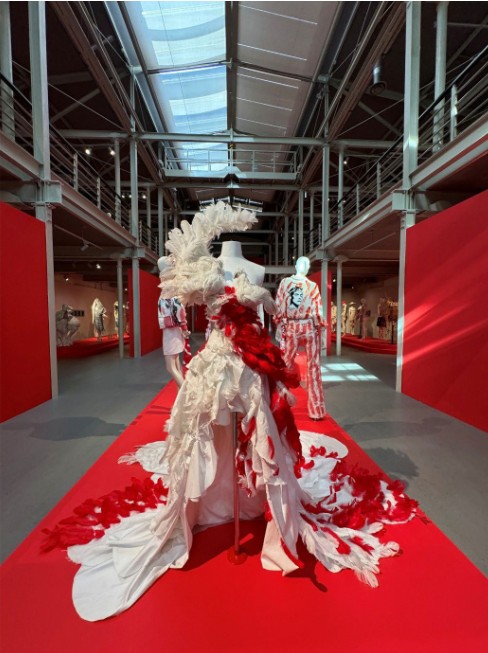
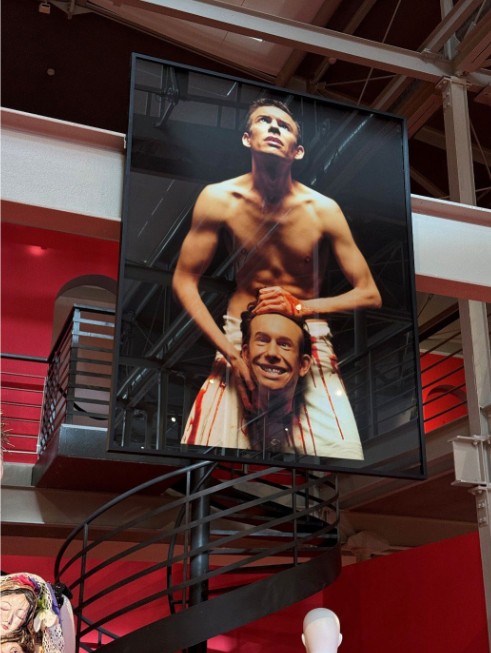
The display was spread over two floors of the museum’s building D and included over 200 objects such as clothes, accessories, collages (primarily available to visitors) as well as magazine covers, press clippings, photographs, and films from Arkadius’ archive (treated as additional memory elements). The physical layout of the exhibition – designed by curator Różyc and visual artist Zuza Golińska – was mimicking a three-nave church interior, with side aisles holding chronological 1999–2001 collections (Wild Orchids in Heaven; Semen of The Gods; Lucina, O!; Queen of Sheba, Paulina; Prostitution?), leading to a central nave, with the silhouettes from Arkadius’ most famous collections titled United States of Mind and Virgin Mary Wears the Trousers, as well as the iconic portrait of the designer holding his severed head (by Robert Wolański).
The second floor featured objects from Arkadius’ later collections (The House of Pleasure, Urban Orchid, Le Freak, C’est Chic, Le Cock) and the last ‘funeral’ P-iFashion project, which, along with the Ashes to Ashes video, recalled the designer’s symbolic death. Additionally, on both floors, Arkadius’ work was confronted with artistic fabrics and objects by contemporary Polish artists from the CMWŁ’s collection, such as Maja Berezowska, Zuza Golińska, Joanna Hasior, Marcin Janusz, Radek Anais Laró, Sebulec, Zonia Pionk, Łukasz Stokłosa, Ewa Wacherlohn, and Marek Wodzisławski. While the ‘liturgical’ exhibition design reinforced Arkadius’ status as a sacred cultural figure of the Polish fashion, the colour arrangement of the space – i.e. white and crimson red – symbolically inscribed Arkadius’ work into the national narrative on Polishness.
The exhibition broke with the previous tabloid image of Arkadius as a scandalous and dissonant national legacy, and constituted his sacralization as a national relic and a living national heritage. Although the exhibition was greatly and often interestingly promoted in the Polish media – and offered the opportunity to see, experience, and contemplate a large number of objects – it did not provide a clear interpretive framework that would unite them into a single story, and the museum did not produce a study of Arkadius’ legacy in the form of an exhibition catalogue. This means that the accompanying paratexts are of great importance when interpreting the exhibition.
Source: Author.
A triple suture
In this section, I discuss the mechanisms of Arkadius’ heritage-making. My study shows that the recent patrimonialisation of Arkadius as a fashion heritage object involves a triple movement: a temporal shift (from the present to the past and back) and two contextual shifts: the first one – from one geographical place (the United Kingdom) to another (Poland), and the second one – from one field of cultural production (fashion) to another (fine arts). These three mechanisms function as sutures, through which the fragmentary story of Arkadius is stitched together to make him an anchor of the national identity and the common good.
The temporal suture operates in many ways. First – by the presence of the object from the past in the present. This is not only about the presence of legendary Arkadius’ archive at the museum exhibition or the presence of the designer in the Polish media promoting the event, but also about the hashtag #Arkadiusidback or similar titles of media paratexts: The Big Return of Arkadius (Meyer-Olejarczyk, 2024), Arkadius Is Back (Zaczyński, 2024), The Return of Arkadius (Tyszko, 2024), and The Great Return of Arkadius (Gimblett, 2024), although Weremczuk himself did not return permanently to Poland or to design for the fashion industry. The Top Model Polska television programme (TVN, 2024) further asserted the contemporary presence of Arkadius works by staging a fashion show in which the participants met the designer and presented his iconic outfits in front of him and the jury of the competition.
Second, the temporal suture is done by dating and the historical discourse on the heritage object that authenticates and details its origins and original context, which, in Arkadius’ case, is the turn of the millennium and the period of political transformation in Poland. The exhibition fulfilled this task mainly by short descriptions of collections and photographs containing dates, press articles, videos from Arkadius’ fashion shows, and documentaries about his work, although the display itself was not focused on a historiographic narrative. Some historiographic elements were provided in aforementioned publications preceding the exhibition, reviews, and press covering, creating a narrative that traces present times of Arkadius’ fashion activity as a bygone past of transition period in Poland, forming nostalgia and gaining historical significance nowadays. Arkadius, with his life and work, remains a central figure of this era’s memory: “The specific attachment the Polish public had to his persona is symptomatic of what he encapsulated in the context of the systemic transformation, from communism to capitalism […] He was the representative of national identity for the emerging, aspirational middle class”, “the desire for cultural indigeneity and recognition in the West, not as Other but as an indistinctive member of capitalistic society” (Wojda, 2024). His journey from a small Polish town to the top of London’s avant-garde fashion scene mirrored the national aspiration for global recognition and the “dream” of the transformation itself. Although this is not always clearly stated in the exhibition or in the accompanying public discourse, the designer is also a “melancholic figure”, reflecting awkward entry into Western capitalism, the trauma of ‘failed success’, and a conflict over the national identity between conservative and progressive sides of the Polish society of that time (Wojda, 2024; Wójtowicz, 2025).
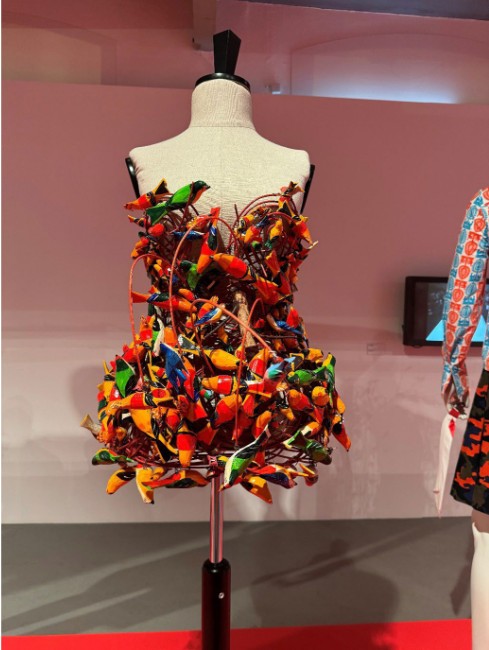
Finally, while it seems to contradict the above, the temporal suture also takes form of the blurring of chronological markers, building bridges between historical periods and presenting Arkadius in a role of an intergenerational mediator. Some media traces make Arkadius part of a certain form of timelessness: “Arkadius perfectly embodied the spirit of that era. In our opinion, Arkadius embodies the spirit of all subsequent eras, including the one we live in now” (Sulej in Pulkowski, 2021); “Twenty years after their premiere, all the silhouettes are still on point and relevant” (Szulc, 2024); “It has not lost its artistic value at all. It is still very strong” (Audioteka, 2021). Arkadius’ relevance is highlighted by showcasing today’s young Polish artists alongside his works at the exhibition and identifying them as his successors, although same commentators have reservations about this gesture or the choice of specific individuals (Sienkiewicz, 2025; Wójtowicz, 2025), and emphasize more clearly some contemporary Polish fashion designers as Arkadius’ heirs: “When I recall the projects of young creators seen in recent years, e.g. at the Lodz Young Fashion, I see their prototypes in the work of Arkadius created 20 years earlier” (Talaga-Nowacka, 2024). Designer Tomasz Armada is “the Arkadius of his generation”, who “is proud of his small-town roots, just like the world-famous designer to whom he is compared” (Sulej, 2025). Furthermore, Arkadius is presented as a forerunner of today’s fashion design and a pioneer of contemporary trends: “Arkadius Goggles, sold since 2005. Still relevant. Design-wise, it surpassed Demna’s Balenciaga, I think. […] In Paulina spring/summer 2001 collection, he lets out models in highlander hard-soled, high-heeled leather moccasins. A dozen or so years later, Phoebe Philo uses the idea, designing for Céline. In the same collection, he uses a terry towel, from which he pins up an asymmetrical skirt, pinned at the hip with a scaled emblem with a folk motif. Do you know that? Yes, that’s Demna for Balenciaga, too. Just like using bazaar bag patterns, which later appear in Louis Vuitton and Balenciaga, respectively” (Szulc, 2024); “This collection featured many surrealistic concepts that echoed in high-end fashion collections years later […] What’s important, in Paulina Arkadius not only drew from folklore as inspiration, but also engaged in co-creation with skilled artisans long before such collaborative practices became industry trends. Koniaków lace, which has gained attention in the fashion world thanks to collaborations with brands like Comme des Garçons and lately Magda Butrym, made its runway debut in Arkadius’s collection” (Czajor, 2024). Additionally, many paratexts present Arkadius as the heir and continuator of Polish creators and traditions. All this brings us to the second suture.
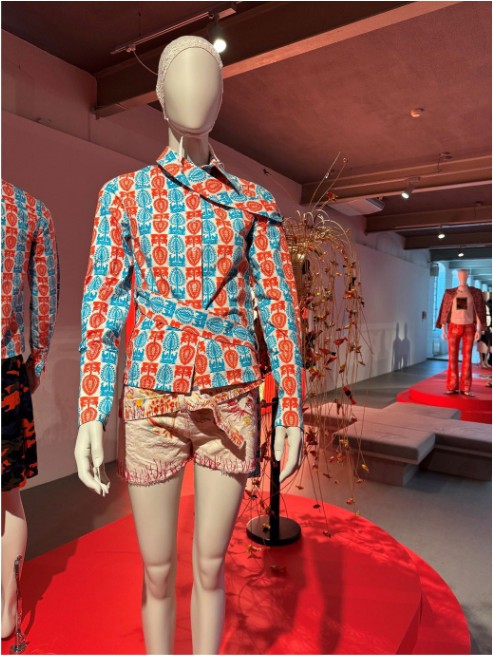
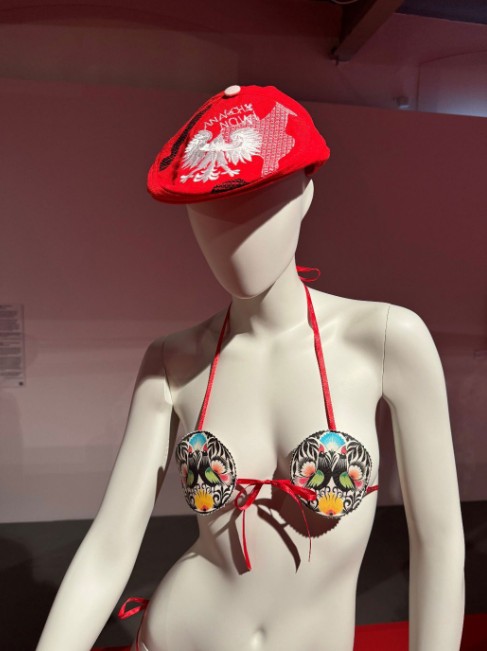
The spatial suture stitches together geographically distant places – British avant-garde fashion scene (where Arkadius was educated and became successful as a designer) with Poland (where he was born and tried to succeed) and Brazil (where he lives now). However, the exhibition itself – “pulsating Polishness” (Szulc, 2024) – focuses on presenting Arkadius primarily as a symbol of the Polish nation – a representation of Polishness and “us” in the world. The curatorial text opening the exhibition states: “Arkadius is one of several people from Poland who have made their mark in the history of European fashion. He was one of the London’s cosmopolitan avant-garde designers, but his fashion exuded Polish noble and folk culture, as well as the dreams of the fathers od the Young Poland movement” (CMWŁ, 2024a). The paratext describing the objects from the Paulina collection further explains that “the dream of making Polish folklore a part of world fashion had dominated in the era of Young Poland. Arkadius made it come true” (CMWŁ, 2024b). Even before the exhibition, i.e. when informing about the purchase of two Arkadius collections for the museum, the CMWŁ emphasized on its website that “in his works, Arkadius combined Western European tendencies with what was native, local, and folk, playing a significant role in promoting Polish culture around the world” (CMWŁ, 2021).
Arkadius’ links with the Polish culture and society are also pointed out in the paratexts of exhibition reviewers: “The exhibition is adorned with Polish national colours in many places. Arkadius often played with Polishness, emphasizing his roots” (Sienkiewicz, 2025); “It’s eternally inspiring to see how the legendary designer and the creative who enamoured London in the late 1990s and early 2000s plays with the idea(s) of Polish-ness: folklore, countryside life, Catholic imagination… all creating a joyful, exuberant mosaic of an artist’s creativity” (Kanarecki, 2024); “Connection to village life became the inspiration for one of his most famous collections Paulina […] However, it wasn’t just a replay of folklore and customs – it gave them a playful, seductive twist. Tradition became vibrant and alive, viewed through a loving lens”, because Arcadius wanted to show, that “Polish tradition can be inspiring and sexy” (Czajor, 2024).
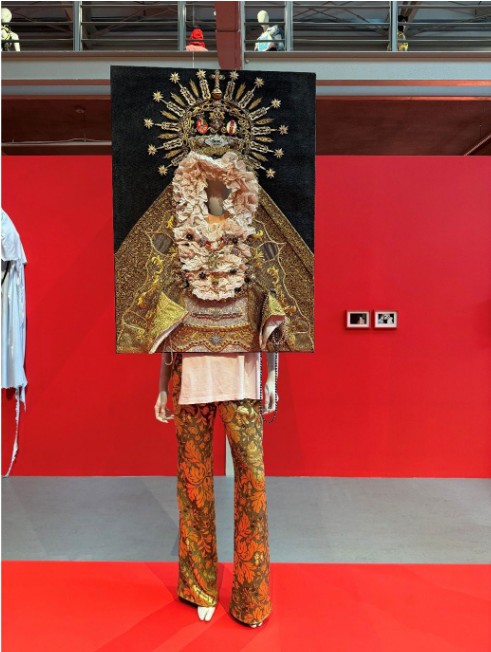
Of course, Arkadius was not the first Polish designer to use folk motifs (see, for example: Kulikowska, Obracht-Prondzyński, 2012; Korduba, 2013; Wiszniewska, 2018; Klekot, 2021). He was, however, the only one who boldly deconstructed and subverted Polishness on the international fashion scene. His dissonant designs that combined the most “sacred” and protected patriotic images and aesthetics – the Catholic iconography (e.g. the Black Madonna of Częstochowa), national symbols (the White Eagle) and Slavic folk traditions (e.g. Polish highlander costumes and embroidery) – with transparent fabrics, erotic silhouettes, and avant-garde headpieces, caused a scandal and criticism from Polish conservative circles at the beginning of the 21st century, revealing the ‘texture’ of power relations as well as the rigidity of the Polish national identity, Polish provincialism, homophobia, and the limits of artistic expression. The institutional, structured, and curated heritage-making process of Arkadius transformed these once-dissonant objects into the symbol of the territory and its creative potential.
Last but not least, the third, symbolic suture of patrimonialisation bridges the fields of fashion creation and art. This contextual shift from one field of cultural creation to another is made through the very exhibition of Arkadius’ works in the museum through the interpretation of his creativity as “fashion that became art” (Zieliński, 2021) as well as by and the constant labelling of Arkadius as an artist, e.g.: “He has always been, above all, a conscious and courageous artist. An artist of critical art like Katarzyna Kozyra or Artur Żmijewski, only using fashion in his art” (Sulej, 2024). The studied discourse employs the rhetoric of inspiration, genius, and creativity, emphasizing that this Polish former fashion designer was an extremely creative individual, always ahead of his time, and an avant-garde creator and provocateur. “He stood among a revolutionary group of designers who entered the new millennium with strong opinions, provocative statements, and manifestos. Alongside Chalayan, McQueen and Galliano, Arkadius pushed beyond the physical limits of clothing, exploring its conceptual and symbolic potential. […] While for a long time in Poland his designs were overshadowed by sensational tabloid stories, this exhibition brings his vision and artistic contributions to the very front – just where they belong” (Czajor, 2024).
Source: Author.
Source: Author.
Source: Author.
Source: Author.
Although the contemporary fashion system is built around the myth of the creative designer and artist, and the artification of fashion at the level of objects, people, and institutions is a permanent practice of this system – additionally recognized in the scientific literature (Crane, 2012; Kapferer, 2014; Pedroni, Volonte, 2014; Augello, 2023) – in the context of Arkadius’ patrimonialisation these operations take on a special meaning. First, the reference to art is central, enabling the joint consideration of works created in different times and different artistic contexts. Second, the artistic and avant-garde labels partly resolve former unstable or contradictory statements about Arkadius in public discourse, strengthening the power of the third suture of patrimonialisation. Third, the recognition of fashion as a cultural phenomenon and a form of artistic expression emerged in Poland only with the transformation and is currently one of the frameworks for describing fashion in Polish discourse. Finally, this type of suture is particularly important in the case of the heritage-making of fashion, where the use and exchange value of clothing is replaced by its display value, increasing the cultural value of the object (Assouly, 2022).
Conclusion
Davallon’s model of patrimonialisation adopted in the analysis allowed us to trace the several-years-long process of the transformation of Polish fashion designer Arkadius from a forgotten, once-scandalous creator into a cornerstone of national cultural heritage. This process began around 2015 with scattered acts of discovery of Arkadius by representatives of the younger generation, and continued through acquiring scattered objects from the designer’s archive, preserving them, classifying them, exhibiting them, and creating discourse around them by the Central Museum of Textiles in Łódź, which systematically built its collection of contemporary Polish fashion under the leadership of Director Aneta Dalbiak. This recontextualization of Arkadius – through shifting him and his collections out of the commercial circuit (and the exchange value) into the cultural framework of museum (and the display value) – is a crucial element of the designer’s heritagization. According to Davallon, an object only becomes heritage when it is placed within a system (such as a museum or a narrative) that makes it common good, understandable to a public.
Davallon’s work focuses on the communicational nature of heritage. The author argues that heritagization is not just about saving an object, but about transforming it into a “communicative being” that carries a social meaning. My study indicates that in the Arkadius heritage-making, the museum acts as a mediator, taking fragmented traces of the past (photos, runway pieces, tabloid stories) and making them public through interpretative schemes. As we have seen, Arkadius carries heavy symbolic weight for the Polish society and occupies a unique niche in the Polish collective memory, where post-communist and actual identity, folk traditions, and the Polish peripheral need for success and aspiration for Western recognition all crystalise. In this sense, Arkadius functions as what Nora calls a place of memory (Fr. lieux de mémoire), which anchors the Polish history and identity through its material, symbolic, and functional dimension (Nora, 1997). Davallon’s model, however, allows for a greater understanding of how the society uses its past designs to speak to current Polish social issues and navigates present social interest and needs. The author’s approach to heritage as reversed explains that by designating Arkadius as heritage, its “heirs” (the museum and its visitors) retroactively create a link to the past and choose their own predecessor to bolster a modern image of Polish creativity and subversion. By creating such a link, they assume the responsibility of caring for their chosen heritage.
Finally, my exploration confirms that modern heritagization, such as in the Arkadius case, relies heavily not only on exhibitions, but above all on interpretative schemes that circulate through paratexts used to create a triple suture between historical periods, places, and fields of human cultural creativity. However, it is worth devoting more research to this issue in the context of fashion heritage in the future, as well as to how heritage actually creates the social community rather than the community simply owning the heritage. The Arkadius case serves this function by inviting a specific audience (fashion enthusiasts, Polish nationals, queer community, etc.) to form a collective identity around the “recovered” traces.
Acknowledgements
I would like to thank Adam Mickiewicz University in Poznań for funding the project Mapowanie praktyk dziedzictwa polskiej mody, as part of the ID-UB programme (ID-UB UAM, 037/02/POB5/0032). I would also like to thank the anonymous Reviewers and the Editorial Board of “Qualitative Sociology Review” for their valuable comments and suggestions, which helped me in working on this article.
Autorzy
* Alicja Raciniewska
Cytowanie
Alicja Raciniewska (2026), Arkadius. Powerful Emotions. Confrontations. The Polish Fashion Heritage in the Making, „Przegląd Socjologii Jakościowej”, t. XXII, nr 3, s. 30–51, https://doi.org/10.18778/1733-8069.22.3.03
References
Assouly Olivier (2022), Capitalism in the Heritage Economy, [in:] 19 Takes on Fashion, Paris: Institut Français de la Mode, pp. 55–69.
Audioteka (2021), Supernowa. Historia Arkadiusa, https://web.audioteka.com/pl/cycle/88fd4381-f8d0-4b32-b540-c92237923081?_src=textSide (accessed: 5.01.2025).
Augello Matteo (2023), Curating Italian Fashion. Heritage, Industry, Institutions, London: Bloomsbury.
Brookey Robert, Gray Jonathan (2017), “Not merely para”: continuing steps in paratextual research, “Critical Studies in Media Communication”, vol. 34(2), pp. 101–110, https://doi.org/10.1080/15295036.2017.1312472
CMWŁ (2021), Unikatowe kolekcje odzieży Arkadiusa w CMWŁ, https://cmwl.pl/public/aktualnosci/unikatowe-kolekcje-odziezy-arkadiusa-w-cmwl,226 (accessed: 11.11.2025).
CMWŁ (2024a), Arkadius. Wielkie namiętności. Konfrontacje, https://cmwl.pl/public/informacje/arkadius-wielkie-namietnosci-konfrontacje,334 (accessed: 10.06.2024).
CMWŁ (2024b), Paulina, https://cmwl.pl/public/informacje/paulina,344 (accessed: 8.02.2025).
CMWŁ (2025), Instagram, 18 July, https://www.instagram.com/p/DMQE6q_sJZP/ (accessed: 20.07.2025).
Crane Diana (2012), La mode, [in:] Nathalie Heinich, Roberta Shapiro (eds.), De l’artification: Enquêtes sur le passage à l’art, Paris: Éditions de l’École des Hautes Études en Sciences Sociales, pp. 241–251.
Creswell John (2014), Qualitative Inquiry and Research Design: Choosing Among Five Traditions, Thousand Oaks: Sage Publications.
Czajor Paulina (2024), Arkadius: freedom is creativity’s best friend, https://www.polishfashionstories.com/we-love-1/2024/10/arkadius (accessed: 3.02.2025).
Dalbiak Aneta (2024), interview in CMWŁ, 13 November (author’s archive).
Davallon Jean (2006), Le don du patrimoine, une approche communicationnelle de la patrimonialization, Paris: Hermès-Lavoisier.
Davallon Jean (2024), Heritage Traces in the Making, London: Willey.
Genette Gérard (1997), Paratexts: Thresholds of interpretation, Cambridge: Cambridge University Press.
Gimblett Monika (2024), Wielki powrót Arkadiusa, https://www.polishculture.nl/pl/2024/07/15/wielki-powrot-arkadiusai/ (accessed: 19.01.2025).
Gray Jonathan (2010), Show sold separately: Promos, spoilers, and other media paratexts, New York: NYU Press.
Harel (2024), Arkadius, największy skandalista polskiej mody, doczekał się wielkiej retrospektywy, “Vogue Polska”, 11 March, https://www.vogue.pl/a/wielka-wystawa-w-lodzi-zaprezentuje-tworczosc-arkadiusa (accessed: 7.10.2024).
Jeanneret Yves (2020), The Trace Factory, London: Willey.
Kanarecki Edward (2024), Arkadius Retrospective, https://designandculturebyed.com/2024/06/10/arkadius-retrospective/ (accessed: 9.12.2024).
Kapferer Jean (2014), The Artification of Luxury: From Artisans to Artists, “Business Horizons”, vol. 57(3), pp. 371–380.
Klekot Ewa (2021), Kłopoty ze sztuką ludową. Gust, ideologie, nowoczesność, Gdańsk: Fundacja Terytoria Książki.
Korduba Piotr (2013), Ludowość na sprzedaż, Warszawa: Fundacja Bęc Zmiana.
Kulikowska Katarzyna, Obracht-Prondzyński Cezary (2012), Etnoinspiracje: inspiracje kulturą ludową we współczesnym polskim wzornictwie, modzie, architekturze, reklamie, Gdańsk: Muzeum Narodowe w Gdańsku.
Kultura Osobista (2024), Arkadius. Wielkie namiętności. Konfrontacje: rozmawia Marta Perchuć-Burzyńska i Marcin Różyc, Radio TOK FM, https://audycje.tokfm.pl/podcast/158881,-Arkadius-Wielkie-namietnosci-Konfrontacje (accessed: 7.11.2024).
Menkes Suzy (1999), Birth of the New Millenium, “The New York Times”, 28 September, https://www.nytimes.com/1999/09/28/style/IHT-birth-of-the-new-millennium.html (accessed: 2.02.2025).
Meyer-Olejarczyk Sylwia (2024), Wielki powrót Arkadiusa, https://muzeon.pl/wielki-powrot-arkadiusa/ (accessed: 5.02.2025).
Nora Pierre (1997), The realms of memory: Rethinking the French past, New York: Columbia University Press.
Pawlak Bartłomiej (2024), “Arkadius. Wielkie namiętności. Konfrontacje”. Pierwsza na świecie wystawa kolekcji projektanta, https://www.pap.pl/aktualnosci/arkadius-wielkie-namietnosci-konfrontacje-pierwsza-na-swiecie-wystawa-kolekcji (accessed: 11.11.2024).
Pedroni Marco, Volonte Paolo (2014), Art seen from outside: Non-artistic legitimation within the field of fashion design, “Poetics”, vol. 43, pp. 102–119.
Pouillon Jean (1975), Fétiches sans fétichisme, Paris: François Maspero.
Pulkowski Radosław (2021), Arkadius ucieleśniał ducha epoki – mówią twórczynie audioserialu o słynnym projektancie [wywiad], “K MAG”, 16 September, https://kmag.pl/article/arkadius-ucielesnial-ducha-epoki-mowia-tworczynie-audioserialu-o-slynnym-projektancie-wywiad (accessed: 18.02.2025).
Sienkiewicz Karol (2025), Matka Boska na obcasach, “Dwutygodnik”, 4/2025, https://www.dwutygodnik.com/artykul/11847-matka-boska-na-obcasach.html (accessed: 1.03.2026).
Stake Robert (1995), The art of case study research, London: Sage Publications.
Sulej Karolina (2015), Modni. Od Arkadiusa do Zienia, Warszawa: Świat Książki.
Sulej Karolina (2024), Anarchista z zasadami, “Vogue Polska”, no. 06.
Sulej Karolina (2025) Ludzie w ubraniach, https://fachlab.pl/ludzie-w-ubraniach/ (accessed: 18.03.2025).
Szczygieł Mariusz (2024), Instagram, 9 June, https://www.instagram.com/szczygiel_mariusz/p/C8AnE6as3i0/?img_index=1 (accessed: 11.11.2024).
Szewczyk Alicja (2024), Na świecie był uwielbiany, w Polsce nikt nie rozumiał jego mody. Rozmowa z Marcinem Różycem, kuratorem wystawy o twórczości Arkadiusa, “Zwierciadło”, 21 June, https://zwierciadlo.pl/moda/542214,1,na-swiecie-byl-uwielbiany-w-polsce-nikt-nie-rozumial-jego-mody-rozmowa-z-marcinem-rozycem-kuratorem-wystawy-o-tworczosci-arkadiusa.read (accessed: 11.11.2024).
Szulc Michał (2024), Arkadius. Notatki z wystawy w Centralnym Muzeum Włókiennictwa, https://miejmiejsce.com/sztuka/arkadius-notatki-z-wystawy-w-centralnym-muzeum-wlokiennictwa (accessed: 18.03.2025).
Talaga-Nowacka Aleksandra (2024), Moda to sztuka! – Arkadius w Łodzi, https://www.e-kalejdoskop.pl/sztuka-a216/moda-to-sztuka-arkadius-w-lodzi-r13245 (accessed: 4.12.2024).
TVN (2024), Top Model: Arkadius, Żabson i modowe zadania. Najlepsze fragmenty 7. odcinka, https://tvn.pl/programy/top-model/aktualnosci/top-model-13-arkadius-zabson-i-modowe-zadania-najlepsze-fragmenty-7-odcinka-st8138796 (accessed: 11.11.2024).
Tyszko Ewa (2024), Powrót Arkadiusa, „Puls Biznesu”, 14 June, https://www.pb.pl/powrot-arkadiusa-1218294 (accessed: 11.11.2024).
Wiszniewska Anna (2018), Lechitka” – Xymena Zaniewska wprowadza polskie motywy ludowe do mody współczesnej, czyli co może wnieść do Europy polska moda?, [w:] Anna Weronika Brzezińska, Sylwia Kucharska (eds.), Twórcy / wytwórcy / przetwórcy. Wokół problematyki wzornictwa regionalnego, Kalisz: Muzeum Okręgowe Ziemi Kaliskiej w Kaliszu, pp. 213–228.
Wojda Weronika (2024), Arkadius as Melancholia, „Most Magazine”, 19 August, https://mostmagazine.org/2024/08/19/arkadius-as-melancholia/ (accessed: 18.03.2025).
Wójtowicz Aleksy (2025), Kreatura mody. „Arkadius. Wielkie namiętności. Konfrontacje” w Centralnym Muzeum Włókiennictwa w Łodzi, „Magazyn Szum”, nr 23, https://magazynszum.pl/kreatura-mody-arkadius-w-centralnym-muzeum-wlokiennictwa-w-lodzi/ (accessed: 15.06.2025).
Yin Robert (2024), Studium przypadku w badaniach naukowych. Wydanie II. Projektowanie, metody i zastosowania, Kraków: Wydawnictwo Uniwersytetu Jagiellońskiego.
Zaczyński Michał (2024), Arkadius powraca. Nikt z Polski nie wzbudził takiej sensacji w świecie mody, „Polityka”, 7 June, https://www.polityka.pl/tygodnikpolityka/kultura/2258207,1,arkadius-powraca-nikt-z-polski-nie-wzbudzil-takiej-sensacji-w-swiecie-mody.read (accessed: 7.06.2024).
Zieliński Dominik (2021), Arkadius. Moda która stała się sztuką, Warszawa: Arkady.
Footnotes
- 1 For nearly 20 years, the most important pieces of Arkadius’ work were stored in a basement in Schottland at a designer’s friend’s place, exposed to rust, fungus, dump, and mould (Dalbiak, 2024a; Szewczyk, 2024). In addition, Weremczuk himself once wanted to burn his collections in a symbolic act of Arkadius’ death (which was presented later during an exhibition at the CMWŁ in the form of a video documenting this act). However, many projects from this event were saved.