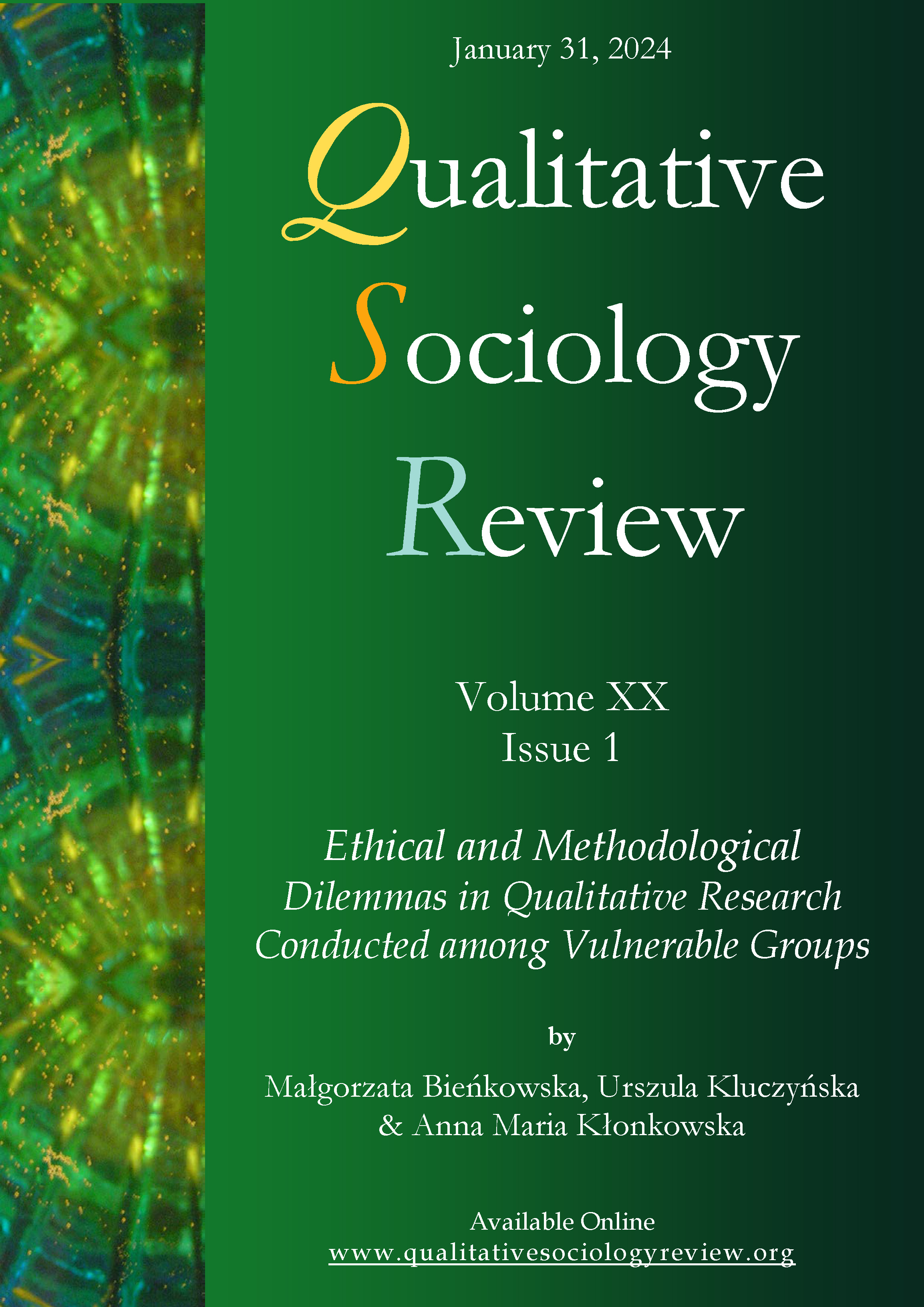
Researching Vulnerable Groups: Definitions, Controversies, Dilemmas, and the Researcher’s Personal Entanglement
DOI:
https://doi.org/10.18778/1733-8077.20.1.02Keywords:
Vulnerability, Vulnerable Group, Vulnerable Population, Vulnerable Person, Ethical Dilemma, Methodological Dilemma, Qualitative Research, Researcher, In-Group Perspective, Me-SearchAbstract
The article aims to describe vulnerable groups in the context of qualitative research in social science with special attention to ethical and methodological dilemmas. This is a theoretical study, which does not aspire to offer solutions or guidelines, but rather show elements worth taking notice of and analyzing when research is planned and carried out. We argue that in the social sciences, vulnerability is relational and crucial. However, social science researchers perceive the category of vulnerability as ambiguous and nuanced. This article shows that ascribing research participants univocally to a vulnerable group may lead not only to them being stereotyped and deprived of individuality but also to a situation where the research act itself disempowers them. We also argue that apart from issues often raised concerning the protection of participants from vulnerable groups, the researcher and their protection are also pivotal, particularly when the researcher, due to their involvement, abandons the out-group perspective or when they belong to the vulnerable group.
Downloads
References
Aldridge, Jo. 2014. “Working with Vulnerable Groups in Social Research: Dilemmas by Default and Design.” Qualitative Research 14(1):112-130. DOI: https://doi.org/10.1177/1468794112455041
Altenmüller, Marlene Sophie, Leonia Lucia Lange, and Mario Gollwitzer. 2021. “When Research Is Me-Search: How Researchers’ Motivation to Pursue a Topic Affects Laypeople’s Trust in Science.” PLoS ONE 16(7):e0253911. Retrieved May 20, 2022 https://journals.plos.org/plosone/article?id=10.1371/journal.pone.0253911 DOI: https://doi.org/10.1371/journal.pone.0253911
Bielecka-Prus, Joanna. 2014. “Po co nam autoetnografia? Krytyczna analiza autoetnografii jako metody badawczej [What Is Autoethnography Good For? Critical Analysis of Autoethnography as Research Method].” Przegląd Socjologii Jakościowej 10(3):76-95. DOI: https://doi.org/10.18778/1733-8069.10.3.04
Bourdieu, Pierre and Loïc J. D. Wacquant. 2001. Zaproszenie do socjologii refleksyjnej [An Invitation to Reflexive Sociology]. Warsaw: Oficyna Naukowa.
Brazier, Margaret and Mary Lobjoit, eds. 1991. Protecting the Vulnerable: Autonomy and Consent in Health Care. London: Routledge.
Brown, Stephen and Anthony Patterson. 2021. “Me-Search? Search Me! A New Twist in the Tale of Introspection.” Journal of Marketing Management 37(13/14):1343-1373. DOI: https://doi.org/10.1080/0267257X.2021.1928268
del Real Alcalá, J. Alberto. 2017. Human Rights Issues and Vulnerable Groups. Sharjah: Bentham Science Publishers. DOI: https://doi.org/10.2174/97816810857601170101
Devendorf, Andrew R. 2022. “Is ‘Me-Search’ a Kiss of Death in Mental Health Research?” Psychological Services 19(1):49-54. DOI: https://doi.org/10.1037/ser0000507
Domańska, Monika. 2018. “People with Disabilities as a Vulnerable Group. The Concept of Protection of the Rights of Vulnerable Groups.” Białostockie Studia Prawnicze 23(4):25-34. DOI: https://doi.org/10.15290/bsp.2018.23.04.02
Ducoulombier, Peggy. 2015. “The Protection of Sexual Minorities in European Law.” Pp. 201-223 in Protecting Vulnerable Groups: The European Human Rights Framework, edited by F. Ippolito and S. Iglesias Sánchez. Oxford: Hart Publishing.
Dwyer, Sonya C. and Jennifer L. Buckle. 2009. “The Space Between: On Being an Insider-Outsider in Qualitative Research.” International Journal of Qualitative Methods 8(1):54-63. DOI: https://doi.org/10.1177/160940690900800105
Edward, Mark. 2018a. Mesearch and the Performing Body. London: Palgrave Pivot. DOI: https://doi.org/10.1007/978-3-319-69998-1
Edward, Mark. 2018b. “Between Dance and Detention: Ethical Considerations of ‘Mesearch’ in Performance.” Pp. 161-173 in The Sage Handbook of Qualitative Research Ethics, edited by R. Iphofen and M. Tolich. Los Angeles, London, New Delhi, Singapore, Washington, Melbourne: Sage. DOI: https://doi.org/10.4135/9781526435446.n11
Ellis, Carolyn, Tony E. Adams, and Arthur P. Bochner. 2011. “Autoethnography: An Overview.” Forum: Qualitative Social Research 12(1):Art. 10. Retrieved August 20, 2022 http://nbn-resolving.de/urn:nbn:de:0114-fqs1101108
Fineman, Martha Albertson. 2008. “The Vulnerable Subject: Anchoring Equality in the Human Condition.” Yale Journal of Law and Feminism 20(1):1-23.
Fines, Francette. 2015. “European Protection for Women.” Pp. 95-111 in Protecting Vulnerable Groups: The European Human Rights Framework, edited by F. Ippolito and S. Iglesias Sánchez. Oxford: Hart Publishing.
Gibbs, Anita. 2018. “Ethical Issues When Undertaking Autoethnographic Research with Families.” Pp. 148-160 in The Sage Handbook of Qualitative Research Ethics, edited by R. Iphofen and M. Tolich. Los Angeles, London, New Delhi, Singapore, Washington, Melbourne: Sage. DOI: https://doi.org/10.4135/9781526435446.n10
Hale, Jacob. 1997. Suggested Rules for Non-Transsexuals Writing about Transsexuals, Transsexuality, Transsexualism, or Trans. Retrieved May 20, 2019 https://hivdatf.files.wordpress.com/2010/09/suggested-rules-for-non-modified.pdf
Hammersley, Martyn. 2018. “Values in Social Research.” Pp. 23-34 in The Sage Handbook of Qualitative Research Ethics, edited by R. Iphofen and M. Tolich. Los Angeles, London, New Delhi, Singapore, Washington, Melbourne: Sage. DOI: https://doi.org/10.4135/9781526435446.n2
Hollway, Wendy and Tony Jefferson. 2000. Doing Qualitative Research Differently: Free Association, Narrative, and the Interview Method. London: Sage. DOI: https://doi.org/10.4135/9781849209007
Iphofen, Ron. 2009. Ethical Decision-Making in Social Research: A Practical Guide. Basingstoke: Palgrave Macmillan.
Iphofen, Ron and Martin Tolich, eds. 2018. The Sage Handbook of Qualitative Research Ethics. Los Angeles, London, New Delhi, Singapore, Washington, Melbourne: Sage. DOI: https://doi.org/10.4135/9781526435446
Ippolito, Francesca and Sara Iglesias Sánchez. 2015a. “Introduction.” Pp. 1-20 in Protecting Vulnerable Groups: The European Human Rights Framework, edited by F. Ippolito and S. Iglesias Sánchez. Oxford: Hart Publishing.
Ippolito, Francesca and Sara Iglesias Sánchez, eds. 2015b. Protecting Vulnerable Groups: The European Human Rights Framework. Oxford: Hart Publishing.
Jecker, Nancy S. 2004. “Protecting the Vulnerable.” The American Journal of Bioethics 4(3):60-62. DOI: https://doi.org/10.1080/15265160490497128
Kacperczyk, Anna. 2014a. “Od redaktora: Autoetnografia – w stronę humanizacji nauki [Autoethnography—Towards the Humanization of Science].” Przegląd Socjologii Jakościowej 10(3):6-13. DOI: https://doi.org/10.18778/1733-8069.10.3.01
Kacperczyk, Anna. 2014b. „Autoetnografia – technika, metoda, nowy paradygmat? O metodologicznym statusie autoetnografii [Autoethnography—Technique, Method, or New Paradigm? On Methodological Status of Autoethnography].” Przegląd Socjologii Jakościowej 10(3):32-74. DOI: https://doi.org/10.18778/1733-8069.10.3.03
Kodeks Etyki Socjologa [Code of Ethics of a Sociologist]. 2012. Retrieved August 28, 2021 https://pts.org.pl/wp-content/uploads/2016/04/kodeks.pdf
Konecki, Krzysztof. 2021. Przekraczanie granic, zamykanie granic. Perspektywa pierwszoosobowa w badaniach socjologicznych [Crossing Borders, Closing Borders. First-Person Perspective in Sociological Research]. Warsaw: Wydawnictwo IFiS PAN.
Larkin, Mary. 2009. Vulnerable Groups in Health and Social Care. London: Sage. DOI: https://doi.org/10.4135/9781446279472
Lee, Raymond M. and Claire M. Renzetti. 1990. “The Problems of Researching Sensitive Topics: An Overview and Introduction.” American Behavioral Scientist 33(5):510-528. DOI: https://doi.org/10.1177/0002764290033005002
Levine, Carol et al. 2004. “The Limitations of ‘Vulnerability’ as a Protection for Human Research Participants.” The American Journal of Bioethics 4(3):44-49. DOI: https://doi.org/10.1080/15265160490497083
Levine, Eleanor K. 1982. “Old People Are Not All Alike: Social Class, Ethnicity/Race, and Sex Are Bases for Important Differences.” Pp. 127-143 in The Ethics of Social Research Surveys and Experiments, edited by J. E. Sieber. New York, Heidelberg, Berlin: Springer-Verlag. DOI: https://doi.org/10.1007/978-1-4612-5719-6_6
Lofland, John et al. 2006. Analyzing Social Settings: A Guide to Qualitative Observation and Analysis. Belmont, CA: Wadsworth/Thomson Learning.
Luxardo, Natalia, Graciela Colombo, and Gabriela Iglesias. 2011. “Methodological and Ethical Dilemmas Encountered during Field Research of Family Violence Experienced by Adolescent Women in Buenos Aires.” The Qualitative Report 16(4):984-1000.
Macklin, Ruth. 2003. “Bioethics, Vulnerability, and Protection.” Bioethics 17(5-6):1467-8519. DOI: https://doi.org/10.1111/1467-8519.00362
Nash, Robert and DeMethra LaSha Bradley. 2011. Me-Search and Re-Search: A Guide for Writing Scholarly Personal Narrative Manuscripts. Charlotte, NC: Information Age Publishing.
Raw, Laurence. 2016. “Mesearch and the Gothic Imagination.” Linguaculture 7(1):34-40. DOI: https://doi.org/10.1515/lincu-2016-0005
Richardson, Laurel. 2001. “Getting Personal: Writing-Stories.” International Journal of Qualitative Studies in Education 14(1):33-38. DOI: https://doi.org/10.1080/09518390010007647
Rios, Kimberly and Zachary C. Roth. 2020. “Is ‘Me-Search’ Necessarily Less Rigorous Research? Social and Personality Psychologists’ Stereotypes of the Psychology of Religion.” Self and Identity 19(7):825-840. DOI: https://doi.org/10.1080/15298868.2019.1690035
Rogers, Wendy and Margaret Meek Lange. 2013. “Rethinking the Vulnerability of Minority Populations in Research.” American Journal of Public Health 103(12):2141-2146. DOI: https://doi.org/10.2105/AJPH.2012.301200
Ruiz-Junco, Natalia and Salvador Vidal-Ortiz. 2011. “Autoethnography: The Social through the Personal.” Pp. 193-211 in New Directions in Sociology. Essays on Theory and Methodology in the 21st Century, edited by I. Zake and M. DeCesare. Jefferson, NC: McFarland & Company.
Russell, Cherry. 1999. “Interviewing Vulnerable Old People: Ethical and Methodological Implications of Imagining our Subjects.” Journal of Aging Studies 13(4):403-418. DOI: https://doi.org/10.1016/S0890-4065(99)00018-3
Shaw, Rhonda M. et al. 2020. “Ethics and Positionality in Qualitative Research with Vulnerable and Marginal Groups.” Qualitative Research 20(3):277-293. DOI: https://doi.org/10.1177/1468794119841839
Sieber, Joan E. 1992. Planning Ethically Responsible Research: Guide for Students and Internal Review Boards. Newbury Park, CA: Sage Publications. DOI: https://doi.org/10.4135/9781412985406
Sleat, Matt. 2013. “Responsible to Whom? Obligations to Participants and Society in Social Science Research.” Academy of Social Sciences’ Professional Briefings 3:15-18.
Van Brown, Bethany L. 2020. “Disaster Research ‘Methics’: Ethical and Methodological Considerations of Researching Disaster-Affected Populations.” American Behavioral Scientist 64(8):1050-1065. DOI: https://doi.org/10.1177/0002764220938115
van den Hoonaard, Will C. 2018. “The Vulnerability of Vulnerability: Why Social Science Researchers Should Abandon the Doctrine of Vulnerability.” Pp. 305-321 in The Sage Handbook of Qualitative Research Ethics, edited by R. Iphofen and M. Tolich. Los Angeles, London, New Delhi, Singapore, Washington, Melbourne: Sage. DOI: https://doi.org/10.4135/9781526435446.n21
Wiklund, Johan. 2016. “Re-Search = Me-Search.” Pp. 245-257 in The Routledge Companion to the Makers of Modern Entrepreneurship, edited by D. Audretsch and E. Lehman. London: Routledge.
Downloads
Published
Issue
Section
License

This work is licensed under a Creative Commons Attribution-NonCommercial-NoDerivatives 4.0 International License.
How to Cite