
Policies and practices for resilience in the face of rural depopulation, economic devitalisation, and fire exposure: A multiscale approach in Northern Portugal and Galicia
José Manuel ROCHA  *
Xurxo LOUREIRO *
Alfonso RIBAS-ÁLVAREZ *
José RIO-FERNANDES *
Abstract. In Northern Portugal and Galicia, European and national initiatives have become the key instruments shaping rural territories and their socio-spatial configurations. Nevertheless, these regions continue to exhibit regressive trends − including depopulation, economic marginalisation, and heightened vulnerability to wildfires − revealing uneven spatial outcomes of development interventions. Against this backdrop, several villages in the northwest of the Iberian Peninsula have shown a significant revitalisation, as a result of substantial public funding, local agency, place-based innovation, and the mobilisation of endogenous resources or private enterprises direct investment. These examples underscore the spatial heterogeneity of rural trajectories and highlight how localised dynamics of resilience and adaptation can challenge broader narratives of rural decline.
Key words: rural development, resilience, public policies, Northern Portugal and Galicia.
1. Introduction
Small villages are not isolated places. They are the result of historical continuity and multilevel dynamics. In southwestern Europe, particularly when distant from major urban centres, they often face challenges such as depopulation, socioeconomic decline, and increasing wildfire risk. Against this backdrop, a number of villages in northern Portugal and Galicia (Spain) have opposed a different mix of resistance, resilience, and modernity.
To understand that it is essential to consider recent national and regional transformations, and the role of public policies through a multiscale perspective, very much influenced by European Union policies. That is what we try to do in this article considering different scales and six villages in the Northwestern of the Iberian Peninsula.
The article is divided in four parts. After a short introduction, we consider recent changes in rural areas from a theoretical perspective, discussing decline, the effects of globalisation and resilience of village in Western Europe. A methodological part based on semi-structured interviews in the villages.
2. Theoretical framework: from decline to hope
2.1. Rural decline
Rural territories in peripheral locations within national and regional systems typically exhibit low and declining population densities and are affected by demographic ageing. These characteristics are normally rooted in long-term processes of spatial unevenness, historically intensified since the Industrial Revolution, as economic activity and public investment became increasingly concentrated in urban centres. The resulting migration of younger populations toward cities has reinforced demographic decline and the erosion of local labour markets, especially under neoliberal regimes privileging capital mobility and urban competitiveness (Antrop, 2004; Wolff, 2018).
Research on depopulation and agrarian change highlights how migration, the contraction of agricultural employment, and structural transformations in land use have contributed to the social, economic, and cultural decadence of rural life (Kobayashi, 2019; Poeta Fernandes, 2019). Traditional agricultural systems have been progressive replaced by large-scale agribusiness and intensive production (Domingues, 2011; Figueiredo, 2008; Vasta et al., 2019). In Spain, the consequences include the degradation of agroforestry landscapes, loss of ancestral knowledge, and the closure of essential services − factors that exacerbate exposure to wildfires (Jurado Almonte and Pazos-García, 2022).
From a territorial perspective, the growing economic and political centrality of cities transforms surrounding rural areas into dependent ‘satellite spaces’, where service withdrawal, infrastructural decline, and value-chain disruption produce cumulative disadvantage (Bryden and Bollman, 2000; Pato, 2020). In Portugal, demographic concentration along coastal and metropolitan corridors has created extensive ‘empty regions’ (Fernandes and Seixas, 2018; Ferrão, 2003). Within this uneven spatial system, most of the villages persist under varying conditions of remoteness and deficient accessibility, facing multi-scalar asymmetries that render rural decline not only a demographic or economic issue, but also a political, cultural, and environmental one (Geneletti et al., 2017; Rumford, 2002).
Thus, rural decline emerges as a spatially embedded process, one shaped by global economic restructuring and in many cases, by policy choices. Addressing it requires not only sectoral interventions, but also territorial strategies aimed at restoring socio-spatial cohesion and sustainability (Horlings and Kanemasu, 2015).
2.2. Rural areas in the face of globalisation
Globalisation has produced an intensified compression of space and time, reshaping territorial hierarchies through rapid communication and transport technologies (Bryden and Bollman, 2000; Kusio et al., 2022). From a centre–periphery perspective (Prebisch-Singer hypothesis), this transformation reinforces the economic centrality of metropolitan regions while deepening the marginalisation of rural peripheries (Bernt and Rink, 2010; Geneletti et al., 2017; Rumford, 2002).
Spatially, globalisation reconfigures rural–urban relations. Enhanced mobility and accessibility reduce physical distance but often generate ‘islands of neglect’ (Geneletti et al., 2017) and ‘forgotten places’ (Rodríguez-Pose et al., 2023), as new forms of connectivity bypass non-strategic territories. Within neoliberal and efficiency-driven frameworks (Brinton Milward, 2012) this leads to widening territorial disparities across Europe (Potrafke, 2019; Santos and Simões, 2021).
However, recent crises the 2008 financial collapse and the COVID-19 pandemic have revealed the continued significance of the state in mediating global flows and providing welfare (Kiess et al., 2017; Vis et al., 2011). The tentative return of redistributive and place-sensitive policies may signal a partial rebalancing of territorial inequalities, though this remains contested among persistent neoliberal logics and emerging protectionist agendas (Piketty, 2014; Rodríguez-Pose, 2000). These dynamics underline the fluid and contradictory nature of globalisation’s territorial imprint, simultaneously integrating and fragmenting rural spaces.
2.3. Resilience and the ‘rural renaissance’
Amid these global transformations, a countertrend has emerged: the articulation of a ‘global countryside’ (Woods, 2007) as an interconnected yet differentiated space that challenges the hegemony of the ‘global city’ (Sassen, 1991). Within this framework, rural multifunctionality promotes economic diversification and a revalorisation of place, blending endogenous resources with external opportunities (Vasta et al., 2019).
Contemporary discourses of rural resilience emphasise adaptive capacities and socio-ecological learning (Christopherson et al., 2010). Resilience operates as a dynamic, multi-equilibrium process, dependent on the interplay between internal community assets and external support systems (Sánchez-Zamora et al., 2016). Locally driven initiatives − whether cultural, entrepreneurial, or environmental − play a crucial role in sustaining communities and reconfiguring their development pathways (de Haan et al., 2019; Kusio et al., 2022).
This emerging ‘rural renaissance’ is propelled by new actors − social innovators, digital nomads, and rural entrepreneurs − who foster collective empowerment and social cohesion while redefining local economies beyond profit maximisation (Achtenhagen et al., 2010; Anderson, 2000). Through their engagement, rural territories are reframed not as passive peripheries but as laboratories of innovation and resilience, capable of generating alternative futures grounded in local agency and territorial capital.
3. Methodology
The main objective of this study is to examine how public policies shape rural transformations in the north-western Iberian Peninsula, with particular attention to the inter-twined challenges of depopulation, economic decline, and increasing wildfire risk. The research analyses how policy frameworks − spanning supranational, national, regional, and local governance levels − interact with territorial dynamics and influence village resilience. A central aim is to identify spatial patterns of policy effectiveness and to highlight place-based initiatives that exemplify ‘best practices’ in rural regeneration.
Adopting an empirical and multi-scalar approach, the study explores administrative and spatial scales from the European Union to local communities. At the supranational level, it assesses EU policies related to territorial cohesion, rural development, and the agroforestry sector. National and regional analyses contrast Galicia, an autonomous community with substantial political capacity, and northern Portugal, where institutional competences in policy coordination and European fund management remain more limited. At the local level, the study focuses on how villages foster resilience, proactivity, and adaptive capacity in response to structural constraints.
The methodology integrates legislative analysis and literature review for the analysis of European, national and subnational rural policies, and direct observation, surveys, and semi-structured interviews in the study of a study of six villages in Galicia and the North of Portugal.
The local scale of the study considered small settlements in different situations regarding public funding and multiscale approaches at both sides of the Portugal-Spain border.
The villages were visited and residents contacted during the year of 2024. After on-site survey, local associations and public administration leaders, major entrepreneurs and some pre-contacted residents were contacted by phone, during the year of 2024. A semi-structured interview was conducted to 6−10 persons per village, fully complying with data protection legislation.
The analysis covers initiatives implemented between 2000 and 2024 and are evaluated in terms of their design, governance mechanisms, and outcomes. Particular emphasis is placed on pilot projects demonstrating successful, place-specific strategies for revitalisation. Beyond demographic and economic dimensions, the study also examines the spatial distribution of wildfire resilience plans and identifies key territorial factors underpinning their effectiveness.
4. Public policies and instruments for rural development
4.1. EEC and the European Union
Social dissatisfaction in rural areas and the desire for agri-food autonomy led to the recognition of agriculture as a central concern within the European Economic Community (EEC), culminating in the creation of the Common Agricultural Policy (CAP) in 1962, primarily aimed at addressing imbalances in rural areas.
The accession of Greece (1981), Spain and Portugal (1986) − following Ireland (1973), where approximately 30% of the active population was employed in agriculture − prompted a reform of structural funds and a reorientation of agricultural policies towards improving rural living conditions (DGDR, 1989; Hill, 2012).
The Future of the Rural World (EC, 1987) defined priority programmes integrated into structural funds, with a fundamentally regional focus. LEADER I (Links between Actions for the Development of the Rural Economy), implemented between 1991 and 1993, introduced measures to combat depopulation, emphasising local revitalisation and the promotion of endogenous characteristics and products (Council Regulation (EEC) No. 797/85, (Law797/85, 1985).
In 1994, LEADER II reinforced a more integrated approach, introducing measures targeting rural actors and territories. Its primary objectives were territorial equity − ensuring equal opportunities in access to public goods and recognition of local capacities − and sustainable rural development, enhancing living conditions and valorising natural, cultural, and landscape resources (Nègre, 2023). Following the Cork Declaration in 1999, the CAP formally incorporated the Rural Development Policy within the Agenda 2000 guidelines (Fig. 1).
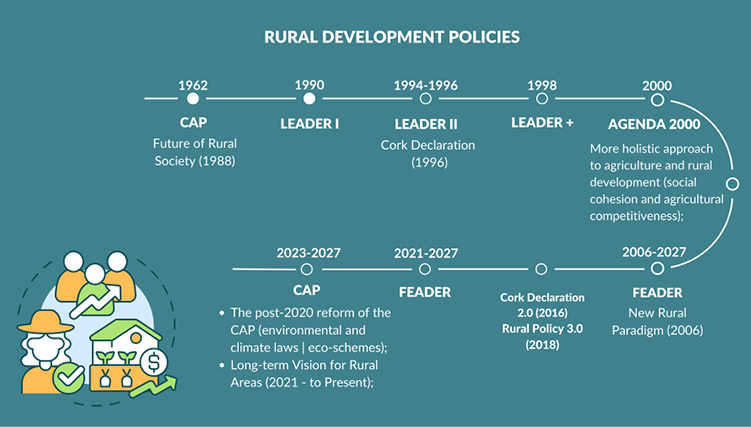
Source: own work based on EU programmes for rural areas.
Agenda 2000 marked a paradigm shift, aligning CAP with rural development objectives (Dax, 2014; Milicevic, 2023). Support was extended to agricultural development, market stabilisation, community agricultural price guarantees, and EAGGF Guarantee funds, facilitating regional measures for environmental protection, and socio-economic development (Nègre, 2019; Sotte, 2004). Policies were simplified, emphasising competitiveness, innovation, young farmer support, sustainable natural resource management, and balanced territorial development (Hill, 2012; Nègre, 2019).
Evaluations of the 2020 CAP policies led to reforms for 2023–2027, prioritising climate change mitigation and adaptation, biodiversity conservation, environmental enhancement, and animal welfare promotion (EC, 2016; Nègre, 2023).
4.2. Portugal and Spain
Portugal
Portugal has 81% of its territory classified as rural, of which 47% is agricultural land and 39% is forested (EC, 2024). Approximately one-third of the population (33%) resides in rural areas (EC, 2024), though the Portuguese National Statistics Institute (INE, 2021a) reports only 11.7%.
Agricultural decline and rural depopulation have been evident since the mid-20th century, driven by industrialisation and population concentration along the coast between Viana do Castelo and Setúbal (Fig. 2). Portugal’s accession to the EEC renewed attention to rural development. The Rural Development Plans within the first Community Support Framework (CSF I, 1989–1993), derived from LEADER I and II funds, led to the creation of Local Action Groups (LAGs) (MADRP, 2007; Vasta et al., 2019), which oversaw 48 local development associations and five collective actors, promoting territorially integrated development.
Alongside the Specific Programme for the Development of Portuguese Agriculture (PEDAP), CAP implementation, and targeted initiatives such as VALOREN (for endogenous energy infrastructure) and the Rural Telecommunications Programme, LEADER+ emphasised stakeholder engagement, rural–urban linkages, sectoral policy integration, environmental awareness, food quality and safety, and territorial organisation (IDRHa, 2006; Vasta et al., 2019).
The European Agricultural Fund for Rural Development (EAFRD, 2007–2013) supported the National Strategic Plan (PEN) and the National Rural Network Programme (PRRN, 2000–2006) under CSF III (MADRP, 2007; Ministério da Agricultura e do Mar, 2015). Within this framework, the Rural Development Plan (PDR) under PORTUGAL 2020, the Continental Rural Development Programme (PRODER), Local Development Strategies (LDS), the National Economic and Social Development Plan (PNDES), and the National Territorial Cohesion Programme (PNCT) were established.
Despite these efforts, rural depopulation persists (Fernandes and Seixas, 2018; Ferrão, 2000; Novais et al., 2000; Pires de Almeida, 2017). Between 1981 and 2011, the rural population declined by 25%, with the sharpest decreases in sparsely populated municipalities such as Torre de Moncorvo (-20.4%), Tabuaço (-20.6%), and Barrancos (-21.8%) (CCDESERT, 2023; INE, 2021a).

Source: own work based on the Series Census in 1960 and 2021 (INE, 2021b).
Population ageing, declining birth rates, and migration have reduced generational renewal (Ferrão, 2000, Portela, 2020, Rodrigues, 2008), resulting in decreased land use, including temporary crops and permanent pastures (Moreno, 2005; Rolo and Cordovil, 2014). Policies promoting rural-to-urban migration, closure of health centres and schools, and CAP reforms have further affected rural vitality (Cavaco, 2005, Figueiredo, 2008, Marques, 2006). Consequences include cultural and heritage loss, soil erosion, biodiversity decline, increased wildfire risk, and infrastructure degradation (Cavaco, 2005; Domingues, 2011; Ferrão, 2016; Monteiro, 2019).
Nonetheless, urban-to-rural movements have emerged. Improved infrastructure, fiscal incentives, and policies encouraging primary residence in rural areas have attracted mobile urban residents, leading to partial rural reinvention, combining heritage restoration with socio-economic diversification, albeit sometimes resulting in ‘Disneyfication’ or socio-cultural disruption (Baudin et al., 2014; Covas, 2020; Covas, 2016). Villages are increasingly rebranded around leisure, technology, and lifestyle, rather than agriculture, creating ‘villages of something’ (Domingues, 2011; Ferrão, 2000; Ferrão, 2016).
Spain
Transformations in Spanish rural areas intensified from the 1960s, with depopulation, ageing, and declining economic dynamism evident in the Agricultural Census of 1972 compared to 1962 (INE, 2024). Economic growth (1950–1980) concentrated in Madrid, Barcelona, and the Basque Country drove internal migration, reducing rural populations by 40–50% and weakening social and cultural structures (Pinilla and Sáez, 2021).
Rural decline was compounded by the Green Revolution, Francoist dictatorship policies (e.g., State Forest Heritage, ICONA), and unequal land ownership. Demographic processes reflect structural adjustment in agriculture, social sustainability considerations, and economic incentives (Camarero et al., 2009).
The 1979 Constitution and autonomous community apparatus enabled decentralised policies, such as support for mountain agriculture (Law25/1982, 1982), though depopulation persisted due to rigid production structures (Arnalte et al., 2008). Law 19/1995 - „Ley 19/1995, de Modernización de las Explotaciones Agrarias,” (Law19/1995, 1995) sought to modernise agricultural holdings, while Spain’s 1986 European Community accession introduced LEADER and successor programmes (LEADER II, LEADER+, EAFRD), promoting local development, governance, and economic diversification (Collantes-Gutiérrez, 2020).
Despite modernisation and technological connectivity, sparsely populated areas remain vulnerable (‘Empty Spain’). Declines in farm numbers and Utilised Agricultural Area (UAA) reflect structural adjustment, generating environmental and landscape challenges, and urban–rural inequalities persist (Soler and Fernández, 2015) (Fig. 3). Nevertheless, innovative, context-specific initiatives integrating economy, technology, quality of life, and cultural recovery offer replicable models for rural revitalisation.

Source: own work based on the Series Census in 1960 and 2021 (INE, 2024).
4.3. Regional Level
Northern Portugal
In the early decades of EEC membership, Northern Portugal’s investments focused on infrastructure, reinforcing urban centres and reducing travel times. Agricultural measures included quotas, subsidies, agri-environmental programs, and policies for mountainous areas (Cavaco, 2005; Mendes, 1992).
Mountain policies aimed at population retention proved largely ineffective. Afforestation subsidies in non-protected areas increased wildfire risk (Cavaco, 2021; Rolo and Cordovil, 2014). Productivist agricultural logic hindered young farmer attraction, and support distribution favoured southern and coastal regions, leaving northern smallholders disadvantaged (Carvalho, 2018; Cavaco, 2021; CCDR-N, 2020).
LEADER initiatives in Northern Portugal focused on heritage, landscape, and cultural restoration (e.g., Quintandona, Paradinha), rural tourism, quality of life, and identity reinforcement. Planning instruments include Regional Territorial Plans (PROTs), Municipal Territorial Management Plans (PMOTs), and sectoral plans (PROFs), alongside regional wildfire management programs (CCDR-N, 2020).
Fire resilience programs, such as “Aldeias Seguras, Pessoas Seguras - Safe Villages, Safe People” and “Condomínios de Aldeia - Village Condominiums,” have become central, supported by neo-rural residents receptive to landscape management (Azevedo, 2021; Fernandes et al., 2016). The Smart Villages project (“Smart Villages of Tâmega and Sousa”) promotes resident retention, entrepreneurship, infra-structure improvement, and digital access (Palma Pinar and Mecha López, 2022).
Galicia
In Galicia, 1980s–1990s strategies prioritised infrastructure to address accessibility deficits (Rodríguez-Pose, 2000), though this created economic polarisation between coastal and interior regions. Post-EU accession, LEADER and PRODER programs emphasised territorial proximity, participation, and endogenous resource enhancement (Rodríguez González and Lois González, 1998).
The 1991 Comarcal Development Plan promoted local planning across Galicia’s 53 comarcas (Ledo, 2000). Land consolidation, dating to the 1950s, sought to increase agricultural competitiveness and mitigate depopulation, though challenges remain, including engagement difficulties, urban proximity, productivity, and market integration (Crecente et al., 2002; Martínez-Filgueira et al., 2017; Pérez-Fra et al., 2012).
Law 11/2021 (2021) recovery of Galicia´s agricultural land, introduced instruments for land recovery, as agroforestry polygons, model villages, and joint management groups, targeting 16% of abandoned territory (500,000 ha) and potentially increasing GVA by ~3% (EUR 1.635 billion/year) (Corbelle-Rico et al., 2022). The law promotes rural core revitalisation through technological innovation, housing improvements, local food systems, sustainable business models, and nature-based solutions.
4.4. Summary
The Common Agriculture Policy (CAP), established in 1962 to address agricultural and rural imbalances, remains a cornerstone of European rural policy (Fig. 1). Rural depopulation in Spain and Portugal was partially mitigated following EU accession, with structural fund reforms and agricultural policies enhancing living conditions.
Key programmes, including LEADER I (1991–1993) and LEADER II (1994), emphasised local revitalisation and territorial specificity. Despite these initiatives and recent policies addressing demographic challenges, rural depopulation and ageing persist, exacerbated by wildfire vulnerability.

Source: own work based on Burned Area Portugal (ICNF, 2024) and Spain (EGIF, 2024).
Agenda 2000 incorporated the “Rural Development Policy” into the CAP, emphasising sustainable rural development, environmental protection, and economic stability. Subsequent CAP reforms (2003; 2023–2027) expanded focus to climate change, biodiversity, and animal welfare. National and regional policies, including forest management and fire resilience programs, continue to shape rural development, yet population loss remains evident, alongside environmental challenges such as unmanaged shrublands and eucalyptus plantations (Fig. 4).
5. Success stories: resilient villages
5.1. Defining success
Success is commonly associated with positive outcomes and achievement; etymologically, it denotes simply ‘what follows’ or ‘what occurs’. As the opposite of failure, success is subjective, varying across individuals, time, and space, and closely linked to expectations and desired outcomes.
At a territorial level, success can emerge through strategic change and is often connected to development processes. Kulkarni and Ranjan (1992) defined development as a coordinated collective effort based on communal conditions and characteristics. De Haan et al. (2019) identified three levels of success, community, network, and organisational, each influencing development unevenly. In rural contexts, success can result from multiple factors: local potential, entrepreneurial capacity, social capital, amenities or proximity to urban centres (Bryden and Bollman, 2000).
Rural areas are shaped by complex socio-economic and natural characteristics, and the outcomes of initiatives depend heavily on the cooperation of actors at individual and collective levels (de Haan et al., 2019, Dinis, 2006, Nogueira et al., 2023). Territorial characteristics, combined with multiscale governance models, necessitate tailored policy strategies, though some transversal factors allow broader interpretation. De Haan et al.(2019) and Tonkens et al. (2012) emphasised actor involvement, attachment to place, and initiative objectives. Hurenkamp (2009) highlighted leadership, effective communication, decision-making, and the importance of external networks for initiative success.
In this study, the aim is to understand success at the local scale, considering recent dynamics in villages of Northern Portugal and Galicia, focusing on their capacity to halt demographic and economic decline and reduce wildfire vulnerability. Six villages are examined − three in each region selected from a total of 18 examined in the context of the INTERREG PAISACTIVO project (Pérez et al., 2024). These villages were chosen considering the existence of a significant public and/or private investment and aims to study how it may produce different effects, considering a multiscale approach, multi agent and resident collaboration in diverse situations of space-based planning and operationalisation.
5.2. Case study
Northern Portugal
The three selected villages in the North of Portugal have different situations.
Quintandona’s is located in the municipality of Penafiel. It has 90 inhabitants (2021) and is included in Portugal’s ‘Historical Villages’ and the Romanesque Route project, leveraging medieval heritage for tourism and employment. The Caza Xiné is a local association ensures the residents participation, reporting over 1,000 visitors monthly from 40 nationalities. Its proximity to the city of Porto (35 km/35 minutes) facilitates commuting and enhances population retention and visit.
Freixiel is a village located in the municipality of the municipality of Vila Flor, in a low-density region, far away from a major city, and has 302 inhabitants (2021). It lies in an agriculture-forestry landscape, featuring a Roman fountain, baths and 16th century gallows.
Paradinha (in the municipality of Arouca and 62 km/55 minutes from Porto) is a special case as it has no permanent residents, consisting of restored houses along the Paiva River, near Arouca Geopark and Passadiços do Paiva trail that include the second longest pedestrian suspended bridge in Europa, being a major attraction, particularly at weekends.
Persistence
The rehabilitation and revitalization project (2005–2007) in Quintandona involved multiple actors, including local authorities, the municipality and the EU funded AGRIS, PRODER, and LEADER programs (EUR 800,000; 80% of investment). Workshops engaged all residents. Population grew from 80 to 90 (12.5% increase) over 20 years. Freixiel transformation also involved public investment, and despite a population decline from 389 inhabitants (2011), loss is slower than in nearby settlements, while Paradinha is periodically inhabited as a tourist village. Both Quintandona and Freixiel retain cultural activities, such as theatre, folklore, and craft workshops, supporting community cohesion.
Economic vitality
Quintandona hosts festivals like ‘Festa do Caldo’ (20,000 visitors in 2024) and a Village Interpretive Centre selling local products. Rural accommodations and restaurants strengthen cultural tourism. Freixiel’s economy is dominated by agriculture, with 410 hectares under cultivation (olive groves, vineyards) supplying the Vila Flor Agricultural Cooperative, supported by EU-funded irrigation projects (EUR 13 million). Paradinha’s revival relies on private investment, complemented by municipal support (EUR 193,000) for landscape and river beach recovery.
Fire prevention and resilience
All villages face wildfire risk. Initiatives include the Aldeias Seguras, Pessoas Seguras - Safe Village, Safe People programme (escape routes, shelters, drills), the Condomínios de Aldeia - Village Condominium (fire-resistant vegetation, forest roads), and local forest management practices. Paradinha manages fuel loads through strategic plantation, while Freixiel relies on agricultural and forested surroundings plus infrastructure like hydrants and reservoirs.
Galicia
The three selected villages in Galicia have some similarities to the Portuguese and different situations.
Santa Mariña de Augas Santas (52 inhabitants) is located 6 km from the town of Allariz, in the province of Ourense. The parish was declared a Historic-Artistic Monument in 1931 and preserves Romanesque churches, a crypt, and the Cibdá de Armeá archaeological complex, alongside oral traditions. It received Conjunto Histórico-Artístico status in 1963.
Puxedo (Lobios, approximately 40 inhabitants) is a mountain village situated over 700 metres altitude within the Parque Natural Baixa Limia–Serra do Xurés. Since 2008, the Asociación de Veciños de Puxedo has driven community-based recovery, creating the Bread Eco-museum and the Casa dos Oficios (Artcraft House).
Míllara (Pantón, 4 permanent inhabitants) is a small medieval hamlet in the heart of the Ribeira Sacra, completely abandoned for decades. It exemplifies private-led revitalisation: in 1999, an entrepreneur acquired the roughly twenty ruined houses and surrounding vineyards, restoring the village and establishing Finca Míllara winery under the D.O. Ribeira Sacra.
Persistence
Augas Santas declined from 68 to 52 inhabitants between 2004 and 2024, a trajectory partially mitigated by sustained public investment and public space improvements. The rehabilitation of the parish builds on the broader Allariz model which was awarded the European Urbanism Prize in 1994. In 2015, the Xunta declared a specific programme for the parish of Augas Santas, encompassing 8.7 sq. km and 358 dwellings eligible for rehabilitation, with a convention signed between the Concello and the Ministry of Fomento. Archaeological campaigns led by the University of Vigo (GEAAT group) since 2012 on the Cibdá de Armea have progressively uncovered a Galician-Roman settlement of approximately 8 hectares, involving local residents who ceded private lands for excavation. This participatory approach has strengthened community engagement and attachment to place.
Puxedo stabilised after prior decline, demonstrating medium-term community commitment’s impact. The Asociación de Veciños was founded in 2008, and the village has grown to approximately 40 inhabitants, gaining around a dozen new residents in recent years. In 2025, the centenary celebration of the emblematic oak tree of San Antonio square symbolised the village’s renewed vitality. Since 2019, a sustained programme of private property rehabilitation, encompassing landscape impact corrections, habitability and energy efficiency improvements, and integral reconstruction of ruined houses using timber, has been co-financed by multiple Galician agencies. These interventions have transformed a substantial share of the village’s built stock and enabled the opening of several rural tourism accommodations
Míllara’s population grew from 0 to 4 permanent inhabitants (2004–2024) due to private initiatives linked to the establishment of a wine company. The rehabilitation respected the original stone-and-timber vernacular architecture. However, the restored dwellings function primarily as second residences for owners attracted by the landscape and Mediterranean-variety microclimate of this Miño river enclave.
Economic vitality
Augas Santas has benefited from sustained public investment in heritage and tourism. In 2024, the Xunta approved a EUR 1 million Tourism Sustainability Plan (Allariz Destino Sostible), financed through NextGenerationEU funds, targeting the Arnoia river corridor, Camino de Santiago elements, and museum improvement. The archaeological project at the Cibdá de Armea also functions as an economic driver, generating guided-tour employment and positioning the parish within cultural tourism circuits
Puxedo combines heritage-based ecotourism with artisanal production. The Ecomuseo do Pan do Xurés (inaugurated 2021, LEADER-funded, Agader Prize 2020) is an open-air museum of the traditional bread cycle, complemented by the Casa dos Oficios, a wine cellar, a local products showcase, and a solar-powered e-bike station project for sustainable mobility. Community events such as the Festa da Malla and artistic residencies reinforce the cultural offer.
Míllara’s economy is anchored in viticulture. Finca Míllara operates around 11 hectares of vineyards within a larger estate, producing approximately 70,000 bottles annually with significant international exports, and offers guided tours within the Ruta del Vino Ribeira Sacra. The adjacent hamlet of Valboa, following the same private model, received Xunta authorization in 2025, signalling this approach’s replicability.
Fire prevention and resilience
Augas Santas and Puxedo are located in Ourense, Galicia’s most fire-prone province − as evidenced by the catastrophic 2025 season. In Augas Santas, heritage rehabilitation keeps landscapes managed around the settlement. In Puxedo, the Mixturando programme promotes mixed-forest restoration replacing pine monocultures, while residents’ agricultural activities reduce fuel loads. Míllara, in the province of Lugo, benefits from a distinct mechanism: its vineyards on stone terraces function as effective firebreaks − a role increasingly recognized through initiatives like the Fire Wine European certification.
5.3. Comparative analysis
This group of 6 villages show different routes to a ‘new life’.
In Quintandona and Augas Santas substantial public investment combined with residents’ involvement was crucial. Depopulation was halted, there are new activities and the rehabilitated architecture and periodical events are attracting visitors.
In Freixiel and Puxedo public funding remains important but bottom-up dynamics are more visible. Agricultural cooperativism in Freixiel and the community-led Asociación de Veciños in Puxedo demonstrate that cultural identity and collective action can be the primary drivers of revitalisation, with institutional support functioning as enabling rather than initiating force.
In Paradinha and Millara, revitalisation is the result of private interest in abandoned villages. Both have achieved economic viability and visitor appeal, yet with zero and four permanent residents respectively, it remains debatable if economic success translates into ‘real villages’ or rather heritage-based enterprises within a rural setting.
Across all cases, fire prevention emerges as intrinsically linked to settlement persistence and if managed landscapes – whether through agriculture, viticulture or heritage maintenance – may reduce wildfire vulnerability or this vulnerability will reinforce rural abandonment, a concern underscored by the catastrophic 2025 fire season in Galicia and Portugal.
6. Conclusions and discussion
The role of EU-funded programs, particularly LEADER (I and II), which has facilitated the translation of theoretical policy measures into tangible local outcomes was essencial for rural development with socioeconomic revival despite demografic decrease. Semi-structured interviews with with the local administation presidents, institution leaders at CIM Tâmega e Sousa (Northern Portugal) and Fundación Juana de Vega (Galice), and academic experts from the Universities of Porto (Northern Portugal) and Santiago de Compostela (Galice) some of them associated with the PAISACTIVO project emphasised the effectiveness of these programs in stimulating integrated socio-economic and environmental development. The combination of public and private initiatives, often coordinated (mainly in concrete actions), has proven essential for stabilising populations, rehabilitating degraded rural spaces, and promoting primary sector activities.
Key differences between the regions include historical land management practices. In Galicia, long-term efforts at land consolidation have enhanced agricultural mechanisation and large-scale farming potential, whereas in Northern Portugal, incomplete recognition of property boundaries and the prevalence of small holdings (‘minifundios’) constrain large-scale reforms. Portuguese initiatives such as BUPi systems aim to streamline land registration, but continuous policy support for cultivation and long-term land use remains limited.
Private-led revitalisation, exemplified by viticulture in Millare, Ribeira Sacra (Galicia) and tourism development in Paradinha, Arouca (Northern Portugal), highlights the potential of endogenous resources to generate economic recovery. However, such models often prioritise leisure and profit over traditional agricultural or livestock activities, reflecting a degree of ‘de-ruralization’ oriented toward urban visitors.
Public policy remains central to villages where depopulation is mitigated through sustained interventions and active community participation. That is the case of Quintandona (Northern Portugal) and Augas Santas (Galicia) illustrating how European and national funds, combined with local engagement, can rehabilitate built heritage, stimulate local economies, and foster sustainable rural development efficiently with a impact on people’s lives. Annual cultural events, such as Quintandona’s Festa do Caldo and Puxedo’s Festa da Malla, play a pivotal role in reinforcing social self esteem and cohesion also generating significant income, while enhancing the villages visibility.
Fire prevention strategies vary regionally, reflecting differences in landscape management and risk perception. In Galicia, measures emphasise territorial resilience through landscape diversification and controlled vegetation around settlements, whereas in Northern Portugal, interventions focus primarily on immediate fire prevention, including clearing around dwellings, installing hydrants, creating evacuation shelters, and raising resident awareness.
Overall, ‘success stories’ in rural areas depends on the interplay between public policy, private initiative, and community engagement. Integrated strategies that combine infrastructure investment, heritage restoration, economic diversification, and environmental management can stabilise populations, enhance economic vitality, and increase disaster resilience, offering a replicable model for sustainable rural development in Europe.
In all cases dynamics are very space-dependent, as each situation poses specific challenges. European, national and regional programs and public funding is generally very important, as an alternative to depopulation or touristification. But it is decisive to count with the resident’s participation around a collective vision, public-private alignment and being persistent. In view of this conclusion, and partial ‘success’ in some of the present cases, we believe EU, national and regional rural policies should guarantee that financial support is associated with resident’s interest and participation from the beginning, and conditions need to be created for persistent process of rehabilitation and revitalisation after public investment.
Autorzy
REFERENCES
ACHTENHAGEN, L., NALDI, L. and MELIN, L. (2010), ‘“Business Growth”—Do Practitioners and Scholars Really Talk about the Same Thing?’, Entrepreneurship Theory and Practice, 34, pp. 289−316. https://doi.org/10.1111/j.1540-6520.2010.00376.x
ANDERSON, A. R. (2000), ‘Paradox in the periphery: an entrepreneurial reconstruction?’, Entrepreneurship & Regional Development, 12, pp. 91−109. https://doi.org/10.1080/089856200283027
ANTROP, M. (2004), ‘Landscape change and the urbanization process in Europe’, Landscape and Urban Planning, 67, pp. 9−26. https://doi.org/10.1016/S0169-2046(03)00026-4
ARNALTE, E. V. A., ORTIZ, D. M. and MORENO, O. (2008), ‘Cambio estructural en la agricultura española: Un nuevo modelo de ajuste en el inicio del siglo XXI’, Papeles de economía española, pp. 59−73.
AZEVEDO, J. (2021), ‘O Programa de Transformação da Paisagem’, Floresta para todos, 21 ed.: Sociedade Portuguesa de Ciências Florestais.
BAUDIN, G., VAZ, D. M. and SILVA, M. C. (2014), Transação territorial: novas relações cidade-campo, Edições Húmus.
BERNT, M. and RINK, D. (2010), ‘«Not relevant to the system»: The crisis in the backyards’, International Journal of Urban and Regional Research, 34, pp. 678−685. https://doi.org/10.1111/j.1468-2427.2010.00985.x
BRINTON MILWARD, H. (2012), ‘Hollow State’. [in:] ANHEIER, H. K. and JUERGENSMEYER, M. (eds.) Encyclopedia of global studies, London: Sage. https://doi.org/10.4135/9781452218557.n254
BRYDEN, J. and BOLLMAN, R. (2000), ‘Rural employment in industrialised countries’, Agricultural Economics, 22, pp. 185−197. https://doi.org/10.1111/j.1574-0862.2000.tb00017.x
CAMARERO, L., CRUZ, F., GONZÁLEZ, M., DEL PINO, J., OLIVA, J. and SAMPEDRO, R. (2009), La población rural de España. De los desequilibrios a la sostenibilidad social. Fundación “la Caixa”.
CARVALHO, P. (2018), ‘Dynamics of rural low density spaces in Portugal’, Méditerranée. Revue géographique des pays méditerranéens/Journal of Mediterranean geography. https://doi.org/10.4000/mediterranee.10516
CAVACO, C. (2005), ‘As paisagens rurais: do “determinismo natural” ao “determinismo político’, Finisterra, 40. https://doi.org/10.18055/Finis1493
CAVACO, C., MOURATO, J., COSTA, J. P., PEREIRA, A., VILARES, E., MOREIRA, P. and MAGALHÃES, M. (2021), Spatial Planning and Regional Development in Portugal, Directorate-General for Territory.
CCDR-N (2020), ‘Estratégia de Desenvolvimento do Norte para Período de Programação 2021-27 das Políticas da União Europeia’ Norte 2030, Porto: Comisssão de Coordenação e Desenvolvimento Regional do Norte.
CCDESERT (2023), ‘Desertificação e Desenvolvimento Rural - Vias de desenvolvimento em territórios despovoados’, Centro de Competências para a Luta Contra a Desertificação (ed.), Câmara Municipal de Alcoutim. DOI: https://ccdesert.pt/documentos-e-publicacoes/
CHRISTOPHERSON, S., MICHIE, J. and TYLER, P. (2010), ‘Regional resilience: theoretical and empirical perspectives’, Cambridge Journal of Regions, Economy and Society, 3, pp. 3−10. https://doi.org/10.1093/cjres/rsq004
COLLANTES-GUTIÉRREZ, F. (2020), ‘Tarde, mal y...¿ quizá nunca? La democracia española ante la cuestión rural’, Panorama social, pp. 15−32.
CORBELLE-RICO, E., SÁNCHEZ-FERNÁNDEZ, P., LÓPEZ-IGLESIAS, E., LAGO-PEÑAS, S. and DA-ROCHA, J.-M. (2022), ‘Putting land to work: An evaluation of the economic effects of recultivating abandoned farmland’, Land Use Policy, 112, Article 105808. https://doi.org/10.1016/j.landusepol.2021.105808
COVAS, A. (2016), ‘A Ruralidade do Século XXI - Em Busca do Lado Virtuoso da Baixa Densidade’, [in:] NEVES, A. O. (ed.), Agricultura, Floresta e Desenvolvimento Rural. Lisboa: IESE - Instituto de Estudos Sociais e Económicos.
COVAS, A. (2020), ‘Cidades Inteligentes e Criativas-Smartificação dos Territórios’, Lisboa: Edições Sílabo. https://doi.org/10.24302/drd.v10ied.esp..2896
CRECENTE, R., ALVAREZ, C. and FRA, U. (2002), ‘Economic, social and environmental impact of land consolidation in Galicia’, Land Use Policy, 19 (2), pp. 135−147. https://doi.org/10.1016/S0264-8377(02)00006-6
DAX, T. (2014), ‘The evolution of European Rural Policy’, [in:] COPUS, A. K. and de LIMA, P. (ed.), Territorial Cohesion in Rural Europe, The relational turn in rural development, Routledge.
DE HAAN, E., HAARTSEN, T., MEIER, S. and STRIJKER, D. (2019), ‘Understanding the success of rural citizens’ initiatives: Perspectives of founders’, Journal of Rural Studies, 70, pp. 207−214. https://doi.org/10.1016/j.jrurstud.2017.11.001
DGDR (1989), ‘Plano de Desenvolvimento Regional 1989-1993’, [in:] Ministério do Planeamento e da Administração do Território - Secretaria de Estado do Planeamento e Desenvolvimento Regional (ed.), Direção Geral de Desenvolvimento Regional (DGDR), Lisboa.
DINIS, A. (2006), ‘Marketing and innovation: Useful tools for competitiveness in rural and peripheral areas’, European Planning Studies, 14, pp. 9−22. https://doi.org/10.1080/09654310500339083
DOMINGUES, Á. (2011), Vida no campo, Dafne Editora.
EGIF (2024), Estadística General de Incendios Forestales, Comité de Lucha contra Incendios Forestales – Gobierno de España, https://www.miteco.gob.es/es/biodiversidad/temas/incendios-forestales/estadisticas-datos.html [accessed on: 05.08.2025].
EUROPEAN PARLIAMENT (1987), ‘Boletim das Comunidades Europeias – O Futuro da Mundo Rural’, Comunidade Europeia, Europa, Mundo Rural, Parlamento Europeu, Política, Bruxelas: Serviços das Publicações Oficiais das Comunidades Europeias.
EUROPEAN PARLIAMENT (2016), ‘Fundos estruturais e de investimento europeus 2014–2020: textos e comentários oficiais’, Politica Regional e Urbana, Luxemburgo: Comissão Europeia, Direção-Geral da Política Regional e Urbana.
EUROPEAN PARLIAMENT (2024), Factsheet on 2014-2022 Rural Development Programme for Mainland, Portugal, European Parlament.
FERNANDES, J. A. R., CHAMUSCA, P., BRAGANÇA, P., FORMIGO, N., MARQUES, H. and SILVA, Â. (2016), Aldeias de montanha: os problemas, as perspetivas e as propostas, vistos desde as serras da Aboboreira, Marão e Montemuro, no Noroeste de Portugal. https://doi.org/10.17127/got/2016.9.006
FERNANDES, J. A. R. and SEIXAS, J. (2018), ‘Cities and urbanisation in democratic Portugal’, Méditerranée, 130. https://doi.org/10.4000/mediterranee.10698
FERRÃO, J. (2000), ‘Relações entre mundo rural e mundo urbano: evolução histórica, situação actual e pistas para o futuro’, EURE (Santiago), 26 (78), pp. 123−130. https://doi.org/10.4067/S0250-71612000007800006
FERRÃO, J. (2003), ‘Dinâmicas territoriais e trajectórias de desenvolvimento: Portugal 1991-2001’, Revista de Estudos Demográficos, 34, pp. 17−25.
FERRÃO, J. (2016), ‘As geografias rurais do Antropoceno: ainda uma terra incognita?’, Agricultura, floresta e desenvolvimento rural, pp. 249−257.
FIGUEIREDO, E. (2008), ‘Imagine there’s no rural: the transformation of rural spaces into places of nature conservation in Portugal’, European Urban and Regional Studies, 15, pp. 159−171. https://doi.org/10.1177/0969776407081939
GENELETTI, D., LA ROSA, D., SPYRA, M. and CORTINOVIS, C. (2017), ‘A review of approaches and challenges for sustainable planning in urban peripheries’, Landscape and Urban Planning, 165, pp. 231−243. https://doi.org/10.1016/j.landurbplan.2017.01.013
HILL, B. (2012), Understanding the common agricultural policy, London, Taylor & Francis Ltd. https://doi.org/10.4324/9781849775618
HORLINGS, L. and KANEMASU, Y. (2015), ‘Sustainable development and policies in rural regions; insights from the Shetland Islands’, Land Use Policy, 49, pp. 310−321. https://doi.org/10.1016/j.landusepol.2015.07.024
HURENKAMP, M. (2009), ‘Organize liberal, think conservative: citizenship in light communities’, City in sight: Dutch dealings with urban change, pp. 141−158. https://doi.org/10.1017/9789048511211.008
ICNF (2024), Gestão de Fogos Rurais - Áreas ardidas, Portugal: Instituto de Conservação da Natureza e Florestas. Available: https://www.icnf.pt/florestas/gfr/gfrgestaoinformacao [accessed on: 05.08.2025].
IDRHa (2006), ‘Atualização do Estudo de Avaliação Intercalar do Programa de iniciativa Comunitária de Desenvolvimento Rural (Leader+)’, [in:] CENTRO INTERDISCIPLINAR DE ESTUDOS ECONÓMICOS (ed.), Instituto de Desenvolvimento Rural e Hidráulica, Relatório Final, 27 de Março.
INE, E (2024), Censo agrario año 2020, España: Instituto Nacional de Estadística de España, https://www.ine.es/dyngs/INEbase/operacion.htm?c=Estadistica_C&cid=1254736176851&menu=ultiDatos&idp=1254735727106 [accessed on: 12.05.2025].
INE, P. (2021a), ‘Censos 2021. XVI Recenseamento Geral da População e da Agricultura. XIV Recenseamento Geral da Habitação’, Instituto Nacional de Estatística de Portugal, Portugal: Censos 2021, https://censos.ine.pt/xportal/xmain?xpid=INE&xpgid=ine_indicadores&indOcorrCod=0008855&contexto=bd&selTab=tab2&xlang=pt [accessed on: 22.04.2025].
INE, P. (2021b), ‘Censos Gerais da População’, População residente em Portugal, segundo o Local de Residência ( à data dos Censos 1960 e 2021), Portugal: Instituto Nacional de Estatística, https://www.ine.pt/xportal/xmain?xpid=INE&xpgid=ine_indicadores&indOcorrCod=0014381&contexto=bd&selTab=tab2 [accessed on: 23.05.2025].
JURADO ALMONTE, J. M. and PAZOS-GARCÍA, F. J. (2022), ‘Population and territorial sustainability of rural spaces in Spain and Portugal’, CUADERNOS GEOGRAFICOS, 61, pp. 61−87. https://doi.org/10.30827/cuadgeo.v61i2.23878
KIESS, J., NORMAN, L., TEMPLE, L. and UBA, K. (2017), ‘Path dependency and convergence of three worlds of welfare policy during the Great Recession: UK, Germany and Sweden’, Journal of International and Comparative Social Policy, 33, pp. 1−17. https://doi.org/10.1080/21699763.2017.1281832
KOBAYASHI, A. (2019), International encyclopedia of human geography, Elsevier.
KULKARNI, G. and RANJAN, R. (1992), ‘Perceptions of development as empowerment’, [in:] CINNÉIDE, M. O. and GRIMES, S. (eds), Planning Development of Marginal Areas, pp. 135−142, Center for Development Studies, Social Science Research Center: University College of Galway.
KUSIO, T., KUDEŁKO, J., BORGES, A., DELIC, A. and STROILA, I. (2022), ‘Are there any differences in rural development challenges within European countries? Social and economic contexts from EU rural leaders’, International Food and Agribusiness Management Review, 25, pp. 737−756. https://doi.org/10.22434/IFAMR2021.0147
LAW11/2021 (2021), ‘recuperación de la tierra agraria de Galicia’, [in:] GALICIA, C. A. D. (ed.) de 26 de junio de 2021, España: Boletín Oficial del Estado - Gobierno de España.
LAW19/1995 (1995), ‘Modernización de las Explotaciones Agrarias’, [in:] ESTADO, J. D. (ed.) de 4 de julio, España: Boletín Oficial del Estado.
LAW25/1982 (1982), ‘agricultura de montaña’, [in:] ESTADO, J. D. (ed.) de 30 de junio, España: Boletín Oficial del Estado - Gobierno de España.
LAW797/85 (1985), ‘Regulamento (CEE) n.° 797/85 do Conselho, de 12 de Março de 1985’, [in:] EUROPEIA, U. (ed.), Jornal Oficial da União Europeia.
LEDO, A. P. (2000), ‘A Regionalization Strategy to Promote Integrated Local Development: The Comarcal Development Plan of Galicia.’ European Planning Studies, 8, pp. 123-134. https://doi.org/10.1080/096543100110965
MADRP (2007), ‘Plano Estratégico Nacional Desenvolvimento Rural (2007–2013). Ministério da Agricultura’, Desenvolvimento Rural e Pescas Lisboa.
MARQUES, T. S. (2006), ‘Portugal urbano: mosaicos, polaridades, relacionamentos e governança= mosaicos, polaridades, relaciones e gobernanza’, Cidade e democracia : 30 anos de transformação urbana em Portugal = Ciudad y democracia : 30 años de transformación urbana en Portugal, FLUP ed. Lisboa: Argumentum.
MARTÍNEZ-FILGUEIRA, X., PEÓN, D. and LÓPEZ-IGLESIAS, E. (2017), ‘Intra-rural divides and regional planning: an analysis of a traditional emigration region (Galicia, Spain)’, European Planning Studies, 25, pp. 1237−1255. https://doi.org/10.1080/09654313.2017.1319465
MENDES, A. M. S. C. (1992), ‘Reforma da PAC: um ponto de vista da Região Norte’, ECO, Portugal.
MILICEVIC, V. (2023), ‘A política agrícola comum - instrumentos e reformas’, Fichas temáticas sobre a União Europeia, Parlamento Europeu.
MINISTÉRIO DA AGRICULTURA E DO MAR (2015), Portaria n.º 402/2015, 9 de Novembro, Ministério da Agricultura e do Mar, Diário da República: 1.ª série, n.º 219, Lisboa.
MONTEIRO, A. (2019), ‘Territórios do interior, coesão territorial e modelos de governança: a propósito do programa nacional para a coesão territorial’, Territórios do interior, coesão territorial e modelos de governança: a propósito do programa nacional para a coesão territorial, pp. 127−151. https://doi.org/10.30553/SOCIOLOGIAONLINE.2019.19.6
MORENO, L. (2005), ‘Estruturas agrárias e produtivas: diferenciação territorial e dinâmicas regionais’, Geografia de Portugal, 3, pp. 61−77.
MPTAP (2021), ‘Plan de Recuperación: 130 medidas frente al reto demográfico’ [in:] Ministerio para la Transición Ecológica y el Reto Demográfico (ed.), Gobierno de España, https://transparencia.gob.es/masinformacion/informes-de-interes/demografia/130medidasretodemografico [accessed on: 20.11.2025].
NÈGRE, F. (2019), ‘Segundo Pilar da PAC: A política de desenvolvimento rural’, Fichas técnicas sobre a União Europeia, Parlamento Europeu.
NÈGRE, F. D., STEPHANIE (2023), ‘O regulamento relativo aos planos estratégicos da política agrícola comum’, Fichas temáticas sobre a União Europeia, Parlamento Europeu.
NOGUEIRA, J., ARAÚJO, J. P., MAMEDE ALONSO, J. and SIMÕES, S. (2023), ‘Common lands, landscape management and rural development: a case study in a mountain village in northwest Portugal’, Acta geographica Slovenica, 63, pp. 51–67. https://doi.org/10.3986/AGS.11081
NOVAIS, A., LOURENÇO, F. and BAPTISTA, F. O. (2000), ‘Portugal (Continente)–uma leitura do rural’, Documento de Trabalho, Lisboa: Departamento Economia Agrária Sociologia Rural, Instituto Superior de Agronomia, Universidade Técnica de Lisboa.
PALMA PINAR, G. and MECHA LÓPEZ, R. (2022), ‘Towards a new rural development in Europe: analysis of the Smart Rural 21 Initiative and Interreg in Spain and Portugal’, Terra: Revista de Desarrollo Local. https://doi.org/10.7203/terra.11.25528
PATO, L. (2020), ‘Entrepreneurship and innovation towards rural development evidence from a peripheral area in Portugal’, EUROPEAN COUNTRYSIDE, 12, pp. 209−220. https://doi.org/10.2478/euco-2020-0012
PÉREZ RODRIGUEZ, N., ONEGA LÓPEZ, F. J., MIRANDA BARRÓS, D., RIO FERNANDES, J. A. and ROCHA, J. M. (2024), Manual de casos de éxito y buenas prácticas en la gestión activa del espacio rural, Lugo: PAISACTIVO. https://doi.org/10.5281/zenodo.13808565
PÉREZ-FRA, M. M., LÓPEZ-IGLESIAS, E., GARCÍA-ARIAS, A. I., SINEIRO, F. and LORENZANA, R. (2012), ‘Representativeness and Civic Participation in Rural Development Programmes:The Case of the PRODER Programme in Galicia, Spain’, Outlook on Agriculture, 41, pp. 215−220. https://doi.org/10.5367/oa.2012.0098
PIKETTY, T. (2014), ‘Capital in the twenty-first century’, Trans. Arthur Goldhammer/Belknap. https://doi.org/10.4159/9780674369542
PINILLA, V. and SÁEZ, L.-A. (2021), ‹La despoblación rural en España: características, causas e implicaciones para las políticas públicas›, Presupuesto y gasto público, 102, pp. 75−92.
PIRES DE ALMEIDA, M. A. (2017), ‘Territorial inequalities: depopulation and local development policies in the Portuguese rural world’, Territorial inequalities: depopulation and local development policies in the Portuguese rural world, pp. 61−87.
POETA FERNANDES, G. (2019), ‘Rural depopulation, social resilience and context costs in the border municipalities of central Portugal. Dichotomies of social reorganization vs absence of public policies’, Economía Agraria y Recursos Naturales, 19, p. 121. https://doi.org/10.7201/earn.2019.01.07
PORTELA, J. (2020), ‘O meio rural em Portugal: entre o ontem e o amanhã’, Trabalhos de Antropologia e Etnologia, 39.
POTRAFKE, N. (2019), ‘The globalisation–welfare state nexus: Evidence from Asia’, The World Economy, 42, pp. 959−974. https://doi.org/10.1111/twec.12748
RODRIGUES, E. (2008), ‘O desenvolvimento da Região Norte’, Geografia: Revista da Faculdade de Letras da Universidade do Porto, 2.
RODRÍGUEZ-POSE, A. (2000), ‘Economic convergence and regional development strategies in Spain: The case of Galicia and Navarre’, 1, p. 88.
RODRÍGUEZ-POSE, A., TERRERO-DÁVILA, J. and LEE, N. (2023), ‘Left-behind versus unequal places: interpersonal inequality, economic decline and the rise of populism in the USA and Europe’, Journal of Economic Geography, 23 (5), pp. 951−977. https://doi.org/10.1093/jeg/lbad005
RODRÍGUEZ GONZÁLEZ, R. and LOIS GONZÁLEZ, R. C. (1998), ‘Luces y sombras del desarrollo rural en Galicia’, Polígonos. Revista de Geografía.
ROLO, J. C. and CORDOVIL, F. (2014), Rural, Agricultura e Políticas, Lisboa, Animar - Associação Portuguesa para o Desenvolvimento Local | Ruranimar.
RUMFORD, C. (2002), ‘7 Rethinking Core–Periphery Relations’, The european union: A political sociology, Wiley Online Library. https://doi.org/10.1002/9780470753569
SÁNCHEZ-ZAMORA, P., GALLARDO-COBOS, R. and CEÑA-DELGADO, F. (2016), ‘La noción de resiliencia en el análisis de las dinámicas territoriales rurales: una aproximación al concepto mediante un enfoque territorial’, Cuadernos de Desarrollo Rural, 13, pp. 93−116. https://doi.org/10.11144/Javeriana.cdr13-77.nrad
SANTOS, M. and SIMÕES, M. (2021), ‘Globalisation, Welfare Models and Social Expenditure in OECD Countries’, Open Economies Review, 32, pp. 1063−1088. https://doi.org/10.1007/s11079-021-09646-2
SASSEN, S. (1991), The Global City: Princeton, New York, London, Tokyo, Princeton University Press.
SOLER, C. and FERNÁNDEZ, F. (2015), ‘Estructura de la propiedad de tierras en España: Concentración y acaparamiento’, Fundación Mundubat y Revista Soberanía Alimentaria, Biodiversidad y Culturas.
SOTTE, F. (2004), ‘From CAP to CARPE: the State of the Question’, 87th Seminar of the European Association of Agricultural Economists, Vienna: European Association of Agricultural Economists.
TONKENS, E. H., VERHOEVEN, I., HEERINGS, M., KROESE, G., ROGGEVEEN, S., HERTOGHS, M., MOERMAN, G. and BROUWERS, A. (2012), Bewonersinitiatieven: proeftuin voor partnerschap tussen burgers en overheid, Pallas Publications Amsterdam. https://doi.org/10.5553/BenM/2011038004005
VASTA, A., FIGUEIREDO, E., VALENTE, S., VIHINEN, H. and NIETO-ROMERO, M. (2019), ‘Place-Based Policies for Sustainability and Rural Development: The Case of a Portuguese Village “Spun” in Traditional Linen’, Social Sciences, 8. https://doi.org/10.3390/socsci8100289
VIS, B., VAN KERSBERGEN, K. and HYLANDS, T. (2011), ‘To What Extent Did the Financial Crisis Intensify the Pressure to Reform the Welfare State?’, Social Policy & Administration, 45, pp. 338−353. https://doi.org/10.1111/j.1467-9515.2011.00778.x
WOLFF, M. (2018), ‘Understanding the role of centralization processes for cities – Evidence from a spatial perspective of urban Europe 1990–2010’, Cities, 75, pp. 20−29. https://doi.org/10.1016/j.cities.2017.01.009
WOODS, M. (2007), ‘Engaging the global countryside: globalization, hybridity and the reconstitution of rural place’, Progress in Human geography, 31 (4), pp. 485−507. https://doi.org/10.1177/0309132507079503