
Former privileged transit railway lines as instruments of cross-border integration? A comparative study of the lines in the Czech-Polish borderland
Artur BOHÁČ  *
*
Emil DRÁPELA *
Bartosz CZEPIL *
Abstract. Privileged transit traffic or similar railway lines illustrate Central Europe’s historical interdependence and the persistence of infrastructural anomalies. This paper analyses their contemporary role as instruments of cross-border integration through two Czech-Polish cases: the Liberec–Bogatynia–Zittau–Varnsdorf–Seifhennersdorf line in the west, which also includes German territory, and the Jeseník–Głuchołazy–Krnov line in the east. Using a qualitative comparative approach that integrates document analysis, field observation, and stakeholder interviews, the study assesses how governance density, fare regimes, and accessibility influence the dimensions of cross-border integration. The results reveal contrasting trajectories. The Zittau line, embedded in trilateral governance frameworks and supported by fare integration, enables frequent services and symbolises everyday transnational normality, except for a small section. Conversely, the Głuchołazy line remains hindered by outdated legal arrangements, low frequency, and peripheral infrastructure. These differences underscore that multilevel governance and fare harmonisation are crucial preconditions for cohesion, while regulatory fragmentation and institutional inertia exacerbate marginality. Overall, the study argues that privileged transit railway connections, if supported by regional advocacy and coordinated investment, can evolve from historical exceptions into agents of European integration.
Key words: transport planning, transnational mobility, privileged transit traffic, Czechia, Poland.
1. Introduction
In post-Schengen Central Europe, national borders no longer constitute significant barriers for physical movement. Yet in practice, many transport connections remain fragmented, especially in peripheral and mountainous areas (Kołodziejczyk, 2020). One notable case involves privileged transit traffic (PTT) (also known as corridor traffic or péage) railways, which traverse foreign territory as part of domestic routes. Although rooted in the functionalist logic of imperial railway planning, these corridors operate theoretically under a very different governance environment shaped by the European Union (EU), multilevel coordination, and the increasing salience of sustainable mobility. However, the interests of national or regional governments still play a crucial role in their functioning, and a passenger can experience a train ride at a speed of 30 km/h on a straight section. National sentiments are also important considering ties between Czechia and Poland or Germany, which have been sharpened by various border crises and incidents (e.g., the migration crisis, restrictions related to the COVID-19 pandemic, controversy surrounding the Turów Mine, and mass Czech shopping tourism in the Polish borderland).
Notable efforts were made to map transport connections in the region in a complex manner (Kołodziejczyk, 2020) or with a focus on the road network (Furmankiewicz et al., 2025). Still, PTT railway lines remain underresearched, despite the topic intersecting recent European debates on railways, specifically cross-border integration (CBI) (EU Agency for Railways, 2022) and multilevel governance (MLG) (Perić, 2019). In addition, the Czech-Polish borderland provides a motivation for observing these dynamics, given its post-war territorial evolution, asymmetrical development patterns, and active Euroregional cooperation. This study emphasises the function of railway connections rather than the physical railways as infrastructure, but physical attributes cannot be overlooked. It seeks to contribute to the state of the art in cross-border transport studies in three main ways:
- It introduces the concept of PTT railway lines into the CBI analytical framework, emphasising their dual role as both products and drivers of multilevel coordination.
- It offers a comparative analysis of two unique cases, representing contrasting governance and performance models.
- It provides empirically grounded insights into the institutional and infrastructural conditions that enable or hinder the transformation of transport anomalies into cohesive systems.
This paper asks the following research questions:
RQ1: To what extent can railway lines that operate under PTT or similar arrangements function as drivers of regional CBI?
RQ2: Which institutional and infrastructural conditions enable or hinder such a role?
We respond by comparing two corridors that share historical origins but diverge in contemporary performance. We seek to unpack these transport phenomena’s multiscalar challenges and potentials. Our contribution is threefold:
- We sharpen the four-dimensional CBI framework by specifying governance-density and accessibility mechanisms.
- We offer an analytically balanced comparison between two historically similar yet operationally divergent corridors.
- We derive implementable policy levers for Central European borderlands.
The following working hypotheses guide the study:
H1: The presence of multilevel governance structures enhances PTT railway lines’ functional and symbolic integration.
H2: The lack of fare integration and passenger accessibility regimes constrains the potential of such railway lines to serve as tools of regional cohesion.
H3: Historical dependencies, infrastructural ownership and investment priorities are critical in shaping PTT railway lines’ current utility and governance.
2. Theoretical background
The study draws on concepts from border studies, political geography, and transport geography. PTT railway connections are situated within the broader framework of cross-border spatial integration, defined by Perkmann (2003). The paper also draws on insights from MLG (Hooghe and Marks, 2003) and infrastructure regionalism (Bachtler et al., 2013), highlighting how transportation infrastructure can serve as both a product and a driver of integration. Recent analyses confirm that transport infrastructure remains a decisive factor in shaping regional development trajectories and integration potentials, particularly in Central and Eastern Europe (Komornicki and Goliszek, 2023). From a metatheoretical standpoint, the research is anchored in a relational constructivist perspective, which views borders and infrastructures not as fixed entities but as socially constructed and practice-dependent. PTT railways are thus conceptualised not merely as a line on a map, but as a dynamic field of cross-border interaction, power asymmetries, and policy experimentation (Sohn, 2014).
Borderlands often reflect the traits of peripheral regions, characterised by negative socioeconomic trends and structural disadvantages compared to the central areas. A notable example of vulnerable borderland peripheries includes territorial protrusions, geographical anomalies where a country’s land extends into the territory of a neighboring state (Alpini, 2003). These cases are also connected to the railway lines studied in this text. These areas often face transportation disadvantages, as the most direct or practical routes between two points within the same country may traverse foreign territory. The border effect is especially pronounced in such contexts, further weakening cross-border interactions and intensifying their peripheral status (Drápela and Bašta, 2018). Cross-border transport plays a pivotal role in regional integration and economic development, enabling the movement of people and goods across national frontiers. It significantly enhances cross-border cooperation (CBC) and cross-border integration, particularly in its functional dimension. However, it also strengthens the ideational dimension of CBI, fostering mutual contact, peaceful coexistence, and the development of cross-border identity (Durand and Decoville, 2019). Despite its importance, the development of cross-border transport systems, including the PTT ones, is frequently hindered by various challenges. Political barriers, including regulatory differences, a lack of intergovernmental coordination, and historically divergent priorities, often obstruct effective transport integration (Smolarski, 2018).
Generally, extraterritorial transport involves moving across national borders involving a foreign territory before returning to the original country of departure. In a stricter sense, it is formally or operationally under the jurisdiction of the originating state and is free from local policies in a foreign territory. It may include application of the originating state’s legal norms, technical standards, administrative authority, or military presence within foreign territory. PTT constitutes a special case of extraterritorial transit rights. It passes through foreign territory under facilitated conditions, without conferring extraterritorial status to the infrastructure or rolling stock. It is defined by transit rights agreed through treaties, but the infrastructure remains fully subject to the laws and regulatory authority of the transit state. In other words, the privilege applies to the movement of people or goods, not to the infrastructure itself (Sohn, 2014). Extraterritorial or PTT corridors often persist due to historical border realignments, enclaves or exclaves, or path dependency in infrastructure (Popescu, 2012). In short, extraterritorial transport usually allows for disembarking on foreign territory, whereas PTT does not. Extraterritorial regulations often present significant hurdles. Harmonised regulations are essential for facilitating seamless transit operations and minimising conflicts arising from differing national laws (Beckman, 2024).
In practical terms, extraterritorial or PTT corridors can:
- Preserve the continuity of pre-existing routes after political or territorial changes.
- Reduce the economic isolation of regions dependent on transit through neighboring countries.
- Serve as models for flexible territorial governance in border-sensitive areas.
However, they may raise security, administrative, and sovereignty concerns, particularly when geopolitical tensions or bilateral trust deteriorate. An example of an extraterritorial railway was the famous Vennbahn, where Belgium controlled a railway on the territory of German enclaves. Elements of PTT can be observed in both cases studied in this text, in particular in the case of the Porajów bottleneck on the Liberec–Bogatynia–Zittau–Varnsdorf–Seifhennersdorf line (later referred to as the Zittau line). In the case of the Jeseník–Głuchołazy–Krnov line (later referred to as the Głuchołazy line), there is no such section without a stop within a national territory. However, in the socialist period and on the Głuchołazy line until 2007 and in fact even later, embarking and disembarking were not possible on non-Czech territory. In the Alps region, the existence of PTT-type railway lines is primarily a result of significant geographical barriers (e.g., the Salzburg–Kufstein railway, which traverses German territory). However, these lines usually stop on the host state’s territory due to advanced CBI in the region. Pure PTT without stops in the foreign territory is mostly a matter of the past in Europe.
Interwar Poland was fascinating in this aspect. New borders between Poland, Germany and the Free City of Gdańsk, which was under the management of the League of Nations, divided the transportation system previously located within the boundaries of the German Empire, with Poland inheriting from Prussia 2,500 km of railway tracks. The predominantly ethnic German Free City of Gdańsk was incorporated into the Polish customs area, and its railway system was subordinated to the Polish authority. Germany’s primary concern was the effective transit of passengers and goods in the east-west axis, while Poland was focused on connecting the south with the ports of the newly accessed Baltic Sea (Sadowski, 2014). The Treaty of Versailles and the Paris Convention of 1921 provided guarantees for the freedom of transit without customs via Poland between mainland Germany and Eastern Prussia, while Poland had the right to transit to the Free City of Gdańsk via Eastern Prussia. Based on the Paris Convention, several railway connections crossing the Polish territory were established. The most prominent example was the former Prussian Eastern Railway (Ostbahn), which connected Berlin with Gdańsk and Königsberg, the capital of East Prussia. In the new border regime, trains from Berlin entered Poland in Chojnice (German-Polish border). In Tczew, they entered the Free City of Gdańsk (Polish-Free City of Gdańsk border) to finally cross the border with the Eastern Prussia in Marienburg (Free City of Gdańsk-German border). The PTT on that route stipulated that passengers could not embark and disembark trains along the non-German section, which was operated by the Polish personnel (Musekamp, 2024).
At the beginning of the interwar period, Polish trains also crossed through the territories of Germany and the Free City of Gdańsk to transport goods from the south to the Baltic Sea coast. As Poland managed the railways in the Free City of Gdańsk, the Polish State Railroad Directorate was established in Gdańsk, underscoring the city’s connection with the Polish state. Similarly, Poles had 50% of the seats in the Council of Port and Waterways of Gdańsk, and the other 50% belonged to the delegates of the Free City of Gdańsk, which secured Poland’s right to import and export via the port in Gdańsk before the construction of the port in Gdynia (Sławski, 1925).
Cross-border transport in cross-border regions (Euroregions) can be framed through functional regionalism, particularly the CBI. Among the most influential contributions to the study of CBI is the analytical framework proposed by Decoville et al. (2013), which conceptualises CBI through four interrelated dimensions: structural, institutional, functional, and ideational. Although this typology has been widely applied in studies of border regions across Western and Northern Europe, it remains relatively underutilised in research focusing on Central Europe, known for historical discontinuities and socio-spatial fragmentation. The institutional dimension pertains to the quality, density, and continuity of governance structures and cooperative networks that operate across borders. As Beck (2019) has suggested, such cooperation can range from informal, ad hoc collaborations to formalised, highly institutionalised partnerships. In the Czech-Polish context, such cooperation has been shown to depend heavily on EU-funded local partnerships and Rural Development Programs rather than on enduring governance frameworks (Furmankiewicz and Trnková, 2024). The functional dimension focuses on the tangible flows of people, goods, services, and capital across borders. Functional integration is operationalised through direct travel time, modal connectivity, and cross-border transfers, using analytical approaches similar to those applied in the Czech-German and Polish-Czech regions (Bertram et al., 2023). The structural dimension highlights the critical role of transport and communication infrastructure, along with disparities in living standards, as key motivations for transport. It also accentuates spatial planning in cross-border regions. In the Czech-Polish borderland, the persistence of infrastructural discontinuities and uneven spatial development has repeatedly constrained integration efforts, with investments often addressing deficits in accessibility rather than promoting cohesive regional planning (Dołzbłasz and Raczyk, 2024). The ideational dimension concerns shared regional identity, collective historical memory, and mutual trust. Despite decades of cooperation, shared regional identity across the Czech-Polish border remains relatively weak, shaped more by pragmatic economic interests than by a deeply rooted sense of community or belonging, except for the specific cultural-historical region of Těšín/Cieszyn Silesia (Böhm et al., 2023b).
3. Characteristics of the studied regions
Both regions lie on the Czech-Polish border, but the western one also includes the Czech-German borderland. After World War II, the population exchange affected both regions, specifically the Czech and Polish border territories. Today, both regions, specifically their Czech and Polish parts, are inhabited primarily by post-war settlers and their descendants, most of whom lack a longstanding tradition of cross-border interaction. This demographic legacy continues to shape the character of CBC and CBI, as well as overall cross-border continuity (Pászto et al., 2019). The replacement of the historically bilingual or multilingual German-speaking population with monolingual Czech and Polish settlers has introduced a linguistic divide that complicates everyday communication and institutional collaboration. This language barrier persists, despite Czech and Polish being similar and belonging to the Western Slavic language family.
The western region with the Zittau line involves the trilateral Euroregion Nisa-Nysa-Neisse (ERN) territory. Since 1991, the ERN has served as a platform for CBC among subnational, primarily public, actors. It was the first cross-border structure to include partners from the former Soviet bloc. It operates through three legal entities, each representing one of the participating countries, and is supported by national secretariats based in Liberec, Zittau, and Jelenia Góra. The national parts of the Euroregion have relatively similar numbers of inhabitants, areas, and geography. While ERN is considered one of the more successful Euroregions in Central Europe, the level of engagement varies significantly among its national components, with the lagging Polish part (Böhm et al., 2023a). Since 2002, Euroregional collaboration has also been reinforced by the Small Triangle (Malý trojúhelník-Kleines Dreieck-Mały Trójkąt, 2025), a local initiative linking border towns of Zittau, Hrádek nad Nisou, and Bogatynia. CBI in the region manifests in shopping tourism (Czechs in Poland and Germany), tourism (Germans and Poles in Czechia, Czechs in Germany), long-term labor mobility (Czechs and Poles in Germany, Poles in Czechia), and also living on the other side of the border (Czechs and Poles in Germany) (Łaborewicz, 2024; Havlíček, 2025). Generally, the Czech part of the ERN is a semiperiphery, the Polish part is a semiperiphery, and the German part is a periphery regarding the country levels of socioeconomic development. Still, despite the Görlitz District being among the economically weakest in Germany, it is substantially wealthier than the neighboring countries and attracts Czechs and Poles for employment opportunities. In Czechia, the railway lies in the Liberec Region (Liberec District with administrative powers) and the Ústí nad Labem Region (Varnsdorf District with administrative powers). In Poland, it passes through the Lower Silesian Voivodeship (Zgorzelec District) and in Germany through Saxony (Görlitz District).
The eastern region with the Głuchołazy line involves the territory of the bilateral Euroregion Praděd/Pradziad (ERP). ERP has existed since 1997, and its national secretariats are located in Vrbno pod Pradědem and Prudnik (Opiola, 2020). There is a considerable disparity between the Czech and Polish parts in terms of population and area, favoring the Polish part. The Czech part is mostly mountainous, and the Polish part is mostly lowland. The course of the railway bypasses the Zlatohorská Highland and Hrubý Jeseník Massif. Compared to the Polish part, the Czech side of the ERP has limited staffing and lower engagement, creating an asymmetric dynamic that hampers equal participation. Although formal cooperation among public institutions remains relatively well-established, the involvement of non-governmental organisations is minimal. Their potential is undermined by administrative obstacles and insufficient capacity to participate in EU-funded programs. CBI remains primarily confined to shopping tourism (Czechs in Poland), tourism (Poles in Czechia), and seasonal labor mobility (Poles in Czechia) (Šmigurová, 2023; Bąk, 2024). Generally, the Czech part of the ERP is considered a periphery, and the Polish part is classified as a semiperiphery in terms of country-level socioeconomic development. The studied railway is in Czechia on the territory of the Moravian-Silesian Region (Krnov District with administrative powers) and the Olomouc Region (Jeseník District with administrative powers). It lies in Poland’s Opole Voivodeship (Nysa and Prudnik Districts). The maps of both researched railways/regions are depicted in the Results.
4. Methodology
The study has adopted a qualitative comparative case study approach (Yin, 2014), selecting two functionally similar yet operationally different railway lines with PTT characteristics. The paper is not only qualitative, as numerical data also support railway line operations. The rationale for case selection lies in their historical origin, current legal arrangements, and relevance for regional mobility. Selected railways are the only PTT ones on the Czech-Polish border. The methodology combines the analysis of available documents and statistics (legal instruments, operator materials, EU programs), field observation (stations, ride-along segments), and semi-structured interviews with regional planners, transport coordinators, and passengers.
Passengers for brief interviews to capture perceived accessibility were selected at random, and no records of their identities were made. However, the rest of the interviewees were selected purposefully. The interviews were conducted with the representatives of all national secretariats of the ERN and ERP, transport departments from the Liberec and Moravian-Silesian Regions, and organisations responsible for coordinating and operating public transport, namely KORID in the Liberec Region and KODIS in the Moravian-Silesian Region. These interviews were transcribed and thematically coded against an a priori codebook aligned with the four CBI dimensions. They aimed to evaluate the current conditions of cross-border public transport on chosen lines, assess demand and institutional engagement, identify key challenges to implementation, and determine whether active measures were being taken to overcome these barriers. Selected interview responses are cited in the study. All respondents were informed about the research objectives and their intended publication.
The document analysis included primary and secondary sources of varying ages. Relevant data sources included up-to-date public transport timetables, obtained via online platforms such as IDOS.cz for Czechia and E–podróżnik for Poland, as well as the official websites of transport operators. Data collection took place between 2023 and 2025 in both studied cases. The selected information was subsequently visualised using GIS tools. For clarity, the study does not provide the historical German names of many of the towns examined.
Each railway line is analysed along operationalised indicators that are derived from the CBI dimensions (Decoville et al., 2013; Durand and Decoville, 2019):
- Institutional CBI – density and quality of governance and cooperation, legal issues and use of projects.
- Functional CBI – purposes of mobility, including commuting, shopping, and leisure.
- Structural CBI – railway infrastructure condition and speeds, passenger accessibility and number of connections, fare integration, and stops location.
- Ideational CBI – symbolic or identity function of cross-border railway connections and travel.
5. Results
5.1. Barriers to cross-border railway transport in the studied regions
The key legislation is Regulation (EC) No. 1370/2007, binding for all EU countries. However, for both studied lines, a special Czech-Polish Convention (Sdělení č. 6/2007 Sb. m. s.) exists. Overall, specific national differences, such as different VAT rates, can cause considerable difficulties for carriers. In international rail transport, the main complication arises from differing national regulations governing the operation of rolling stock on a country’s rail network. Although all railway vehicles must comply with centrally defined EU standards, each type of vehicle must also be approved by the national authority. This homologation is lengthy, often leading carriers on international routes to deploy older rolling stock. A similar problem arises with train drivers, as national examinations include a local language test. Unfortunately, the shortage of bilingual or trilingual train drivers is a limiting factor in developing cross-border services (Rubinstein, 2024). The solution would be to address this centrally at the EU level and designate a single communication language for its entire territory.
Another significant problem that carriers must address in cross-border services is the difference in local VAT rates. Generally, if a passenger uses a cross-border service solely within one country, the local VAT rate should apply and be paid in that country. Conversely, for international tickets, a 0% VAT rate is applied. This situation creates problems for carriers, as their accounting systems and ticket machines are often not equipped to handle such scenarios. For example, KORID prefers to pay VAT at 21% even on international tickets, because their accounting system cannot distinguish between them and domestic ones (Pospíšil, 2024). Paying VAT in another country is also a complication that leads some carriers, for instance, to refusing the sale of tickets for journeys that do not cross the border.
There are also obstacles connected to financing and organising public transport in various countries. In Czechia, long-distance rail transport is centrally commissioned by the Ministry of Transport, while the regions commission regional rail and bus services. In Germany, rail transport is under the authority of the individual federal states, while bus services are managed at the district level. In Poland, the relevant authorities are at the national and voivodeship levels for rail transport. This asymmetry leads to complications during negotiations or to a limited engagement by the other side toward proposed services that are not among the priorities of central authorities. Lengthy bureaucratic procedures result in delays in project approval or indefinite postponement. Aligning international timetables with domestic transport is also complicated, as partners on both sides of the border sometimes have different requirements for arrival and departure times.
One of the main financial obstacles is the high cost of funding regional cross-border transport, where operations are typically financed from regional budgets. However, under the budgetary tax allocation system, which is the source of revenue for the regions, cross-border transport is not considered – it is merely an additional factor. Therefore, it depends on the willingness of the regional leadership whether cross-border services will be funded or not. The so-called soft projects within the Interreg calls are often used, but these do not address the most essential issue – the financing of operations. Such projects reportedly existed, but they are no longer available today.
In some cases, misunderstandings arise due to passengers’ lack of knowledge about the fare systems on the other side of the border. Interviews have indicated that it is vital for drivers to be well-informed about the different types of tickets available in both countries, and for stops to display the clearest possible information about the fare system, not just the timetable. A good solution is international network tickets, such as the Euro-Nisa-Ticket+, which spare passengers the need to handle these issues (Mehnert, 2024).
From a political perspective, there is only one key factor – the willingness to finance cross-border services. The problem primarily lies in the fact that cross-border areas are often a low priority for public transport funding. The existence of cross-border connections usually depends on whether they are attractive to residents of regional capitals and borderland agglomerations, such as Ostrava or Liberec. Another issue may be one-sided interest in cross-border services or the absence of suitable partners on the other side of the border, especially in cases where the same agenda is handled only at the central level, or conversely, only at the municipal level.
5.2. The Zittau line: A model of operational flexibility with a minor constraint
This line crosses three countries within 5 km: Czechia, Poland (Porajów and Kopaczów, settlements of the Bogatynia Commune), and Germany, then it returns to Czechia (Varnsdorf), and in most cases, it continues to Germany (Seifhennersdorf), where the line ends. The line is currently operated by Die Länderbahn (Trilex), linking Liberec with Saxon towns and forming a vital node for regional commuters. The line can be perceived as extraterritorial from both the Czech and German perspectives. However, the transit in the German-Czech-German segment is seamless, so the text is focused on the Czech-Polish-German section.
The need for a railway network around Liberec was connected to the expansion of the textile industry in the city, specifically the need to import coal and to enhance the export of goods. It led to the construction of the Liberec–Pardubice and Liberec–Zittau railway lines, which were opened in 1859 (Schreier, 2004). The Zittau line was based on the cooperation of the Habsburg Monarchy and Saxony. Still, the Habsburgs did not want a foreign railway operator on their territory, so the company called Zittau-Liberec Railways, with a dominant Saxon share, was established. The first traces of PTT could be observed in the legal settings, although the line permitted passenger embarkation and disembarkation within the host state’s territory. Since the 1870s, the line has gone from Liberec through Zittau and Varnsdorf to Seifhennersdorf (Rettig, 2010). At the beginning of the 20th century, the Zittau-Liberec Railways were nationalised by the Saxon Railways and then by the German Railways. During the First Czechoslovak Republic, the line was operated by the German Railways. After 1938, the railway experienced its most significant period of growth. The Zittau–Liberec segment was used by express trains running between Berlin and Cheb, or Berlin and Vienna (Bufe et al., 2003).
After World War II, railway operations were limited due to the five-year Soviet blockade in Zittau. In Czechoslovakia, the connection between Liberec and Hrádek nad Nisou was operating under the auspices of Czechoslovak Railways. In Germany, the line was used for accessing warehouses. The stops in Kopaczów and Porajów were abolished due to unclear territorial arrangements (Rettig, 2010). The Treaty on Privileged Railway Traffic on the line sections Seifhennersdorf–Großschönau via Varnsdorf and Liberec–Varnsdorf via Zittau, signed in 1951 between Czechoslovakia, Poland and the German Democratic Republic, formally framed and restored cross-border connections (Vursta, 2014). Since the 1970s, lengthy border checks were gradually shortened, and from 1982, it became possible to embark and disembark in Zittau. Between 1980 and 1990, long-distance express trains operated on the Dresden–Košice and Leipzig–Margecany routes (Šindlauer, 1999). The 1990s meant changes in railway operators. Czechoslovak Railways became Czech Railways in Czechia after the split of Czechoslovakia in 1993. Next year, the East German Deutsche Reichsbahn merged with the West German Deutsche Bundesbahn and Deutsche Bahn was created.
In 2004, operations on the line began to include the companies Connex and Railtrans alongside the Czech Railways. Connex provided services on the Liberec–Zittau–Dresden–Berlin–Stralsund route, while Railtrans operated the Liberec–Zittau–Varnsdorf–Eibau connection. In 2010, the company Vogtlandbahn (then part of Arriva, now Die Länderbahn) took over services on the Zittau line. The Liberec–Dresden connection remained operated by the Czech Railways in cooperation with German Railways. Since 2014, all railway operations have been taken over by Vogtlandbahn-GmbH.
The operation relies on Schengen rules and trilateral agreements regarding track access and rolling stock. The infrastructure is split among the Railway administration in Czechia, PKP Polish Railways in Poland, and German Railways Network in Germany. Despite technical and linguistic complexity, daily passenger services run uninterrupted. Partial fare integration is available through the Euro-Nisa-Ticket+, IDOL, and ZVON systems for the Liberec Region and Upper Lusatia. A small area around Varnsdorf is part of the DÚK system of the Ústí nad Labem Region. Euro-Nisa-Ticket+ is an example of a cross-border fare system that has significantly simplified travel within another country’s territory and eliminated a high handling fee charged upon crossing the border. Using such a ticket is also very simple, and passengers do not have to worry about the cost of the trip.
Trains run regularly every hour on weekdays and weekends during the day. The railway between Liberec and Zittau is also used for the Liberec–Dresden line, which operates only on weekends, runs six times a day, and is predominantly intended for tourists. The section between Liberec and Zittau is used daily by approximately 2,500 passengers, as the stream of passengers between the Šluknov Protrusion and the Liberec agglomeration is high. The line is also vital for commuting from Saxon municipalities to Zittau. During weekends, tourists constitute a significant segment of the passengers.
Long-term problems exist with the substandard condition of the railway running on 2.7 km of the Polish territory. This area creates a Porajów infrastructural bottleneck, a small territorial spur wedged between Czechia and Germany and a part of the larger Turoszów Protrusion (Fig. 1). Trains can go there at no more than 30 km/h, which complicates traveling from Liberec to Zittau by half an hour. Reconstruction efforts are connected with plans to reestablish the stop in Porajów. The stop would make it easier for citizens of Bogatynia to travel to Germany and Czechia for work or tourism. The Czech and German sides have been striving to modernise the Polish section for decades, but PKP Polish Railways has practically no interest in doing anything about the dismal state. In 2019, Czech, Polish, and German local and regional politicians and transport coordinators met and prepared the Joint declaration on improving the quality of the railway transport connection Hrádek nad Nisou–Zittau, which was sent to their central institutions (Genus, 2019). In 2025, Martin Půta, the governor of the Liberec Region, met with Paweł Gancarz, the governor of the Lower Silesian Voivodeship. Also, the ERN actively supported the process. It participated mainly as a coordination (especially KORID and ZVON) and partnership platform, as Euroregions manage Interreg microprojects and in large projects, they are involved in soft roles (Havlíček, 2025). Negotiations led to PKP Polish Railways promising reconstruction by 2025, which is expected to enable trains to travel at a speed of 120 km/h. Nonetheless, the stop on the Polish territory is not a part of the project. Today, the operator pays PKP Polish Railways for transit. Building a stop in the Polish territory could change that.
Multinational dispatching systems complicate real-time coordination. Regulatory fragmentation (e.g., safety standards, driver certification) persists. However, the line exemplifies cross-border normality in everyday life and demonstrates how institutional experimentation and EU co-funding (Interreg large infrastructural projects, Saxon-Czech cooperation) can overcome spatial complexity.
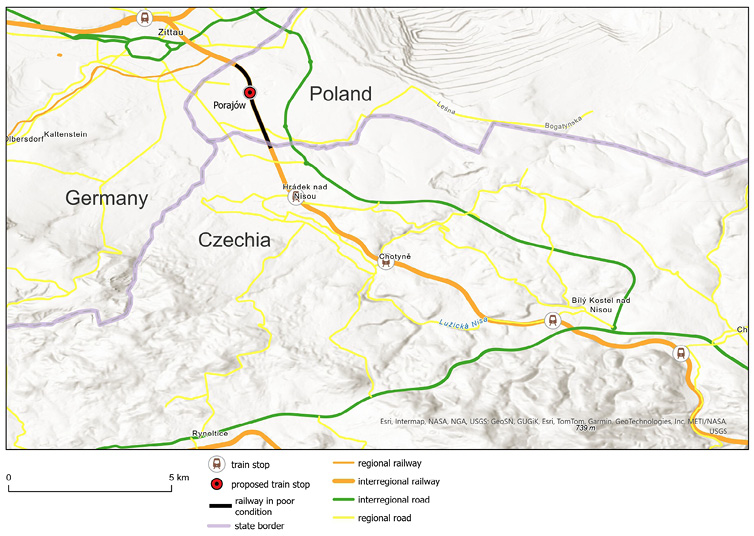
Source: own work (2025).
5.3. The Głuchołazy line: residual peripheral railway with sparks of hope
This line now serves Czech domestic routes via Polish territory (Głuchołazy). The line’s 19th-century origins lie in an Austro-Hungarian-German infrastructural constellation. In 1875, Głuchołazy was connected with Krnov, and in 1888, with Jeseník (Strauchmann, 2025). Later, the railway was extended to regional centers. The railway was also connected to the Austrian-Hungarian Emperor Ferdinand Northern Railway via Ostrava and the German Upper Silesian Railway via Opole. It was possible to embark and disembark in Głuchołazy despite the legal settings of PTT.
At the end of the 19th century, both sides of the border were populated by Germans, so linguistic and cultural bonds facilitated cross-border passenger movements, including tourism to the Hrubý Jeseník Massif. Since 1918, the line has been operated by Czechoslovak/Czech Railways. A decisive rupture came in 1945–1947 with border shifts, expulsions of ethnic Germans, and securitised border regimes on both sides. Of several pre-war border-crossing lines in the area, three were dismantled. The Jeseník–Głuchołazy–Krnov line survived primarily as a PTT route serving Czech domestic connectivity across a narrow Polish salient. The arrangement was codified in the 1948 Convention (Sdělení č. 45/2005 Sb. m. s.) on PTT via Głuchołazy, which prohibited boarding and alighting in Poland, restricted opening doors and windows, and mandated armed border-guard escorts. These provisions entrenched a transit-only logic and a strong sense of separateness in the everyday experience of the line.
Border-crossing and railway agreements (e.g., convention – Sdělení č. 6/2007 Sb. m. s.) that softened the strict regime emerged after the fall of socialism in both countries. They aimed to align the practice with EU law and enable boarding in Poland under certain conditions. From the Schengen accession in 2007 to 2023–2024, passengers to the Głuchołazy station were checked in accordance to the Czech national tariff, with limited integration into Polish distribution channels and an absent international regional ticket. Passengers from the Głuchołazy station were checked in as if they had travelled from an unstaffed stop in Czechia. Euroregional institutionalisation (ERP) expanded spaces for cross-border dialogue and project programming (Opioła, 2020; Böhm et al., 2023a). Yet these positive shifts did not translate into a fully embedded cross-border passenger service in Głuchołazy. Until recently, passengers could board in Poland only under ad-hoc arrangements; timetable and fare information often remained invisible in Polish channels. The service bypassed the renovated city center station, using an outlying stop 3 km away, which dampened Polish ridership. One random local in the city center told the first two authors, when they were speaking Czech, that the station for Czechs is far to the north. On the Polish territory, low track speeds around 40 km/h compounded the accessibility deficit, while headways on the Czech service pattern remained around 240 minutes, which is inadequate for everyday commuting.
In this context, observed demand outside peak tourist seasons fell to several dozen passengers per day. The resulting equilibrium is self-reinforcing, as low frequency depresses ridership. Weak demand reduces political salience and investment priority. Poor infrastructure constrains speeds and reliability, and the service’s weak visibility in Polish information systems dampens new user acquisition (cf. Dołzbłasz, 2017). According to information obtained by the authors from the Polish Ministry of Infrastructure (following a public information request on 14 November 2024), steps to supersede the 1948 convention culminated in a new bilateral agreement signed on 18 August 2023 (unpublished), harmonising safety and rolling-stock admission standards with EU law. However, the financial architecture remains delicate: the Czech side pays infrastructure charges to the Polish infrastructure manager. The values are modest in absolute terms (approximately 50,000 euros), yet they symbolically reinforce a transit framing rather than a shared, integrated service logic.
There were efforts to limit or cancel the railway operation from the Czech side (Ministry of Transport, Olomouc Region, Moravian-Silesian Region) because of the small number of passengers (several dozen, except during the summer and winter tourist seasons) and the payments to Polish Railways. There were ideas for complete replacement by bus transport that would not go through Polish territory, partial replacement with buses going from the Zlaté Hory railway station to Krnov, or building a new connecting railway between Zlaté Hory and Jindřichov. Currently, both Jeseník and Krnov are advocating for an increase in the number of connections on the route. Considering the planned reconstruction of the Polish segment, they also point to the dismal railway parts on the Czech side. They strive to increase the frequency of trains to 120 minutes, at least on Fridays, weekends and holidays. Since 2013, the rail connection between the two towns has consisted of four pairs of semi-fast trains, operating every four hours. It may be sufficient for occasional travel, such as weekly trips to boarding schools or universities, but not for daily commuting to work or school. Moreover, the connection between the two regions is gradually deteriorating due to the reduction of long-distance bus services (Deník.cz, 2025). Even a direct bus ride takes two hours, while other connections involve additional transfer problems. People then prefer individual car transport, which puts further strain on the region’s rather poor-quality roads. Generally, the high interest in functioning railway connections is in the Olomouc Region, because the Jeseník area is relatively isolated. An agreement between the Moravian-Silesian and Olomouc Region on financing the line exists, including payments to the Polish side (Muras, 2024).
Since Poland and Czechia entered the Schengen zone, there have been debates about reconstructing the Polish part and creating stops in the center of Głuchołazy and Pokrzywna/Moszczanka (Fig. 2), which existed before 1945 (Tygodnik Prudnicki, 2025). The stop in the city center would attract more passengers, because the current stop/railway station is distant. A small stop could be built on the Czech track, connected by a footbridge to the existing station in the center of Głuchołazy. Stopping in Pokrzywna would benefit tourists due to the local swimming pool and its proximity to hiking destinations.The strategy of the ERP for 2021–2029 (Euroregion Pradziad, 2020) presents the connection as a strength and a chance for enhancing cooperation. Still, at the same time, it is defined as a weakness, because this connection is not fully exploited, and the railway infrastructure is in poor technical condition, and the Polish section epitomises an infrastructural bottleneck. Finally, the Euroregion has become a platform for lobbying for change.

Source: own work (2025).
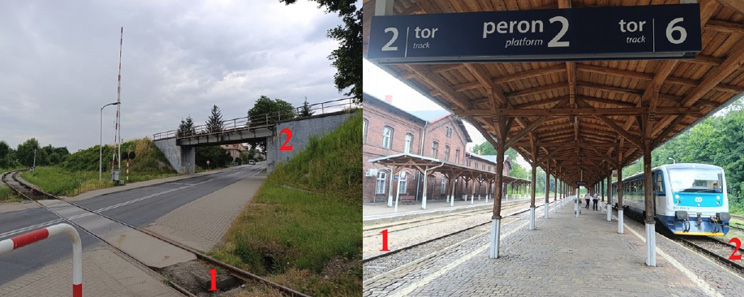
Source: own work (2025).
Administrative inertia prevented the renegotiation of outdated legal regimes. Głuchołazy remains disconnected from broader mobility strategies in the region, and trains to Opole are not frequent. Despite its potential, the line is locked into a legacy mode of transit. With modest, coordinated interventions, such as increasing the frequency to 120-minute headways on priority days, re-centering access in Głuchołazy plus a tourism stop in Pokrzywna/Moszczanka, targeted renewals on both sides, and a simple cross-border ticket, the line could evolve from a residual corridor into an everyday regional transport axis.
| Dimension | The Zittau line | The Głuchołazy line |
|---|---|---|
| Historical context | Built within the Austro-Hungarian-Saxon cooperation; strong industrial logic; maintained operations during the Cold War via trilateral arrangements. | Developed within the Austrian Northern Railway system; the Cold War bilateral treaty underpins today’s regime; relevance declined after 1945. |
| Geographical context | Mainly in the urbanized lowlands of the Nisa/Nysa River and the Zittau Basin; with one minor barrier in the Nisa/Nysa Valley bridged by the viaduct. | Mostly in rural areas in the foothills of Hrubý Jeseník Massif; with a dispersed settlement network; rugged terrain with pronounced gradients in Czechia. |
| Governance structure | Trilateral with active ERN and the Small Triangle roles. | Bilateral with growing involvement of the ERP; the legacy treaty framework limits flexibility. |
| Infrastructure condition | Largely modernised; one Polish bottleneck with upgrading announced for 2025. | Substandard segment on the Polish side; planned works lack national priority. |
| Service frequency and accessibility | Approx. hourly all day; full boarding/alighting services in all three countries; serves commuters and visitors. | 4 semi-fast pairs/day; until 2023, largely transit-only in the Polish territory; the station sits far from Głuchołazy center. |
| Fare integration | Partial, via Euro-Nisa-Ticket+ and regional systems; comparatively user-friendly. | Minimal until recently; sales under the Czech tariff; no widely usable international integrated ticket. |
| Passenger demand | High: mix of commuters, cross-border workers, and tourists. | Low: several dozen/day off-season; weak commuter base. |
| Symbolic/identity function | Strong: an everyday symbol of cross-border normality and regional cohesion. | Weak: residual corridor, weakly embedded in regional mobility narratives. |
| Key barriers | Speed constraint and no stop in Poland; multilingual driver certification; taxation friction. | Outdated legal base; low national salience; peripheral station siting; low service frequency; terrain. |
| Drivers of change | Robust regional advocacy (municipalities, ERN); EU co-funding; tourist demand. | Municipal pressure and regional backing (Olomouc, Moravian-Silesian, ERP), but fragile without national commitment. |
| Overall assessment | Functioning, adaptive cross-border service with solvable constraints; model of operational flexibility. | Peripheral corridor with potential dependent on legal/infrastructure reform and frequency gains. |
Source: own work (2025).
The first case demonstrates that even complex PTT arrangements can function effectively when political will, regional advocacy, and EU incentives are aligned. The second case illustrates a stagnant institutional landscape, where historical agreements hinder contemporary functionality.
6. Discussion
In our opinion, the modernisation of problematic sections on Polish territory is a local issue connected with pressure from people and municipalities on regional governments. The studied railway connections are of little importance to the central government. While both lines originated under similar geopolitical and functional conditions, their contemporary trajectories diverge.
The findings speak to the study’s guiding questions:
RQ1: To what extent can railway lines that operate under PTT or similar arrangements function as drivers of regional CBI?
They can act as effective instruments of functional and ideational CBI, but only contingently, i.e., when embedded in dense MLG and user-friendly service designs. The Zittau line provides hourly all-day service, partial fare integration, and clear symbolic value normalising everyday cross-border mobility. In contrast, the Głuchołazy line remains weakly integrative due to sparse service and poor accessibility.
RQ2: Which institutional and infrastructural conditions enable or hinder such a role?
Enablers include active governance density (Euroregions, European Groupings of Territorial Cooperation – EGTCs, city-triangles, transport coordinators) that routinise cross-border coordination, simple cross-border tickets and fare integration, regular and short headways, central and intermodal stop locations, targeted capital works on short foreign bottlenecks via trilateral agreements, and recognition of cross-border services in fiscal formulas. Barriers involve regulatory fragmentation (vehicle and driver certifications, multilingual requirements), VAT/accounting asymmetries for international tickets, legacy bilateral treaties, discontinuous upgrades that lock in slow segments, peripheral station siting, long headways, and poor presence in national sales and timetable channels.
Taken together, the results, assembled in Table 1, speak directly to our hypotheses:
H1: The presence of MLG structures enhances PTT railway lines’ functional and symbolic integration.
The findings largely confirm this hypothesis. The Zittau line, embedded within a trilateral governance structure and supported by the ERN and the Small Triangle initiative, demonstrates how institutional density can foster operational flexibility and symbolic integration. Despite technical and legal obstacles, such as speed restrictions on the Polish section and regulations on driver certification, the line has maintained hourly services, integrated partial fare systems, and functioned as a symbol. In contrast, the Głuchołazy line operates under an old bilateral treaty. Its institutional environment is characterised by inertia and asymmetry. The weaknesses of MLG and CBC mechanisms have hindered their functionality and symbolic role. This comparison confirms that governance structures matter in their formal design and capacity to mobilize actors across different levels and sectors (Hooghe and Marks, 2003).
H2: The lack of fare integration and passenger accessibility regimes constrains the potential of such railway lines to serve as tools of regional cohesion.
The analysis strongly supports this hypothesis. The Zittau line benefits from the Euro-Nisa-Ticket+, simplifying cross-border travel by reducing costs and eliminating administrative hurdles for passengers. Additionally, passengers can board and alight at multiple stations across all three national territories without restriction. These factors have generated significant demand, consisting of commuters, tourists, and cross-border workers. By contrast, the Głuchołazy line illustrates the detrimental impact of absent fare integration and limited accessibility, which is closely tied to the region’s geographical settings. Until recently, boarding was not permitted on the Polish segment, and passengers were checked under Czech domestic tariffs as if departing from a ghost stop. The current Głuchołazy station is far from the town center, making it inconvenient for everyday use, particularly in combination with the low service frequency of only four train pairs daily. This severely undermines the line’s ability to attract passengers. The contrast between the two cases highlights the importance of fare integration and accessible infrastructure as prerequisites for functional and symbolic cross-border mobility, a finding also confirmed by Kołodziejczyk (2020).
H3: Historical dependencies, infrastructural ownership and investment priorities are critical in shaping PTT railway lines’ current utility and governance.
This hypothesis is partly confirmed. The Zittau line exemplifies how historical legacies, such as ownership fragmentation between Czech, German, and Polish railway administrations, continue to shape operational challenges. The poor condition of the Polish section remains a bottleneck that undermines the efficiency of the entire corridor. However, through sustained lobbying, trilateral declarations, and EU co-funding, actors have pushed for modernisation, with reconstruction of the Polish segment now planned. Historical infrastructural constraints can be mitigated when there is a political will and external resources are available. Conversely, the Głuchołazy line reveals how deeply entrenched historical arrangements can lock a railway line in a residual mode of operation. The Cold War-era treaty continues to frame operations in ways that are disconnected from contemporary mobility needs. At the same time, infrastructural neglect reinforces its marginal status. The absence of strong incentives to renegotiate legal regimes or invest in modernisation perpetuates a cycle of decline. However, it is worth noting that the terrain along the line is more complicated than on the Zittau line. This underlines the weight of institutional and infrastructural path dependency, especially in contexts where peripheral position and low passenger numbers reduce political visibility. A general shift in planning responsibility from central to regional levels is also apparent in the road network (Furmankiewicz et al., 2025). This kind of change requires a robust MLG and CBC foundation.
The Zittau line illustrates that PTT railway lines can serve as integration tools when embedded in dense governance networks and supported by integrated fare systems and accessible infrastructure. The Zittau corridor’s hourly pattern and partial fare integration reflect the shift from symbolic to functional integration highlighted in cross-border regionalism (Durand and Decoville, 2019). This echoes Sohn’s (2014) notion of functional integration in cross-border metropolitan regions: when accessibility and governance routines converge, networks override discontinuities in territorial jurisdiction. It also proves that historical path dependencies can be reframed by strong regional actors and bottom-up cooperation (cf. Perkmann, 2003; Bachtler et al., 2013). With the planned reconstruction of the Porajów bottleneck and the potential construction of a stop there, the line could become a standard cross-border railway connection, featuring reciprocal boarding rights across all territories, fare integration, and user-focused governance.
The Głuchołazy line demonstrates how outdated legal frameworks, lack of accessibility, and entrenched infrastructural dependencies can limit the integrative potential of such corridors. These findings align with previous work (Bertram et al., 2023), which demonstrates that mode choice (rail vs. road) has a significant impact on cross-border mobility patterns. Infrastructural barriers and outmoded legal frameworks continue to obstruct the integration potential of the Głuchołazy line. Such developments contrast with Kołodziejczyk’s (2020) findings in the Czech-Polish context, which emphasise the catalytic role of multilateral coordination in transforming spatial discontinuities into opportunities for tourism, labor mobility, and regional identity. The stop in Głuchołazy is scarcely used, so in fact, the line is still in a quasi PTT regime. Railway reconstruction and the construction of accessible stops can change this situation.
Notably, the comparison suggests that historical legacies do not predetermine outcomes. With sufficient political will, regional advocacy, and EU-level incentives, PTT connections can overcome structural CBI obstacles and evolve into meaningful instruments of cross-border cohesion. Placing the findings in relation to MLG and infrastructure regionalism, the cases support the claim that transport corridors are both products and drivers of integration, especially connected to the dependence between institutional thickness and user-level integration (Hooghe and Marks, 2003; Perkmann, 2003).
Our results also align with the recent push for sustainable and decarbonized transport in EU strategies (European Commission, 2025). Both lines, despite their anomalies, represent low-emission mobility solutions that could aid in the ongoing modal shift from car to rail. However, only the Zittau line currently illustrates the argument of Bertram et al. (2023) that integrating rail into everyday mobility patterns requires reliable schedules and perceptual normality.
Seen in the light of other European and historical cases, as outlined in the theoretical background, the divergent trajectories of the Zittau and Głuchołazy lines reinforce the broader argument that PTT railways reflect wider border dynamics. As exemplified by the Vennbahn between Germany and Belgium or the Ostbahn’s post-Versailles configurations, the persistence of corridor-like railways reflects enduring tensions between territorial segmentation and functional connectivity (Sadowski, 2014; Musekamp, 2024). The Czech-Polish cases demonstrate that similar tensions persist in present-day EU borderlands: infrastructural enclaves (Porajów on the Zittau line), legacy transit treaties (Głuchołazy line), and uneven national investment priorities reflect earlier constellations where extraterritorial exceptions were tolerated but rarely integrated. Nevertheless, as illustrated by Alpine PTT-like lines, where former bottlenecks were absorbed into advanced cross-border regimes, contemporary PTT railways may evolve into everyday regional connectors when supported by synchronised reconstructions, fare harmonisation, and user-centred governance.
7. CONCLUSION
Several policy recommendations emerge from this study. Regional authorities should:
- Proactively advocate for the modernisation of bottlenecks located on foreign territory, as local and regional pressure often proves more effective than relying solely on national governments.
- Treat cross-border fare integration as a central accessibility element, extending successful models like the Euro-Nisa-Ticket+.
- Ensure that new or reactivated stops are strategically located to serve residents and tourists, preferably in town centers or near key destinations and multimodal hubs.
- Advocate for reforms in intergovernmental fiscal systems to recognise cross-border mobility within budget allocations, ensuring stable long-term funding instead of relying on short-term project support.
- Strengthen institutional cooperation through structures such as EGTCs, which can provide co-management mechanisms and reduce dependence on outdated bilateral treaties.
Beyond these functional improvements, the ideational dimension of CBI is equally important. The Zittau line illustrates how seamless railway operations normalise everyday transnational practices. Visible markers such as integrated tickets, bilingual signage, and frequent cross-border services reinforce this symbolic dimension. In contrast, the Głuchołazy line demonstrates how inadequate service, restrictive legal frameworks, and infrastructural neglect sustain the perception of borders as barriers, limiting their contribution to regional identity formation.
In conclusion, PTT railway lines hold significant promise as functional and ideational CBI instruments in Central Europe. Realising this potential requires policymakers to view them not as peripheral technical problems but as strategic resources for enhancing connectivity, cohesion, and shared identity in border regions. Far from being anomalies, these railway lines are stress tests of institutional coordination, regulatory flexibility, and political ambition. To fully unlock their potential, policymakers should:
- Update legal frameworks to reflect contemporary needs, including regional stopping rights.
- Pursue technical harmonisation in electrification, rolling stock, and timetabling.
- Foster strong cross-border governance bodies (e.g., EGTCs) capable of co-management.
- Integrate PTT lines into EU transport strategies, particularly the Trans-European Transport Network (TEN-T) (European Commission, 2025) and sustainable mobility initiatives.
- Enhance their tourism appeal, a key driver of cross-border railway demand in the Czech-Polish and Czech-German borderlands.
At the same time, these cases resonate with current EU policy priorities. The Green Deal and the TEN-T framework emphasise decarbonisation, modal shift from road to rail, and improved cross-border connectivity. Successful integration of the mentioned PTT railway lines into European transport strategies would demonstrate the EU’s ability to transform historical anomalies into drivers of sustainable regional development and cross-border cohesion.
There are several limitations of the study:
- Relying on qualitative triangulation, as comprehensive multi-year passenger counts were unavailable.
- Interviews were conducted primarily with institutional actors and selected passengers, which may bias perceptions toward governance and operational perspectives.
- Infrastructural and legal changes are ongoing, and the situation may evolve rapidly.
Future work should integrate mobile-device location data and datasets from transport operators to quantify frequency and fare integration. The data, combined with qualitative governance analysis, could be used to test how institutional density translates into measurable changes in ridership, frequency, and modal shift. Comparative studies could be extended to other Central European PTT and PTT-like railway connections (e.g., in Austria, Germany or Switzerland) to assess whether similar governance mechanisms and infrastructural path dependencies apply.
Autorzy
REFERENCES
ALPINI, J. (2003), ‘De la naissance des territories aux « queues de poêle » et autres écarts de forme’, Mappemonde, 71 (3), pp. 38–41.
BACHTLER, J., MENDEZ, C. and WISHLADE, F. (2013), EU cohesion policy and European integration: the dynamics of EU budget and regional policy reform, Routledge.
BĄK, P. (2024), Interview with the employee of the Polish part of the ERP, 10 April.
BECK, J. (2019), ‘Cross-border cooperation in Europe as an object in transdisciplinary research. An introduction’, [in:] BECK, J. (ed.), Transdisciplinary Discourses on CBC in Europe, Peter Lang, pp. 13–28.
BECKMAN, L. (2024), ‘Authority and coercion beyond the state? The limited applicability of legitimacy standards for extraterritorial border controls’, Jus Cogens, 6 (2), pp. 141–160. https://doi.org/10.1007/s42439-024-00092-5
BERTRAM, D., CHILLA, T. and HIPPE, S. (2023), ‘Cross-border mobility: Rail or road? Space-time-lines as an evidence base for policy debates’, Journal of Borderlands Studies, 39 (5), pp. 913–930. https://doi.org/10.1080/08865655.2023.2249917
BÖHM, H., BOHÁČ, A. and WRÓBLEWSKI, Ł. (2023a), ‘Evaluation of cross-border cooperation in Czechia since 1993: Euroregions on the way to authentic cross-border regions?’, Geografický časopis, 75 (3), pp. 253–267. https://doi.org/10.31577/geogrcas.2023.75.3.13
BÖHM, H., BOHÁČ, A., NOWAK-ŻÓŁTY, E. and SZAFRAŃSKA, A. (2023b), ‘The divided town of český těšín/Cieszyn as the most integrated part of the Czech-Polish borderland: a life in the cross-border educational togetherness or side by side?’, Moravian Geographical Reports, 31 (4), pp. 194–202. https://doi.org/10.2478/mgr-2023-0018
BUFE, S., SCHRÖPFER, H. and LOSOS, L. (2003), Železnice v Sudetech 1938–1945, Praha: RCH.
DRÁPELA, E. and BAŠTA, J. (2018), ‘Quantifying the power of border effect on Liberec region borders’, Geografické informácie, 22 (1), pp. 51–60. https://doi.org/10.17846/GI.2018.22.1.51-60
DECOVILLE, A., DURAND, F., SOHN, C. and WALTHER, O. (2013), ‘Comparing cross-border metropolitan integration in Europe: towards a functional typology’, Journal of Borderlands Studies, 28 (2), pp. 221–237. https://doi.org/10.1080/08865655.2013.854654
DENÍK.CZ (2025), Po letech redukcí obrat, Jeseník žádá dvojnásobek vlaků do Krnova, https://sumpersky.denik.cz/zpravy_region/jesenik-vlak-krnov-20250721.html [ accessed on: 16.04.2025].
DOŁZBŁASZ, S. (2017), ‘From divided to shared spaces: Transborder tourism in the Polish-Czech borderlands’, [in:] HALL, D. (ed.), Tourism and Geopolitics, Wallingford: CABI, pp. 123–145. https://doi.org/10.1079/9781780647616.016
DOŁZBŁASZ, S. and RACZYK, A. (2024), ‘The stability of cooperation in the context of cross-border cooperation: The example of Poland’s borderlands’, Moravian Geographical Reports, 32 (3), pp. 164–175. https://doi.org/10.2478/mgr-2024-0014
DURAND, F. and DECOVILLE, A. (2019), ‘A multidimensional measurement of the integration between European border regions’, Journal of European Integration, 42 (1), pp. 1–16. https://doi.org/10.1080/07036337.2019.1657857
EU AGENCY FOR RAILWAYS (2022), Cross-border Rail Transport Potential, Luxembourg: Publications Office of the EU.
EUROPEAN COMMISSION (2025), Trans-European Transport Network (TEN-T), https://transport.ec.europa.eu/transport-themes/infrastructure-and-investment/trans-european-transport-network-ten-t_en [accessed on: 30.10.2025].
EUROREGION PRADZIAD (2020), Strategia rozwoju współpracy polsko-czeskiej w Euroregionie Pradziad na lata 2021-2029, Prudnik: Stowarzyszenie Gmin Polskich Euroregionu Pradziad.
FURMANKIEWICZ, M. and TRNKOVÁ, G. (2024), ‘Cross-border cooperation of Polish and Czech area-based partnerships supported by Rural Development Programmes: Genuinely international or solely national projects?’, Moravian Geographical Reports, 32 (2), pp. 137–150. https://doi.org/10.2478/mgr-2024-0012
FURMANKIEWICZ, M., BURYŁO, K., DOSTÁL, I., HEŁDAK, M., LIPSA, J. and ZATHEY, M. (2025), ‘Planning and practice of the Polish-Czech transborder road network development: From ineffective top-down plans to bottom-up lack of coordination?’, European Spatial Research and Policy, 32 (1), pp. 57–93. https://doi.org/10.18778/1231-1952.32.1.01
GENUS (2019), 2,7 kilometru dlouhý úsek trati přes polské území je v tak špatném stavu, že tam vlaky mohou jezdit max. čtyřicítkou, https://genus.cz/regiony/liberecko/2-7-kilometru-dlouhy-usek-trati-pres-polske-uzemi-je-v-tak-spatnem-stavu-ze-tam-vlaky-mohou-jezdit-max-ctyricitkou-n661977.htm [accessed on: 10.04.2025].
HAVLÍČEK, O. (2025), Interview with the secretary of the Czech part of the ERN, 2 June.
HOOGHE, L. and MARKS, G. (2003), ‘Unraveling the Central State, but How? Types of Multilevel Governance’, The American Political Science Review, 97 (2), pp. 233–243.
KOŁODZIEJCZYK, K. (2020), ‘Cross-border public transport between Poland and Czechia and the development of the tourism functions of the region’, Geographia Polonica, 93 (2), pp. 261–285. https://doi.org/10.7163/gpol.0173
KOMORNICKI, T. and GOLISZEK, S. (2023), ‘New Transport Infrastructure and Regional Development of Central and Eastern Europe’, Sustainability, 15 (6), 5263. https://doi.org/10.3390/su15065263
ŁABOREWICZ, I. (2025), Interview with the historian connected to the Polish part of the ERN, 17 March.
MALÝ TROJÚHELNÍK-KLEINES DREIECK-MAŁY TRÓJKĄT (2025), Official Facebook page, https://www.facebook.com/profile.php?id=100064705987771 [accessed on: 10.04.2025].
MEHNERT, C. (2024), Interview with the managing director of ZVON, 14 November.
MURAS, I. (2024), Interview with the head of the transport department of the Moravian-Silesian region, December 4.
MUSEKAMP, J. (2024), Shifting lines, entangled borderlands: mobilities and migration along the Prussian Eastern Railroad, Bloomington: Indiana University Press.
OPIOŁA, W. (2020), ‘Euroregion Pradziad/Praděd’, [in:] WASSENBERG, B. and REITEL, B. (eds), Critical Dictionary on Borders, Cross-Border Cooperation and European Integration, Peter Lang, pp. 437–439.
PÁSZTO, V., MACKŮ, K., BURIAN, J., PÁNEK, J. and TUČEK, P. (2019), ‘Capturing cross-border continuity: the case of the Czech-Polish borderland’, Moravian Geographical Reports, 27 (2), pp. 122–138. https://doi.org/10.2478/mgr-2019-0010
PERIĆ, A. (2019), ‘Multi-level governance as a tool for territorial integration in Europe: Example of the Orient/East-Med Corridor’, [in:] SCHOLL, B., PERIĆ, A. and NIEDERMAIER, M. (eds), Spatial and transport infrastructure development in Europe: Example of the Orient/ East-Med Corridor, Hannover: Verlag der ARL – Akademie für Raumforschung und Landesplanung, pp. 91–105.
PERKMANN, M. (2003), ‘Cross-border regions in Europe: significance and drivers of regional cross-border cooperation’, European Urban and Regional Studies, 10 (2), pp. 153–171. https://doi.org/10.1177/0969776403010002004
POPESCU, G. (2012), Bordering and ordering the twenty-first century: understanding borders, Rowman & Littlefield.
POSPÍŠIL, O. (2024), Interview with the managing director of KORID, Liberec region, 15 November.
RETTIG, W. (2010), Eisenbahnen im Dreiländereck: Ostsachsen (D), Niederschlesien (PL), Nordböhmen (CZ); Band, Geschichte der Hauptstrecken, Betriebsstellen, Elektrifizierung und Fahrbeschreibungen, Freiburg: EK-Verlag.
RUBINSTEIN, E. (2024), Interview with the managing director of Die Länderbahn, 10 November.
SADOWSKI, S. (2014). ‘Separacja sieci kolejowych na Pomorzu Nadwiślańskim w latach 1920–1939’, [in:] SIERZPUTOWSKA, K., SADOWSKI, S. and KOSECKI, A. (eds), Świat – Niemcy – Polska: szkice politologiczne i historyczne ofiarowane prof. dr. hab. Zbigniewowi Leszczyńskiemu w 70. rocznicę urodzin, Bydgoszcz: Uniwersytet Kazimierza Wielkiego w Bydgoszczy, pp. 299–317.
SCHREIER, P. (2004), Zrození železnic v Čechách, na Moravě a ve Slezsku, Praha: Baset.
SDĚLENÍ č. 45/2005 Sb. m. s. 2005, Sdělení Ministerstva zahraničních věcí o sjednání Dohody mezi republikou Československou a republikou Polskou o privilegované průvozní dopravě železniční z Československa do Československa přes Głuchołazy.
SDĚLENÍ č. 6/2007 Sb. m. s. 2007, Sdělení Ministerstva zahraničních věcí o sjednání Dohody mezi vládou České republiky a vládou Polské republiky o železniční dopravě přes státní hranice.
ŠINDLAUER, Z. (1999), Už dlouho nejel žádnej vlak: zvídavý pohled do dějin soukromých drah v širším okolí Lužických hor, Česká Lípa: END.
SŁAWSKI, S. (1925), Dostęp Polski do morza a interesy Prus Wschodnich, Gdańsk: Drukarnia Gdańska.
ŠMIGUROVÁ, A. (2023), Interview with the director of the Czech part of the ERP, 29 November.
SMOLARSKI, M. (2018), ‘Railway border crossings on Polish-Czech borderland. Level of utilization and public transport offer’, Transportation Overview – Przeglad Komunikacyjny, 3, pp. 1–7. https://doi.org/10.35117/a_eng_18_03_01
SOHN, C. (2014), ‘Modelling cross-border integration: the role of borders as a resource’, Geopolitics, 19 (3), pp. 587–608. https://doi.org/10.1080/14650045.2014.913029
STRAUCHMANN, K. (2025), ‘Dlaczego czeskie pociągi jeżdżą przez Polskę? To jedyna taka linia tranzytowa w tej części Europy’, https://nto.pl/dlaczego-czeskie-pociagi-jezdza-przez-polske-to-jedyna-taka-linia-tranzytowa-w-tej-czesci-europy/ar/c1-19046092 [accessed on: 12.04.2025].
TYGODNIK PRUDNICKI (2025), O czeskim tranzycie kolejowym przez Głuchołazy i Moszczankę, https://www.youtube.com/watch?v=sGCzcTpihq4&ab_channel=TygodnikPrudnicki [accessed on: 12.04.2025].
VURSTA, P. (2014), Mezinárodní železnice Liberec-Žitava-Varnsdorf; Internationale Eisenbahn Liberec-Zittau-Varnsdorf, Liberec: Liberecký kraj.
YIN, R. K. (2014), Case study research: Design and methods (5th ed.), Los Angeles: SAGE Publications.