
Systematic literature review of workplace environment studies at the Space Syntax Symposia 1-13
Hicret AYDOĞAN  *
*
Mehmet Emin ŞALGAMCIOĞLU *
Abstract. This systematic scoping review investigates the influence of spatial design on employee behaviour by analysing workplace research presented at the Space Syntax Symposia (SSS). Adhering to PRISMA guidelines, 37 articles from the 1st–13th SSS were analysed regarding their spatial, social, and methodological components. The study reveals correlations between analysis techniques, syntactic properties, and social behaviours. Although limited to symposium proceedings, the review demonstrates strong representativeness and operational consistency.
Two primary contributions emerge: the identification of three contextual patterns mapping the relationship between syntactic metrics and behavioural phenomena across office types, and the establishment of a comprehensive empirical foundation connecting behaviour, perception, and metrics. This work provides a critical baseline for future meta-analyses and theoretical research in the field.
Key words: workplace, space syntax symposium, organisational behaviour, literature review, spatial morphology.
1. Introduction
Workplace environment studies focus on social and physical aspects. Space syntax, with its „theory and set of techniques,” explores these aspects and their relationships using specific concepts, theories, and methods (Burdet, 1997). Bridging theory and practice, space syntax is useful for empirical research because of its measurable results. As a result, it has gained attention over the years and has evolved through contributions from various fields.
In 1997, the first Space Syntax International Symposium was held to promote these advancements and new studies in the field. Researchers gathered to share research and information, and this conference has continued biennially since then (Greene et al., 2012; Karimi, 2016; Space Syntax Network Symposia Database, 2024). Accordingly, a study analysing conference papers from the first to the eleventh symposium found a shift in the use of methodological, conceptual, and theoretical foundations of space syntax theory in line with these developments (Krenz et al., 2019). Similarly, another study, a meta-analysis of the relationship between pedestrian movement and the built environment, identified patterns between syntactic metrics, techniques, and pedestrian movement. The analysis methods influenced the outcomes of space syntax studies from 1975–2016 (Sharmin and Kamruzzaman, 2018). Furthermore, a systematic review incorporating socio-spatial experiences in space syntax studies revealed a consistent pattern showing that several syntactic measures are significant regardless of scale and analysis (Lee et al., 2023). Lastly, a bibliometric review of space syntax research from 1976 to 2023 indicated that urban studies primarily focus on how morphology and street layout influence limited cognitive and behavioural aspects, forming recognizable patterns (Mohamed and Yamu, 2024). However, another systematic review on sociability in urban environments argues that, although space syntax is useful, there is a gap in the literature because it concentrates on limited topics and concepts related to the social environment in urban areas (Askarizad et al., 2024). Consequently, Space Syntax Symposia (SSS) have been held every two years since 1997 to bring together researchers, discuss new developments, contributions, and discoveries, which are often verified multiple times.
In summary, despite the accumulated knowledge and experience, few reviews have focused on analysing trends in the use of space syntax within the literature. Furthermore, these studies generally evaluate spatial and behavioural patterns without considering behavioural differences related to scale, function or social identity, which are vital in architectural space. Therefore, there is still a need for fresh, comprehensive, focused, and systematic reviews on space syntax research that also address these factors.
Building on this, this literature review will include these factors and focus on workplace studies presented at the SSS 1–13. It will examine social and spatial impacts on employee behaviour at the architecture scale through a systematic literature review process—PRISMA. The main question of this review is how spatial morphology and employee behaviour (interaction, movement, and co-presence) relate and what research components are used to investigate the relationships between spatial and social environments. Due to the specific standards of the systematic literature review method, this review aims to identify patterns objectively among research components such as spatial, social, and methodological elements, and to discuss common findings and variations among studies according to standards established by this method. The goal is to provide evidence from existing literature that supports workplace design aligned with organisational needs and a healthy social environment.
2. Methods and materials
2.1. Method of the review
In this study, a systematic literature review process is followed to establish high standards for analysing and synthesising previous research findings in a systematic, transparent, and reproducible manner (Davis et al., 2014; Snyder, 2019). They organise the review process around a well-defined research question to ensure comprehensive identification, critical assessment, and synthesis of all relevant empirical evidence, following a predetermined set of inclusion and exclusion criteria to ensure transparency and reproducibility. This rigorous process aims to minimise bias and provide a reliable overview of current knowledge (Moher et al., 2009; Page et al., 2021; Lee et al., 2023).
Based on this, the current literature review aims to explore space syntax studies in the workplace more thoroughly and accurately regarding employee behaviours, to uncover the connections between social, spatial, and methodological components through predefined criteria that filter relevant articles and assess their quality, enabling careful conclusions to be drawn from the literature. Additionally, the use, patterns, and research results related to space syntax are examined.
Given that, this literature review can be classified as a ‚systematic scoping review’ since it limits the scope to the Space Syntax Symposia, the academic community that focuses exclusively on space syntax studies, in order to meet the homogeneity criteria of the procedure and address practical constraints such as limited time, workload, and researcher capacity. Moreover, the SSS committee applies a blind peer-review process and specific eligibility criteria to reduce bias and uphold academic standards (Greene et al., 2012). Nonetheless, this remains the first and most comprehensive effort on this topic to date, aiming to advance the field through its detailed approach and serving as a meaningful proxy for the broader research landscape.
2.2. Finding material
In this literature review, a pre-study was conducted to screen relevant literature through a multi-pronged strategy involving Web of Science Core Collection (WoS), Scopus, citation research, and the Space Syntax Network Symposia Database. This screening yielded 101 relevant papers with duplicates identified from 1982–2022. It is observed that some researchers frequently contributed to the literature and presented similar cases and content at the SSS, either as individuals or groups. Also, many of these contributors are connected through research groups, have worked together multiple times, and participated in the SSS.
Furthermore, Fig. 1 indicates that these researchers have the highest scores and are ranked among the top 15 in the relevant literature, according to Scopus, Web of Science Core Collection, and the Space Syntax Network Symposia Database, from left to right respectively. Researchers listed in all three databases are marked in bold black, while those appearing in two are in bold grey. The authors enclosed in frames are partners in the same research and are listed together, though other collaborations also exist.
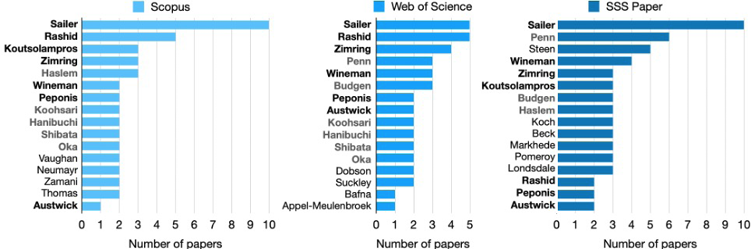
Note: Researchers highlighted in bold black appear at the top of all three lists, while those highlighted in bold grey appear at the top of two lists.
Source: own work based on Scopus, WoS, and the Space Syntax Network Symposia Database.
Additional research showed that they presented parts of the same studies, similar cases, and content from the SSS papers; in some instances, the exact same material appeared in other publications (Steen, 2009; Steen, 2010; Markhede and Steen, 2008; Penn et al., 1997; Serrato and Wineman, 1997).
Lastly, the SSS papers constitute the majority of the relevant literature, with 37 out of 72 papers screened through Scopus, Web of Science Core Collection, and the Space Syntax Network Symposia Database, including papers with high similarity. Therefore, although not every researcher in the field participates in the SSS, it is believed that limiting the relevant literature to the SSS can offer useful insights into the broader discipline by covering the majority, as shown in Fig. 2 and other reasons mentioned above. Nevertheless, it should be noted that the results of this literature review are subject to debate regarding their generalisability due to its scope, as it only partially covers the relevant literature.
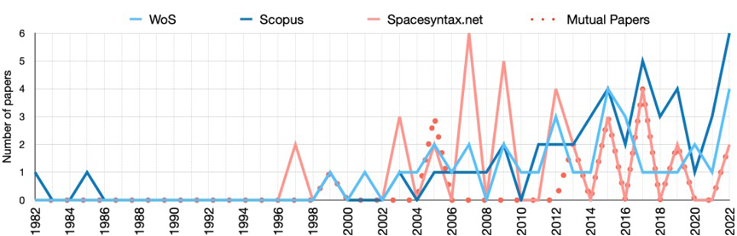
Note: Thirty-seven of the 72 papers originate from the SSS, exhibiting significant overlaps in cases, content, and research groups with the non-SSS papers.
Source: own work.
2.2.1. Eligibility for symposium criteria
The SSS was chosen as the primary eligibility criterion to standardize research qualifications because it is a multidisciplinary, comprehensive, and prestigious conference that accepts peer-reviewed papers presenting new scientific research, ensuring reliability and objectivity, and is written in academic English.
The conference has been hosted internationally by various institutions across different countries, accepting full papers, short papers, and posters within a structured format provided annually by the steering committee. To date, 14 symposia have been held, with the most recent in 2024 in South Cyprus; however, this study reviews presentations from 1 to 13, which have been published. The proceedings from these symposia are available through two databases: Scopus and the Space Syntax Network Symposia Database. Scopus has indexed proceedings since 2013, covering nearly half of all published papers (846 out of 1551), starting with SSS9. The Space Syntax Network Symposia Database, owned by Space Syntax Limited and affiliated with The Space Syntax Laboratory at University College London, has made all proceedings from the first to the thirteenth symposium available, totalling 1551 papers through 2024. Although all studies are accessible via the Space Syntax Network Symposia Database without Scopus, the latter is used for analysing data such as researcher and institution participation, keywords, and evaluating the quality of the proceedings.
2.2.2. Keywords criteria
To identify workplace-related studies in the symposium, relevant keywords „workplace,” „workspace,” and „office” were searched in the titles, abstracts, and keywords. Different search strategies were used for each database. Initially, the search on Scopus.com was refined to „space AND syntax AND symposium” in the „conference” field and further limited to „workplace” OR „workspace” OR „office” in the „article title, abstract, keywords” field. This search yielded 34 papers out of a total of 846 papers with „space AND syntax AND symposium” on the site. After removing an abstract, an introductory letter, and three papers lacking keywords in the correct sections, 29 papers met the criteria. Next, since the Space Syntax Network Symposia Database does not have an effective search engine, the following process was used: all papers were downloaded and compiled into a single file. The file’s „finder” search function was used to identify relevant papers containing the defined keywords; then, they were manually examined to remove those where keywords appeared only in the wrong sections. This process identified 1,551 papers from the 1st to the 13th SSS, totalling 611 papers mentioning these keywords, of which 103 were eligible. After excluding papers with multiple keywords, 76 relevant papers remained. Finally, posters and abstracts were excluded, leaving 73 papers for further review on the Space Syntax Network Symposia Database.
22.3. Spatial criteria
Since this systematic review aims to examine evidence-based practices related to employee behaviour in the workplace, spatial factors such as scale, function, and user profile are essential considerations. Therefore, spatial criteria were set to exclude urban studies, virtual space studies, and other research unrelated to employee behaviour, such as studies on libraries, prisons, and housing. Using the same screening method as before, 13 papers from Scopus.com and 37 papers from Space Syntax Network Symposia Database were identified as eligible for this review and are listed in an Excel file for further analysis, as shown in Fig. 3.
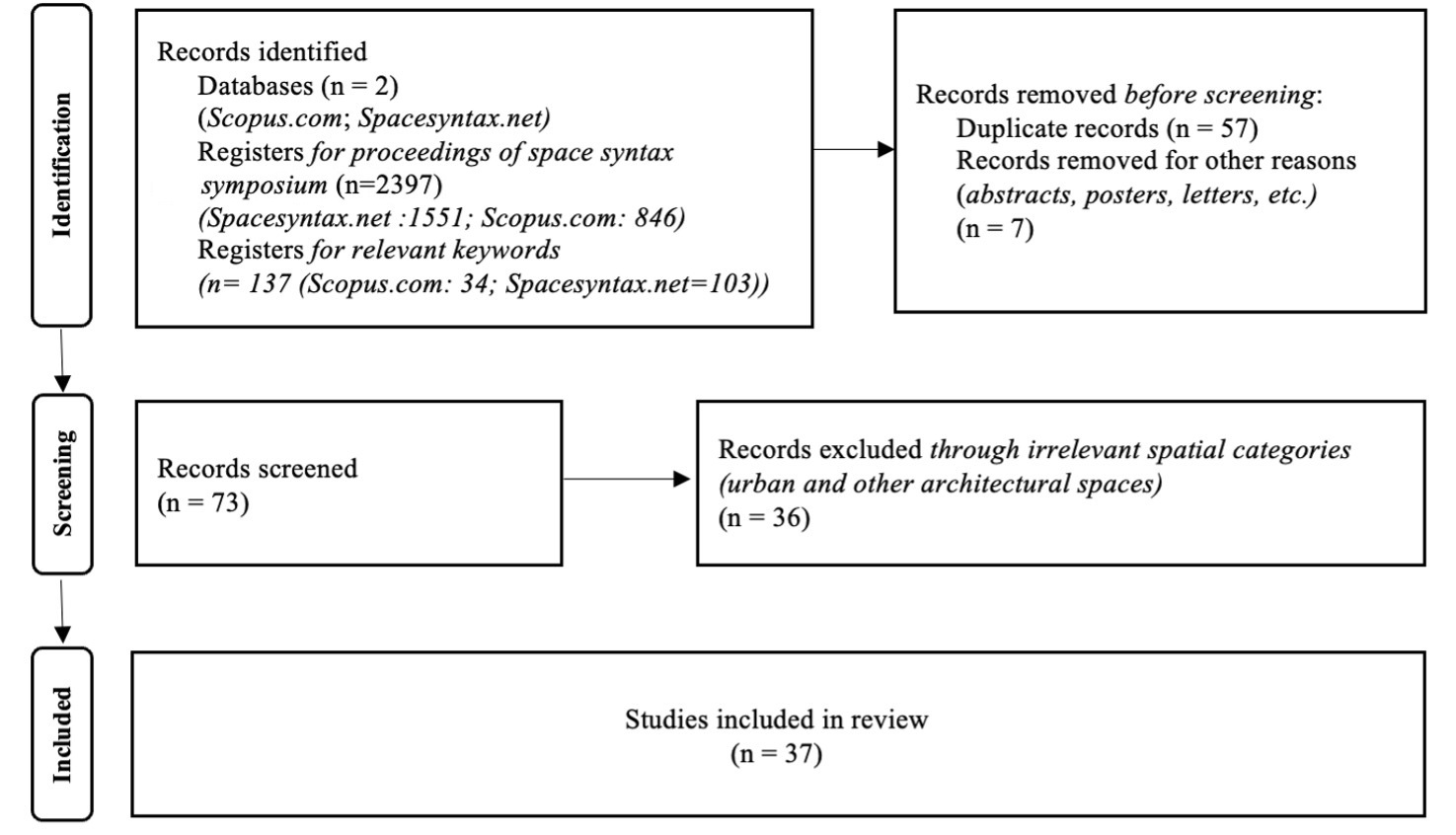
Source: PRISMA Executive.
3. Data analysis procedure
The correspondence theory of space syntax suggests that behaviour patterns are influenced by the spatial configuration if trans-spatial aspects legitimise them (Hillier and Hanson, 1984; Hillier, 2007). Based on this, the overall approach of space syntax research begins with analysing spatial configuration syntactically to assess interaction possibilities, then traces actual spatial behaviours and interaction patterns, and concludes with examining the relationship between these possibilities and actual patterns in the observed space. While spatial configuration is presumed to guide space use patterns, trans-spatial factors such as perception, culture, and demands can also significantly influence these patterns. Space syntax helps identify these relationships through complementary concepts, theories, and techniques. This holistic approach enables workplace (WP) studies to explore the connection between social and spatial environments and to gather evidence of the effects of spatial design.
In this context, four research components are discussed in this literature review within the framework of the WP studies of the SSS, two are data types investigated for correlation: spatial and social aspects. Additionally, research methodology, including spatial analysis techniques and social data collection methods, will be discussed. Since most studies do not elaborate on the correlation methods, the discussion is limited to the data types and collection methods, which are sufficiently defined for classification in the research.
3.1. Social components
In space syntax studies, the effect of spatial configuration is primarily observed through social aspects, mainly behavioural patterns. In addition, trans-spatial factors such as perception are important elements that are assumed to influence behaviour patterns and be affected by the spatial configuration. Similarly, WP studies at the SSS examined these two social components to understand the relationship between social and spatial environments. However, there are also studies that evaluate behavioural patterns solely through morphological analysis without considering the social environment. Based on this, this review will discuss the studies in three categories based on the type of social data analysed: morphology, behaviour, and perception.
3.1.1. Morphology-based studies
One common approach is focusing on spatial morphology and analysing the spatial patterns using the methodological and theoretical basis of space syntax to evaluate the workplace environment without observing any social patterns. However, they may still discuss the possibilities of the social environment based on spatial configuration. Given that, morphology-based studies measure only spatial aspects and do not directly assess social aspects, even though they estimate the potential social environment in those spaces.
3.1.2. Behaviour-based studies
Behavioural patterns are vital for understanding social and spatial environments in workplaces because they provide data on activity types, frequencies, and the influences of trans-spatial and spatial factors on behaviour in workplace studies (Grajewski and Hillier, 1982).
Given that, space syntax theory proposes that there are two main activities people perform in a place: moving or occupying space; and their patterns naturally arise from spatial factors (Hillier and Hanson, 1984; Hillier, 2007). Therefore, these two activities are described as spatial behaviours that are also assumed to exhibit trans-spatial factors according to the theory.
Additionally, Hillier (2007) has suggested that social behaviours are created by spatial configuration, as it shapes opportunities for co-presence. Observing interaction patterns and examining their relationship with interaction possibilities are key techniques in space syntax research. For example, a proportional relationship is believed to show that spatial configuration supports socio-organisational needs, while a lack of relationship indicates that trans-spatial factors—such as organisational and perceptual aspects—influence behaviour patterns. Moreover, social behaviours are linked to organisational behaviours, including communication, collaboration, knowledge sharing, innovation, productivity, and creativity. These are key components of WP studies at the SSS regarding employee behaviour.
Based on this, studies are categorised as behaviour-based when they focus on behaviour patterns as the primary social data rather than other psychosocial constructs, observing behaviour patterns through various methods to correlate with spatial components in this literature review.
3.1.3. Perception-based studies
Perceptual components, which can be defined as subjective judgments of environmental factors that influence behaviour, are among the social aspects examined in employee behaviour studies of the SSS such as satisfaction, safety, and privacy. The studies are classified as perception-based in this review because they focus on perceptual components like sense of security, autonomy, control, communication, social support, satisfaction, and usefulness, and are analysed quantitatively in most cases using different methods. These studies primarily observe behaviour patterns, as well as perception and investigate the relationships between behaviour, perception, and spatial configuration; thus, their content and approach differ from behaviour-based studies.
3.2. Spatial components
Spatial components are the morphological dimensions and syntactic properties in space syntax research. Morphological dimensions include physical limits and connections of built environments, such as visibility and accessibility. Visibility is the most studied morphological dimension for understanding the use limits and potentials of space in space syntax (Krenz et al., 2019). However, this dimension relies on eye-level visual perception, excluding gaps and obstacles above that level, while accessibility, defined as knee-level visibility, includes them to describe movement limits. Conversely, syntactic properties are related morphological measures that identify the accessibility or visibility of space based on factors like integration, connectivity, and occlusivity.
3.3. Research methodology
3.3.1. Spatial analysis techniques
In space syntax theory, three spatial analysis techniques were initially proposed: axial line, justified graph, and convex space maps (Hillier and Hanson, 1984). However, visibility graph analysis, introduced decades later, has become the most widely used technique since then (Turner, 2001; Hillier, 2007; Benedikt and McElhinney, 2019; Krenz et al., 2019).
By description, axial line analysis (ALA) relies on linear representations of spatial configurations, which are accumulations of the longest paths between any two points within the space. Justified graph analysis (JGA) is based on an abstract graph that depicts the connection system of the layout and measures the syntax of the space by counting the transitions to access other spaces from a point. Convex space analysis (CSA) uses regional representations that define the largest spatial partitions within which all points are mutually visible (Hillier and Hanson, 1984). Given that, CSA is also recognised as a “functional map,” which identifies the spatial boundaries of functions within a configuration, and it is used to define organisational borders that delineate departmental territories as well (Markus, 1993; Hillier, 2007; Ostwald, 2011; Dawes and Ostwald, 2018). Finally, visibility graph analysis (VGA) is based on grid representations of spatial configurations, assessing permeability via isovist, which defines the visible boundaries of a base point in a space (Benedikt, 1979; Turner, 2001; Dawes and Ostwald, 2018).
Given that, spatial analysis techniques are important factors in studies since different techniques can produce varying results according to findings (Benedikt and McElhinney, 2019; Krenz et al., 2019; Lee et al., 2023; Azkarizad et al., 2022). For instance, VGA provides more detailed insights into spatial visibility compared to ALA, which may explain its increasing popularity (Benedikt and McElhinney, 2019).
3.3.2. Social data collection methods
Data about social components is collected through various methods depending on the type and context of the information. Generally, two main approaches are used, each involving different techniques: self-report and on-field observation. First, on-field observation techniques, such as space syntax analysis, are widely applied to study behaviour patterns. Researchers collect data in real time at the site using methods like snapshot analysis, tracking, and gate counting. Second, self-report techniques are also commonly used, where participants provide data about their activities through digital or handwritten logs, notepads, questionnaire surveys, and interviews, including ethnographic observation methods.
4. Results of the data analysis procedure
The results of the analysis of the WP research in the SSS, according to the defined procedure, are shown in Table 1. The rates, frequencies, and preference patterns of these data types and their collection methods are discussed based on the selected sample following the systematic review process. Research gaps and weaknesses in approaches will be addressed based on these topics.
Next, the findings of the studies will be discussed in three categories according to social data type: perception, behaviour, and morphology.
| Authors | Cases | Social/ Behavioural patterns and methods | Spatial analysis technique | Syntactic properties | |||||||||
|---|---|---|---|---|---|---|---|---|---|---|---|---|---|
| Int | Occ | Mov | Perc | A L A |
C S A |
J G A |
V G A |
Integ. | Depth | Conn. | Others | ||
| Penn et al., 1997 | A case + a pre-post case | O, S | O | O, S | Quest.-usefulness of interactions | + | + | + | + | - | |||
| Wineman and Serrato, 1997 | 2 cases | S | S | S | - | + | + | - | |||||
| Spiliopoulou and Penn, 1999 | 4 cases | O, S | O | O | - | + | + | - | |||||
| Steen, 2001 | A pre-post case | S | O | O | - | + | + | + | + | - | |||
| Shpuza, 2003 | 17 cases | - | - | - | - | average perimeter distance, perimeter length | |||||||
| Rashid and Zimring, 2003 | 4 cases | - | - | - | - | + | + | + | + | + | - | ||
| Steen and Blombergsson, 2003 | A case | O, S | O | O | - | + | + | + | - | ||||
| Rashid et al., 2005 | 4 cases | O | O | O | Quest.- psychosocial constructs | + | + | + | + | - | |||
| Shpuza and Peponis, 2005 | 7 cases | - | - | - | - | + | + | + | compactness | ||||
| Bafna and Ramash, 2007 | 48 cases | - | - | - | - | + | + | - | |||||
| Markhede and Carranza, 2007 | A case | O, S | O, S | O, S | - | + | + | intervisibility | |||||
| Markhede and Koch, 2007 | 2 cases | O, S | O, S | O, S | - | + | + | - | |||||
| Wineman and Adhya, 2007 | 7 cases | - | - | - | Quest.- job satisfaction | + | + | + | - | ||||
| Sailer, 2007 | 3 cases | O, S | O | O, S | + | + | + | + | metric distance, angular distance, topological distance | ||||
| Sailer et al., 2007 | A pre-post case | O, S | - | - | Quest.-usefulness of interactions | + | + | - | |||||
| Sailer et al., 2009 | 2 pre-post cases | O | O | O | Quest.-usefulness of interactions | + | + | - | |||||
| Sailer and Penn, 2009 | 3 cases + 1 pre-post case | O, S | - | O | - | + | + | - | |||||
| Appel-Meulenbroek, 2009 | A case | S | S | S | - | + | + | + | isovist field, isovist perimeter, occlusivity, compactness | ||||
| Steen, 2009 | A case | O, S | O | O | - | + | + | + | - | ||||
| Lu et al., 2009 | A case | O | O | O | - | + | + | + | targeted visual conn., targeted mean step depth | ||||
| Koch and Steen, 2012a | 5 cases | O, S | - | O, S | - | + | + | + | - | ||||
| Koch and Steen, 2012b | 5 cases | S | - | S | - | + | + | + | - | ||||
| Sailer et al., 2012 | 62 cases | - | - | - | - | + | + | + | - | ||||
| Beck, 2012 | 2 cases | S | S | S | Quest.- satisfaction with social and physical env. | + | + | + | + | + | + | half-isovist (area, compactness, occlusivity, maximum radial) | |
| Beck, 2013 | 2 pre-post cases | S | S | S | Quest.- satisfaction with physical env. | + | + | + | + | half-isovist (area, perimeter, occlusivity) | |||
| Wineman et al., 2013 | A case | O | O | O | - | + | + | movement choice (metric choice) | |||||
| Beck, 2015 | A pre-post case | S | S | S | Quest.-satisfaction with physical env. | + | + | + | + | isovist, full isovist (area, length, perimeter, compactness, occlusivity; window array) back-half isovist; front- half isovist | |||
| Koutsolampros et al., 2015 | 27 cases | O | O | O | - | + | + | + | - | ||||
| Sakr et al., 2015 | 2 pre-post cases | O | O | O | - | + | + | + | - | ||||
| Koutsolampros et al., 2017 | 45 cases | O | O | O | - | + | + | + | + | - | |||
| Lehrer-Melamed and Fisher-Gewirtzman, 2017 | 2 cases | O | O | O | interview -sense of privacy | + | + | + | + | - | |||
| Wackernagel, 2017 | A pre-post case | Agent-based | Agent-based | Agent-based | - | + | + | + | - | ||||
| Pachilova et al., 2017 | 4 cases | O, S | O, S | O, S | - | + | + | visual step depth, angular step depth, metric step depth | |||||
| Koutsolampros et al., 2019 | 41 cases | O | O | O | - | + | + | + | + | compactness; control; controllability; metric mean shortest path angle; angular mean depth; visual relativised entropy; metric mean straight-line | |||
| Sailer and Thomas, 2019 | 2 cases | O | O | O | - | + | + | + | - | ||||
| Hajo, 2022 | A case | O, S | O | O | - | + | + | + | intervisibility | ||||
| Yenel-Güler and Demirkan, 2022 | A case | S | S | - | - | + | + | + | generic visibility analysis, targeted visibility analysis | ||||
(Int.: Interaction; Occ: Occupancy; Mov: Movement; Perc: Perception; O: Field observation; S: Self-report techniques; Quest.: Questionnaire; Integ.: Integration; Con.: Connectivity)
Source: own work.
4.1. Preference of spatial components
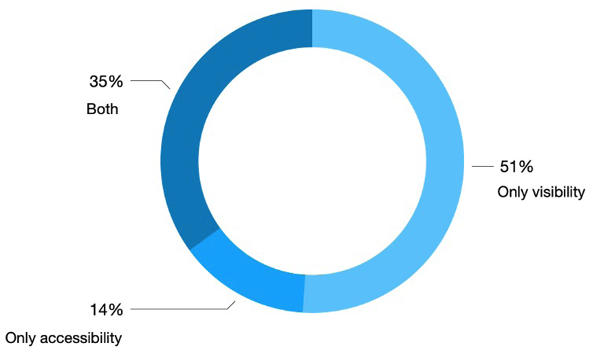
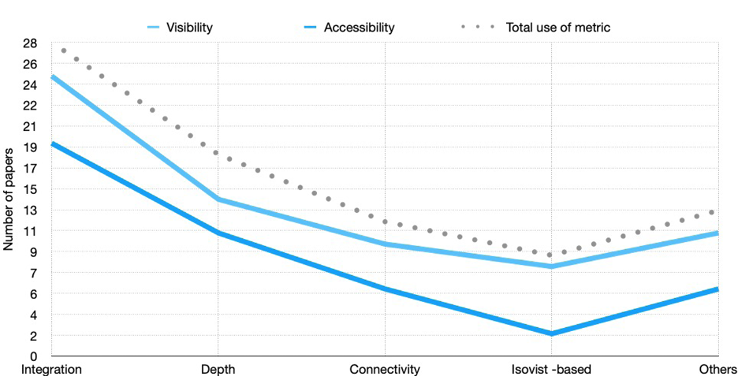
Starting with the morphological dimensions, visibility is the favoured dimension by 86% of the selected sample, indicating that visual perception dominates for spatial perception, as shown in Fig. 4. Accessibility was used by 49% of the sample, particularly regarding power distance, face-to-face interaction frequency, organisational structure, network, and hierarchy. Half of the studies focused solely on visibility, while only 14% focused exclusively on accessibility. The remaining studies analysed both dimensions, accounting for 35%. In contrast, preferences for morphological dimensions in relation to syntactic properties are similar, except for isovist-based metrics such as targeted visibility and intervisibility.
Various forms of visibility are highly emphasised in nearly one-fifth of the sample, including targeted isovist fields, half, back, front, and side isovist (parts of visible area in a specific direction) (Beck, 2012, 2013, 2015); exposure (visibility to others), surveillance (visibility of others), and intervisibility (visibility to each other) analyses (Markhede and Carranza, 2007; Lu et al., 2009; Beck, 2012, 2013, 2015; Yenel-Güler and Demirkan, 2022; Hajo, 2022). These derivative properties are used to understand the impacts of different perspectives and scopes of visibility, such as visible contacts on interaction patterns when seated or standing, on the sense of privacy, or control.
Source: own work.
In terms of syntactic metrics, space syntax software defines at least 25 measures of spatial configurations, and 18 different metrics are used in the selected sample, while 10 of them appeared only once, such as choice, control, controllability, entropy, maximum radial, window array, path angle, angular depth, and mean straight-line.
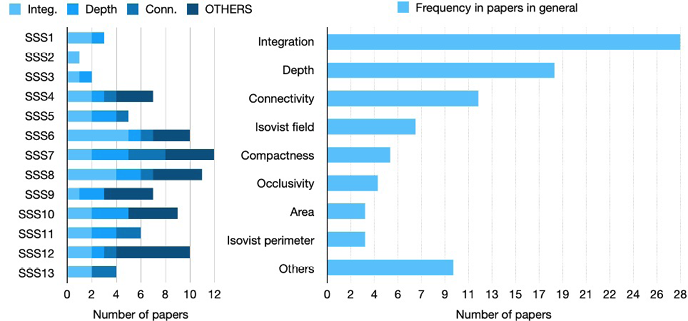
The preference rates show that integration and depth, the oldest syntactic properties and their reciprocals, were significantly more favoured, as shown in Fig. 5. Moreover, except for one study which generated its own metrics (Shpuza, 2003), each has certainly participated in research, while coexisting in one third (12/37). However, integration was the most preferred property, appearing in three quarters (28/37), while depth appeared in half (19/37) of the selected sample. Additionally, 12 studies, one third, relied solely on integration, while only four studies, one tenth, relied solely on depth.
Source: own work.
The overall ranking of these properties is as follows: connectivity ranks third and is used in one third of the studies; isovist field follows at one fifth, 22% (8/37); then compactness at one sixth, 14% (5/37); occlusivity at one tenth, 11% (4/37); isovist perimeter and area each at less than one tenth, 8% (3/37); and various properties used only once account for 3% of these 37 studies as shown in Fig. 6.
Among them, 11 new metrics are generated in the sample, mostly based on the isovist field, as mentioned above. Furthermore, new analysis techniques and metrics are developed to measure perimeter length and perimeter distance to explore correlations between floor plate shapes and natural daylight (Shpuza, 2003). Finally, intelligibility, which measures the relationship between integration and connectivity, appears in several behaviour-based studies (Rashid and Zimring, 2003; Beck, 2012; Lehrer-Melamed and Fisher-Gewirtzman, 2017).
Source: own work.
Briefly, while integration has always been the primary measure and has never lost interest, more than half of the studies in the selected sample also measured depth or connectivity. These metrics have remained prominent to date, and many other metrics have been measured alongside them in later cases. Therefore, integration and depth are the metrics that mostly coexisted with others, since at least one or the other was certainly measured in papers concerning any spatial analysis techniques. However, integration is mentioned more frequently in studies, especially for metrics based on the isovist-field.
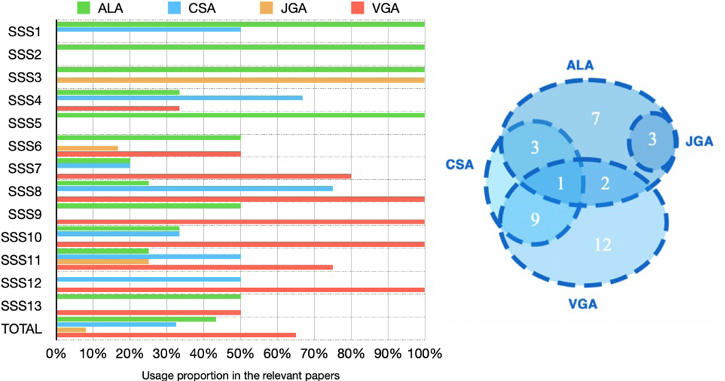
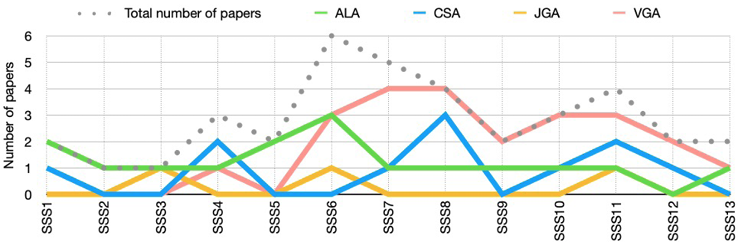
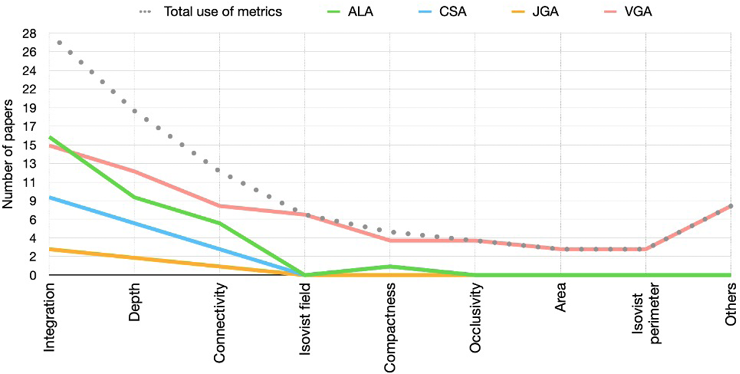
Regarding spatial analysis techniques, VGA is the most commonly used technique, unsurprisingly employed in 64% (24/37) of the selected sample, as shown in the schema in Fig. 7. It was quickly adapted to studies, having been introduced at the 3rd SSS by Turner (2001), and was immediately applied in WP studies starting from the 4th SSS (Steen and Blombergsson, 2003), as shown in Fig. 8 and 9.
In the second place, ALA is employed in 43% (16/37) of the cases from the first to the last Symposia, as shown in Fig. 7 and Fig. 8. Although the least-line map is the most common, all-line maps and segment line maps are also used in behaviour studies to measure accessibility (Penn et al., 1997; Sailer, 2007). However, ALA is mostly used in morphology-based studies, especially after VGA.
Third, CSA appears in 32% (13/37) of the selected samples and is combined with ALA or VGA because it does not assess overall syntax but rather describes co-presence and transition patterns, as shown in Fig. 9. It is generally used to define functional or organisational maps, particularly regarding collaboration between departments or teams (Rashid et al., 2003; Steen et al., 2003; Koch and Steen, 2012a, b) and how architectural programs influence space use and movement patterns (Rashid et al., 2003; Steen et al., 2003; Koch and Steen, 2012a, b; Koutsolampros et al., 2015, 2017; Sailer and Thomas, 2019).
Note: General use of only VGA 32%; only ALA 19%; 49% added CSA or JGA to ALA or VGA in the sample.
Source: own work.
Following this, JGA appears in only 10% (4/37) of the studies, supporting ALA but not VGA, as shown in Fig. 7. It is used to explore the relationship between organisational structure, hierarchy, network, and spatial configuration through integration, depth, and connectivity (Steen, 2001; Sailer, 2007; Lehrer-Melamed and Fisher-Gewirtzman, 2017).
Additionally, some studies have developed their own techniques, claiming that existing methods had limitations for these analyses. For example, one study used an original method involving drawing outlines through the centre of the floorplate to estimate daylight penetration and analyse its relationship with perimeter morphology, finding a positive correlation (Shpuza, 2003). Another study used a grid to measure distance and compactness, similar to the VGA method (Shpuza and Peponis, 2005).
Finally, one study employed agent-based analysis based on isovists, categorised under VGA for further evaluations (Wackernagel, 2017).
In summary, four main space syntax techniques were used for spatial analysis in the selected sample. As ALA and VGA are the most prominent, ALA was preferred for measuring distance over VGA (Sailer, 2007; Beck, 2015). The usage trends show a shift over time; ALA was used in nearly all the studies before VGA was developed, with 7 out of 9 papers; however, after VGA was announced in 2001, it overtook ALA, accounting for 72% of the sample (24 out of 33). The use of ALA decreased to 35% after 2001, with half of those studies also supporting the use of other techniques, including VGA. ALA and VGA were used together in only three studies from the same research group (Beck, 2012; 2013; 2015). Overall, ALA was used alone in nine studies (24%), VGA alone in 12 (35%), and JGA or CSA were used only as supportive techniques in 42% of the sample.
Source: own work.
Additionally, there are correlations between spatial analysis techniques and syntactic properties in the sample, as shown in Fig. 9. For example, ALA, CSA, and JGA, which are the oldest techniques, are only used to measure integration, depth, and connectivity. In contrast, VGA is employed for all preferred properties, including derived ones. Furthermore, studies used VGA to measure either integration or depth analyses, which are interchangeable. Overall, these patterns indicate that spatial analysis techniques influence the preference for certain syntactic properties due to their geometric capabilities for measuring spatial configurations.
Source: own work.
4.2. Preference of social components and data collection methods
4.2.1. Social components
There are three types of research based on social components: behaviour, perception, and morphology studies. However, these components overlap across different categories.
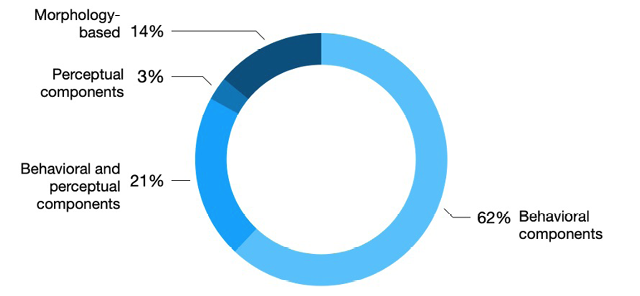
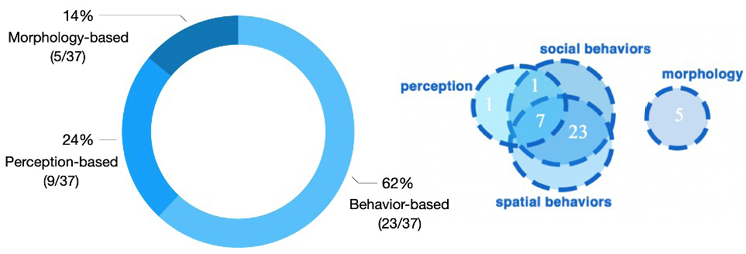
Preference rates show that behaviour patterns are the most significant components, with 83% of the sample participating, while 21% of those are perception-based studies, as shown in Fig. 10. The remaining studies focusing on morphology discuss their predictability through syntactic patterns despite often neglecting them (Rashid and Zimring, 2003; Shpuza, 2003; Shpuza and Peponis, 2005; Wineman and Adhya, 2007; Bafna and Ramash, 2007; Sailer et al., 2012). Although occupancy and movement studies frequently overlap, one to five studies observing one element disregarded the other. Conversely, studies focusing solely on occupancy patterns addressed similar issues without incorporating movement patterns, such as working and interaction behaviours (Lu et al., 2009; Beck, 2012; 2013; 2015; Yenel-Güler and Demirkan, 2022). Meanwhile, studies concentrating only on movement patterns explored the relationship between organisational hierarchy, workflow, and spatial configuration (Sailer, 2007; Sailer and Penn, 2009; Markhede and Carranza, 2007; Koch and Steen, 2012b). Notably, interaction is the most prominent topic, appearing more frequently than others, and is connected to all studies examining spatial behavioural patterns, linking them to interaction patterns.
Source: own work.
Within the scope of perceptual components, 9 out of 37 papers investigated correlations with the spatial environment, while eight of them also observed behaviour patterns to analyse the social environment more accurately, as shown by the schema in Fig. 11. Therefore, major topics relate to interaction and social environment, such as sense of security, safety, territoriality, communality, communication, hierarchy, privacy, control, comfort, social support, and the usefulness of interactions. While privacy is mentioned most frequently, 6 out of 9 papers address it, and three papers investigate perceptions of the physical environment (Beck, 2012; 2013; 2015), while another three examine the usefulness of the interactions (Penn et al., 1997; Sailer et al., 2007; 2009); their researchers are related.
Lastly, there are five studies in the selected sample that ignore social patterns, which are referred to as morphology-based studies in this review (Shpuza, 2003; Rashid and Zimring, 2003; Shpuza and Peponis, 2005; Bafna and Ramash, 2007; Sailer et al., 2012), as shown in the schema in Fig. 11. Although they focus on relationships such as daylight, floorplate shape, spatial hierarchy, spatial efficiency, workstation allocation, workstation density, and floor plate, they assume that these spatial factors may not always predict use patterns and social interactions. Since these studies adopt a comparative approach with the highest number of cases—ranging from 62 to the lowest of 7—their findings may have some degree of generalisability.
Overall, these preference patterns indicate that social components maintained their significance over time. For example, morphology-based studies are subjected only in 2003–2012, while behaviour patterns, observed through various methods, have become more prominent especially in the last decade. It also suggests that exploratory research may become more important with small case sets and detailed approaches over time, whereas morphology-based studies with large case numbers have shifted away from a focus on comparative approaches.
Source: own work.
4.2.2. Preference of data collection methods
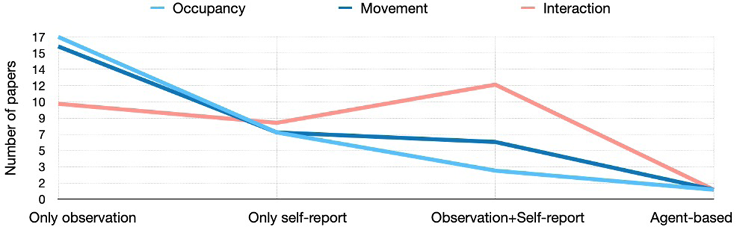
According to preference rates, behaviour patterns are the most important social aspects examined in WP studies at the SSS. For example, occupancy and movement patterns were analysed in 70% of the sample, with different variations, while interaction patterns were examined in 84%, 31 out of 37 papers. Studies mostly preferred combining methods, with about one-third (12/37) using different methods for different behaviour patterns, or observing twice with different methods in some cases, as shown in Fig. 12. About one-fourth (9/37) relied solely on field observation, and one-sixth (6/37) employed various self-report techniques such as handwritten logs or digital records kept by participants.
Regarding occupancy patterns, the field observation technique was used in half of the sample, including two studies that utilised digital recordings complemented by ethnographic methods (Wineman et al., 2013; Pachilova et al., 2017). Similarly, movement patterns were observed on-site in 59% (22/37) of cases, with two studies collecting data via digital badges (Wineman et al., 2013; Pachilova et al., 2017), and four studies supported by self-reported data (Penn et al., 1997; Koch and Steen, 2012; Markhede and Carranza, 2007; Pachilova et al., 2017). While digital badges or devices recorded movement patterns, occupancy locations, and interactions, project or publication partnerships are used to objectively observe social and collaboration networks within organisations (Wineman et al., 2013). Conversely, interaction patterns were directly observed in 64% (24/37), with more than half of these incorporating self-reported techniques. Three studies used survey methods to infer space use habits (Beck, 2012; 2013; 2015), while one relied exclusively on prospective interaction data that employees self-reported as part of their work habits (Sailer et al., 2007).
Additionally, agent-based analysis was used to simulate behaviour patterns in a study (Wackernagel, 2017). Compared to behavioural components, very few methods were used for perceptional components in the sample. Because perception is subjective and intrinsic data, a self-report approach was preferred, and Likert-type questionnaire surveys were mainly used for quantifiable data—except for one study, like one tenth, which employed interviews to assess perceptions of privacy (Lehrer-Melamed and Fisher-Gewirtzman, 2017). Besides another study that collected only perceptual data as a social component (Wineman and Adhya, 2007), all perception studies also examined correlations with behaviour patterns. Half of them used observations (Penn et al., 1997; Rashid et al., 2005; Sailer et al., 2009; Lehrer-Melamed and Fisher-Gewirtzman, 2017), and the other half relied on self-report (Sailer, 2007; Beck, 2012; 2013; 2015) to find correlations. Therefore, it can be said that exploring the links between perceptual, behavioural, and spatial components is a key issue for this community.
Finally, as a standard practice, morphology studies that discuss configurational patterns without examining social outcomes did not use any methods for social data collection. However, they analysed the relationships between various spatial needs of organisations, such as daylight, spatial efficiency, and interactive environments. They argued that behavioural patterns might not be predicted solely based on spatial configuration (Bafna and Ramash, 2007; Shpuza and Peponis, 2005).
Source: own work.
Overall, social data was collected through two main methods in the selected sample: self-report and direct observation. While each has specific pros and cons, they are used to identify social patterns and relate them to spatial patterns in WPs. Compared to on-field observation, self-report methods were debated regarding scientific reliability due to limited sample sizes and personal biases, but they remained relevant because they were time-saving, manageable, and effective for data that direct observational techniques often find hard to capture due to security, time, and privacy issues (Rashid et al., 2005; Steen, 2009). As a result, the use of ethnographic techniques for behaviour patterns have decreased, while on-field observation has increased over time. Although preferences have shifted, both methods were mainly used together either for different types of data or the same data to minimise technical limitations.
4.3. Rates of socio-spatial analysis and patterns of spatial and social data
Socio-spatial analyses are regression analyses of collected social and spatial data aimed at revealing their interrelationships and causal connections. Common patterns of components, such as behaviour patterns and syntactic properties, were preferred when discussing the socio-spatial environment of WPs in the selected sample.
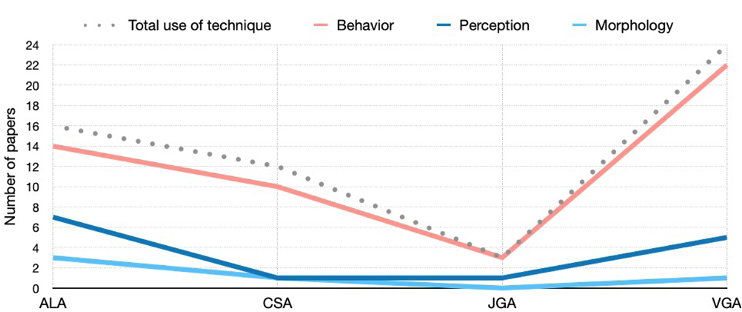
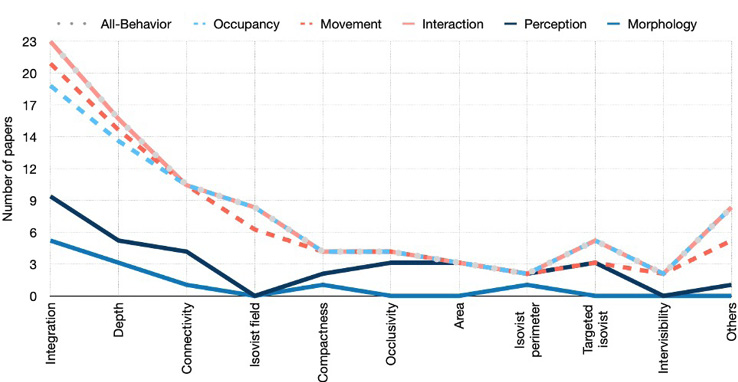
For instance, the preference rates of components in behavioural research are highly responsive to overall preference rates, since they constitute the majority. The preference rates of spatial analysis techniques in behavioural research are nearly the same as the general preference rates shown in Fig. 13. Furthermore, the preference rates of syntactic metrics in general are also very similar to those in behaviour studies, as shown in Fig. 14. Their preference rates over the years are also similar, such as VGA being the most used technique in behaviour-based studies, while integration, depth, and connectivity are leading metrics. However, different behavioural patterns correlate with different syntactic metrics. For example, interaction is studied in greater detail compared to spatial behaviours and is linked to all spatial properties in the sample. Similar findings are observed in occupancy; movement patterns are correlated with fewer spatial properties. For instance, the isovist field, ranked fourth in preference, is often correlated with co-presence and interaction patterns through alternative approaches like different scopes of visibility.
Source: own work.
Source: own work.
On the other hand, although most perception studies were conducted after VGA was developed, ALA remains the most popular technique in the selected sample. For example, seven of nine studies, almost 80%, used ALA, while VGA was used in half of the studies and was the second most popular, as shown in Fig. 13. Additionally, JGA and CSA are used only once, mainly to support ALA or VGA (Penn et al., 1997; Lehrer-Melamed and Fisher-Gewirtzman, 2017).
Conversely, preference rates for syntactic metrics are comparable to the overall preference rates, with similar rankings. Integration, depth, and connectivity are the primary metrics, with integration used in all these studies. The remaining five properties utilised in perception studies were examined in three papers related to the same study, evaluating exposure, surveillance, and intelligibility (Beck, 2012; 2013; 2015).
Similarly, on the one hand, morphological studies predominantly preferred ALA exclusively in three of the five studies in the selected sample, even though they were conducted after VGA between 2003 and 2012. VGA and a specific method, on the other hand, were used once in the remaining two studies. While only one of each spatial analysis technique is preferred in these studies, only four syntactic properties were measured in the sample, with the ranking of preference rates being identical to the general preference rates, as shown in Fig. 14. While integration is used in all, depth is used in three out of five, and connectivity and compactness are used only once. According to this, integration and depth—opposite configurational patterns—are dominant for identifying morphological patterns. Furthermore, the relationship between spatial hierarchy and organisational hierarchy is discussed, particularly through these properties, regarding potential behaviour and interaction patterns (Rashid et al., 2005; Wineman and Adhya, 2007; Beck, 2012; 2013; 2015).
4.4. Findings of socio-spatial analysis
In summary, the findings indicate that space syntax analysis can provide valuable insights into how office design decisions influence organisational, behavioural, and perceptual dynamics within a workspace. However, some conclusions are questionable due to ongoing development of more rigorous technical, methodological, and conceptual approaches.
In the first quarter, between 1997 and 2001, studies involving SSS 1–3 employed elemental spatial properties, such as integration and depth, with ALA as the main analysis technique, and included on-field observations of behaviour patterns, except for one study. Perceptual components were observed through self-report techniques in another study (Penn et al., 1997; Wineman and Serrato, 1997; Spiliopoulou and Penn, 1999; Steen, 2001). All four papers supported the idea that integrated spatial configurations often promote greater interaction and knowledge sharing. They also highlighted the perceived usefulness of interactions alongside organisational status, emphasising that spatial design remains a key factor in shaping organisational behaviour despite telecommunications.
In the second quarter, between 2003 and 07, SSS 4–6, the use of space syntax and social components remained quite similar to the first quarter, with VGA also present and used in four out of six behaviour-based studies during this period, representing a quarter of the 11 papers. However, morphology-based studies were prominent during this period, with four papers, making up 80% of morphology-based studies in the overall sample. All of these studies preferred ALA for integration, along with depth, connectivity, or compactness, except for one that developed its own metrics and analysis method (Shpuza, 2003). These studies indicated that spatial configuration and organisational structure influence communication, privacy, territoriality, and movement accessibility (Rashid and Zimring, 2003), and that spatial depth and global integration impact flexibility, visibility, and interaction potential (Shpuza, 2003). Conversely, later research on office layout and workstation density showed that, although morphology alone poorly predicts behaviour, it still helps with space efficiency and workstation allocation (Shpuza and Peponis, 2005; Bafna and Ramash, 2007). Additionally, one-third of perception-based studies from this period focus on morphology rather than behaviour patterns, finding correlations between syntactic properties and user perception based on several psychosocial factors (Wineman and Adhya, 2007). The other perception-based studies involving behaviour patterns revealed that spatial configuration indirectly influences perceptions such as privacy, control, satisfaction, safety, and autonomy, as well as social behaviours like collaboration, by affecting spatial behaviour patterns (Rashid et al., 2005; Sailer et al., 2007). Finally, earlier VGA-based behaviour research in this sample found that spatial configuration may facilitate movement but does not always lead to increased interaction when organisational culture intervenes (Steen et al., 2003). Similarly, evidence- based design research has shown that spatial redesign can reshape organisational culture, as changing space often alters behaviour patterns (Sailer, 2007; Sailer et al., 2007). However, complementary approaches, such as positioning analysis and prototype tools like SPOT, argued that visibility, intervisibility, and movement structures influence interaction (Markhede and Koch, 2007; Markhede and Carranza, 2007).
In the third quarter, between 2009 and 13, SSS 7–9, there are noteworthy changes in the use of space syntax, social data, and methods. For instance, self-report techniques for behaviour patterns are used only as much as solo observation and combinations, with one third of 11 papers employing one of each. Moreover, the reliance on earlier methods declined, and studies began applying more refined techniques and additional syntactic properties due to VGA. Eventually, isovist-based metrics such as the isovist field in different scopes and directions became in demand, affecting interaction according to organisational role, perception, and behaviour, with better workstation orientation, visibility, and layout linked to higher satisfaction and increased interaction through various metrics (Lu et al., 2009; Beck, 2012; 2013). However, another study found that central position in a social network supported collaboration, while spatial depth or isolation supported productivity (Wineman et al., 2013). Other research revealed that interaction patterns are influenced by formal ties and schedules (Appel-Meulenbroek, 2009; Beck, 2012; 2013). Additionally, continuation of evidence-based studies, including the only study with ALA in this period, reports similar findings as the previous quarter – such as changing spatial configurations helping to increase collaborativeness (Sailer and Penn, 2009; Sailer et al., 2009). Lastly, besides the perception-based studies in the second and third parts of this period, the final morphology-based study of this quarter revealed that elemental syntactic metrics like integration are shaped by factors such as the number of floors, circulation layout, and the proportion of open space, based on an analysis of more than sixty office buildings (Sailer et al., 2012).
In the last quarter, in 2015–22, or SSS 10–13, the use of space syntax has evolved from just techniques to also include more metrics, with a focus on behaviour research—11 studies in this period concentrated on this. Most studies increased field observation, except for one that was the only agent-based study simulating behaviour patterns within the sample, finding that certain configurational patterns influence perceptual factors like control, privacy, and protection (Wackernagel, 2017). Conversely, research shows that spatial layout does not always boost interaction. For instance, while corridor width, visibility, and circulation patterns affect interaction, results suggest that high visibility may actually decrease work-related interactions if visual privacy is compromised (Yenel Güler and Demirkan, 2022; Lehrer-Melamed and Fisher-Gewirtzman, 2017; Beck 2015). Still, other studies using multiple syntactic properties have found that spatial layout can significantly shape behaviours and user satisfaction, especially when balancing open and enclosed spaces (Sakr et al., 2015; Koutsolampros et al., 2015; Koutsolampros et al., 2017; Koutsolampros et al., 2019; Yenel-Güler and Demirkan, 2022).
Overall, these studies highlight the complex relationship between spatial design and organisational factors, emphasising the need to understand both spatial and social elements thoroughly. While earlier research suggested that more integrated spatial layouts tend to promote greater interaction and knowledge sharing, later studies reveal that spatial integration does not always lead to increased interaction due to organisational influences. Therefore, while spatial configuration can influence employee behaviour, organisational factors such as hierarchical culture and structure generally have a stronger impact. This confirms that space syntax provides a foundation and toolkit for understanding the connection between spatial and social factors and employee behaviour.
Additionally, several factors influence research findings, including social and spatial aspects, as well as methods. Preference for ALA has diminished significantly in behaviour studies due to the development of VGA and is now primarily used in morphology-based research. Moreover, the limited metric options of ALA are another disadvantage compared to VGA for detailed analyses. Furthermore, ALA-based analyses typically support space syntax theory and confirm links between spatial configuration and aspects of behaviour, perception, and organisation, despite some mixed results. Conversely, VGA studies have produced different outcomes by employing more advanced techniques and concepts, such as agent-based analysis and new syntactic properties. Similarly, these conflicting results underscore the complex relationship between spatial design, behaviour, and perception.
4.5. Results
Space syntax has become a key method in workplace architecture research, progressing from basic spatial metrics to more comprehensive approaches that incorporate behaviour and perception. This review of WP studies from the SSS 1st to 13th shows evolving priorities in spatial techniques and user-centred insights.
Briefly, space syntax suggests that behavioural patterns are social structures stemming from spatial arrangements and offers a supplementary method to its theoretical foundation. Based on this, WP studies generally focus on actual and potential behaviour patterns to explore how spatial and social variables impact employee conduct. This review shows evolving priorities in spatial techniques and user-centred insights.
In this sample, social behaviours such as interaction received more emphasis than spatial behaviours, with almost all spatial patterns being examined for their correlation with social behaviour patterns. Moreover, they are believed to be products of spatial behaviours and perception; thus, the correlations with these factors are also widely investigated. Besides, perceptual aspects such as privacy, satisfaction, and awareness have gained attention in recent years, but are still inconsistently addressed. Nevertheless, one in seven studies in the sample ignored actual behaviour patterns but estimated them through spatial morphology.
Researchers have employed a variety of observational and ethnographic methods to study these behaviours, with observational data becoming more common over time because it carries more credibility. However, two key morphological characteristics significantly affecting how people move, occupy, and interact in space are identified: visibility and accessibility, with visibility being preferred roughly twice as much. The choice of these characteristics depends on specific research goals and the advantages each offers in measuring spatial data and its impact on occupant behaviour and social patterns.
Additionally, variables and research methods have evolved over time. While CSA and JGA assisted other techniques throughout, ALA was the dominant analysis method in the first decade, primarily focusing on a few basic syntactic properties. Subsequently, VGA was developed and has taken the lead, utilising various specified syntactic properties in studies. This shift also influenced the main research questions and results, providing more detailed and comprehensive information about spatial configuration. For example, factors such as co-presence and visibility fields which is a crucial factor in perception, space usage, and knowledge-sharing environments. Similarly, different syntactic properties like occlusivity, maximum radial, isovist perimeter, area, control, and entropy are examined in relation to behaviours and perception. However, while VGA generally offers more detailed measurements, it showed less correlation with behavioural patterns, whereas ALA analyses often revealed positive or negative, weak or strong correlations. This is also questionable.
Furthermore, although several syntactic properties were measured, only a few were used commonly, and the greater the number of properties, the less significant the correlations. Lastly, an exploratory and comparative approach prevailed, helping to identify differences resulting from organisational or spatial setups and seeking to uncover causality between spatial arrangements and behaviour.
All in all, the field has experienced three identifiable phases chronologically. From the 1990s to the early 2000s, studies were dominated by ALA and CSA with a focus on movement and direct interaction. In the mid-2000s, researchers began integrating perceptual and psychosocial variables and adopting more diverse methods, including VGA and their experimental techniques. Since the 2010s, attention has shifted toward visibility, awareness, and organisational culture, accompanied by greater use of mixed methods and larger sample sizes. Despite the extent and workload of the observation methods, some of them analysed behaviours as well. This progression mirrors changes in workplace design from cellular and hierarchical setups to open, flexible, and user-centric environments and reflects a broader transition in space syntax from measuring spatial efficiency to evaluating spatial experience.
Overall, the preferences in technical, methodological, and social aspects of WP studies at the SSS followed certain patterns, showing clear progress and common yet debatable results.
5. Discussion
Space syntax has advanced architectural understanding of workplace environments by offering empirical tools that reveal how spatial configuration influences social behaviour and perception. The adoption of visibility graph analysis (VGA) and perceptual metrics aligns with contemporary priorities like visibility, autonomy, and collaboration. The field has matured methodologically, shifting from single-case studies to broader, mixed-method research incorporating real-time analytics and sensor-based tools.
Despite this progress, several challenges remain. Most studies are descriptive, lacking predictive power or causal inference. While VGA is increasingly used, it is not consistently integrated with other spatial models like topological analysis. Behavioural components are often cited but insufficiently contextualised, and perceptual measures remain inconsistently defined. User diversity, such as age, gender, or neurodivergence, is rarely addressed. Furthermore, large-sample studies are limited, hindering the development of generalisable workplace typologies.
Pre- and post-occupancy studies are common but lack standardised evaluation frameworks and long-term tracking. Future research should refine these methods, adopt structured evidence-based approaches, and incorporate digital tools for dynamic behavioural insight. Overall, space syntax research is evolving toward multi-dimensional analysis, but future progress depends on methodological rigor, inclusion, and alignment with organisational realities.
Briefly, workplace studies in space syntax have evolved from simple spatial-behavioural correlations to complex, multi-dimensional analyses that integrate spatial, social, and experiential data. This trajectory reflects not only advances in analytical tools but also a deepening understanding of how space influences, and is influenced by, organisational life. Strengthening methodological rigor and embracing diversity in data and users will be critical to future progress.
This systematic review provides a focused synthesis of workplace-oriented space syntax research, offering an in-depth assessment of how spatial techniques such as axial analysis and visibility graph analysis have been applied to understand interaction, movement, occupancy, and perception in office environments. Unlike broader studies such as Askarizad et al. (2024), which focus on sociability in public spaces, or Lee et al. (2023), which span diverse domains, this review delivers typological specificity and architectural relevance. It complements bibliometric overviews like Mohamed and Yamu (2024) by illustrating how shifts toward experiential metrics are reflected in empirical workplace studies. Similarly, it extends the thematic mapping of Krenz et al. (2019) by translating conceptual trends into methodological patterns across nearly three decades. The use of a PRISMA protocol enhances transparency, while the introduction of a novel research component framework enables systematic comparison across spatial and social dimensions. Although limited to SSS papers, this focus ensures thematic consistency and highlights evolving design priorities. The study also identifies persistent gaps, such as inconsistent treatment of perception, underuse of evaluative frameworks, and minimal attention to user diversity. While the framework would benefit from further validation and expansion to newer data sources (e.g., digital behaviour or hybrid models), this review establishes a rigorous and practice-relevant foundation for advancing space syntax research in workplace architecture.
The findings of this review align with prior research in highlighting visibility and spatial integration as key drivers of interaction, echoing conclusions in Askarizad et al. (2024) and Lee et al. (2023). However, this study reveals that in workplace contexts, behavioural components like movement and occupancy are less consistently analysed, and perceptual factors—while increasingly present—remain underdeveloped. Unlike earlier reviews that emphasise thematic or disciplinary trends, this review shows a clear methodological shift from axial to VGA and growing, yet uneven, interest in user experience. It uniquely demonstrates how these spatial-social pairings vary across case scales and periods, offering more nuanced architectural insights.
In practice, these findings offer practical guidance for workplace design and management. Companies can use this information to create spaces that foster collaboration, boost efficiency, and increase employee satisfaction. However, it is important to recognise that optimal design solutions depend on each organisation’s unique culture and needs.
Limitations of this review include a focus on traditional office layouts and the inclusion of only English-language sources, which may not fully reflect current trends such as remote and hybrid work.
Future research should focus on longitudinal studies to evaluate how office design influences organisations over time and explore cultural and industry-specific differences.
6. Conclusions
This study provides the first systematic, PRISMA-guided review of workplace-oriented space syntax research, filling a significant gap in the literature. Focusing on workplace research presented at the Space Syntax Symposia, it reveals important insights into how spatial design influences employee behaviour. Reviewing 37 relevant studies, it demonstrates that space syntax provides a strong theoretical and methodological foundation for exploring how office layouts relate to organisational dynamics.
Yet narrowing scope to the SSS brings generalisability and bias risks within, it also brings a consistency in some ways such as quality issues across studies that are evaluated together. Besides, its core strength lies in its combination of methodological rigor and architectural specificity; it goes beyond thematic aggregation to classify, quantify, and compare how spatial metrics are paired with behavioural and perceptual outcomes across nearly three decades of research. The structured framework it introduces offers a replicable model for future systematic reviews within architecture and environmental behaviour studies.
The review also identifies critical field-wide gaps: limited integration of spatial and social models, underrepresentation of diverse user profiles, and a lack of evidence-based or pre/post-evaluation methods. Addressing these gaps is essential for advancing space syntax as a predictive, evaluative, and inclusive design tool. By consolidating empirical knowledge within a practical, theory-informed structure, this review makes a timely and valuable contribution to the architectural research community, with strong relevance for both scholars and practitioners navigating the future of workplace design. Likewise, it highlights progress in research methods over time, with more sophisticated spatial analyses and data collection techniques emerging. Lastly, the findings emphasise that the interaction among physical space, organisational factors, and employee behaviours is highly complex.
All in all, this review offers a foundation for future research by clarifying which spatial and social variables are well-studied and which remain underexplored. It supports more informed methodological choices and highlights gaps in user diversity and evaluation. Future studies should further develop space syntax approaches while recognising the essential role of social and cultural influences in shaping how office spaces function and are perceived. For design, it provides empirical guidance to create more responsive, inclusive workplace environments.
Acknowledgements. The authors received no financial support for the research, authorship, and/or publication of this article. The authors declare that there are no conflicts of interest.
Autorzy
REFERENCES
ASKARIZAD, R., LAMÍQUIZ DAUDÉN, P. J. and GARAU, C. (2024), ‘The Application of Space Syntax to Enhance Sociability in Public Urban Spaces: A Systematic Review’, ISPRS International Journal of Geo-Information, 13, 227. https://doi.org/10.3390/ijgi13070227
BAFNA, S. and RAMASH, R. (2007), ‘Designing the Spatial Syntax of Office Layouts’, Proceedings of the 6th International Space Syntax Symposium, Istanbul.
BECK, M. P. (2012), ‘The Role of Space Towards Intelligibility and Comfort in Justice Facilities’, Proceedings of the 8th International Space Syntax Symposium, Santiago de Chile.
BECK, M. P. (2013), ‘Visibility and Exposure in Workspaces’, Proceedings of the 9th International Space Syntax Symposium, Seoul.
BECK, M. P. (2015), ‘Slicing the Cake: An Isovist-Based Analysis of Computerised Workplace Configuration’, Proceedings of the 10th International Space Syntax Symposium, London.
BENEDIKT, M. L. (1979), ‘To Take Hold of Space: Isovists and Isovist Fields’, Environment and Planning B: Planning and Design, 6 (1), pp. 47–65. https://doi.org/10.1068/b060047
BENEDIKT, M. L. and MCELHINNEY, S. (2019), ‘Isovists and the metrics of architectural space’, Proceedings 107th ACSA annual meeting, pp. 1–10, Pittsburgh, PA: Association of Collegiate Schools of Architecture: Pittsburgh, PA, USA.
BURDET, R. (1997), ‘Welcome to the Symposium and Introduction of Sir Norman Foster’, Proceedings of the 1st International Space Syntax Symposium, London.
DAVIS, J., MENGERSEN, K., BENNETT, S. and MAZEROLLE, L. (2014), ‘Viewing Systematic Reviews and Meta-Analysis in Social Research Through Different Lenses’, SpringerPlus, 2014, 3, 511. https://doi.org/10.1186/2193-1801-3-511
DAWES, M. J. and OSTWALD, M. J. (2018), ‘Space Syntax: Mathematics and the Social Logic of Architecture’, [in:] SRIRAMAN, B. (ed.), Handbook of the Mathematics of the Arts and Sciences, Cham: Springer International Publishing AG, part of Springer Nature. https://doi.org/10.1007/978-3-319-70658-0_6-1
GREENE, M., REYES, J. and MORA, R. (2012), ‘News: JOSS, Vol. 3, Issue 1: Eighth International Space Syntax Symposium’, The Journal of Space Syntax, 3 (1), pp. 150–154.
HAJO, H. (2022), ‘The Future of Innovative Workplaces: A socio-spatial investigation of interaction patterns in accelerator and incubator workplaces’, Proceedings of the 13th Space Syntax Symposium, Bergen.
HILLIER, B. (2007), Space Is the Machine: A Configurational Theory of Architecture, London: Space Syntax, Electronic Edition.
HILLIER, B. and HANSON, J. (1984), The Social Logic of Space. Cambridge, New York: Cambridge University Press. http://dx.doi.org/10.1017/CBO9780511597237
HILLIER, B. and HANSON, J. (1997), ‘The Reasoning Art: or, the Need for an Analytical Theory of Architecture’, Proceedings of the 1st International Space Syntax Symposium, London.
KARIMI, K. (2016), ‘The Shifting Paradigm of Space Syntax Research and its Future Prospects: A Reflection on the 10th International Space Syntax Symposium in London, 2015’, The Journal of Space Syntax, 6 (2).
KOCH, D. and STEEN, J. (2012a), ‘Analysis of Strongly Programmed Workplace Environments – Architectural configuration and time-space properties of hospital work’, Proceedings of the 8th International Space Syntax Symposium, 13.
KOCH, D. and STEEN, J. (2012b), ‘Decomposing Programmes. Re‐coding Hospital Work with Spatially Syntactic Information’, Proceedings of the 8th International Space Syntax Symposium, Santiago de Chile.
KOUTSOLAMPROS, P., SAILER, K., HASLEM, R., AUSTWICK, M. Z. and VAROUDIS, T. (2017), ‘Big Data and Workplace Micro-Behaviours: A Closer Inspection of the Social Behaviour of Eating and Interacting’, Proceedings of the 11th Space Syntax Symposium, Lisbon.
KOUTSOLAMPROS, P., SAILER, K., POMEROY, R., AUSTWICK, M. Z., HUDSON-SMITH, A. and HASLEM, R. (2015), ‘Spatial Databases: Generating New Insights on Office Design and Human Behaviours in the Workplace’, Proceedings of the 10th International Space Syntax Symposium, London.
KOUTSOLAMPROS, P., SAILER, K., VAROUDIS, T. and HASLEM, R. (2019), ‘Dissecting Visibility Graph Analysis: The Metrics and Their Role in Understanding Workplace Human Behaviour’, Proceedings of the 12th Space Syntax Symposium, Beijing.
KRENZ, K., PSARRA, S. and NETTO, V. M. (2019), ‘The Anatomy of Knowledge: Quantitative and Qualitative Analysis of the Evolution of Ideas in Space Syntax Conference Articles (1997–2017)’, Proceedings of the 12th Space Syntax Symposium, Beijing.
LEE, J. H., OSTWALD, M. J. and ZHOU, L. (2023), ‘Socio-Spatial Experience in Space Syntax Research: A PRISMA-Compliant Review’, Buildings, 2023, 13, 644. https://doi.org/10.3390/buildings13030644
LEHRER-MELAMED, R. and FISHER-GEWIRTZMAN, D. (2017), ‘The Balance Between Physical Closure and Openness in Office Workspace and the Relation of the Interaction Between Workers and Their Need for Privacy’, Proceedings of the 11th Space Syntax Symposium, Lisbon.
LU, Y., PEPONIS, J. and ZIMRING, C. (2009), ‘Targeted Visibility Analysis in Buildings Correlating Targeted Visibility Analysis with Distribution of People and Their Interactions within an Intensive Care Unit’, Proceedings of the 7th International Space Syntax Symposium, Stockholm.
MARKHEDE, H. and CARRANZA, P. M. (2007), ‘Spatial Positioning Tool: A prototype software and some background correlation data’, Proceedings of the 6th International Space Syntax Symposium, Istanbul.
MARKHEDE, H. and KOCH, D. (2007), ‘Positioning Analysis: social structures in configurative modelling’, Proceedings of the 6th International Space Syntax Symposium, Istanbul.
MARKUS, T. A. (1993), Buildings and Power Freedom and Control in the Origin of Modern Building Type, NEW YORK: Routledge.
MARKHEDE, H. and STEEN, J. (2008), Creativity demands new office designs. Proceedings, CIB W70, European Facility Management Conference, Healthy and Creative Facilities, Edinburgh, pp. 313–320.
MOHAMED, A. A. and YAMU, C. V. (2024), ‘Space Syntax has Come of Age: A Bibliometric Review from 1976 to 2023’, Journal of Planning Literature, 2024, 39 (2), pp. 203–217.
MOHER, D., LIBERATI, A., TETZLAFF, J. and ALTMAN, D. G. (2009), ‘Preferred reporting items for systematic reviews and meta-analyses: the PRISMA statement’, BMJ 2009, 339. https://doi.org/10.1136/bmj.b2535
OSTWALD, M. J. (2011), ‘The Mathematics of Spatial Configuration: Revisiting, Revising and Critiquing Justified Plan Graph Theory’, Nexus Network Journal, 13, pp. 445–470. https://doi.org/10.1007/s00004-011-0075-3
PACHILOVA, R., SAILER, K. and KING, M. (2017), ‘The Dynamic Nature of Caregiver Communication Networks and Spatialised Work Processes in Hospital Wards’, Proceedings of the 11th International Space Syntax Symposium, 18.1–18.9.
PAGE, M., MCKENZIE, J., BOSSUYT, P., BOUTRON, I., HOFFMANN, T. and MULROW, C., (2021), ‘The PRISMA 2020 statement: An updated guideline for reporting systematic reviews’, BMJ 2021, 372, 71. https://doi.org/10.1136/bmj.n71
PENN, A., DESYLLAS, J. and VAUGHAN, L. (1997), ‘The Space of Innovation: Interaction and Communication in the Work Environment’, Proceedings of the 1st International Space Syntax Symposium, London.
PRISMA Executive, PRISMA 2020 flow diagram for new systematic reviews which included searches of databases and registers only, https://www.prisma-statement.org/prisma-2020-flow-diagram [accessed on: 27.07.2025].
RASHID, M. and ZIMRING, C. (2003), ‘Organizational constructs and the structure of space: A comparative study of office layouts’, Proceedings of the 4th International Space Syntax Symposium, London.
RASHID, M., ZIMRING, C., JEAN WINEMAN, F. T., NUBANI, L. and HAMMASH, R. (2005), ‘The Effects of Spatial Behaviors and Layout Attributes on Individuals’ Perception of Psychosocial Constructs in Offices’, Proceedings of the 5th Space Syntax Symposium, Delft.
SAILER, K. (2007), ‘Movement in Workplace Environments: Configurational or Programmed?’, Proceedings of the 6th International Space Syntax Symposium, İstanbul.
SAILER, K. and PENN, A. (2009), ‘Spatiality and Transpatiality in Workplace Environments’, Proceedings of the 7th International Space Syntax Symposium, Stockholm.
SAILER, K. and THOMAS, M. (2019), ‘Correspondence and Non-Correspondence: Using office accommodation to calculate an organization’s propensity for new ideas’, Proceedings of the 12th Space Syntax Symposium, Beijing.
SAILER, K., BUDGEN, A., LONSDALE, N., TURNER, A. and PENN, A. (2007), ‘Effective Workplaces: bridging the gap between architectural research and design practice’, Proceedings of the 6th International Space Syntax Symposium, Istanbul.
SAILER, K., BUDGEN, A., LONSDALE, N., TURNER, A. and PENN, A. (2009), ‘Comparative Studies of Offices Pre and Post How Changing Spatial Configurations Affect Organisational Behaviours’, Proceedings of the 7th International Space Syntax Symposium, Stockholm.
SAKR, F. L., PACHILOVA, R., HUTCHINSON, P. and MACGADIE, C. (2015), ‘Elements of design in workplace environment: Pre and post studies’, Proceedings of the 10th International Space Syntax Symposium, London.
SCOPUS, https://www.scopus.com [accessed on: 21.11.2024]. Search query: TITLE-ABS-KEY (“space syntax” AND (office OR workplace OR workspace)).
SHARMIN, S. and KAMRUZZAMAN, M. (2018), ‘Meta-analysis of the relationships between space syntax measures and pedestrian movement’, Transport Reviews, 2018, 38 (4), pp. 524–550. https://doi.org/10.1080/01441647.2017.1365101
SHPUZA, E. and PEPONIS, J. (2005), ‘Floorplate Shapes and Office Layout’, Proceedings of the 5th International Space Syntax Symposium, Delft.
SNYDER, H. (2019), ‘Literature review as a research methodology: An overview and guidelines’, Journal of Business Research 104 (2019) pp. 333–339. https://doi.org/10.1016/j.jbusres.2019.07.039
SPACE SYNTAX NETWORK, Symposia Database, https://www.spacesyntax.net/symposia [accessed on: 20.10.2024].
SPILIOPOULOU, G. and PENN, A. (1999), ‘Organisations as Multi-layered Networks: Face to Face, e-mail and Telephone Interaction in the Workplace’, Proceedings of the 2nd International Space Syntax Symposium, London.
STEEN, J. (2001), ‘The Office: Form and Space for Action’, Proceedings of the 3rd International Space Syntax Symposium, Atlanta.
STEEN, J. (2009), ‘Spatial and Social Configurations in Offices’, Proceedings of the 7th International Space Syntax Symposium, Stockholm.
STEEN, J. and BLOMBERGSSON, M. W. (2003), ‘Useful Spatial Systems for Office Activities’, Proceedings of the 4th Space Syntax Symposium, London.
STEEN, J. (2010), Offices – the need to design both the spatial and social configuration in new ways. CIB W070 International Conference in Facilities Management, 203–211.
TURNER, A. (2001), ‘Depthmap: A program to perform visibility graph analysis’, Proceedings of the 3rd International Space Syntax Symposium, Atlanta.
WACKERNAGEL, S. (2017), ‘Combining Environmental Psychology and Space Syntax Analysis: The extent of users’ well-being influencing variables control, protection and privacy in an open plan office’, Proceedings of the 11th Space Syntax Symposium, Lisbon.
WEB OF SCIENCE CORE COLLECTION, https://www.webofscience.com; [accessed on: 20.10.2024]. Search query: space syntax (Topic) AND “workplace” or “workspace” or “office” (Topic).
WINEMAN, J. and SERRATO, M. (1997), ‘Enhancing Communication In Lab-Based Organisations’, Proceedings of the Space Syntax First International Symposium.
WINEMAN, J. and ADHYA, A. (2007), ‘Enhancing Workspace Performance: predicting the influence of spatial and psychosocial factors on job satisfaction’, Proceedings of the 6th International Space Syntax Symposium, İstanbul.
WINEMAN, J., HWANG, Y., KABO, F., OWEN-SMITH, J. and DAVIS, G. (2013), ‘Spatial Layout, Social Networks and Innovation in Organizations’, Proceedings of the 9th International Space Syntax Symposium, Seoul.
YENEL-GÜLER, G. and DEMIRKAN, H. (2022), ‘The Effects of Visual Privacy on Work-Process Interactions in Open-Plan Offices a Computational Approach to Measure Interaction, Generic and Targeted Visibility’, Proceedings of the 13th Space Syntax Symposium, Bergen.