
At the bottom and top of the educational system: spatial patterns of highest educational attainment based on the Hungarian census of 2022
András BÉRES  *
*
Éva MÁTÉ *
Helga ANDL *
Abstract. This study examines the spatial patterns of educational attainment in Hungary using settlement-level data from the 2022 census, focusing on individuals with at most lower secondary (ISCED 0–2) and tertiary education (ISCED 5–8). A two-stage analysis – bivariate choropleth mapping and Optimised Hot Spot Analysis – revealed pronounced regional inequalities. A comparison of the 2011 and 2022 census data shows a nationwide decline in low attainment and growth in tertiary education, especially in urban areas. However, peripheral regions remain disadvantaged. These findings highlight the uneven spatial effects of educational expansion, reinforcing the need for territorial-specific education and development policies.
Key words: educational attainment, spatial inequality, Hot Spot analysis, Hungarian census, geography of education, spatial statistics.
1. Introduction
The spatial distribution of educational attainment raises crucial social and economic issues, underlying numerous societal phenomena and determining various economic opportunities. Investigating spatial disparities in education enables a deeper understanding of the connections between social mobility, labour market dynamics, and regional development. The spatial patterns of educational attainment facilitate the examination of factors such as local human capital development, labour supply structures, and the resulting local economic potential; this paper endeavours to provide a detailed analysis of these factors.
The interrelations of the above factors can indirectly influence demographic trends (Bella and Charbit, 2022; Janssen et al., 2024), local economic activities, and long-term sustainability of settlements (Lucas, 1988). Based on the spatial distribution of various educational levels, we can infer the capacity of a region to attract and retain skilled labour, as well as its available economic development opportunities. Based on Hungarian data from the ISSP 2019 survey (Medgyesi and Tóth, 2022), educational attainment is a significant factor in relation to wages (Pearson’s r = .439, p < .001), while certain mediating factors, such as increased participation rates in higher education and openness to international trade, significantly reduce inequalities (Pop, 2023). However, in only a few cases did the proportion of higher educated inhabitants increase in peripheral areas, and even in such instances, it did not reinforce the local economy or social cohesion. Examples of counterurbanisation show that the relatively high immobility of intellectuals in rural peripheries often results in a more fragmented society, rather than stimulating local economic capital (Halfacree, 2006). Moreover, the lack of opportunity and increasing isolation in these regions mean that certain groups – especially the youth – are more likely to migrate from the countryside (Yarwood, 2023), as many young people are leaving rural areas to find jobs, go to school, and have new cultural experiences (Haugen and Villa, 2006; Stockdale, 2004). Numerous factors influence educational attainment, among which four stand out: socio-economic background, individual capabilities (cognitive abilities and interests), family environment, and school system-related factors (Guo, 2025; Langensee et al., 2024; Liu, 2024; Morris et al., 2016; Morris et al., 2021; Suleman et al., 2014). In terms of socio-economic background, parental socio-economic status (SES) and socialisation environments are particularly notable, with parental SES having been identified as a significant determinant of educational attainment (van Ewijk and Sleegers, 2010). Even more so, further research indicates that in educational choices, SES has a more decisive influence than individual abilities (Bittmann, 2022; O’Connell and Marks, 2022). Other recent studies have also shown that the father’s occupation is one of the strongest predictors (Låftman, 2008; Tsukahara, 2007), and the impact of other factors (e.g., parental education, number of siblings, and household income) also tends to vary by gender (McIntosh and Munk, 2007). The SES level of the broader environment, not just that of the immediate family, is also significant; students attending high schools with a higher average SES are more likely to attain higher education (Cattaneo et al., 2007; Maaz et al., 2008; Palardy, 2013; Stäbler et al., 2017). However, some studies dispute the role of environmental factors, suggesting that the composition of school populations (average performance or SES) has negligible direct effects on later educational pathways[1] (Vigdor and Ludwig, 2010; von Keyserlingk et al., 2020). Beyond parents’ educational level, stricter parenting styles and supplementary educational activities are also influential (Hintsanen et al., 2017), and cooperation between schools and parents also plays a crucial role. According to Pusztai et al. (2025), institutional practices supporting Family-School-Community Partnership (FSCP) significantly influence parental involvement, especially in families with lower SES. Active, targeted school practices can mitigate the disadvantages stemming from social inequalities by sensitively responding to diverse parental needs.
The role of educational systems and policies deserves further attention. Gogescu (2024) employed cluster analysis to examine how educational and vocational training systems across European countries structure student educational trajectories. The analysis identified three distinct groups of countries, each organising educational pathways, vocational training, labour market relationships, and school-to-work transitions differently. Countries in Cluster 2 – including Belgium, Hungary, Latvia, France, Romania, Bulgaria, Italy, Greece, Portugal, and Spain – feature stratified education systems with tracking and streaming at the upper secondary level. Selection occurs at a medium age, with many students predominantly entering school-based initial vocational education and training (iVET). The employment premium for iVET graduates is low, prompting many to pursue further education due to limited job opportunities. Tertiary education also exhibits significant stratification, with many students enrolling in non-bachelor’s programmes. High rates of early school leaving – for instance, in Hungary, where the rate is significantly higher even than the EU average (European Commission, 2024) – coexist with intense competition among continuing students, reflecting a tournament-style educational system in which sustained effort is necessary, as success remains uncertain.
Within the European Union, Hungary performs relatively well in terms of its highest educational attainment (Eurostat, 2024b). Figure 1 illustrates the proportion of the population aged 15–64 with educational attainment at most International Standard Classification of Education (ISCED) levels 0–2[2] across EU Member States and selected additional European countries. Hungary shares the 12th place among Austria and Switzerland, each at 18.6%. By 2023, this value improved to 18.1%, advancing Hungary to the 11th position among the countries shown in Fig. 1, overtaking Finland among others. Globally, these indicators suggest improved national educational levels. However, Polónyi (2023) and Pop (2023) found that the Kuznets curve applied to Hungary in terms of education, implying reduced inequality with increasing educational attainment. However, some authors view the Hungarian educational system as perpetuating spatial and social inequalities (Velkey, 2020). Regarding ISCED levels 5–8[3], Hungary ranked 16th among the countries mentioned above in 2023, sharing similar values with the Czech Republic and Iceland (Eurostat, 2024a).
Hungary offers a particularly compelling case for examining the spatial dimensions of educational inequality due to its unique historical and institutional trajectory. As a post-socialist Central European country, Hungary has undergone significant socio-economic transformations over the past three decades, accompanied by structural reforms in its education system. Despite notable improvements in average educational attainment, the country continues to exhibit pronounced regional disparities that are deeply rooted in historical legacies, patterns of urbanisation, and uneven economic development (Lux, 2019; Szakálné Kanó et al., 2017). Moreover, Hungary’s education system is characterised by early tracking, limited vertical permeability, and stratified tertiary institutions, which may reinforce spatial and social inequalities (Hordósy and Szanyi-F, 2020; Horn, 2013; Pénzes et al., 2018; Velkey, 2022). Previous studies have shown that regions with greater economic potential and initially low levels of higher education attainment have experienced the most growth, while areas lacking economic dynamism show minimal change, which highlights that in declining industrial centres, the relatively high number of degree holders is concentrated in the oldest age cohorts (Forray and Híves, 2011; Pénzes et al., 2018). Understanding the spatial distribution of educational outcomes in such a context provides valuable insights not only for national policy but also for international comparative research on education, inequality, and regional development.
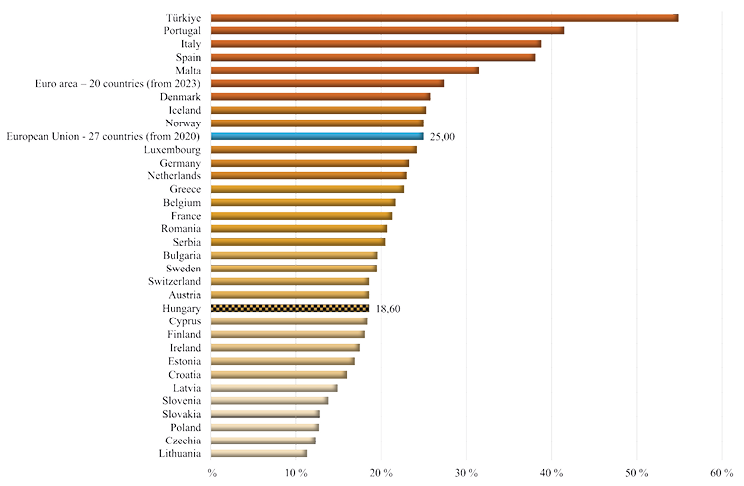
Source: own work based on Eurostat (2024b).
The primary objective of this study is to examine and analyse the spatial patterns of educational attainment at both ends of the Hungarian educational spectrum, based on data from the 2022 national census. Specifically, the research focuses on two distinct educational categories: individuals whose highest level of educational attainment is ISCED level 2 or below (lower secondary education), and those who have attained ISCED levels 5–8 (tertiary education).
Studies in the fields of geography of education and educational ecology have repeatedly shown that educational opportunities are significantly shaped by spatial structures, most notably through urban–rural divides and centre–periphery polarisation (Cao and Huo, 2025; Graham, 2024; Holloway and Jöns, 2012; Million et al., 2017). Earlier studies in Hungary had also shown how the stratified and selective school system reinforces territorial inequalities (Horn, 2013; Velkey, 2020, 2022). However, most of these analyses have been conducted at the regional or institutional level, providing only a partial picture of the settlement-level dynamics of educational attainment (Forray and Híves, 2011). The present study addresses this gap by applying bivariate choropleth mapping and Optimised Hot Spot Analysis to the 2022 census data, offering a fine-grain view of educational polarisation that reveals sharp contrasts between Budapest and peripheral rural areas. By uncovering statistically significant clusters at the lowest and highest attainment levels, this study not only advances methodological approaches within the Hungarian context but also contributes to international debates on spatial educational inequalities and the policy need for place-sensitive interventions (Polónyi, 2023; Pop, 2023).
To achieve this, we employed a two-stage analytical approach. Initially, a bivariate choropleth mapping technique was used to visualise and compare the spatial distribution of these two educational groups, highlighting areas of overlap and divergence in their relative proportions. Although this visual representation effectively illustrates broad spatial relationships, it is insufficient for establishing statistically significant spatial clusters in the data.
Therefore, the second stage utilised spatial statistical analysis, specifically the Getis–Ord Gi* clustering method, to statistically identify and assess areas with significantly high (Hot Spots) or low (Cold Spots) proportions for each educational attainment category. By combining these spatial analytic methods, this study aims to uncover detailed spatial relationships and regional disparities in educational attainment levels across Hungarian settlements. Ultimately, this study contributes insights into the spatial dimensions of Hungary’s educational system and identifies regions characterised by educational inequalities.
2. Materials and methods
This study used data from Hungary’s 2022 national census. Conducted every ten years using standardised methodology and uniform content, as is generally the case across Europe in alignment with the EU’s census regulation framework, Hungary’s census methodology ensures a comprehensive and precise representation of the country’s demographic, economic, and social characteristics, including educational attainment. The 2022 census was unique in that the respondents had the option to complete the survey online within an 18-day window. Those who did not participate online were subsequently visited by the census enumerators. Under current legislation, participation in the Hungarian census is mandatory for all residents (Act CI of 2018 on the 2021 Census, 2021). The unit of observation in this study is at the settlement level, and given the extensive coverage of the census, the dataset can be considered near-population level (Dusek, 2004). The polygon dataset of settlement boundaries used for the spatial representation and analysis was sourced from OpenStreetMap. Data organisation and processing were performed using Microsoft Excel (Microsoft Corporation, 2025) to ensure the integration of settlement-level information. The dataset contained no missing values, and data filtering was also conducted within Excel, leveraging the census database’s completeness. OpenStreetMap polygon data were manually verified for consistency in settlement counts and naming conventions.
In this analysis, the International Standard Classification of Education (ISCED) was used to ensure the international comparability of educational attainment data. Developed by UNESCO and revised in 2011, the ISCED provides a standardised framework for classifying educational levels, programme orientations, and progression opportunities. The 2011 revision introduced a more detailed three-digit coding system and, for the first time, included a classification for educational attainment (ISCED-A) to enhance analytical precision. The shift from ISCED 1997 to ISCED 2011 is particularly relevant in the Hungarian context, where not all secondary programmes guarantee access to higher education. The revised system more finely differentiates general and vocational pathways and marks whether programmes are progression-enabling or terminal upon completion. For example, short-cycle tertiary programmes (ISCED 5), bachelor’s (ISCED 6), master’s (ISCED 7), and doctoral degrees (ISCED 8) are now clearly differentiated by their length, orientation, and level. This structure offers a more accurate reflection of Hungary’s education system and supports a deeper analysis of educational mobility (Hungarian Central Statistical Office, n.d.).
A spatial analysis was conducted using ArcGIS Pro (Esri Inc., 2024) by applying multiple geostatistical methods. The study first employed a bivariate choropleth mapping technique which allowed for the simultaneous visualisation of two quantitative variables within a single map layer. This approach facilitates the comparison and distinction of educational attainment patterns across spaces. Similar to the graduated colour method, bivariate choropleth mapping divides variables into classes and assigns specific colour combinations to represent their values (ESRI, n.d.-a). The categorisation followed Jenks’s natural breaks classification, ensuring meaningful group segmentation:
- For ISCED 2 or lower (lower secondary education), the three bins were: 0–21%, 21–30%, and above 30%;
- For ISCED 5–8 (tertiary education), the three bins were: 0–14%, 14–28%, and above 28%.
Combining these two variables into a 3×3 matrix results in a total of nine unique colour categories, thus providing a nuanced spatial depiction of educational disparities.
To account for potential cognitive biases in visual interpretation, this study integrated spatial statistical methods to objectively assess the clustering patterns. Unlike traditional statistical approaches that often overlook spatial dependencies, geostatistical methods address the complexity introduced by social and natural spatial structures (Dusek and Kotosz, 2017). This study employs Optimised Hot Spot Analysis using the Getis–Ord Gi* statistic to detect statistically significant clusters of educational attainment levels.
Optimised Hot Spot Analysis in ArcGIS Pro applies the Getis–Ord Gi* statistics by automatically adjusting parameters based on input data characteristics. Much like a camera auto-adjusts settings for optimal results, this tool first assesses data adequacy (minimum of 30 features), variation, and locational outliers. Point data aggregates incidents into weighted features using grid cells or polygons. The appropriate scale of analysis is determined using Incremental Spatial Autocorrelation (Global Moran’s I) or by calculating the average distances to neighbours. Subsequently, the Gi* test identifies significant hot and cold spots, adjusting for significance levels using False Discovery Rate (FDR) correction. The output includes z-scores, p-values, Gi Bin classifications, and neighbourhood statistics, providing a robust basis for interpreting spatial patterns (ESRI, n.d.-b; Getis and Ord, 1992; Ord and Getis, 1995).
The results of the Optimised Hot Spot Analysis are visualised using Gi Bin categories, which classify areas based on statistical significance. Hot Spots (statistically significantly high values) are displayed in shades of red, whereas cold spots (statistically significantly low values) appear in shades of blue. The intensity of these colours corresponds to the statistical confidence level (z-score and p-value); darker and more vivid colours indicate stronger statistical significance and spatial concentration. Areas that were not statistically significant are represented by neutral or light colours (e.g., grey or pale shades).
In this context, a hot spot indicates a cluster of neighbouring settlements where the proportion of residents with a given level of educational attainment is consistently and significantly higher than the national average. Conversely, a cold spot reflects a spatial concentration of significantly lower-than-average values. Thus, these clusters reveal regional patterns – such as areas with relatively highly educated populations and, by contrast, regions with persistently low attainment – and thereby enhance the interpretation of spatial inequalities in education across Hungarian settlements.
3. Results and discussion
3.1. National-level correlations and socio-economic influences
The spatial analysis of educational attainment in Hungary revealed significant regional disparities at both the lower and higher ends of the educational spectrum, highlighting distinct clustering patterns shaped by broader socio-economic and historical processes. In line with McIntosh and Munk (2007), and van Ewijk and Sleegers (2010), the highest level of educational attainment in Hungarian society is also influenced by parental SES. Based on data from the 11th round of the European Social Survey (ESS), the father’s level of education appeared to have a more pronounced effect, although both parents played a significant role in shaping educational outcomes (father: Pearson’s r = .476, p < .001; mother: Pearson’s r = .440, p < .001). Furthermore, educational attainment also plays a key role in partner selection, thereby influencing the next generation as well (partner’s highest level of education: Pearson’s r = .671, p < .001).
These patterns suggest that regional disparities in educational attainment may be further reinforced through self-fulfilling mechanisms, which is consistent with the Golem effect. In areas where educational achievement has for a long time been low, institutional and societal expectations may reflect and perpetuate these patterns, thus contributing to the intergenerational transmission of disadvantages. Rather than countering inequalities, such expectations reinforce them, as students from less-educated backgrounds may internalise limited aspirations, which in turn constrain their educational trajectories. As such, this dynamic may intensify the spatial polarisation over time.
Figure 2 illustrates a clear generational shift in educational attainment in Hungary, reflecting the effects of educational expansion since the late 20th century. Older age cohorts were predominantly represented in the lowest attainment category (ISCED 1–2), indicating limited access to extended schooling in earlier decades. In contrast, middle-aged groups (particularly those aged 40–49) show a peak representation at the upper-secondary level (ISCED 3–4), corresponding to the massification of secondary education during the 1980s and the 1990s (Arató and Lavicza, 2015; Kozma, 2016). In addition to state-run institutions, church-controlled schools have expanded considerably since the 2000s, with rapid growth after 2010. Their role, traditionally strong in grammar schools, has extended to primary and vocational education, and by the mid-2010s they became the sole providers of primary education in some settlements. Their role is particularly strong in small towns, where they often attract students from more advantaged family backgrounds, thereby reinforcing local patterns of educational selection and segregation (Papp, 2022; Tomasz, 2017).
Notably, the highest proportion of tertiary graduates (ISCED 5–8) appears among younger cohorts, especially those aged 30–39, underscoring the substantial growth in higher education since the democratic transition. Additionally, the data revealed a gendered dimension of expansion, with women surpassing men in tertiary attainment among younger age groups. These patterns collectively highlight the long-term impact of educational reforms and the broadened access to Hungary’s population structure.
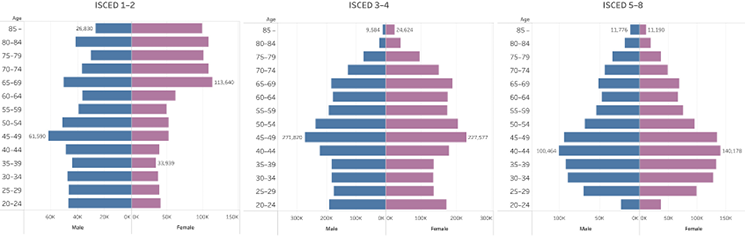
Source: own work based on data from the Hungarian Central Statistical Office (2023).
3.2. Regional trends in educational attainment (2011–2022)
Based on census data from 2011 and 2022 (Fig. 3), the distribution of the highest educational attainment among the population group aged 15 and above in Hungary has undergone significant regional shifts, reflecting broader patterns of educational expansion and persistent territorial disparities.
The number of individuals with the lowest educational attainment (ISCED 1) decreased markedly in every region, with the most substantial declines observed in Northern Hungary (−38,539 persons), the Northern Great Plain (−53,597), and the Southern Great Plain (−37,865). Budapest’s ISCED 1 population – already relatively small – declined by 11,460. These reductions suggest gradual educational improvement, even in socioeconomically disadvantaged regions (Northern Hungary, Northern Great Plain, and Southern Transdanubia).
A similar tendency may be observed in ISCED Level 2 (completion of primary education) population data. The largest decreases were observed in Budapest (−75,135) and the Southern Great Plain (−88,626), followed by the Northern Great Plain (−74,469). The continued decline in lower educational levels underscores the ongoing transition towards higher minimum attainment standards across Hungary.
In contrast, ISCED 3C (vocational upper secondary education without a school-leaving certificate) showed heterogeneous trends. Some regions experienced slight changes (e.g., Central Transdanubia: −4,171; Western Transdanubia: +4,537), whereas others saw small declines (e.g., the Southern Great Plain: −9,731). These mixed patterns indicate region-specific developments in vocational education preferences and opportunities.
Regarding ISCED 3A/3B (general and vocational upper secondary education with a school-leaving certificate [equivalent to the Matura Examination in Hungary]), modest increases were observed across most regions. The most notable growth occurred in Pest County (+21,160) and Budapest (−17,594), although the decline in the capital may reflect a population shift towards higher tertiary education levels rather than stagnation at the secondary level.
Tertiary education (ISCED 5–8) has experienced a substantial nationwide growth. The number of individuals with ISCED 6 qualifications (bachelor’s or equivalent) increased significantly in Budapest (+26,136), Pest (+37,534), and Central Transdanubia (+12,667). The ISCED 7 (master’s or equivalent) figures rose across all regions, most strikingly in Budapest (+75,724) and Pest (+53,877). Even less-developed regions saw marked increases, such as +30,566 in the Northern Great Plain.
Finally, the number of individuals with ISCED 8 (doctoral or equivalent) qualifications also increased, particularly in Budapest (+4,398), although the overall figures remained relatively low. This growth reflects Hungary’s gradual expansion of advanced academic and research-oriented education.
3.3. Territorial extremes and regional profiles
Beyond the general trend of increasing educational attainment, distinct regional patterns and extremes can be identified in Hungary between 2011 and 2022. These findings highlight both the uneven spatial dynamics of educational development and the influence of broader socio-economic and demographic factors.
Budapest has emerged as the epicentre of tertiary education expansion. It experienced the largest absolute increase in ISCED Level 7 qualifications (+75,724) and notable gains in both ISCED 6 and ISCED 8 levels, reinforcing its role as the national academic and research hub. At the same time, it was the only region to witness a decline in ISCED 3A/3B, suggesting that more residents now bypass upper secondary education as their highest level of attainment in favour of higher education credentials.
In contrast, the Northern Great Plain, traditionally a socioeconomically disadvantaged area, has demonstrated broad-based educational improvement. The region saw large declines in ISCED 2 attainment (−74,469), alongside significant growth in ISCED 3A/3B (+17,723) and ISCED 7 (+30,566). However, it still retains some of the highest absolute numbers of residents with ISCED 1 and 2 as their highest qualifications, indicating that, despite progress, legacy inequalities remain.
Similarly, the Southern Great Plain showed substantial reductions in lower attainment levels (−88,626 in ISCED 2 and −37,865 in ISCED 1) and impressive gains in tertiary education. However, unlike most other regions, it also maintained one of the largest increases in ISCED 3C, suggesting the enduring importance of vocational pathways in the region.
Central and Western Transdanubia exhibited a relatively balanced development, with moderate gains across most educational levels. Western Transdanubia was one of the few regions where ISCED 3C grew slightly, indicating a stable vocational track, whereas Central Transdanubia’s figures remained steady without major shifts. These patterns may indicate a more stable educational structure in economically stronger regions.
Conversely, Northern Hungary has lagged in educational advancement. The region registered the smallest increase in ISCED 6 (+2,531) and one of the lowest gains in ISCED 7 (+20,241) while still showing relatively high levels of low attainment. These figures reflect both structural constraints and the slow progress in overcoming long-standing educational disadvantages.
Finally, Pest County – surrounding Budapest – displayed strong growth across nearly all levels of educational attainment, particularly tertiary education (ISCED 6: +37,534; ISCED 7: +53,877). This suggests that the trend of suburbanisation and the expected economic gravity of the capital drive broad educational gains in the region.
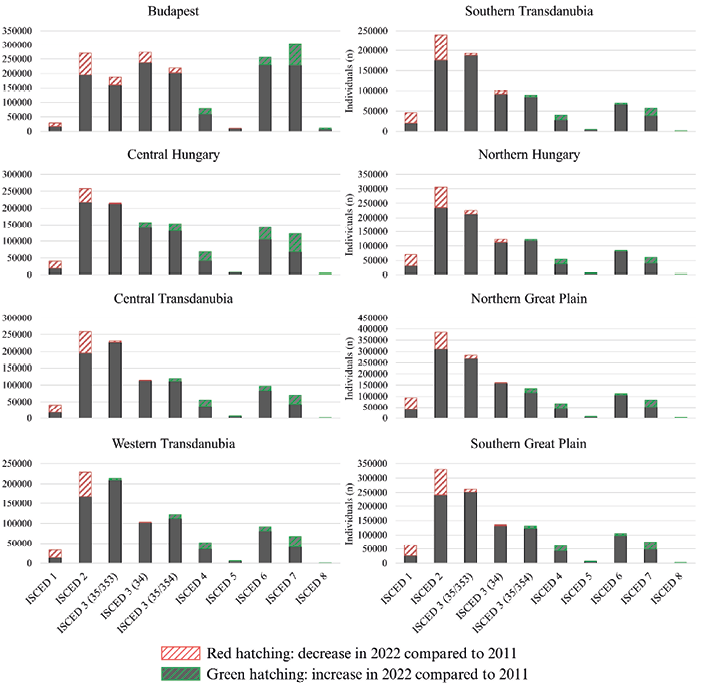
Source: own work based on data from the Hungarian Central Statistical Office (2013, 2023).
3.4. Polarisation of educational attainment
Having examined the overall distribution across all educational levels, the analysis shifted to the two extremes of the educational spectrum, focusing on the lowest and highest attainment levels. Figure 4 displays a bivariate choropleth map comparing the proportion of individuals with ISCED level 2 or below and those with ISCED levels 5–8 as their highest educational attainment. Examination of the two poles of the scale revealed several notable spatial trends.
At the lower end of the scale, populations with at most ISCED 0–2 attainment are primarily concentrated in the peripheral regions of the country. These include Northern Hungary, Southern Transdanubia, and parts of the Northern Great Plain, where disadvantaged socio-economic structures, small-village settlement patterns, and higher proportions of Roma population are characteristic. In these areas, the share of residents with only primary or lower secondary education significantly exceeds the national average, reinforcing long-standing centre–periphery divides.
At the upper end of the scale, tertiary educational attainment (ISCED 5–8) is strongly concentrated in Hungary’s major urban centres and their suburbs. These areas benefit not only from the presence of universities but also from related sectors – public services, healthcare, and knowledge-intensive industries – that attract and retain highly educated populations. The capital city, Budapest, along with its surrounding area in Pest County, stands out because of the overrepresentation of tertiary-educated individuals. This marked polarisation between the capital city, regional university centres, and peripheral areas is consistent with previous research that has highlighted significant inequalities in higher educational attainment across Hungary (Sánta et al., 2015). In addition, elevated proportions of higher education attainment are observed around major tourist destinations, such as Lake Balaton, Lake Velence, and other recreational regions. While the concentration in Pest County can be explained by the suburbanisation of diploma-holding populations originally from Budapest – a trend that accelerated after 2020 in the wake of the COVID-19 pandemic (Bajmócy and Jakus, 2023) – the patterns around Lake Balaton and Lake Velence are more closely related to lifestyle migration, tourism, and the presence of secondary residences rather than metropolitan suburbanisation.
Additionally, county seats and other major regional cities have prominently emerged with higher rates of tertiary education. In contrast, across much of rural Hungary, when comparing the highest and lowest levels of educational attainment, settlements tend to exhibit higher proportions of individuals with only ISCED level 1–2 education, suggesting a concentration of lower educational outcomes in less urbanised areas. The strong correlation between parents’ educational attainment and income poverty must be emphasised within the complex set of problems connected to this issue in the Hungarian context. In 2022, 25–35% of children with parents with ISCED 0–2 attainment levels lived in income poverty, while in the case of ISCED 3–4 parents, this rate fell to 7–8%, with the lowest rate (1–2%) of income poverty occurring in households with ISCED 5–8 parents (Hajdu et al., 2024).
Although the expansion of educational opportunities in Hungary has been substantial in recent decades, spatial mobility remains severely constrained for many students. As Forray and Híves (2009) observed, commuting to school was primarily feasible for those with higher educational qualifications and stronger social capital. In contrast, disadvantaged groups – particularly in peripheral rural areas – were often excluded from basic mobility due to transportation costs, infrastructural limits, or institutional barriers. Ovenden-Hope et al. (2023) have similarly emphasised how the geography of access can undermine formal rights to education. Velkey (2020) has argued that the state’s educational services often reproduce territorial inequalities rather than compensate for them, making mobility a mechanism of exclusion rather than a means for increasing equity.
Taken together, these patterns reveal a sharp polarisation: low educational attainment remains dominant in rural and peripheral regions, while tertiary education is concentrated in urban and suburban centres. This duality underscores the long-standing territorial inequalities in the Hungarian educational system, which are further elaborated in the subsequent Hot Spot Analysis.
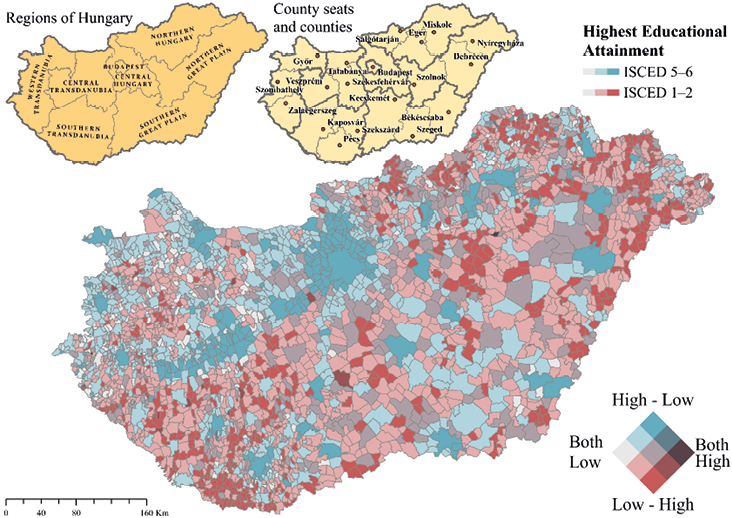
Source: own work based on data from the Hungarian Central Statistical Office (2023).
3.5. Spatial Hot and Cold Spots of low educational attainment (ISCED 0–2)
Given the potential for cognitive bias in the visual interpretation of spatial data, as outlined in the methodology section, we now proceed with a detailed spatial pattern analysis of the two distinct ends of educational attainment.
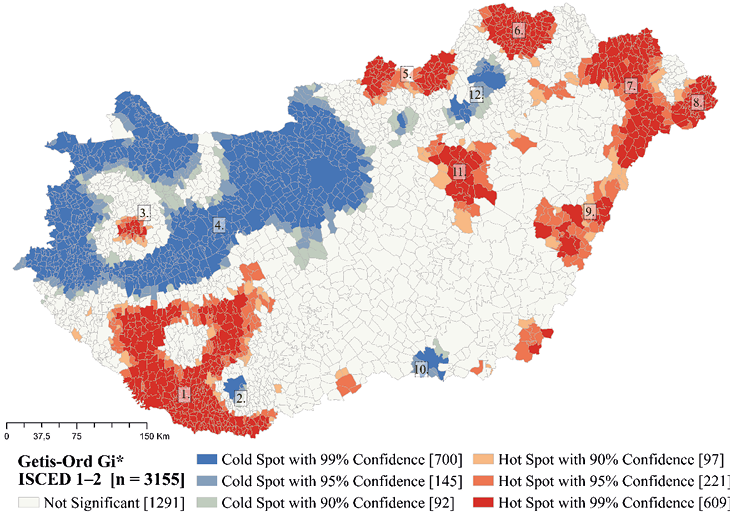
Figure 5 presents a comprehensive spatial analysis of the population with at most ISCED level 2 education (lower secondary education or below) across Hungarian settlements, based on an Optimised Hot Spot analysis using the Getis-Ord Gi* statistic (Table 1). The map reveals pronounced territorial disparities in low educational attainment, with statistically significant patterns that align with Hungary’s historical development trajectories and socio-economic divisions. The analysis identifies seven major Hot Spot clusters (displayed in red shades), representing areas with statistically significant concentrations of individuals whose highest educational attainment is lower secondary education or below.
A well-defined western cluster extends from the eastern part of the Vasvár district to the Devecser district, covering parts of the counties of Vas and Veszprém. This compact cluster primarily encompasses rural settlements, with historical agricultural economies and limited industrial development.
A large, spatially coherent cluster dominates Southern Transdanubia, which is particularly pronounced across the counties of Somogy and Baranya. This region represents one of Hungary’s most disadvantaged areas and is characterised by small villages, ageing populations, and limited economic opportunities. Within this extensive Hot Spot, only Pécs (the regional centre with a major university) and its immediate suburban ring emerged as significant cold spots, illustrating the stark urban-rural educational divide. The city of Kaposvár appears as an educational “island” classified as non-significant, suggesting that it neither significantly outperforms nor underperforms relative to national averages (Alpek et al., 2018; Balogh et al., 2018).
A substantial cluster spanning the northern counties of Heves, Nógrád, and parts of Borsod-Abaúj-Zemplén, an area that experienced significant economic decline following the collapse of heavy industries in the socialist era. The challenging topography of this region coupled with its poor transportation infrastructure and limited employment opportunities has contributed to persistent educational disadvantages (Kiss, 2012; Kocziszky and Szendi, 2021).
An extensive cluster along Hungary’s northeastern border (particularly in the Szabolcs-Szatmár-Bereg County) and eastern regions (parts of the counties of Hajdú-Bihar and Békés), areas with historically high poverty rates, Roma populations, and distance from major economic centres. These peripheral regions face significant challenges in terms of educational development and economic integration (György, 2014; Kovács et al., 2024; Tagai et al., 2018). Similar patterns linked to high rates of Roma population can also be observed in Northern Hungary and Southern Transdanubia (Hungarian Central Statistical Office (2023); Pénzes et al., 2018, 2019). In addition, border regions also face challenges in educational attainment, as demonstrated by Pénzes et al. (2023).
Source: own work based on data from the Hungarian Central Statistical Office (2023).
Several smaller but statistically significant Hot Spots appear scattered across central and eastern Hungary, often corresponding to microregions characterised by small settlement structures and limited access to educational facilities.
In stark contrast, northwestern Hungary (particularly the Győr-Moson-Sopron County, and parts of the counties of Vas and Komárom-Esztergom) emerged as significant cold spots (displayed in blue shading). This region benefits from its proximity to Western European markets, substantial foreign direct investment, and robust industrial development, resulting in stronger educational outcomes and lower proportions of individuals with only lower educational attainment level (Pénzes et al., 2018).
The map also highlights the educational polarisation between urban and rural settlements. Major regional centres and university towns – Eger, Miskolc, Szeged, and Pécs – stand out as distinct Cold Spots within otherwise disadvantaged regions, exhibiting significantly lower proportions of residents with minimal educational attainment. This pattern demonstrates how urban centres function as educational oases, attracting and retaining more educated populations, while potentially drawing human capital away from the surrounding rural areas. These findings are consistent with previous analyses that also identified a strong spatial concentration of tertiary educational attainment in Hungary (Dövényi and Németh, 2018).
Budapest and its immediate surroundings also display consistently low proportions of minimal educational attainment, reflecting the concentration of educational and employment opportunities in the country’s primary metropolitan area.
These spatial patterns align closely with Hungary’s broader socio-economic divisions and highlight how educational disadvantage is geographically structured, with clear east-west and centre-periphery gradients that have persisted despite overall educational improvements nationwide. School closures in rural Hungary have not only reduced physical access to education but have also triggered long-term community disintegration. As several authors have highlighted, shutting down schools – especially in marginalised areas – often leads to depopulation, intensifies social isolation, and increases ethnic segregation (Andl, 2021, 2023; Fejes and Szűcs, 2018; Kroismayr, 2019; Mutgan and Tapia, 2025; Sageman, 2022). These closures represent not only an infrastructural setback but also a symbolic loss of communal vitality and local identity. Particularly in villages with ageing population and scarce resources, the disappearance of educational infrastructure reinforces structural exclusion and limits the prospects of intergenerational mobility.
| ID | Number of settlements (N) | Mean [%] | Std. dev. [%] |
|---|---|---|---|
| 1 | 266 | 49.66 | 13.27 |
| 2 | 2 | 22.59 | 1.49 |
| 3 | 13 | 45.53 | 7.34 |
| 4 | 673 | 28.13 | 7.45 |
| 5 | 46 | 48.45 | 11.86 |
| 6 | 97 | 51.06 | 18.03 |
| 7 | 102 | 48.50 | 10.76 |
| 8 | 50 | 48.52 | 10.19 |
| 9 | 12 | 48.14 | 9.97 |
| 10 | 1 | 18.74 | 0.00 |
| 11 | 20 | 54.15 | 16.07 |
| 12 | 12 | 29.05 | 8.60 |
| National average | 3155 | 35.75 | 9.49 |
Note: The IDs correspond to the clusters indicated on the map (Fig. 5.). The number of settlements (N) refers only to those within each cluster where the 99% significance level could be measured.
Source: own work based on data from the Hungarian Central Statistical Office (2023).
3.6. Spatial Hot and Cold Spots of tertiary education (ISCED 5–8)
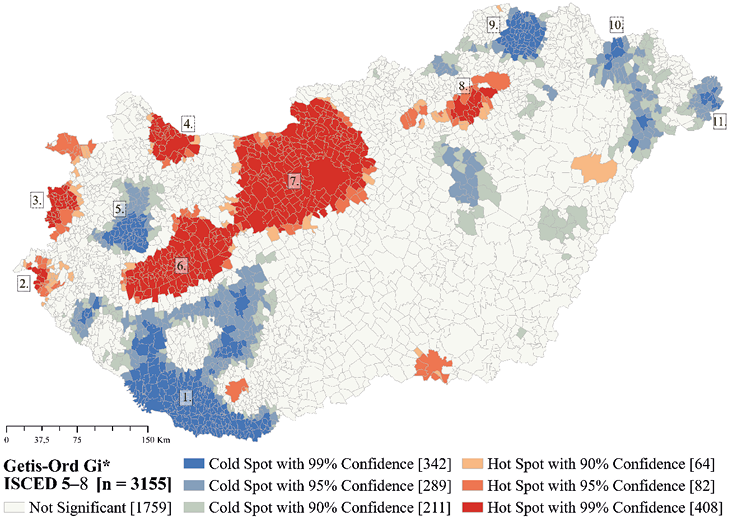
Figure 6 presents a sophisticated spatial analysis of the population with tertiary education (ISCED Levels 5–8) across Hungarian settlements, revealing distinct patterns that illuminate the geography of higher educational attainment in the country (Table 2). While these patterns generally contrast with those of lower educational attainment shown in Fig. 5, they do not form a perfect inverse relationship, suggesting complex underlying socio-spatial dynamics.
Budapest and its metropolitan region emerged as the dominant Hot Spot for tertiary education, displaying the highest concentration of university graduates in the country. This primacy reflects the capital’s historical role as Hungary’s principal educational, economic, and cultural centre, hosting several prestigious universities and offering diverse employment opportunities for highly qualified professionals. The Hot Spot extends well beyond the administrative boundaries of Budapest into its surrounding agglomeration zone, particularly towards the western and northern suburban areas (Budaörs, Szentendre, Dunakeszi) (Varga et al., 2020). This pattern captures the post-socialist suburbanisation process, which accelerated after 2000 and intensified following the COVID-19 pandemic as highly educated urban professionals sought larger homes and better environmental conditions while maintaining access to employment in the capital (Bajmócy and Jakus, 2023; Sulyok et al., 2024).
The analysis identifies several secondary Hot Spots centred on regional university cities that form a polycentric network of higher educational attainment across the country. Debrecen, Hungary’s second-largest city and the home to the University of Debrecen in the Eastern Great Plain, shows a pronounced concentration of tertiary-educated residents that extend to its immediate suburban zone (Pénzes et al., 2023). Beyond the university, Debrecen’s role as a regional centre of public administration, healthcare, and its rapidly growing IT and pharmaceutical sectors also contribute significantly to this concentration (Molnár and Kozma, 2019; Tarnóczi and Bauerné Gáthy, 2024).
Szeged, the regional centre of the Southern Great Plain and the host of the University of Szeged, forms another significant Hot Spot, benefiting from its role as a major research centre and its proximity to the Serbian border. Similarly, the city’s concentration of public services and healthcare institutions, along with expanding knowledge-intensive industries, reinforces its high levels of tertiary educational attainment (Gyurkovics and Juhász, 2018; Molnár et al., 2018).
Pécs in Southern Transdanubia constitutes a striking educational island within an otherwise disadvantaged region; this is due to the presence of the University of Pécs and its historical role as a regional cultural centre (Tóth and Farkas, 2019; Varjú and Óvári, 2024).
The northwestern axis of Győr-Sopron-Szombathely forms an interconnected cluster of high educational attainment, supported by economic prosperity from the automotive and electronics industries, cross-border connections with Austria, and the presence of vibrant regional universities (Molnár et al., 2020; Németh et al., 2023; Rechnitzer, 2015).
Eger in Northern Hungary represents a smaller but statistically significant Hot Spot which also extends to Miskolc. While Eger’s educational profile is enhanced by Eszterházy Károly Catholic University and tourism-related development, Miskolc contributes to the Hot Spot as a regional centre with its university, industrial heritage, and public service institutions (Kristóf, 2017, 2018; Schuchmann, 2022).
Particularly noteworthy is the Őrség microregion near the Austrian and Slovenian borders, appearing as an unexpected Hot Spot despite its peripheral location and rural character. This anomaly likely reflects amenity migration – the settlement of highly educated professionals and retirees attracted by the region’s natural beauty, cultural heritage, and tranquillity. The Őrség case demonstrates how certain rural areas can develop distinctive educational profiles through selective in-migration, challenging the conventional urban-rural educational divide.
The spatial distribution of tertiary education reflects Hungary’s post-socialist transition and subsequent economic restructuring. Areas that are successfully integrated into knowledge-based and service economies show higher concentrations of university graduates, whereas regions that are dependent on declining traditional industries or agriculture demonstrate persistent educational disadvantages. This pattern has been reinforced by the uneven distribution of higher education institutions – the doctoral programmes are mostly concentrated in four cities (Budapest, Debrecen, Szeged, and Pécs) – creating “educational deserts” in peripheral regions (Hungarian Educational Authority, n.d.).
The patterns observed align with international literature on the geography of human capital, thus emphasising how skilled labour tends to concentrate in urban agglomerations that offer diverse employment opportunities, knowledge spillovers, and quality amenities (Puškárová and Piribauer, 2016; Thisse, 2018; Wibisono, 2022). In the Hungarian context, these patterns have been shaped by historical development trajectories, socialist era industrial and educational policies, post-socialist economic restructuring, and more recent European integration processes.
The spatial concentration of highly educated populations creates self-reinforcing cycles of advantages and disadvantages. Hot Spot regions benefit from increased innovation capacity, higher productivity, and greater attractiveness for knowledge-intensive investments, while Cold Spot areas face challenges in economic diversification, innovation adoption, and the retention of young talent. The resulting educational polarisation contributes significantly to broader regional development disparities across Hungary. Even where tertiary qualifications have expanded, spatial variation in their economic and social returns remains substantial. As Polónyi (2023) argues, the labour market value of formal educational credentials is increasingly shaped by the geographic context and institutional prestige. In many peripheral regions, higher qualifications do not necessarily lead to upward mobility or improved socio-economic outcome. This underscores how educational expansion alone does not guarantee territorial convergence, because returns to education remain strongly conditioned by local opportunity structures and regional labour market dynamics.
Source: own work based on data from the Hungarian Central Statistical Office (2023).
| ID | Number of settlements (N) | Mean [%] | Std. dev. [%] |
|---|---|---|---|
| 1 | 189 | 6.84 | 5.05 |
| 2 | 6 | 21.61 | 6.11 |
| 3 | 31 | 22.12 | 7.06 |
| 4 | 27 | 25.94 | 8.90 |
| 5 | 47 | 8.82 | 4.54 |
| 6 | 119 | 26.55 | 11.37 |
| 7 | 207 | 27.82 | 12.01 |
| 8 | 12 | 24.70 | 9.89 |
| 9 | 59 | 7.27 | 6.79 |
| 10 | 5 | 8.66 | 2.96 |
| 11 | 8 | 7.98 | 3.86 |
| National average | 3155 | 9.88 | 6.18 |
Note: The IDs correspond to the clusters indicated on the map (Fig. 6.). The number of settlements (N) refers only to those within each cluster where the 99% significance level could be measured.
Source: own work based on data from the Hungarian Central Statistical Office (2023).
4. Conclusion
This study explored the spatial disparities in educational attainment across Hungarian settlements by focusing on the extremes of the educational spectrum – individuals with lower secondary education (ISCED 2 or below) and those with tertiary education (ISCED 5–8) – based on data from the 2022 national census. The integration of bivariate choropleth mapping and Optimised Hot Spot analysis allowed for a nuanced understanding of spatial clusters and patterns, enhancing the interpretability of territorial inequalities.
The EU has set ambitious educational goals, including reducing low achievement by 15% by country (Hanushek and Woessmann, 2020). Between 2011 and 2022, Hungary experienced substantial educational shifts across all its regions. The number of individuals with only ISCED 1 or 2 qualifications declined markedly nationwide, with the most significant changes occurring in the traditionally disadvantaged northeastern and southeastern regions. Nationally, the share of individuals with at most ISCED 1–2 level education has dropped from 32% in 2011 to 23% by 2022. In parallel, tertiary education (ISCED 5–8) expanded considerably, particularly in Budapest and in the Pest County, as well as in regional university centres such as Debrecen, Szeged, and Pécs. Even the peripheral regions recorded measurable gains, although the disparities persisted.
The spatial distribution of educational attainment reveals pronounced territorial polarisation. High shares of low educational attainment continue to characterise rural and economically lagging areas – especially in Southern Transdanubia and northeastern Hungary – while urban and suburban zones increasingly concentrate on the highly educated. This duality underscores a structural divide, with access to higher education shaped by settlement size, institutional presence, and the regional socio-economic trajectory.
Although educational expansion is evident nationwide, the effects are uneven. The rise in tertiary qualifications reflects both increased access to and a growing valuation of higher education, yet it also accentuates spatial inequalities where opportunities remain limited. These trends suggest that, without territorially differentiated policy responses, educational divergence may persist or deepen over time.
Theoretically, the results support the spatial dimension of educational inequality and align with the perspective that educational systems can both reproduce and mitigate territorial disparities (Pop, 2023; Velkey, 2020). The observed clusters reinforce the notion of educational Kuznets curves in post-socialist contexts, in which increasing national education levels may not uniformly reduce spatial inequalities (Polónyi, 2023).
These results have important policy implications. They underscore the need for territorially differentiated educational and developmental strategies that address the specific challenges faced by regions with persistently low educational attainment. Strengthening regional universities, creating rural innovation hubs, and implementing targeted educational interventions could help retain graduates locally, stimulate regional development, and reduce educational inequality (Gunasekara, 2006; Neszmélyi et al., 2022; Uyarra, 2010; Wibisono, 2022). As Schnabel (2025) argues, mitigating territorial inequalities in education requires not only centralised redistribution, but also renewed forms of decentralisation and regional planning. Multilevel governance structures that empower local stakeholders to design inclusive, context-sensitive educational environments are essential to advancing spatial justice.
Despite the robust nature of the spatial analysis, certain limitations must be acknowledged. The study relies on cross-sectional census data, which captures a snapshot in time and does not account for temporal dynamics, such as recent migration or educational reforms. Additionally, while settlement-level data offer high granularity, individual-level factors such as SES or migration trajectories cannot be incorporated. It is also important to note that our findings align with those of Forray and Híves (2009), who more than fifteen years ago observed a persistent overlap between higher levels of educational attainment and more disadvantaged regions – areas that appear to have remained unable to alter their structural position since then.
Future research should integrate longitudinal data and individual-level variables to better understand the causal mechanisms of spatial educational inequalities. Furthermore, comparative analyses with previous census data can reveal the evolution of these patterns and the effectiveness of past policy interventions. One of the key mechanisms behind the persistence of spatial educational disparities is the increasing centralisation of educational governance in Hungary. Following the nationalisation of previously municipally maintained schools, the decision-making authority became heavily centralised (Sáska, 2013; Kozma, 2015). This restructuring, as Velkey (2019a, b) notes, relieved local actors from responsibility while also introducing new asymmetries, especially in areas where public institutions were transferred to church control (Polónyi, 2005). These shifts have constrained territorial responsiveness, further deepening spatial inequalities in both access and institutional diversity.
In conclusion, this study makes a significant contribution to the growing literature on the territorial embeddedness of educational outcomes in post-socialist contexts. By revealing distinct spatial clusters of educational attainment across Hungary, we highlight how educational inequality manifests geographically and persists despite the overall improvement in national educational levels. These findings emphasise the importance of place-sensitive educational policies that address long-standing regional inequalities and foster inclusive development across all territories.
Acknowledgments. This work was supported by project 2024-2.1.1-EKÖP, funded by the Ministry of Culture and Innovation, National Fund for Research, Development, and Innovation, under the University Research Grant Programme EKÖP-24-3-I.
Autorzy
REFERENCES
Act CI of 2018 on the 2021 Census [2018. évi CI. törvény a 2021. évi népszámlálásról] (2021), https://njt.hu/jogszabaly/2018-101-00-00
Act CXC of 2011 on National Public Education [2011. évi CXC. törvény a nemzeti köznevelésről] (2025), https://njt.hu/jogszabaly/2011-190-00-00
ALPEK, L. B., TÉSITS, R. and HOVÁNYI, G. (2018), ‘Spatial inequalities of disadvantage accumulation and their impact on employability in Hungary’, Regional Statistics, 8 (1), pp. 96–119. https://doi.org/10.15196/RS080104
ANDL, H. (2021), ‘A kisiskolák és lehetőségeik’, Educatio, 29 (3), pp. 409–424. https://doi.org/10.1556/2063.29.2020.3.6
ANDL, H. (2023), ‘«Our Shared Fate»: Villages and Schools’, Educatio, 32 (2), pp. 257–273. https://doi.org/10.1556/2063.32.2023.2.6
ARATÓ, N. and LAVICZA, Z. (2015), ‘The Hungarian Education System in Transition’, [in:] MENLO, A. and COLLET, L. (eds), Do Teachers Wish to be Agents of Change?, Rotterdam: SensePublishers, pp. 133–149. https://doi.org/10.1007/978-94-6209-959-3_7
BAJMÓCY, P. and JAKUS, I. (2023), ‘A szuburbanizáció szakaszai, és azok térbelisége Magyarországon’ [The stages of suburbanization and their spatial characteristics in Hungary], Településföldrajzi Tanulmányok, 12 (1–2), pp. 29–45. https://ojs.elte.hu/tft/article/view/8684
BALOGH, A., BAJMÓCY, P. and ILCSIKNÉ-MAKRA, Z. (2018), ‘Social and ethnic segregation amongst the smallest Hungarian villages’, Geographica Pannonica, 22 (3), pp. 208–218. https://doi.org/10.5937/gp22-16641
BELLA, N. and CHARBIT, Y. (2022), ‘Education, Population and Development. In Population and Development Issues’, [in:] DENISE, P. and BRIDGETTE, B. (eds), Population and Development Issues, Hoboken: Wiley, pp. 24–52. https://doi.org/10.1002/9781394156009.ch2
BITTMANN, F. (2022), ‘Are Cognitive Ability and Conscientiousness Really More Important for Educational Attainment Than SES? A Replication and Extension of O‘Connell and Marks (2022)’, Collabra: Psychology, 8 (1), 37460. https://doi.org/10.1525/collabra.37460
CAO, G. and HUO, G. (2025), ‘Reassessing urban-rural education disparities: evidence from England’, Educational Studies, pp. 1–20. https://doi.org/10.1080/03055698.2025.2478831
CATTANEO, A., HANSLIN, S. and WINKELMANN, R. (2007), ‘The Apple Falls Increasingly Far: Parent-Child Correlation in Schooling and the Growth of Post-Secondary Education in Switzerland’, Swiss Journal of Economics and Statistics, 143 (2), pp. 133–152. https://doi.org/10.1007/BF03399236
DÖVÉNYI, Z. and NÉMETH, Á. (2018), ‘«Kiművelt emberfők» a térben – A diplomások területi eloszlása valóban a kiegyenlítődés irányába mutat?’ [“Civilized Human Beings” in Space – Does Spatial Distribution of Diplomaed People Point to Equalization?], Területi Statisztika, 58 (2), pp. 129–150. https://doi.org/10.15196/TS580201
DUSEK, T. (2004), A területi elemzések alapjai [Basics of Spatial Analysis], Budapest: ELTE Regionális Földrajzi Tanszék-MTA-ELTE Regionális Tudományi Kutatócsoport.
DUSEK, T. and KOTOSZ, B. (2017), Területi statisztika [Regional Statistics], Budapest: Akadémiai Kiadó. https://doi.org/10.1556/9789634540014
ESRI Inc. (2024), ArcGIS Pro, (Version 3.4) [Computer software], Environmental Systems Research Institute, Redlands, California, U.S.A.
ESRI Inc. (n.d.-a), Bivariate colors – ArcGIS Pro | Documentation, https://pro.arcgis.com/en/pro-app/latest/help/mapping/layer-properties/bivariate-colors.htm [accessed on: 19.03.2025].
ESRI Inc. (n.d.-b), Optimised Hot Spot Analysis (Spatial Statistics) – ArcGIS Pro | Documentation, https://pro.arcgis.com/en/pro-app/latest/tool-reference/spatial-statistics/optimized-hot-spot-analysis.htm [accessed on: 19.03.2025].
EUROPEAN COMMISSION (2024), Education and training monitor 2024: Hungary, Publications Office of the European Union. https://data.europa.eu/doi/10.2766/769254
EUROPEAN SOCIAL SURVEY EUROPEAN RESEARCH INFRASTRUCTURE (2024), ESS11 – integrated file, edition 2.0 [Dataset]. Sikt – Norwegian Agency for Shared Services in Education and Research. https://doi.org/10.21338/ess11e02_0
EUROPEAN UNION (2024), Structure of the National Education System. https://doi.org/10.2797/7270983 [accessed on: 19.03.2025].
EUROSTAT (2024a), Population by educational attainment level, sex, and age [Dataset]. https://doi.org/10.2908/EDAT_LFS_9901 [accessed on: 19.03.2025].
EUROSTAT (2024b), Population by educational attainment level, sex, and NUTS 2 region (%) [Dataset]. https://doi.org/10.2908/EDAT_LFSE_04
FEJES, J. B. and SZŰCS N. (eds) (2018), Én vétkem: helyzetkép az oktatási szegregációról [My Fault: An Overview of Educational Segregation], Szeged: Motiváció Oktatási Egyesület.
FORRAY, R. K. and HÍVES, T. (2011), ‘Az iskolázottság térszerkezete, 2011’ [The spatial structure of educational attainment, 2011], Educatio®, 22 (4), pp. 493–504, http://epa.oszk.hu/01500/01551/00066/pdf/EPA01551_educatio_13_04_493-504.pdf [accessed on: 19.03.2025].
GETIS, A. and ORD, J. K. (1992), ‘The Analysis of Spatial Association by Use of Distance Statistics’, Geographical Analysis, 24 (3), pp. 189–206. https://doi.org/10.1111/j.1538-4632.1992.tb00261.x
GOGESCU, F. (2024), ‘Mapping the distinct patterns of educational and social stratification in European countries’, Journal of European Social Policy, 34 (3), pp. 271–288. https://doi.org/10.1177/09589287241240966
GRAHAM, L. (2024), ‘The Grass Ceiling: Hidden Educational Barriers in Rural England’, Education Sciences, 14 (2), 165. https://doi.org/10.3390/educsci14020165
GUNASEKARA, C. (2006), ‘Reframing the Role of Universities in the Development of Regional Innovation Systems’, The Journal of Technology Transfer, 31 (1), pp. 101–113. https://doi.org/10.1007/s10961-005-5016-4
GUO, Z. (2025), ‘An Analysis of the Influence of Family Socio-economic Status on Students’ Academic Performance’, Lecture Notes in Education Psychology and Public Media, 84 (1), pp. 49–53. https://doi.org/10.54254/2753-7048/2025.20619
GYÖRGY, L. (2014), ‘Main challenges of Hungarian public education with special focus on inequality: An international comparison’, Acta Oeconomica, 64 (1), pp. 1–26. https://doi.org/10.1556/aoecon.64.2014.1.1
GYURKOVICS, J. and JUHÁSZ, S. (2018), ‘The knowledge network of biotech firms in Szeged – Biopolis revisited’, Tér És Társadalom, 32 (4), pp. 167–184. https://doi.org/10.17649/TET.32.4.3033
HAJDU, T., HERMANN, Z., HORN, D., HŐNICH, H. and VARGA, J. (2024), A közoktatás indikátorrendszere 2023 [The Public Education Indicator System 2023], Budapest: HUN-REN Közgazdaság- és Regionális Tudományi Kutatóközpont Közgazdaság-tudományi Intézet, https://kti.krtk.hu/wp-content/uploads/2024/05/Indikatorkotet_2023.pdf [accessed on: 19.03.2025].
HALFACREE, K. (2006), ‘From dropping out to leading on? British counter-cultural back-to-the-land in a changing rurality’, Progress in Human Geography, 30 (3), pp. 309–336. https://doi.org/10.1191/0309132506ph609oa
HANUSHEK, E. A. and WOESSMANN, L. (2020), ‘A quantitative look at the economic impact of the European Union’s educational goals’, Education Economics, 28 (3), pp. 225–244. https://doi.org/10.1080/09645292.2020.1719980
HAUGEN, M. S. and VILLA, M. (2006), ‘Rural idylls or boring places?’ [in:] BOCK, B. B. and SHORTALL, S. (eds), Rural gender relations: issues and case studies, Cambridge: CABI Publishing, pp. 181–195. https://doi.org/10.1079/9780851990309.0181
HINTSANEN, M., HINTSA, T., MERJONEN, P., LEINO, M. and KELTIKANGAS-JÄRVINEN, L. (2017), ‘Family- and School-related Factors in 9- to 15-Year-Olds Predicting Educational Attainment in Adulthood: A Prospective 27-year Follow-up Study’, Electronic Journal of Research in Education Psychology, 9 (24), pp. 523–540. https://doi.org/10.25115/ejrep.v9i24.1447
HÍVES, T. and FORRAY, R. K. (2009). ‘Az iskolázottság, a foglalkoztatottság és az ingázás területi összefüggései’ [Spatial correlates of education, employment and commuting], Szociológiai Szemle, 19 (2), pp. 42–59.
HOLLOWAY, S. L. and JÖNS, H. (2012), ‘Geographies of education and learning’, Transactions of the Institute of British Geographers, 37 (4), pp. 482–488. https://www.jstor.org/stable/41678649
HORDÓSY, R. and SZANYI-F, E. (2020), ‘Moving Through and Moving Away: (Higher) Education Strategies of Hungarian Students’, Intersections East European Journal of Society and Politics, 6 (4), pp. 34–62. https://doi.org/10.17356/IEEJSP.V6I4.600
HORN, D. (2013), ‘Diverging performances: The detrimental effects of early educational selection on equality of opportunity in Hungary’, Research in Social Stratification and Mobility, 32 (1), pp. 25–43. https://doi.org/10.1016/j.rssm.2013.01.002
HUNGARIAN CENTRAL STATISTICAL OFFICE (2013), Népszámlálás 2011 [2011 Census of Hungary] [Dataset], https://www.ksh.hu/nepszamlalas/teruleti_adatok, https://nepszamlalas2022.ksh.hu/ [accessed on: 04.05.2025].
HUNGARIAN CENTRAL STATISTICAL OFFICE (2023), Népszámlálás 2022 [2022 Census of Hungary] [Dataset], https://nepszamlalas2022.ksh.hu [accessed on: 04.05.2025].
HUNGARIAN CENTRAL STATISTICAL OFFICE (n.d.), Classification – ISCED, https://www.ksh.hu/classification_isced [accessed on: 04.05.2025].
Hungarian Educational Authority (n.d.), FIR – OSAP [Higher Education Information System – National Statistical Survey Programme], https://firstat.oh.gov.hu/ [accessed on: 24.04.2025.
JANSSEN, F., VAN HEMELRIJCK, W., KAGENAAR, E. and SIZER, A. (2024), ‘Enabling the examination of long-term mortality trends by educational level for England and Wales in a time-consistent and internationally comparable manner’, Population Health Metrics, 22 (1), p. 19. https://doi.org/10.1186/s12963-024-00324-2
KISS, E. (2012), ‘The impacts of the economic crisis on the spatial organization of Hungarian industry’, European Urban and Regional Studies, 19 (1), pp. 62–76. https://doi.org/10.1177/0969776411428652
KOCZISZKY, G. and SZENDI, D. (2021), ‘Quo vadis Northern Hungary? Ex-ante analysis of the possible development paths of the region’, Regional Statistics, 61 (6), pp. 679–711. https://doi.org/10.15196/TS610601
KOVÁCS, T., RUSZKAI, C., CSÁFOR, H. and VASVÁRI, M. (2024), ‘Social perception of the process of rural shrinkage: Application of loss mapping method in one of Hungary’s inner peripheral regions’, Bulletin of Geography, Socio-Economic Series, 65, pp. 127–140. https://doi.org/10.12775/bgss-2024-0028
KOZMA, T. (2015), ‘Kié az iskola? Huszonöt év múlva’ [Whose School? Twenty-Five Years On], Magyar Tudomány, 176 (7), pp. 790–794.
KOZMA, T. (2016), ‘A tanulás térformáló ereje’ [The space-shaping power of learning], Educatio, 25 (2), pp. 161–169, http://epa.oszk.hu/01500/01551/00096/pdf/EPA01551_educatio_2016_2_161-169.pdf [accessed on: 19.03.2025].
KRISTÓF, A. (2017), ‘The Development Path of the Miskolc Agglomeration (1970–2015)’, Acta Universitatis Sapientiae, European and Regional Studies, 12 (1), pp. 5–24. https://doi.org/10.1515/auseur-2017-0006
KRISTÓF, A. (2018), ‘The impact of suburbanization on social differentiation in Hungary: A case study of the Miskolc agglomeration’, Geographica Pannonica, 22 (3), pp. 176–188. https://doi.org/10.5937/gp22-17081
KROISMAYR, S. (2019), ‘Small school closures in rural areas-the beginning or the end of a downward spiral? Some evidence from Austria’, [in:] ANSON, J., BARTL, W., KULCZYCKI, A. (eds), Studies in the Sociology of Population International Perspectives, Cham: Springer Cham, pp. 275–300. https://doi.org/10.1007/978-3-319-94869-0_11
LÅFTMAN, S. B. (2008), ‘Parent presence and gender‐typicalness of educational choice’, The British Journal of Sociology, 59 (4), pp. 757–782. https://doi.org/10.1111/j.1468-4446.2008.00218.x
LANGENSEE, L., RUMETSHOFER, T. and MÅRTENSSON, J. (2024), ‘Interplay of socio-economic status, cognition, and school performance in the ABCD sample’, Npj Science of Learning, 9 (1), p. 8. https://doi.org/10.1038/s41539-024-00233-x
LIU, J. (2024), ‘Impact of Individuals’ and Peers’ Socio-economic Status on Academic Achievement’, Journal of Education, Humanities and Social Sciences, 29, pp. 475–479. https://doi.org/10.54097/76jq8972
LUCAS, R. E. (1988), ‘On the mechanics of economic development’, Journal of Monetary Economics, 22 (1), pp. 3–42. https://doi.org/10.1016/0304-3932(88)90168-7
LUX, G. (2019), ‘Reindustrialisation initiatives in the Modern Cities Programme’, Tér És Társadalom, 33 (1), pp. 44–65. https://doi.org/10.17649/TET.33.1.3067
MAAZ, K., TRAUTWEIN, U., LÜDTKE, O. and BAUMERT, J. (2008), ‘Educational Transitions and Differential Learning Environments: How Explicit Between‐School Tracking Contributes to Social Inequality in Educational Outcomes’, Child Development Perspectives, 2 (2), pp. 99–106. https://doi.org/10.1111/j.1750-8606.2008.00048.x
MCINTOSH, J. and MUNK, M. D. (2007), ‘Scholastic ability vs family background in educational success: evidence from Danish sample survey data’, Journal of Population Economics, 20 (1), pp. 101–120. https://doi.org/10.1007/s00148-006-0061-3
MEDGYESI, M. and TÓTH, I. (2022), International Social Survey Programme: Social Inequality V – ISSP 2019 (Hungary) [Dataset], GESIS, Cologne. ZA7811 Data file Version 1.0.0, https://dx.doi.org/10.4232/1.13854
MICROSOFT CORPORATION (2025), Office 365 for Windows, [Computer software], Microsoft Corporation, Redmond, Washington, U.S.A.
MILLION, A., COELEN, T., HEINRICH, A. J., LOTH, C. and SOMBORSKI, I. (2017), ‘Educational Politics and Urban Design for Learning. Local Educational Landscapes in Policy and Practice’, [in:] MILLION, A., HEINRICH, A. J. and COELEN, T. (eds), Education, Space and Urban Planning, Springer International Publishing, pp. 177–191. https://doi.org/10.1007/978-3-319-38999-8_17
MOLNÁR, E. and KOZMA, G. (2019), ‘Flagships of economic development of Debrecen: characteristics of industrial parks in the city’, Tér És Társadalom, 33 (3), pp. 49–71. https://doi.org/10.17649/TET.33.3.3188
MOLNÁR, E., DÉZSI, G., LENGYEL, I. M. and KOZMA, G. (2018), ‘A Comparative Analysis of the Hungarian Minor Cities’, Területi Statisztika, 58 (6), pp. 610–637. https://doi.org/10.15196/TS580604
MOLNÁR, E., KOZMA, G., MÉSZÁROS, M. and KISS, É. (2020), ‘Upgrading and the geography of the Hungarian automotive industry in the context of the fourth industrial revolution’, Hungarian Geographical Bulletin, 69 (2), pp. 137–155. https://doi.org/10.15201/hungeobull.69.2.4
MORRIS, T., DORLING, D., and DAVEY SMITH, G. (2016), ‘How well can we predict educational outcomes? Examining the roles of cognitive ability and social position in educational attainment’, Contemporary Social Science, 11 (2–3), pp. 154–168. https://doi.org/10.1080/21582041.2016.1138502
MORRIS, T. T., DORLING, D., DAVIES, N. M. and DAVEY SMITH, G. (2021), ‘Associations between school enjoyment at age 6 and later educational achievement: evidence from a UK cohort study’, Npj Science of Learning, 6 (1), p. 9. https://doi.org/10.1038/s41539-021-00092-w
MUTGAN, S. and TAPIA, E. (2025), ‘Can school closures decrease ethnic school segregation? Evidence from primary and lower secondary schools in Stockholm, Sweden’, Journal of Urban Affairs, 47 (2), pp. 404–427. https://doi.org/10.1080/07352166.2023.2177549
NÉMETH, Á., GÖNCZ, B., KOHLBACHER, J., LENGYEL, G. Y., MELEGH, A., NÉMETH, Z. S., REEGER, U. and TÓTH, L. (2023), ‘International Migration Patterns in and between Hungary and Austria’, MIGWELL Working Papers, No. 2. 46 p.
NESZMÉLYI, G. I., VINOGRADOV, S. and NAGY, H. (2022), ‘Regional inequalities within the Visegrad group over the years 2000–2018’, European Spatial Research and Policy, 29 (1), pp. 5–24. https://doi.org/10.18778/1231-1952.29.1.01
O’CONNELL, M. and MARKS, G. N. (2022), ‘Cognitive ability and conscientiousness are more important than SES for educational attainment: An analysis of the UK Millennium Cohort Study’, Personality and Individual Differences, 188, 111471. https://doi.org/10.1016/j.paid.2021.111471
ORD, J. K. and GETIS, A. (1995), ‘Local Spatial Autocorrelation Statistics: Distributional Issues and an Application’, Geographical Analysis, 27 (4), pp. 286–306. https://doi.org/10.1111/j.1538-4632.1995.tb00912.x
PALARDY, G. J. (2013), ‘High School Socio-economic Segregation and Student Attainment’, American Educational Research Journal, 50 (4), pp. 714–754. https://doi.org/10.3102/0002831213481240
PAPP, Z. A. (2022), ‘Measured by Numbers: Some Official and Contextual Statistics of Church-Run Schools’, Educatio, 31 (3), pp. 356–373. https://doi.org/10.1556/2063.31.2022.3.2
PÉNZES, J., HEGEDŰS, L. D., MAKHANOV, K. and TÚRI, Z. (2023), ‘Changes in the Patterns of Population Distribution and Built-Up Areas of the Rural–Urban Fringe in Postsocialist Context – A Central European Case Study’, Land, 12 (9), 1682. https://doi.org/10.3390/land12091682
PÉNZES, J., KISS, J. P., DEÁK, A. and APÁTI, N. (2018), ‘Regional diversity and stability: Changes in the inequalities of education at settlement level in Hungary between 1990 and 2011’, Regional Statistics, 58 (6), pp. 567–594. https://doi.org/10.15196/TS580602
PÉNZES, J., PAPP, I., APÁTI, N. and KISS, J. P. (2023), ‘Border areas and educational attainment – Long-term analysis of Hungary for the period between 1960 and 2022’, DETUROPE – The Central European Journal of Tourism and Regional Development, 15 (2), pp. 109–128. https://doi.org/10.32725/det.2023.015
PÉNZES, J., PÁSZTOR, I. Z., TÁTRAI, P., and KÓTI, T. (2019), ‘Roma Population in Hungary – Spatial Distribution and its Temporal Changes’, DETUROPE – The Central European Journal of Tourism and Regional Development, 11 (3), pp. 138–159. https://doi.org/10.32725/det.2019.030
PÉNZES, J., TÁTRAI, P., PÁSZTOR, I. Z. (2018), ‘Changes in the Spatial Distribution of the Roma Population in Hungary During the Last Decades’, Regional Statistics, 58 (1), pp. 3–26. https://doi.org/10.15196/TS580101
POLÓNYI, I. (2023), ‘Educational inequalities – and what lies behind them’, Iskolakultúra, 33 (3), pp. 3–15. https://doi.org/10.14232/iskkult.2023.3.3
POLÓNYI, I. and TIMÁR, J. (2005), ‘Gondolatok az oktatáspolitikáról’ [Thoughts on Education Policy], Új Pedagógiai Szemle, 55 (9), pp. 3–26. https://epa.oszk.hu/00000/00035/00095/2005-09-ta-Tobbek-Gondolatok.html
POP, T. M. (2023), ‘A Novel Assessment of the Growth-Inequality Nexus in East-Central Europe’, Timisoara Journal of Economics and Business, 16 (1), pp. 25–40. https://doi.org/10.2478/tjeb-2023-0002
PUŠKÁROVÁ, P. and PIRIBAUER, P. (2016), ‘The impact of knowledge spillovers on total factor productivity revisited: New evidence from selected European capital regions’, Economic Systems, 40 (3), pp. 335–344. https://doi.org/10.1016/j.ecosys.2015.09.006
PUSZTAI, G., BACSKAI, K., CEGLÉDI, T., KOCSIS, Z. and HINE, M. G. (2025), ‘Mission Possible? Institutional Family-School-Community Partnership Practices and Parental Involvement in Hungarian Majority and Minority Schools in Three Central and Eastern European Countries’, Social Sciences, 14 (2), 19 p. https://doi.org/10.3390/socsci14020107
RECHNITZER, J. (2015), ‘The «Model of Gyor»: Triple Helix interactions and their impact on economic development’, [in:] Dameri, R. P., Garelli, R., Resta, M. and Beltrametti, L. (eds), Proceedings of the European Conference on Innovation and Entrepreneurship, ECIE, Genoa: Academic Conferences and Publishing International Limited, pp. 787–795.
SAGEMAN, J. (2022), ‘School Closures and Rural Population Decline’, Rural Sociology, 87 (3), pp. 960–992. https://doi.org/10.1111/ruso.12437
SÁNTA, É., SZAKÁLNÉ KANÓ, I. and LENGYEL, I. (2015), ‘Csökkennek az iskolázottság területi egyenlőtlenségei? A felsőfokú végzettségűek területi eloszlása a népszámlálások adatai alapján, 1990–2011’ [Are Regional Inequalities in Educational Attainment Decreasing? The Spatial Distribution of Tertiary Graduates Based on Census Data, 1990–2011], Területi Statisztika, 55 (6), pp. 541–555. https://publicatio.bibl.u-szeged.hu/15124/
SÁSKA, G. (2013), ‘Centralizáció, decentralizáció, demokrácia’ [Centralization, Decentralization and Democracy], Educatio, 2013 (1), pp. 3–22.
SCHNABEL, J. (2025), ‘A postcode lottery in education? Explaining regional inequality in multilevel systems’, Policy Studies Journal, 53 (2), pp. 263–284. https://doi.org/10.1111/psj.12565
SCHUCHMANN, J. (2022), ‘Social challenges of Hungarian middle sized cities: The case of a livable middle sized city, Eger’, Észak-Magyarországi Stratégiai Füzetek, 19 (1), pp. 122–134. https://doi.org/10.32976/stratfuz.2022.11
STÄBLER, F., DUMONT, H., BECKER, M. and BAUMERT, J. (2017), ‘What happens to the fish’s achievement in a little pond? A simultaneous analysis of class-average achievement effects on achievement and academic self-concept’, Journal of Educational Psychology, 109 (2), pp. 191–207. https://doi.org/10.1037/edu0000135
STOCKDALE, A. (2004), ‘Rural Out‐Migration: Community Consequences and Individual Migrant Experiences’, Sociologia Ruralis, 44 (2), pp. 167–194. https://doi.org/10.1111/j.1467-9523.2004.00269.x
SULEMAN, Q., HUSSAIN, I. and NISA, Z. (2014), ‘Effects of Parental Socio-economic Status on the Academic Achievement of Secondary School Students in District Karak (Pakistan)’, International Journal of Human Resource Studies, 2 (4), pp. 14–31. https://doi.org/10.5296/ijhrs.v2i4.2511
SULYOK, J., NEMES, G., ORBÁN, É. and TOMAY, K. (2024), ‘«Is Second the New First?» – The Conversion of Second Homes Into Primary Ones During and After the COVID-19 Pandemic’, European Countryside, 16 (1), pp. 64–85. https://doi.org/10.2478/euco-2024-0005
SZAKÁLNÉ KANÓ, I., KAZEMI-SÁNTA, É. and LENGYEL, I. (2017), ‘Territorial distribution of highly educated individuals in Hungary after 1990’, Regional Statistics, 7 (2), pp. 171–189. https://doi.org/10.15196/RS070209
TAGAI, G., BERNARD, J., SIMON, M. and KOÓS, B. (2018), ‘Two faces of peripherality: labour markets, poverty, and population dynamics in Hungary and Czechia’, Regional Statistics, 8 (2), pp. 19–45. https://doi.org/10.15196/RS080204
TARNÓCZI, T. B. and BAUERNÉ GÁTHY, A. (2024), ‘Megéri több lábon állni?’ [Is It Worth Standing on Multiple Legs?], Debreceni Szemle, 31 (3), pp. 243–255. https://doi.org/10.59424/debreceniszemle/2023/31/3/243-255
THISSE, J. (2018), ‘Human Capital and Agglomeration Economies in Urban Development’, The Developing Economies, 56 (2), pp. 117–139. https://doi.org/10.1111/deve.12167
TOMASZ, G. (2017), ‘Increasing Church Presence in Education’, Educatio, 26 (1), pp. 94–112. https://doi.org/10.1556/2063.26.2017.1.9
TÓTH, D. Á. and FARKAS, M. (2019), ‘Economic influence of higher education institutions in a regional economy: the example of the University of Pecs’, [in:] BARKOVIĆ, D., CRNKOVIĆ, B., SUŠAC, M. Z., DERNOSCHEG, K. H., PAP, N., RUNZHEIMER, B. and WENTZEL, D. (eds), Interdisciplinary Management Research XV, Osijek: Josip Juraj Strossmayer University of Osijek, Faculty of Economics in Osijek, pp. 1412–1429.
TSUKAHARA, I. (2007), ‘The Effect of Family Background on Occupational Choice’, Labour, 21 (4–5), pp. 871–890. https://doi.org/10.1111/j.1467-9914.2007.00395.x
UYARRA, E. (2010), ‘Conceptualizing the Regional Roles of Universities, Implications and Contradictions’, European Planning Studies, 18 (8), pp. 1227–1246. https://doi.org/10.1080/09654311003791275
VAN EWIJK, R. and SLEEGERS, P. (2010), ‘The effect of peer socio-economic status on student achievement: A meta-analysis’, Educational Research Review, 5 (2), pp. 134–150. https://doi.org/10.1016/j.edurev.2010.02.001
VARGA, V., TEVELI-HORVÁTH, D. and SALAMIN, G. (2020), ‘Potential for attracting young and educated people in the outer city ring around Budapest’, Regional Statistics, 60 (2), pp. 179–210. https://doi.org/10.15196/TS600204
VARJÚ, V. and ÓVÁRI, Á. (2024), ‘Challenges of applying circular economy principles in urban planning practice in Pécs (Hungary)’, Planning Practice & Research, pp. 1–14. https://doi.org/10.1080/02697459.2024.2349465
VELKEY, G. (2019a), ‘Spatial-social inequalities and their reproduction in the Hungarian primary school system’, Tér És Társadalom, 33 (4), pp. 104–131. https://doi.org/10.17649/TET.33.4.3191
VELKEY, G. (2019b), ‘Területi jellemzők és legfontosabb változásaik a hazai közoktatás, köznevelés rendszerében’ [Spatial Characteristics and Key Changes in the Hungarian Public Education System], Opus et Educatio, 6 (1), pp. 15–23. https://doi.org/10.3311/ope.291
VELKEY, G. (2020), ‘The impact of changes in the education system on the educational and employment opportunities of young people living in deprived rural areas’, Tér és Társadalom, 34 (4), pp. 122–142. https://doi.org/10.17649/TET.34.4.3304
VELKEY, G. (2022), ‘The Increasing Replication of Territorial and Social Inequalities in Public Education in Hungary – Causes, Components, Practices and Mechanisms’, Social Sciences, 11 (3), p. 24. https://doi.org/10.3390/SOCSCI11030095
VIGDOR, J. and LUDWIG, J. (2010), ‘Neighborhoods and Peers in the Production of Schooling’, [in:] PETERSON, P., BAKER, E. and MCGAW, B. (eds), International Encyclopedia of Education, Elsevier, pp. 431–437. https://doi.org/10.1016/B978-0-08-044894-7.01237-9
VON KEYSERLINGK, L., BECKER, M., JANSEN, M. and MAAZ, K. (2020), ‘Effects of student composition in school on young adults’ educational pathways’, Journal of Educational Psychology, 112 (6), pp. 1261–1272. https://doi.org/10.1037/edu0000411
WIBISONO, E. (2022), ‘Universities and smart specialisation in less developed European regions: an evidence-based overview’, European Spatial Research and Policy, 29 (1), pp. 135–149. https://doi.org/10.18778/1231-1952.29.1.07
YARWOOD, R. (2023), Rural Geographies, London: Routledge. https://doi.org/10.4324/9780429448966
FOOTNOTES
- 1 In Hungary, all children are required to participate in formal education and fulfill their compulsory schooling obligations. Compulsory education begins in the calendar year in which the child turns six by August 31, or no later than the following year. It continues until the end of the academic year in which the student turns sixteen (Act CXC of 2011 on National Public Education, 2025).
- 2 ISCED 1 (Primary Education) typically lasts six years, starting between ages 5–7, and focuses on foundational skills in literacy, numeracy, and basic knowledge in subjects like history, geography, natural sciences, social sciences, arts, music, and sometimes religious education. ISCED 2 (Lower Secondary Education) builds on ISCED 1, consolidating essential skills, supporting lifelong learning and personal development. Education at this level is usually subject-specific with multiple specialized teachers per class and typically concludes compulsory schooling. In Hungary, ISCED 1 corresponds to grades 1–4 of general education (általános iskola alsó tagozat), while ISCED 2 typically covers grades 5–8 of general education (általános iskola felső tagozat), with compulsory education ending at the age of 16 in most cases (European Union, 2024; Hungarian Central Statistical Office (n.d.)).
- 3 ISCED 5 (Short-cycle Tertiary Education) includes practically oriented programmes that prepare students for the labour market or further study. ISCED 6 (Bachelor or equivalent level – “alapképzés”), ISCED 7 (Master or equivalent level – “Mesterképzés”), and ISCED 8 (Doctoral or equivalent level – “Doktori képzés” [PhD/DLA]) represent progressively advanced stages of higher education, culminating in research qualifications or advanced professional credentials (European Union, 2024; Hungarian Central Statistical Office (n.d.)).