
The economic significance of small towns in Hungary: in light of reindustrialisation
Gábor PIRISI  *
*
Éva MÁTÉ *
András TRÓCSÁNYI *
Abstract. Small towns play a significant role in the settlement network, primarily serving as economic and service centres for rural areas. After 1990, deindustrialisation severely impacted small towns in Central and Eastern Europe, including Hungary, challenging their competencies. However, in the 2000s, a wave of reindustrialisation began, extending to the small-town level. This study attempts to assess the economic significance of Hungarian small towns and its changes between 2011 and 2022, connecting this to the effects of reindustrialisation and exploring the regional disparities in small-town development.
Key words: small towns, Hungary, reindustrialisation, spatial convergence.
1. Introduction and Objectives
Research on small towns generally follows two, not always interconnected, trajectories. One line of inquiry focuses on the specific characteristics of small-town societies, particularly social capital, cohesion, and patterns of local attachment (Couch, 2016; Leetma et al., 2013; Putnam, 2001). From this perspective, the small town is understood primarily as a distinct community. The second major approach examines small towns within the settlement hierarchy, often from demographic or economic-geographical viewpoints (Bartosiewicz et al., 2019; Horeczki and Egyed, 2021; Steinführer et al., 2016), interpreting them as nodes with particular functional roles in the wider urban network.
Most authors agree that these roles are best defined in relation to rural hinterlands (Courtney et al., 2007; Pirisi, 2009; Yu et al., 2023). Small towns typically act as local service centres, provide access to markets, and concentrate employment opportunities, functioning as commuting hubs (Vaishar and Zapletalová, 2009). However, towards the end of the 20th century and in the early 21st century, this economic and service-providing role was increasingly challenged (Hannemann, 2004), particularly due to the effects of deindustrialisation. In Central and Eastern Europe – including Hungary – deindustrialisation occurred more rapidly than in Western Europe as part of the post-socialist transition, embedded within broader global restructuring processes (Vaishar et al., 2023).
These transformations disproportionately affected small towns reliant on light industry, food processing, or extractive sectors. The erosion of economic functions also contributed to outmigration and shrinkage (Ljubenović et al., 2025; Makkai et al., 2017). Although additional factors, such as the withdrawal of state functions, intensified the challenges faced by these settlements, the loss of industrial employment remained central.
If this interpretation holds, then reindustrialisation may represent a significant turning point in redefining the economic position of small towns. While debates on reindustrialisation – linked to concepts such as Industry 4.0, deglobalisation, and the shortening of supply chains – have gained prominence in Europe, they seldom focus specifically on small towns (Bole et al., 2020; E. Nagy et al., 2024). This may seem counterintuitive, given that rural areas often retain more accessible labour reserves than highly tertiary, labour-constrained metropolitan regions. Nonetheless, reindustrialisation also contrasts with alternative development perspectives that emphasise sustainability (Mayer and Knox, 2010), liveability (Fertner et al., 2015) or tourism-based strategies (Cotella and Vitale Brovarone, 2022; Leśniewska-Napierała, 2017).
Despite extensive literature on small-town economic change, including numerous case studies, attempts to quantitatively assess the economic significance of small towns remain limited. Consequently, it is not yet clear how much their economic weight declined during deindustrialisation, nor whether measurable signs of reindustrialisation have emerged at this settlement scale.
This study, therefore, pursues two main objectives. First, it evaluates the economic importance of Hungarian small towns and examines how this has evolved between 2011 and 2022. Second, it investigates whether the effects of reindustrialisation are detectable in these towns. After reviewing theoretical connections between reindustrialisation and small towns, we analyse shifts in the economic weight of small towns using Hungarian regional statistical data. Finally, we explore how observed reindustrialisation trends relate to changes in small-town economic significance.
2. Reindustrialisation
Reindustrialisation is a relatively recent economic – spatial process, typically referring to renewed industrial expansion following a period of deindustrialisation, often in a markedly different structural and geographical context (Czirfusz et al., 2008; Krugman, 1988). The principal motivations commonly associated with reindustrialisation include the enhancement of competitiveness, the reduction of import dependency, employment creation, and the mitigation of social and regional inequalities (Binz and Gong, 2022; Domański, 2003; Radosevic and Rozeik, 2005). These dynamics have manifested with particular intensity in East-Central Europe (Landesmann and Székely, 1995; Lux, 2012), where the post-socialist transition, coupled with sudden market opening and long-standing capital scarcity, rendered traditional industrial sectors – such as extractive industries, metallurgy, mechanical engineering, electronics, and textiles – economically unsustainable. Subsequent waves of industrial investors arrived in the region, either revitalising existing structures or establishing new greenfield sites (Czirfusz et al., 2008).
Although the post-socialist states shared a broadly similar legacy of rapid deindustrialisation, each national context developed distinct characteristics (Eichler, 2005; Sokol, 2001). Nevertheless, reindustrialisation has been most comprehensively analysed in cases such as the former East Germany, the Czech Republic, Slovakia, Poland, Hungary, Romania, Bulgaria, and Slovenia. EU accession further shaped these trajectories by introducing both the opportunities and challenges of market liberalisation – through foreign direct investment and increased exposure to goods markets – while simultaneously granting access to substantial EU funds (Kiss, 2007; Radosevic and Rozeik, 2005). The adoption of common EU competitiveness and industrial policies (e.g., Industry 4.0), along with a unified regulatory framework (European Commission, 2020), created a more predictable environment for European investors and facilitated market access for external actors.
A defining feature of reindustrialisation in East-Central Europe is its strong reliance on pre-existing socialist and early post-socialist industrial structures, combined with rapid integration into European and global production networks driven predominantly by foreign direct investment (Landesmann and Székely, 1995). While this model has contributed significantly to technological upgrading, productivity growth (Capello and Cerisola, 2022), competitiveness, and export expansion (Reinert et al., 2009; Radosevic and Rozeik, 2005), it has also reinforced dependency, exacerbated regional inequalities, and limited the emergence of knowledge-intensive or higher value-added domestic sectors (Bailey et al., 2016; Kovács and Domonkos, 2024; Lux, 2017; Stojčić and Aralica, 2017, 2018).
Within this broader context, several industrial sectors have reshaped the regional economic landscape. The most profound transformation has been driven by the highly complex automotive industry (Molnár and Radics, 2021; Radosevic and Rozeik, 2005), which has established major new production sites across nearly all countries in the region. This has been accompanied by the expansion of extensive supplier networks and associated industries, including electronics, OEM activities, metalworking, rubber production, IT, and communications (Turienzo and Lampón, 2023). Alongside automotive dominance, reindustrialisation has also been reflected in segments of the food, chemical, pharmaceutical, furniture, electronics, and machinery-manufacturing sectors (Lengyel et al., 2017; Lux, 2017).
Spatially, reindustrialisation exhibits clear and multi-scalar patterns (Lengyel et al., 2017; Lux, 2017; Kovács and Domonkos, 2024). At the macro level, industrial investment first entered East-Central Europe from the ‘core’ EU economies, particularly in regions with more advanced infrastructures and innovation capacities. Former East Germany, the Czech Republic, Slovenia, and the western peripheries of Poland and Hungary formed the leading zones of early reindustrialisation. As transport infrastructures expanded and the EU enlarged, investment gradually spread to additional regions. At the meso level, the initial dominance of metropolitan and large-urban areas gave way to increasing concentration in medium-sized and small-town settings, which still possessed available labour reserves and brownfield redevelopment opportunities (Lengyel et al., 2017). Across all cases, accessibility and infrastructural development were fundamental prerequisites. At the local scale, industrial sites systematically relocated from inner-urban brownfield belts to suburban and peri-urban areas, reflecting broader trends in urban restructuring.
Despite these developments, the specific role of small towns in reindustrialisation remains insufficiently explored. Regional-scale analyses tend to dominate the field, leaving the contribution of small towns implicit or overshadowed. Yet certain indicators hint at their growing role. EUROSTAT data, for example, shows that between 2015 and 2023 the share of industry in gross value added for predominantly urban regions remained nearly constant (15.3% → 15.5%), while rural regions – where small towns exert significant influence – experienced a notable increase (24.0% → 28.5%) (Eurostat, 2026).
From a theoretical perspective, Capello and Cerisola’s (2023) typology of reindustrialisation – distinguishing upgrading, reorientation, and diversification – suggests that small towns may follow multiple, path-dependent trajectories. Scholars have also stressed the importance of local industrial culture and traditions in enabling advanced technological activities to emerge even in formerly peripheral industrial locations (Demirović Bajrami et al., 2025; Pipan, 2018). However, comprehensive analyses assessing the general extent to which small towns can be considered beneficiaries of reindustrialisation are still absent from the literature.
Beyond theoretical relevance, this question has significant implications for regional policy. If small towns were long viewed as the ‘losers’ of globalisation, it becomes essential to ask whether they might instead become ‘winners’ of recent deglobalisation and onshoring tendencies, including reindustrialisation. Equally, the issue may be framed in terms of whether a long-term development strategy can be anchored in positioning small towns as (re)industrial hubs, offering stable employment for rural populations that typically do not possess higher education qualifications.
At the European level, reindustrialisation gained political prominence primarily in the 2020s. Key milestones included ‘A New Industrial Strategy for Europe’ (European Commission, 2020) and the SME Strategy published concurrently. Subsequent revisions, accelerated by rapidly changing global conditions, culminated in new initiatives such as the European Chips Act (European Parliament and Council, 2023) and the recent proposal of the Industrial Accelerator Act (Directorate-General for Internal Market, Industry, Entrepreneurship and SMEs, 2026). While these frameworks emphasise restoring autonomy in strategic sectors, fostering the green transition, and shortening supply chains, their spatial implications – particularly for small towns – remain secondary.
In the Hungarian context, reindustrialisation became an explicit development strategy during the 2010s. The Hungarian Prime Minister repeatedly emphasised the centrality of industrial production and industrial employment (Orbán, 2013), framing these objectives within a broader strategy of constructing a “work-based society” (Lakner and Tausz, 2016). According to members of the political elite, this orientation represents a crucial foundation for success in the 21st century (Orbán, 2017, 2024; Hungary Today, 2024). Despite this rhetoric, between 2011 and 2022 the share of industry in Hungary’s GDP fell slightly (by 0.45%), while industrial employment remained essentially stagnant. These dynamics compare favourably with other Visegrád Group countries, where declines were more pronounced, but they nonetheless raise questions regarding the effectiveness of Hungary’s reindustrialisation efforts. After more than a decade of policy emphasis, it is timely to assess the extent to which these developments have benefited small towns.
3. Materials and methods
For the purposes of this research, a small town is defined as a settlement with an urban status (town rank) whose population did not exceed 30,000 in 2022. In recent years, this threshold has become conventional in small-town studies, as empirical experience suggests that it best approximates the dividing line between small and medium-sized towns (Pirisi and Trócsányi, 2015). The justification is twofold: first, at the time of data collection even the smallest county seated exceeded 30,000 inhabitants; second, many larger non-county-seat towns formally classified as urban (“cities with county rights”) functioned as secondary regional centres rather than local small towns. Setting a 30,000-inhabitant threshold therefore ensures that the analysis focuses on towns whose institutional provision remains at most at the district level and whose functional embeddedness is primarily local. Although the use of administrative urban status as a lower boundary may appear somewhat arbitrary, the wave of formal urbanisation in the 2000s (Karsai and Trócsányi, 2019) resulted in a set of officially designated towns that, while not perfect, largely corresponds to settlements of genuine economic relevance.
Using this definition, the sample comprises 315 small towns with a combined population of 2.93 million. The smallest settlement included had slightly over 1,000 inhabitants, while the largest had exactly 30,000. For comparison, the analysis distinguishes three additional categories within the Hungarian settlement system: the capital city, 32 medium-sized and large cities, and 2,807 villages.
In several parts of the analysis, it was necessary to examine separately those small towns situated within metropolitan areas. These were identified based on their official classifications by the Hungarian Central Statistical Office (KSH, 2014). This delineation is widely used in spatial research and planning and it is grounded primarily in labour-market linkages – particularly commuting patterns – supplemented by several additional indicators. In practice, only the 32 small towns within the Budapest metropolitan region display distinct development pathways. By contrast, the 44 small towns classified within the agglomerations of regional cities form a coherent group with the remaining 239 non-agglomerated small towns.
The data was sourced from the KSH and accessed through the TEIR regional information system. Certain variables – such as the distribution of employed persons per economic sector – were only available from the 2022 census, which is why this year serves as the endpoint of the analysis. To maintain parsimony, the study focuses on the following indicators for each settlement:
- Permanent population,
- Number of active-age population (15−64 years),
- Number of employed persons within the settlement’s population, specifically the number of employees in industry and construction (local residents only),
- Revenue of enterprises (at 2022 prices),
- Export revenue of enterprises (at 2022 prices),
- Number of people employed in the settlement,
- inbound and outbound commuter flows,
- Number of enterprises employing more than 250 people.
All indicators were collected for the years 2011 and 2022. The choice of these years was deliberate: census years provide a robust basis for comparison, and the period in question coincides with the era in which reindustrialisation became an explicit policy priority in Hungary. The aim was, therefore, to examine both the baseline situation and the dynamics of change.
However, the dataset has notable limitations that must be considered when interpreting the results. At the settlement level, publicly available data do not distinguish between industrial and non-industrial activities with regard to revenues, commuting, large employers, and exports. Moreover, corporate statistics only include enterprises liable for corporate tax; consequently, major public institutions (e.g., hospitals) do not appear among large employers. In most small towns, large enterprises are manufacturing firms; exceptions include tourism-intensive towns and specialised service or logistics centres. Export revenue also serves as a useful proxy for industrial activity: according to KSH data, approximately 85% of Hungary’s exports consist of merchandise trade, a share likely even higher in small-town economies. A substantial rise in export values therefore typically signals industrial expansion.
Another complication arises from the recording of data at the settlement of a company’s registered headquarters, rather than at the location of production. Some well-known cases involve small-town production sites whose outputs are accounted for in larger towns or cities serving as headquarters. This issue generally underestimates the actual performance of small towns while inflating the economic weight of larger centres.
Static and dynamic indicators were generated from the data. For 2011, per capita revenue, employment rate, the share of inbound commuters, and the number of large enterprises served as baseline variables. These four inputs were standardised to z-scores, following an approach successfully applied in earlier studies of small-town differentiation (Konecka-Szydłowska et al., 2018). The sum of these values served as an index of economic significance, based on which small towns were grouped into quartiles and classified as above average (upper quartile), average (2nd–3rd quartile) or below average (lower quartile). The same procedure was repeated using change ratios between 2011 and 2022, offering a simplified visualisation of dynamic trends. While not optimal for evaluating individual settlements, this approach effectively highlighted broader regional patterns.
In the final step, small towns affected by reindustrialisation were identified based on two distinct criteria. A town was categorised as Type R1 if:
- the share of industrial employees increased by at least 1 percentage point between 2011 and 2022 and
- the commuting balance (inbound/outbound commuters) improved by at least 25%.
A town was classified as Type R2 if:
- per capita export revenue at least doubled and
- the number of enterprises employing more than 250 people increased by at least one.
Maps were generated using QGIS 3.34, and all statistical analyses were conducted using descriptive regional analytical methods.
4. Results
4.1. Economic weight of small towns
Our previous research has indicated that small towns closely align with the national average across a range of social and economic indicators (Trócsányi et al., 2018). This context is essential when interpreting the results presented below. The total population of small towns – 2.93 million – represents approximately 30% of the national population. This proportion serves as a benchmark for assessing whether small towns are over or under-represented in various economic dimensions.
| Categories | Population [%] | Revenues [%] | Export revenues [%] | Companies with over 250 employees [%] | Share of industrial employees [%] | Share of incoming commuters [%] |
|---|---|---|---|---|---|---|
| Budapest | 16.3 | 42.5 | 33.6 | 36.8 | 10.7 | 23.7 |
| Other cities | 22.9 | 24.6 | 31.9 | 27.9 | 22.9 | 29.9 |
| Small towns | 30.2 | 23.7 | 25.7 | 24.3 | 32.5 | 30.2 |
| Villages | 30.6 | 9.2 | 8.8 | 10.9 | 33.9 | 16.2 |
Source: own calculations and compilation based on KSH data.
Table 1 shows that the share of small towns is below the national average in terms of total revenue, export revenue, and the number of large enterprises. These indicators are strongly interrelated, and the moderate under-representation of small towns can be explained, at least in part, by the fact that firms headquartered in the capital or larger cities often conduct their actual production in small towns, but their performance is statistically attributed to their headquarters. However, the export share of small towns exceeds their revenue share, suggesting a relatively stronger industrial orientation – given the predominantly manufacturing origins of export activity.
A further indicator underlining this is the share of industrial employees. At 32.5%, small towns exhibit the highest value among all settlement categories. Their share of industrial employment surpasses that of large cities (27.5%) and, unsurprisingly, the capital (15.3%). Villages have an even higher proportion (33.9%), which reflects the concentration of manufacturing jobs in areas accessible from both small and large towns. Since corporate activities are inversely concentrated relative to industrial employment, it can be inferred that many industrial positions in towns – large and small – are filled by commuters from surrounding villages. Nonetheless, the commuting share of small towns precisely matches the national average, which is somewhat unexpected given their presumed functional centrality.
| Categories | Number | Share of population [%] | Revenues [%] | Export revenues [%] | Companies with over 250 employees [%] | Share of industrial employees [%] | Share of incoming commuters [%] |
|---|---|---|---|---|---|---|---|
| Small towns in the Budapest agglomeration | 32 | 14.8 | 30.4 | 29.5 | 24.4 | 13.2 | 23.9 |
| Other small towns | 283 | 85.2 | 69.6 | 70.5 | 75.6 | 86.8 | 76.1 |
Source: own calculations and compilation based on KSH data.
Behind the average values of small towns lie substantial internal differences (Table 2). Most notably, the small towns of the Budapest agglomeration form a distinct group. Despite representing less than a sixth of the total small-town population, they generate roughly a third of all revenues and exports. Their above-average share of inbound commuters is also notable – particularly for settlements with suburban characteristics.
4.2. Trends in the changing significance of small towns
Between 2011 and 2022, Hungary experienced one of its most dynamic periods since the 1990 transition. During this period, average annual GDP growth approached 3% and per capita GDP in euros increased by 61%. Much of this expansion was driven by employment rather than productivity growth (Lengyel and Varga, 2018). The employment rate of 15–64-year-olds rose from 64.5% to 77.3%. These favourable macro-level trends are also reflected in small towns (Table 3).
| Categories | Company revenues [%] | Export revenues [%] | Companies with over 250 employees [%] | Industrial employees [%] | Incoming commuters [%] |
|---|---|---|---|---|---|
| Budapest | 174 | 268 | 118 | 120 | 194 |
| Other cities | 203 | 249 | 105 | 116 | 150 |
| Small towns | 179 | 213 | 121 | 117 | 149 |
| Villages | 192 | 194 | 190 | 125 | 158 |
| National average | 183 | 238 | 120 | 119 | 160 |
Source: own calculations and compilation based on KSH data.
Across multiple indicators, the rate of change in small towns closely matched the national average. Yet a crucial observation is that, while static 2022 values often placed small towns near national norms, the overall dynamics suggested a relative lag. Small towns reached or exceeded the national rate of change only in two areas: growth in the number of large enterprises and growth in the number of industrial employees. In contrast, deviations in total revenue and export growth rates were notable, partly explained by the rapid – though low-base – growth of villages.
The marked increase in export revenues relative to total revenues indicated deepening integration into global markets and value chains. Similarly, the rise in inbound commuter flows – growing faster even than total employment – highlighted increasing labour-market integration. However, the increase in industrial employees represented little more than maintenance of the existing structure: nationally, the proportion of industrial employees remained essentially unchanged between 2011 and 2022 (28.3% → 28.2%). In small towns specifically, this share declined slightly (32.2% → 31.6%).
| Categories | Company revenues [%] | Export revenues [%] | Companies with over 250 employees [%] | Industrial employees [%] | Incoming commuters [%] |
|---|---|---|---|---|---|
| Small towns in the Budapest agglomeration | 215 | 331 | 161 | 133 | 170 |
| Other small towns | 164 | 185 | 113 | 115 | 143 |
Source: own calculations and compilation based on KSH data.
When small towns in the Budapest agglomeration are analysed separately, a markedly different pattern emerges. In these settlements, growth consistently exceeds the small-town average – especially in export revenues, but also in industrial employment and commuter inflows. Notably, more than half (23 of 44) of the new large enterprises established during the period were located in just 15% of small towns, predominantly in the agglomeration.
Economic concentration varied greatly by indicator. While industrial employees and commuters were relatively evenly distributed, large enterprises showed strong concentration, and revenue and export values were extremely concentrated. This was partly influenced by the headquarters-location issue previously discussed, which tends to exaggerate the centralisation of economic activity.
Between 2011 and 2022, concentration declined in four of the five indicators (revenue being the exception). The most substantial shift occurred in exports, which initially exhibited the highest concentration. Nevertheless, the pattern of deconcentration had limits. For indicators such as the number of large enterprises and industrial employees, the second quintile emerged as the clear beneficiary, suggesting that moderately developed small towns captured a disproportionate share of growth.
| Categories | 2011 | 2022 | ||
|---|---|---|---|---|
| Share of the top 10 small towns [%] | Number of towns exceeding 50% of the total value | Share of the top 10 small towns [%] | Number of towns exceeding 50% of the total value | |
| Revenues | 42.0 | 15 | 45.0 | 13 |
| Export revenues | 62.0 | 6 | 55.2 | 8 |
| Companies with over 250 employees | 30.6 | 23 | 28.8 | 26 |
| Industrial employees | 12.4 | 71 | 11.6 | 74 |
| Incoming commuters | 20.2 | 43 | 19.3 | 44 |
Source: own calculations and compilation based on KSH data.
4.3. Reindustrialisation of small towns
Reindustrialisation was identified according to two distinct criteria. Type R1 towns experienced growth in both the share of industrial employees and in commuting balance; Type R2 towns saw significant increases in export revenue and in the number of large enterprises. In total, 20 towns were categorised as Type R1 and 22 as Type R2, with only two towns fulfilling both criteria – resulting in 40 reindustrialising small towns.
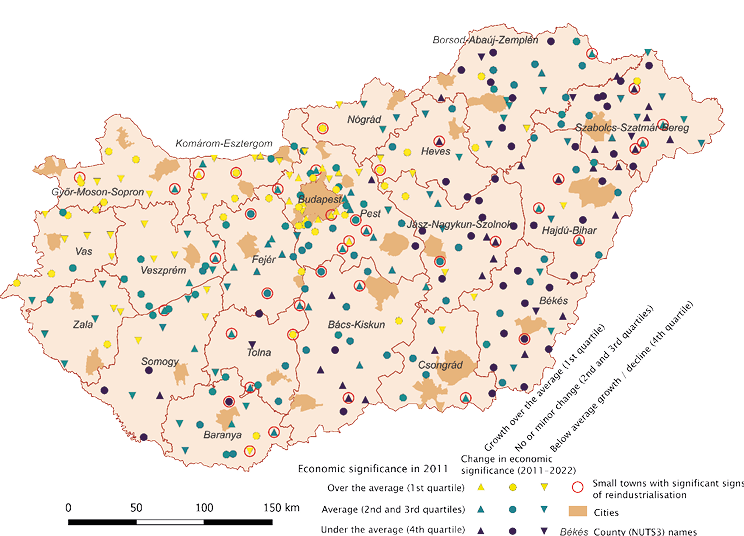
Average population sizes differed between the types: Type R1 towns averaged around 9,000 inhabitants, whereas Type R2 towns averaged approximately 12,200. Overall, these 40 reindustrialising towns constituted 13% of all small towns and 15% of the small-town population. Larger small towns were somewhat more likely to fall into this group: 11% of towns with <10,000 inhabitants, 15% of those between 10,000 and 20,000, and 22% of those above 20,000 were categorised as reindustrialising. Geographically, only three towns lied within the Budapest agglomeration and three on its outer fringe; five functioned as suburbs of major regional cities (Fig. 1.)

Source: own edition based on KSH-data.
A defining feature of this group is the dynamic expansion of large enterprises. The number of firms employing over 250 people in reindustrialising towns tripled from 17 in 2011 to 52 in 2022. Their share of all large enterprises in small towns rose from 8.3% to 20.8%. However, it remains uncertain how many of these firms represented genuinely new investments. The simultaneous decline in the number of mid-sized enterprises (50–250 employees) by 40 raises questions: this pattern may suggest that industrial growth in reindustrialising towns was driven at least partly by the expansion of locally embedded small and medium-sized firms rather than by new greenfield arrivals.
Previous research (Trócsányi et al., 2018) indicated that many of these towns had limited or secondary industrial traditions prior to reindustrialisation. Only a minority – including Mohács, Hatvan, Komló, and Berhida – fit the profile of former industrial towns experiencing genuine recovery after long-term decline. Other cases included formerly suburban settlements without distinct economic profiles (e.g., Pilis, Újhartyán, Rákóczifalva), agrarian towns (e.g., Nádudvar, Bábolna), and regional service centres (e.g., Berettyóújfalu, Csákvár).
4.4. Spatiality of small-town transformation
There has long been a consensus in academic literature regarding the fundamental elements defining Hungary’s spatial structures. The determining features of the spatial structure that emerged after the political transition include: the significant economic weight of the capital city and its region, a north-west to (south-)east development slope, the relative weakness of regional centres, and the underdevelopment of tiny-village areas located in external and internal peripheries, some with highly fragmented structures (Nemes-Nagy, 2000; Pénzes et al., 2015; Rechnitzer et al., 2014). These conditions mean that the capital city, interpreted as a separate region, accounts for 168% of the EU’s GDP per capita (calculated on a PPP basis). The three more developed regions, covering the north-western parts of the country and encompassing the capital’s agglomeration, stand at 65−68%, while the four less developed regions (including the southwest in addition to the whole of Eastern Hungary) are at 48−54%, forming a tripartite structure in terms of development.
These conditions are also reflected in the context of small towns. Figure 1 visualises this by combining static data from 2011 (colouring of the symbols) with changes between 2011 and 2022 (shape of the symbols). It is visible that economically significant small towns are found almost exclusively in the Northwest and the Budapest agglomeration. Outside these areas, only a few important industrial sites (e.g., Paks with Hungary’s only nuclear power plant, Tiszaújváros, a centre of petrochemicals, etc.) or spa towns and tourist centres fall into this category. The reverse is also true: the developed, central, and north-western regions generally feature small towns with less than average economic weight.
However, the average and less developed categories do not separate so clearly in space; rather, the data suggests that small towns with the least economic weight are concentrated along the country’s borders (external peripheries) and often along county borders (internal peripheries).
If we compare the static picture with its change dynamics (above average growth, average, below average growth), the spatial pattern changes significantly. Higher dynamism is linked to lower levels of development. This is not only visible in the spatial representation (the changes in small towns in Győr-Moson-Sopron, Vas or Veszprém counties are particularly noteworthy) but also statistically demonstrable, as there is a correlation coefficient of -0.13 between the 2011 Z-score values and the change values, indicating a very weak but negative connection. Only 16% of small towns that were above average in development in 2011 showed high dynamism, while 35% of the least developed ones did.
It is not necessarily true that dynamically developing settlements are found only in peripheral locations. While we do see such small towns in both internal and external peripheries – such as the southern part of Bács-Kiskun County, the eastern region of Jász-Nagykun-Szolnok County, and even in the north-eastern border areas – they are also commonly concentrated at the edges of central regions. For example, this can be observed on the southeastern fringe of the Budapest agglomeration or in the southern part of Fejér County, which is generally considered developed but has distinct divides.
Source: own edition based on KSH-data.
In terms of population, the catching-up small towns tend to be smaller. The average population of high-dynamism settlements in the lowest development category is 6,800, although it is also true that the average population of low-base but declining settlements is even smaller (5,900) and significantly lags dynamic (15,000) or declining (11,500) small towns that started from a higher base.
Reindustrialisation is closely linked to dynamic development. In fact, 35% of small towns in the upper quartile, known for their rapid growth, were classified as being affected by reindustrialisation. In contrast, only 5.5% of towns in all other quartiles fell into this category. Looking at it from another angle, towns undergoing reindustrialisation were evenly distributed among all groups in 2011. However, by 2022, small towns in the high-development group were significantly overrepresented, accounting for 45% of all reindustrialising small towns.
5. Discussion
A central issue when interpreting the results concerns the longstanding debate on convergence versus divergence in regional development. This question has been the focal point of spatial research for decades – even under the planned economy – and it grew substantially in importance after the political transition of the 1990s. Early transition years were characterised by rapid social polarisation, which manifested strongly at the territorial level (Kovács, 2004; Rechnitzer, 2012).
From the outset, assessments of these processes have been shaped by two factors:
(1) the theoretical framework applied, and
(2) the spatial scale of analysis.
Macro-level studies focusing primarily on GDP have generally highlighted the European convergence of the Hungarian economy as a whole (Herz and Vogel, 2003). Over time, however, this optimism weakened. By the second half of the 2010s, even amid comparatively strong economic growth (Lengyel and Varga, 2018), doubts about convergence resurfaced, as Hungary’s regions continued to lag behind those of other Central European transition countries (Benedek and Kocziszky, 2015).
In contrast, studies adopting a critical geographical perspective (G. Nagy et al., 2012; Timár, 2007) or exploring sub-regional and local dynamics (Bakucs and Fertő, 2020) emphasised social and spatial polarisation from the beginning, highlighting processes of marginalisation and the limited effectiveness of territorial policies. Previous small-town research similarly concluded that long-term disparities persist (Pirisi and Trócsányi, 2015).
Against this backdrop, the present research offers a more nuanced perspective on small-town development. The findings reveal a trend towards partial equalisation during the 2010s: less developed small towns generally experienced faster growth than their more developed counterparts, resulting in a decline in the concentration of economic performance. Given that employment expansion was a central component of Hungary’s growth model during this period, it is unsurprising that many peripheral areas – where labour reserves remained available – were able to benefit.
However, this equalisation is neither uniform nor universal. The most dynamic catching-up processes occurred in territories located at the edges of existing development poles, such as the southeastern fringe of the Budapest agglomeration, northern Bács-Kiskun County, and southern Fejér County. What appears as territorial equalisation is, therefore, partly explained by the outward extension of central, already strong regions and only to a lesser extent by genuine improvements in peripheral areas. For most small-town residents, relative position within the national hierarchy remains the dominant component of their lived experience.
A broader question concerns the success or limitations of reindustrialisation as a development strategy. Evaluating reindustrialisation is inherently complex. In many regions with strong industrial legacies, reindustrialisation is viewed as essential for socio-economic recovery (Krzysztofik et al., 2019), reflecting the deeply path-dependent nature of industrial transitions. However, the number of small-town case studies remains limited compared with regional-scale analyses. Existing research raises additional considerations: for instance, some authors have emphasised the role of reindustrialisation in community rebuilding (Cercleux et al., 2022), while others – using a more literal understanding of reindustrialisation – have warned that local labour-force limitations may prevent small towns from engaging in advanced industrial trajectories (Dabasi-Halász et al., 2021). This raises doubts about the long-term viability of strategies based on the traditional heavy industry. Consequently, complementary or hybrid development models, including tourism–industry co-evolution, have gained increasing attention (Napierała et al., 2022).
The findings of this study only partially support such concerns. While small towns exhibit high employment rates and growing levels of commuting – both from surrounding villages to towns and from small towns to larger centres – labour reserves are indeed becoming increasingly constrained. In this context, the organised import of foreign labour, already evident in Hungary (Jankó et al., 2024), may introduce social tensions, particularly in smaller and more socially cohesive communities.
The results also suggest that multiple pathways of small-town reindustrialisation coexist. The distinction between Type R1 and Type R2 towns captures this diversity well. While Type R2 reindustrialisation is more closely associated with the entry or expansion of major external investors, Type R1 reflects more organic development – linked to regional labour-market integration and the growth of locally embedded firms. This aligns with case studies that highlight the role of local industrial traditions, workforce skills, and institutional legacies, and emphasise the importance of small and medium-sized enterprises integrating into wider production networks (Molnár et al., 2022; Molnár and Lengyel, 2015).
Overall, reindustrialisation appears to have partially fulfilled the expectations placed upon it. It has contributed to employment expansion, local economic dynamism, and, crucially, the re-integration of surrounding rural areas into the economic orbit of small towns. Rising industrial employment in villages is closely linked to the strengthening of nearby small towns. Yet the concentration of revenue and export performance remains high, raising questions about the long-term sustainability of reindustrialisation-led growth, particularly in peripheral locations. While reindustrialisation can provide short to medium-term momentum, its capacity to drive lasting structural change in the broader small-town space remains uncertain.
6. Summary
This study set out to explore the economic weight of small towns in Hungary and how it changed between 2011 and 2022, a period characterised by relatively rapid national growth. During these years, reindustrialisation played a central role in economic policy. Accordingly, the research also sought to assess whether reindustrialisation represents a realistic development trajectory for small towns.
The findings indicate that small towns contributed slightly less to Hungary’s economic output than their share of the population would imply. However, this discrepancy was modest. Small-town enterprises played a substantial role in employment generation, particularly in manufacturing, where they were over-represented compared with larger urban centres.
The period between 2011 and 2022 did not fundamentally alter this overall picture. Nevertheless, the processes of spatial deconcentration and partial territorial equalisation were more pronounced than before. Economically weaker small towns generally recorded substantial growth in revenues, the number of large enterprises, and employment – especially industrial employment.
Reindustrialisation played a non-negligible part in these developments. The 40 small towns identified as reindustrialising displayed significantly higher dynamism than those not affected by industrial expansion. At the same time, the findings show that reindustrialisation did not substantially transform the established spatial structure of the small-town system. Many of the apparent equalisation effects reflected the outward extension of already developed regions, rather than widespread improvements across peripheral areas. In the peripheries, reindustrialisation tends to manifest as isolated cases of accelerated growth, producing a mosaic of ‘islands’ rather than coherent regional uplift.
Importantly, reindustrialisation – through increasingly integrated labour markets – strengthened the employment base not only of small towns but also of their rural hinterlands. Rising industrial employment in villages suggests that reindustrialising small towns have partially rebuilt the functional linkages that had weakened during the post-socialist transition.
Overall, the study concludes that reindustrialisation can enhance the economic dynamism of small towns and support local and regional labour markets. However, its long-term capacity to reshape the broader small-town landscape remains uncertain, especially in structurally disadvantaged peripheral regions.
Autorzy
REFERENCES
BAILEY, D., LENIHAN, H. and DE RUYTER, A. (2016), ‘A cautionary tale of two «tigers»: Industrial policy ‘lessons’ from Ireland and Hungary?’, Journal of the Local Economy, 31 (8), pp. 873–891. https://doi.org/10.1177/0269094216677779
BAKUCS, Z. and FERTŐ, I. (2020), ‘Convergence or Divergence? Analysis of Regional Development Convergence in Hungary’, Eastern European Countryside, 25 (1), pp. 121–143. https://doi.org/10.12775/eec.2019.005
BARTA, G., CZIRFUSZ, M. and KUKELY, G. (2008), ‘Re-industrialisation in the World and in Hungary’, European Spatial Research and Policy, 15 (2), pp. 5−26.
BARTOSIEWICZ, B., KWIATEK-SOŁTYS, A. and KUREK, S. (2019), ‘Does the process of shrinking concern also small towns? lessons from Poland’, Quaestiones Geographicae, 38 (4), pp. 91–105. https://doi.org/10.2478/quageo-2019-0039
BENEDEK, J. and KOCZISZKY, G. (2015), ‘Paths of Convergence and Polarization in the Visegrád Countries’, [in:] LANG, T., HENN, S., EHRLICH, K. and SGIBNEW, W. (eds), Understanding Geographies of Polarization and Peripheralization: Perspectives from Central and Eastern Europe and Beyond, pp. 217–234, Palgrave Macmillan. https://doi.org/10.1057/9781137415080_12
BINZ, C. and GONG, H. (2022), ‘Legitimation dynamics in industrial path development: New-to-the-world versus new-to-the region industries’, Regional Studies, 56 (4), pp. 605–618. https://doi.org/10.1080/00343404.2020.1861238
BOLE, D., KOZINA, J. and TIRAN, J. (2020), ‘The socioeconomic performance of small and medium sized industrial towns: Slovenian perspectives’, Moravian Geographical Reports, 28 (1), pp. 16–28. https://doi.org/10.2478/mgr-2020-0002
CAPELLO, R. and CERISOLA, S. (2023), ‘Regional reindustrialization patterns and productivity growth in Europe’, Regional Studies, 57 (1), pp. 1−12. https://doi.org/10.1080/00343404.2022.2050894
CERCLEUX, A. L., SORENSEN, A., MERCIU, F. C., SAGHIN, I., PARASCHIV, M., SECĂREANU, G., SĂGEATĂ, R. and IANOŞ, I. (2022), ‘Community re-creating of a small industrial town in Southeast Europe: lessons from Fieni, Romania’, Mitteilungen Der Österreichischen Geographischen Gesellschaft, 164, pp. 311–336. https://doi.org/10.1553/moegg164s311
COTELLA, G. and VITALE BROVARONE, E. (2022), ‘Tourism as an opportunity to effectively counteract marginalisation: the case of the Italian national strategy for inner areas’, European Spatial Research and Policy, 29 (2), pp. 59–77. https://doi.org/10.18778/1231-1952.29.2.04
COUCH, J. (2016), The small-town Midwest: Resilience and hope in the twenty-first century, University of Iowa Press. https://doi.org/10.1353/book44994
COURTNEY, P., MAYFIELD, L., TRANTER, R., JONES, P. and ERRINGTON, A. (2007), ‘Small towns as “sub-poles” in English rural development: Investigating rural-urban linkages using sub-regional social accounting matrices’, Geoforum, 38 (6), pp. 1219–1232. https://doi.org/10.1016/j.geoforum.2007.03.006
DABASI-HALÁSZ, Z., LIPTÁK, K., SÁFRÁNYNÉ GUBIK, A. and VARGA, B. (2021), ‘Human resources requirements for reindustrialisation in Borsod-Abaúj-Zemplén county’, Studia Mundi – Economica, 8 (4), pp. 55–71. https://doi.org/10.18531/Studia.Mundi.2021.08.04.55-71
DEMIROVIĆ BAJRAMI, D., PETROVIĆ, M. D., TURGEL, I. D., RADOVANOVIĆ, M. M. and BUGROVA, E. D. (2025), ‘Reindustrializing the Hidden Gems: A Systematic Review of Creative Efforts in Second-Tier Cities’, Urban Science, 9 (12). https://doi.org/10.3390/urbansci9120493
DIRECTORATE-GENERAL FOR INTERNAL MARKET, INDUSTRY, ENTREPRENEURSHIP AND SMES 2026: COM(2026)100 - Proposal for a Regulation on establishing a framework of measures for accelerating industrial capacity and decarbonisation in strategic sectors (Industrial Accelerator Act). 4 March 2026.
DOMAŃSKI. B. (2003), ‘Industrial Change and Foreign Direct Investment in the Postsocialist Economy: the case of Poland’, European Urban and Regional Studies, 10 (2), pp. 99−118. https://doi.org/10.1177/0969776403010002001
EICHLER, M. (2005), ‘Explaining postcommunist transformations: Economic nationalism in Ukraine and Russia’, [in:] HELLEINER, E. and PICKEL, C. (eds), Economic Nationalism in a Globalizing World, Cornell Studies in Political Economy, Ithaca: Cornell University Press, pp. 69–87. https://doi.org/10.7591/9781501726620-006
EUROPEAN COMMITTEE (2020), A New Industrial Strategy for Europe. Brussels 10.3.2020 COM(2020) 102 final, https://eur-lex.europa.eu/legal-content/EN/TXT/PDF/?uri=CELEX:52020DC0102 [accessed on: 12.01.2026].
EUROPEAN PARLIAMENT AND EUROPEAN COUNCIL (2023), Establishing a framework of measures for strengthening Europe’s semiconductor ecosystem and amending Regulation (EU) 2021/694 (Chips Act). Regulation (EU) 2023/1781 of the European Parliament and of the Council, Brussels, 13 September 2023.
EUROSTAT (2026), Gross value added at basic prices by other typologies. https://doi.org/10.2908/URT_10R_3GVA
FERTNER, C., GROTH, N. B., HERSLUND, L. and CARSTENSEN, T. A. (2015), Small towns resisting urban decay through residential attractiveness. Findings from Denmark, Geografisk Tidsskrift-Danish Journal of Geography, 115 (2), pp. 119–132. https://doi.org/10.1080/00167223.2015.1060863
HANNEMANN, Ch. (2004), Marginalisierte Städte. In Probleme, Differenzierungen und Chancen ostdeutscher Kleinstädte im Schrumpfungsprozess, Berlin. Berliner Wissenschafts-Verlag.
HERZ, B. and VOGEL, L. (2003), Regional Convergence in Central and Eastern Europe: Evidence from a Decade of Transition. Universität Bayreuth Rechts- Und Wirtschaftswissenschaftliche Fakultät Wirtschaftswissenschaftliche Diskussionspapiere, 13 (3), pp. 1–30. https://doi.org/10.2139/ssrn.988275
HORECZKI, R. and EGYED, I. (2021), ‘Small town development in peripheral areas’, Deturope – The Central European Journal of Regional Development and Tourism, 13 (2), pp. 52–65. https://doi.org/10.32725/det.2021.013
HUNGARY TODAY (2024), Construction of One Hundred New Factories to Start This Year, The Foreign Minister’s video announcement, https://hungarytoday.hu/construction-of-one-hundred-new-factories-to-set-off-this-year/ [accessed on: 20.01.2026].
JANKÓ, F., CZIRFUSZ, M. and BERKI, M. (2024), ‘Migratory birds: Dehumanization of migrant workers in West Hungary’, Population, Space and Place, 30 (5). https://doi.org/10.1002/psp.2760
KARSAI, V. and TRÓCSÁNYI, A. (2019), ‘Aki kimarad(t), lemarad(t)? – A település sikeressége és a városi cím’, Földrajzi Közlemények, 143 (4), pp. 339–357. https://doi.org/10.32643/fk.143.4.4
KISS, E. (2007), ‘Foreign Direct Investment in Hungary. Industry and its spatial effects’, Eastern European Economics, 45 (1), pp. 6–28. https://doi.org/10.2753/EEE0012-8775450101
KONECKA-SZYDŁOWSKA, B., TRÓCSÁNYI, A. and PIRISI, G. (2018), ‘Urbanisation in a formal way? The different characteristics of the “newest towns” in Poland and Hungary’, Regional Statistics, 8 (2), pp. 135–153. https://doi.org/10.15196/RS080202
KOVÁCS, O. and DOMONKOS, E. (2024), ‘Deindustrialisation and reindustrialisation patterns in V4 countries–industry 4.0 as a way forward?’, Post-Communist Economies, 36 (4), pp. 432−463. https://doi.org/10.1080/14631377.2024.2323834
KOVÁCS, Z. (2004), ‘Socio-economic transition and regional differentiation in Hungary’, Geographical Bulletin, 1 (2).
KRUGMAN, P. R. (1988), Deindustrialization, Reindustrialization, and the Real Exchange Rate. Working Paper 2586. https://doi.org/10.3386/w2586
KRZYSZTOFIK, R., KANTOR-PIETRAGA, I. and KŁOSOWSKI, F. (2019), ‘Between Industrialism and Postindustrialism—the Case of Small Towns in a Large Urban Region: The Katowice Conurbation’, Poland. Urban Science, 3 (3). https://doi.org/10.3390/urbansci3030068
KSH (2014), Magyarország településhálózata 1 - Agglomerációk, településegyüttesek, Central Statistical Office, Hungary.
LAKNER, Z. and TAUSZ, K. (2016), ‘From a Welfare to a Workfare State: Hungary’, Challenges to European Welfare Systems, pp. 325–350. https://doi.org/10.1007/978-3-319-07680-5_15
LANDESMANN, M. A. and SZÉKELY, I. P. (eds) (1995), Industrial restructuring and trade reorientation in Eastern Europe, 60, Cambridge University Press.
LEETMA, K., NUGA, M. and ORG, A. (2013), ‘Entwicklungsstrategien und soziales Kapital in den schrumpfenden Kleinstädten Südestlands’, [in:] BURDACK, J. and KRISZÁN, Á. (eds), Kleinstädte in Mittel- und Osteuropa: Perspektiven und Strategien lokaler Entwicklung, 19, pp. 31–52, Institut für Länderkunde.
LENGYEL, I. and VARGA, A. (2018), ‘A magyar gazdasági növekedés térbeli korlátai – helyzetkép és alapvető dilemmák’, Közgazdasági Szemle, 65 (5), pp. 499–524. https://doi.org/10.18414/ksz.2018.5.499
LENGYEL, I., VAS, Z., SZAKALNE KANO, I., and LENGYEL, B. (2017), ‘Spatial differences of reindustrialization in a post-socialist economy: manufacturing in the Hungarian counties’, European Planning Studies, 25 (8), pp. 1416−1434. https://doi.org/10.1080/09654313.2017.1319467
LEŚNIEWSKA-NAPIERAŁA, K. (2017), ‘The potential of cultural heritage of national minorities in small towns – the case of Brzeziny’, Space – Society – Economy, 19, pp. 105–120. https://doi.org/10.18778/1733-3180.19.06
LJUBENOVIĆ, M., PROTIĆ, I. B., BRANKOVIĆ, M. D., ĐEKIĆ, J. and IGIĆ, M. (2025), ‘Identifying characteristics and typology of small shrinking towns in Serbia: The case of the Region of Southern and Eastern Serbia’, Acta Geographica Slovenica, 65 (1), pp. 7–23. https://doi.org/10.3986/AGS.13717
LUX, G. (2012), ‘Reindusztrializáció Magyarországon’, [in:] BARANYI, B., and FODOR, I. (eds), Környezetipar, újraiparosítás és regionalitás Magyarországon, Pécs, Magyarország, Debrecen, MTA Közgazdaság- és Regionális Tudományi Kutatóközpont Regionális Kutatások Intézete, pp. 21−34.
LUX, G. (2017), ‘A külföldi működő tőke által vezérelt iparfejlődési modell és határai Közép-Európában’, Tér és Társadalom, 31 (1), pp. 30−52. https://doi.org/10.17649/TET.31.1.2801
LUX, G. (2021), ‘Manufacturing in the post-industrial city: The role of a “hidden sector” in the development of Pécs, Hungary’, [in:] CUDNY, W. and KUNC, J. (eds), Growth and Change in Post-socialist Cities of Central Europe, Abingdon: Routledge, pp. 94–112. https://doi.org/10.4324/9781003039792-6
LUX, G. (2025), ‘A kiegészítő újraiparosodás térbeli folyamatai és korlátjai Magyarországon’, [in:] SZANYI, M., SZUNOMÁR, Á. and TÖRÖK, Á. (eds), Trendek és töréspontok VI.: trendváltás és túlélés, Budapest, Akadémiai Kiadó, pp. 109−115.
MAKKAI, B., MÁTÉ, E., PIRISI, G. and TRÓCSÁNYI, A. (2017), ‘Where Have All the Youngsters Gone? The Background and Consequences of Young Adults’ Outmigration from Hungarian Small Towns’, European Countryside, 9 (4), pp. 789–807. https://doi.org/10.1515/euco-2017-0044
MAYER, H. and KNOX, P. (2010), ‘Small-town sustainability: Prospects in the second modernity’, European Planning Studies, 18 (10), pp. 1545–1565. https://doi.org/10.1080/09654313.2010.504336
MOLNÁR, E. and LENGYEL, M. I. (2015), ‘Újraiparosodás és útfüggőség: gondolatok a magyarországi ipar területi dinamikája kapcsán’, Tér és Társadalom, 26 (4), pp. 42–59. https://doi.org/10.17649/TET.29.4.2726
MOLNÁR, E., SAIDI, F. A. and SZABÓ, K. (2022), ‘Strategic coupling on the European periphery: A case study of a small Hungarian town’, Tér és Társadalom, 36 (3), pp. 122–144. https://doi.org/10.17649/tet.36.3.3424
MOLNÁR, E. and RADICS, ZS. (2021), ‘Automotive Production Networks: an Economic Dimension of Intraregional Cooperation in East-Central Europe’, [in:] CHIRODEA, F., ŢOCA, C.-V. and ŞOPRON, L. (eds), Europe in a changing world: opportunities and challenges: In Honorem Professor Ioan Horga, Oradea, Debrecen, Oradea University Press, Debrecen University Press, pp. 265−280.
NAGY, E., BRÓDY, L. S. and MIHÁLY, M. (2024), ‘Locked In: Reindustrialisation and the Production of Multiple Marginalities in an Old Mining Town of Hungary’, Antipode. https://doi.org/10.1111/anti.13069
NAGY, G. (2007), ‘Divergencia vagy konvergencia - Az átmenet gazdasági térfolyamatainak mérlege földrajzos szemmel’, Tér és Társadalom, 21 (1), pp. 35−51. https://doi.org/10.17649/TET.21.1.1092
NAGY, G., NAGY, E. and TIMÁR, J. (2012), ‘The Changing Meaning of Core–Periphery Relations in a Non-Metropolitan “Urban Region” at the Hungarian–Romanian Border’, DisP – The Planning Review, 48 (2), pp. 93–105. https://doi.org/10.1080/02513625.2012.721613
NAPIERAŁA, T., LEŚNIEWSKA-NAPIERAŁA, K., NALEJ, M. and PIELESIAK, I. (2022), ‘Co-evolution of tourism and industrial sectors: the case of the Bełchatów industrial district’, European Spatial Research and Policy, 29 (2), pp. 149–173. https://doi.org/10.18778/1231-1952.29.2.09
NEMES-NAGY, J. (2000), ‘The new regional structure in Hungary’, [in:] GORZELAK, G., MAIER, G. and PETRAKOS, G. (ds), Integration and transition in Europe: The economic geography of interaction, pp. 170–186, Routledge.
ORBÁN, V. (2013), Prime Minister Viktor Orbán’s State of the Nation Speech. Government of Hungary, https://2010-2014.kormany.hu/en/prime-minister-s-office/the-prime-ministers-speeches/prime-minister-viktor-orban-s-state-of-the-nation-speech [accessed on: 20.05.2026].
ORBÁN, V. (2017), Magasabb fokozatba kapcsol az iparosítás (Industrialization moves to a higher gear). The Prime Minister’s speech at the opening ceremony of the new battery-factory of Samsung SDI at Göd, Hungary, https://2015-2022.miniszterelnok.hu/2017-ben-magyarorszagon-magasabb-fokozatba-kapcsol-az-iparositas/ [accessed on: 20.05.2026].
ORBÁN, V. (2024), Egy világrendszerváltás idején szükség van egy magyar nagystratégiára is (In a time of global transformation, a Hungarian grand strategy is also required) – The Prime Minister’s speech at the 33rd Annual Bálványos Summer Open University in Tusnádfürdő, https://youtu.be/-q-ghe63zic [accessed on: 14.12.2025].
PÉNZES, J., MOLNÁR, E. and PÁLÓCZI, G. (2015), ‘Local Labour System After the Turn of the Millennium in Hungary’, Regional Statistics, 5 (2), pp. 62–81. https://doi.org/10.15196/RS05204
PIPAN, T. (2018), ‘Neo-industrialization models and industrial culture of small towns’, GeoScape, 12 (1), pp. 10–16. https://doi.org/10.2478/geosc-2018-0002
PIRISI, G. (2009), ‘Város vagy nem város? Dilemmák a formális és a funkcionális városfogalom kettőssége kapcsán’, Területi Statisztika, 12 (2), pp. 129–136.
PIRISI, G. and TRÓCSÁNYI, A. (2015), ‘Between shrinking and blooming: the crossroad of small towns’ urbanisation in Hungary’, Annales Universitatis Paedagogicae Cracoviensis Studia Geographica, 8 (1), pp. 12–28.
PRISECARU, P. (2014), ‘Eu Reindustrialization Policy’, Knowledge Horizons – Economics, 6 (2), pp. 21−25.
PUTNAM, R. D. (2001), Bowling alone: The collapse and revival of American community, Simon and Schuster. https://doi.org/10.1145/358916.361990
RADOSEVIC, S. and ROZEIK, A. (2005), Foreign direct investment and restructuring in the automotive industry in Central and East Europe, UCL, School of Slavonic and East Europoean Studies Working Papers No. 53.
RECHNITZER, J. (2012), ‘The Features of the Transition of Hungary’s Regional System’, Discussion Papers, 32, pp. 5–54.
RECHNITZER, J., PÁTHY, Á. and BERKES, J. (2014), ‘Stability and Changes of the Hungarian City-Network’, [in:] SOMLYÓDYNÉ PFEIL, E. (ed.), Industrial districts and cities in Central Europe, Universitas-Győr Nonprofit Ltd, pp. 109−130.
REINERT, E. S., KATTEL, R. and SUURNA, M. (2009), Industrial restructuring and innovation policy in Central and Eastern Europe since 1990, 23, TUT Ragnar Nurkse Department of Innovation and Governance.
SOKOL, M. (2001), ‘Central and Eastern Europe a decade after the fall of state-socialism: Regional dimensions of transition processes’, Regional Studies, 35 (7), pp. 645–655. https://doi.org/10.1080/00343400120075911
STEINFÜHRER, A., VAISHAR, A. and ZAPLETALOVÁ, J. (2016), ‘The small town in rural areas as an underresearched type of settlement. Editors’ introduction to the special issue’, European Countryside, 8 (4), pp. 322–332. https://doi.org/10.1515/euco-2016-0023
STOJČIĆ, N. and ARALICA, Z. (2018), ‘(De)industrialisation and lessons for industrial policy in Central and Eastern Europe’, Post-communist economies, 30 (6), pp. 713−734. https://doi.org/10.1080/14631377.2018.1443251
STOJČIĆ, N., and ARALICA, Z. (2017), ‘Choosing right from wrong: Industrial policy and (de)- industrialization in Central and Eastern Europe’, Radni materijali EIZ-a, 3, pp. 5−36.
TIMÁR, J. (2007), ‘Different Scales of Uneven Development – in a (No Longer) Post-socialist Hungary’, Treballs de La Societat Catalana de Geografia, 64, pp. 103–128.
TRÓCSÁNYI, A., PIRISI, G. and MÁTÉ, É. (2018), ‘An interpretation attempt of Hungarian small towns’ shrinking in a post-socialist transformation context’, Chasopys Socialno-Ekonomichnoyi Heohrafiyi / Human Geography Journal, 24 (1), pp. 5–20. https://doi.org/10.26565/2076-1333-2018-24-01
TURIENZO, J. and LAMPÓN, J. F. (2023), ‘New mobility technologies as incentive to location decisions: relocation strategy in the automotive industry’, Kybernetes, 52 (11), pp. 5444−5459.
VAISHAR, A. and ZAPLETALOVÁ, J. (2009), ‘Small towns as centres of rural micro-regions’, European Countryside, 1 (2), pp. 70–81. https://doi.org/10.2478/v10091/009-0006-4
VAISHAR, A., ŠŤASTNÁ, M. and ZAPLETALOVÁ, J. (2023), ‘Small industrial towns in Moravia: a comparison of the production and post-productive eras’, European Planning Studies, 31 (8), pp. 1776−1796. https://doi.org/10.1080/09654313.2022.2110377
YU, Z., YUAN, D., ZHAO, P., LYU, D. and ZHAO, Z. (2023), ‘The role of small towns in rural villagers’ use of public services in China: Evidence from a national-level survey’, Journal of Rural Studies, 100, 103011. https://doi.org/10.1016/j.jrurstud.2023.103011