
Spatial and temporal dynamics of tourism development in the Lake Neusiedl region
Michal KLOBUČNÍK  *
*
Vanessa ČASOVÁ *
Abstract. The study analyses tourism in the Lake Neusiedl region, an important tourist area on the Austrian-Hungarian border. It analyses not only its long-term development but also the current state of accommodation capacities and visitor numbers in selected Austrian municipalities in the region. Emphasis is placed on identifying key trends and seasonal fluctuations. The work is based on data for the years 2000 to 2024, which have been processed using appropriate methods and subsequently visualised. The results indicate a concentration of tourism in a few central municipalities, persistent seasonality, and a slight decline in the region’s relative importance within Burgenland. At the same time, the potential for further sustainable tourism development in the area is identified.
Key words: Lake Neusiedl, Burgenland, accommodation facilities, visitation, seasonality of tourism.
1. Introduction
Tourism is a complex phenomenon, continuously generating new forms. Many of these are based on leveraging the water environment and its immediate surroundings as tourist resources (Furgała-Selezniow and Jankun-Woźnicka, 2021). Despite their long-standing importance in leisure and tourism, lakes only began to attract significant international tourism research attention in the early 21st century (Tuohino and Lóránt, 2012). One such example is the area around Lake Neusiedl, a natural and cultural landmark on the border between Austria and Hungary. Characterised by strong winds and extreme shallowness, Lake Neusiedl is a distinctive steppe lake in Europe (Herzig and Dokulil, 2001). Lake Neusiedl has unique natural conditions and is home to many endangered species of animals and plants. Thanks to its unique nature and convenient location, the Lake Neusiedl area enjoys considerable popularity among tourists. The economic importance of the region lies primarily in water sports and nature tourism. However, the future poses a significant challenge for the area: maintaining a stable water level in the lake amid ongoing climate change (Soja et al., 2013). Lake Neusiedl in Austria has become an increasingly popular tourist destination in recent years, which has had a significant positive impact on the development of the entire region.
The paper aims to assess the current state of tourism at Lake Neusiedl and comprehensively examine its development and dynamics over the 25 years from 2000 to 2024. The analysis is structured into two main parts: the first focuses on a detailed examination of accommodation capacities, and the second examines the development of the region’s visitor arrivals and their seasonality, a crucial aspect of this destination. We will examine tourism at the level of individual municipalities near Lake Neusiedl, utilising several relevant data and statistical indicators to gain a deeper understanding of transformations and trends.
The results of the analysis provide a comprehensive view of the current state and development of tourism around Lake Neusiedl, as well as indicate opportunities and challenges for the future. The study should thus serve as a valuable source of information for tourism professionals, local authorities, and all those involved in the sustainable development of this region.
2. Literature review
Lakes play a key role in the analysis of tourist destinations. They serve as a fundamental attraction that directly generates visitor numbers to a region and often forms the core of a destination’s appeal (Cooper, 2006). Lake tourism brings significant economic and social benefits to many locations, especially in rural areas, creating jobs and enhancing local living conditions (Duda-Gromada et al., 2010). However, effective regulation and management of holiday rentals near lakes is essential for the sustainable development of this sector (Belotti, 2019). As part of lake tourism research, attention is also paid to assessing the strengths and weaknesses of the region, to use the findings to support future marketing campaigns and development (Schröder, 2024). At the same time, environmental changes pose a constant challenge to the future development of these regions, which also directly affects the sustainability of lake tourism (Dokulil et al., 2010; George, 2009).
Lake tourism is a complex area of interest that has been the subject of extensive and diverse research. Numerous studies have analysed the specifics and challenges associated with tourism at lakes worldwide, ranging from comprehensive case studies of specific locations to theoretical models of sustainable development. Together, these works contribute to a deeper understanding of the economic, social, and environmental aspects that shape the dynamics of lake destinations.
Research on Lake Garda has shown that protecting local resources (both natural and cultural) is a key economic priority that directly influences tourist satisfaction and increases the value of the destination (Goffi et al., 2021). Research projects on Lake Altaussee in the Alps indicate how global issues such as climate change and pollution are affecting the lake’s ecosystem (Deheyn et al., 2025). Effective environmental and landscape planning is essential for areas with diverse land use, such as Lake Constance (Megerle and Eberle, 2005). Puczkó and Rátz (2000) focused their research on Lake Balaton in Hungary, examining the characteristics of tourism development with a particular emphasis on the physical impacts of this development on the environment and how residents and tourists perceived them. It is noteworthy that although both groups perceived both positive and negative effects of tourism, residents considered economic benefits to be the most significant. According to Petrovszki et al. (2024), mass tourism was the main driver of urbanisation in the Balaton coastal zone. This process led to the extensive expansion of built-up areas at the expense of the natural regions. Although the intensity of tourism varies, urbanisation continues to spread, requiring regulation to ensure sustainable development.
Research on Lake Neusiedl highlights not only its ecological and tourist importance but also its high sensitivity to environmental changes (Mitter and Kropf, 2025). As Teubner et al. (2022) noted, research on this lake had shifted from initial species inventories to a current focus on the impact of global warming and human activities. More recent studies examine the lake’s hydrology and its vulnerability to climate change in detail, confirming its vulnerability to water level changes (Tolotti et al., 2021). Meteorological variables influence water level fluctuations (Hackl and Ledolter, 2023). Water balance projections for 2035–2065 indicate a significant risk of hydrological deficits, leading to a drop in water levels below current levels (Soja et al., 2013). Meteorological conditions and existing climate change will be key factors for the future of Lake Neusiedl, despite all development plans (Sailer and Maracek, 2019).
The management of Lake Neusiedl faces significant conflicts of interest, where the economic demands of tourism clash with the need for ecological management and nature conservation. Csaplovics (2019) indicated the polarisation between economic exploitation and environmental protection in the region. Finding a sustainable balance between these conflicting goals is crucial for the future of the area. It is precisely in the context of this need for sustainability that research also focuses on cooperation with stakeholders, with Kropf et al. (2021) emphasising that solving complex social problems requires a coordinated approach. Zimmermann-Timm and Teubner (2021) have stressed the fundamental importance of effective communication and open discussion with the public, which includes diverse interest groups (farmers, water managers, national park representatives, hunters, municipal representatives, and citizens).
Lake Neusiedl is a key area that is the subject of comprehensive research in many strategic documents. These documents examine it from various angles: from nature conservation and biodiversity (Wolfram et al., 2014; Wrbka et al., 2012), national park management (Nationalpark Neusiedler See – Seewinkel, 2021), tourism and regional development (Tourismusverband Nordburgenland, 2024), water resource management (Wolfram et al., 2020), and climate change adaptation (Weiss et al., 2013).
Tourism around Lake Neusiedl, often linked to cultural and natural heritage (UNESCO World Heritage Centre, 2020), is also an essential area of research. Studies evaluate nature conservation systems and tourism development in border areas (Šilhánková and Pondělíček, 2013; Sallay et al., 2016), sustainable development of lake tourism in the region (Pomucz and Csete, 2015), and the potential of ecotourism, including cycling tourism (Lukic and Filipovic, 2019; Gauster et al., 2020). At the same time, the impact of climate change on summer outdoor tourism is being investigated (Pröbstl-Haider et al., 2021).
3. Methodology
In the initial phase of our study, it was necessary to identify the Austrian municipalities around Lake Neusiedl that would be included in the analysis. In selecting the municipalities, we focused on the districts of Neusiedl am See and Eisenstadt-Umgebung. However, it is essential to note that the town of Rust has a statutory status, which means it is not part of any of the districts mentioned above and has its administration.
We then included in our selection those Austrian municipalities whose cadastral territories are directly adjacent to Lake Neusiedl. Based on this criterion, we identified a total of 13 municipalities that were included in our analytical investigation. Subsequently, we expanded our scope to include an additional eight municipalities that, although not directly bordering Lake Neusiedl, are located in its immediate geographical vicinity. In including them in our analysis, we carefully considered additional relevant aspects. The primary criterion was the environmental criterion, specifically whether the municipality’s territory overlaps with the Neusiedler See-Seewinkel National Park. In addition, we also considered the economic and social importance, focusing on municipalities with a dominant tourism presence, a long wine-growing tradition, or a demonstrable historical significance for the region. Figure 1 represents the selected municipalities.
For the analysis of tourism in the Lake Neusiedl region, we relied exclusively on data provided by Statistics Austria (STATcube Austria). Our study utilised 25 years of annual data (2000–2024), which enabled us to identify long-term trends and developments. However, when examining seasonality, we proceeded to a more detailed analysis at the monthly level within this same 25-year period. This approach enabled us to capture more subtle fluctuations and gain a deeper understanding of the seasonal characteristics of tourism in the region.
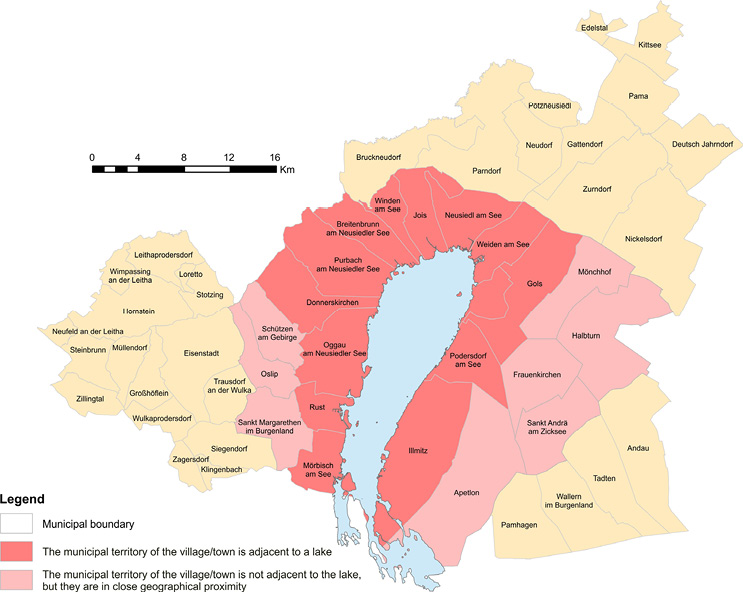
Source: own work based on data from http://data.statistik.gv.at
The first part of our analysis focused on a detailed examination of the accommodation sector in the region. The key indicators we focused on included the total number of accommodation facilities, their structure by type (hotels, apartments/guesthouses, private accommodations, other accommodations), as well as the total accommodation capacity in terms of the number of beds. Even though campsites are an essential part of the region’s accommodation facilities and capacity, we did not include their quantitative data in our statistics to avoid potential distortion in the analysis results. However, we have devoted a separate section to these accommodations in the results section of our paper. The second part of the follow-up analysis focused on the characteristics of the region’s visitor arrivals and their seasonal fluctuations, examining the total number of arrivals and overnight stays in detail.
Throughout our analysis, we utilised a range of specific indicators. In this section, we, therefore, explain the methodology for calculating the various indicators used to ensure the transparency and clarity of our findings.
Based on Krukowska and Świeca (2018), we defined the Tourist accommodation density index for our analysis. While the authors mentioned above utilised the number of beds in their methodology, we opted to use the number of accommodation facilities to reflect the specific data available for the studied region.

The Statistical Office of Austria (STATcube Austria) provided the database of the built-up area of individual municipalities. This approach is crucial for achieving more accurate results, as it considers the actual level of concentration of accommodation capacities within the urbanized areas of individual municipalities.
As part of the analysis of the region’s visitor numbers, we also focused on a key indicator, the occupancy rate of accommodation facilities. This parameter provided us with valuable information on the current occupancy of hotels, guesthouses, and other types of accommodations, which enabled us to understand the dynamics of demand and the efficiency of the existing accommodation capacity in the region. According to Eurostat (2025), the following relationship applies to the calculation of the bed occupancy rate:

For a more accurate assessment of seasonal fluctuations in visitor arrivals, the analysis of occupancy rates often considers whether the period refers to the primary summer season (May to October, i.e., 184 days) or the winter season (November to April, i.e., 181 days), or the year-round period (365 days).
Seasonality is a key characteristic of tourism, manifested in the temporal imbalance of visitor numbers, expenditures, and infrastructure utilisation (Butler, 2001). Tourism seasonality poses a global problem for most major destinations, particularly from a sustainability perspective. Despite its significance, there is no homogenous international methodology for measuring it on a worldwide scale (Duro and Turrión-Prats, 2019). When examining the seasonality of visitors to the region, we focused on the number of overnight stays, which is a key indicator in this context. Overnight stays are directly related to the economic benefit of accommodation and other services in the region. Longer stays mean higher visitor spending on lodging, meals, activities, and shopping. The number of overnight stays is, therefore, a better indication of the actual utilisation of accommodation facilities. A high number of arrivals may also include overnight visits, which do not utilise accommodation services to the same extent as multi-day stays. An analysis of overnight stays at different times of the year can reveal not only when most visitors arrive but also how long they tend to stay in other seasons. Karamustafa and Ulama (2010) shed light on different metrics for measuring seasonality in tourism, highlighting that although overnight stay data was crucial for deeper analysis, its use was dependent on data availability. In their research, the authors often used the indicator of the number of overnight stays (Vergori, 2017; Ferrante et al., 2018; Krabokoukis and Polyzos, 2024).
For our seasonality analysis, we applied the coefficient of variation method, which we calculated using monthly data on the number of overnight stays over a 12-month period. This approach aligns with methodologies employed by other researchers, such as Duro and Turrión-Prats (2019), who also utilised the coefficient of variation in their studies. This statistical tool enabled us to quantify the degree of variability in the number of overnight stays during the year, thereby identifying the intensity of seasonal fluctuations in visitation to the region. To calculate the coefficient of variation (Bedeian and Mossholder, 2000):
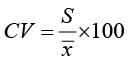 where:
S represents the standard deviation of the data set (in our case, the number of overnight stays per month);
x̅ represents the arithmetic mean of the dataset (average number of overnight stays per month);
The coefficient of variation is also often expressed as a percentage by multiplying the result by 100.
This coefficient indicates the relative degree of variability of the data about their mean. The higher the value of the coefficient of variation, the greater the variability (dispersion) of the data around the mean, which, in our context, indicates more pronounced seasonality.
4. Results
In the results section of our research, we focused on two main areas. The first was an analysis of accommodation facilities in the Lake Neusiedl region, where we examined their development and structure in detail. The second, equally important area was the analysis of visitor numbers and seasonality in the Lake Neusiedl region. Within this section, we identified key trends in visitation, examined the impact of seasonal fluctuations, and provided a comprehensive overview of the region’s tourism dynamics.
4.1. Analysis of accommodation facilities in the Lake Neusiedl region
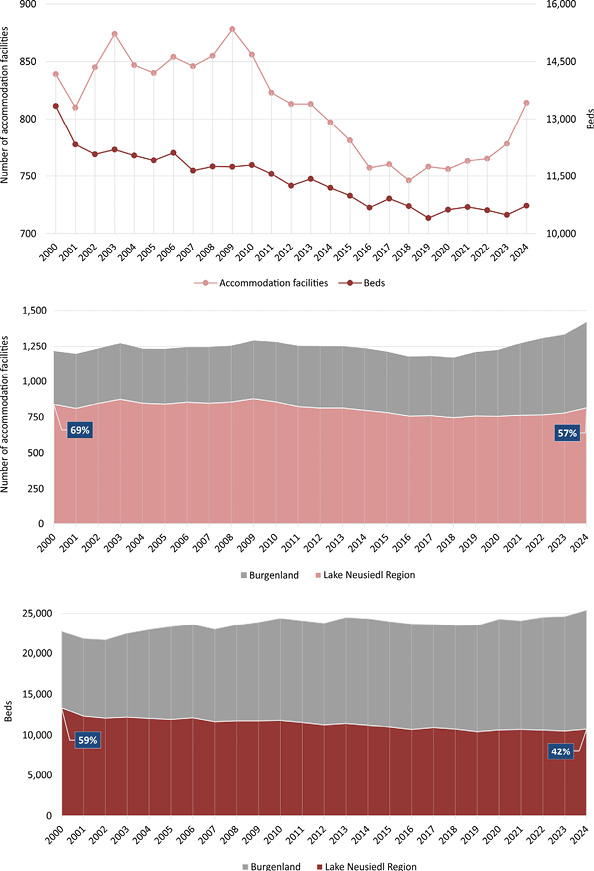
Accommodation facilities and their capacities represent a key element of tourism infrastructure, the development of which provides essential information on the dynamics of tourism in a given area. A closer look at the Lake Neusiedl region itself (Fig. 2) reveals interesting structural changes.
While the number of accommodation facilities has declined significantly since 2009, the number of beds has declined more moderately and has shown more stability since the beginning of the period under review. The increase in the number of accommodation facilities in the area in recent years has likely led to the addition of smaller, private accommodation providers, even outside the central tourist municipalities.
At the beginning of the reference period (2000), the Lake Neusiedl region accounted for a significant part of Burgenland’s accommodation base (approx. 69%). However, over the period 2000 to 2024, this proportion gradually decreased. While the total number of accommodation facilities in Burgenland has shown an increasing trend in recent years, the Lake Neusiedl region has stagnated, leading to a decrease in its share to 57% (2024). This development suggests a more dynamic development of accommodation services in other parts of Burgenland. From a long-term perspective, it is challenging to determine with certainty the exact factors that have contributed to the observed development in the share of accommodation facilities. Burgenland has started to invest more in tourism outside Lake Neusiedl. Interest in rural tourism, cycling, and wine tourism has also increased in other parts of the region. Supply and demand within the Lake Neusiedl region have also influenced the development of accommodation services.
The area accounted for approximately 59% of the total number of beds in Burgenland in 2000, indicating its strong dominance in tourist accommodation at the turn of the millennium. However, in the following years, this share also gradually declined, reaching only 42% in 2024. This change indicates a decline in the relative importance of the Lake Neusiedl region in terms of total bed capacity. The fact that accommodation capacity in the other areas of Burgenland has been increasing slightly has also contributed to the decline in the share.
In the long term, therefore, it is clear that although the Lake Neusiedl region retains a vital position in terms of accommodation facilities and accommodation capacity, its relative position in Burgenland as a whole is gradually declining.
Source: own work, STATcube Austria.
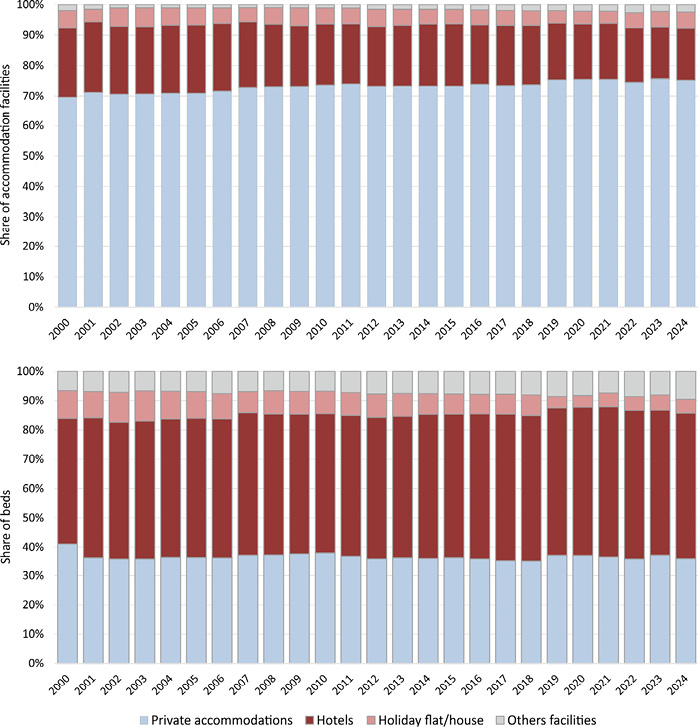
The structure of accommodation facilities has been most strongly influenced by private facilities throughout the study period, with a share consistently above 70% and showing a slight upward trend recently (Fig. 3). These are smaller, often family-run accommodations typical of a region with a tradition of private tourism. Their high proportion is indicative of the powerful entrenchment of this form of tourism and the preference for smaller, more personal accommodation. Although hotels consistently represent around 20% of all accommodation types, their long-term stability has recently shown a slight decline. This suggests that while hotels remain a vital component of the accommodation landscape, their overall significance in the region is gradually declining.
Source: own work, STATcube Austria.
The largest share of beds has long been held by hotels, which consistently account for approximately 50–55% of the total accommodation capacity. This share reflects the fact that, although hotels are not the most numerous type of facility, they provide the largest capacity. Private accommodation, on the other hand, accounts for only around 35–40% of beds. They are often smaller private accommodations with a limited number of beds, usually intended for individual travellers or families.
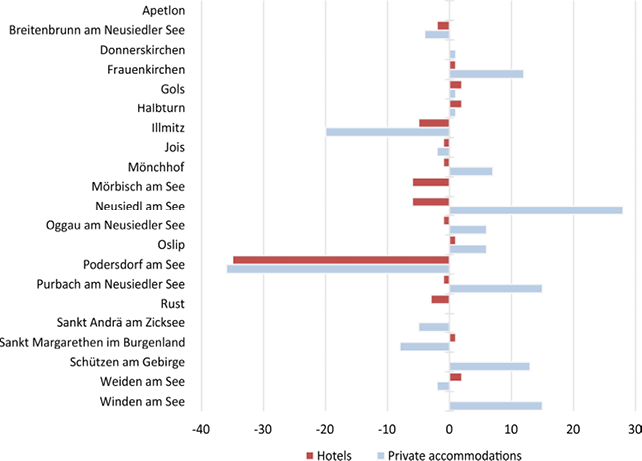
Figure 4 presents the change in the number of selected accommodation facilities, specifically hotels and private accommodation. The graph reveals the varying dynamics within the municipalities of the region: in some, such as Winden am See, Schützen am Gebirge, and Oslip, an increase in private accommodations is evident, which may indicate the beginning of tourism development and dynamism. Conversely, municipalities such as Neusiedl am See and Purbach am See have seen a shift in orientation from hotels to private accommodations. A negative trend, i.e., a decrease in the number of hotels and private accommodations, is noticeable in Illmitz and Podersdorf am See. In the case of Podersdorf am See, this decline is probably due to the increase in camping sites, which absorb part of the accommodation demand.
Source: own work, STATcube Austria.
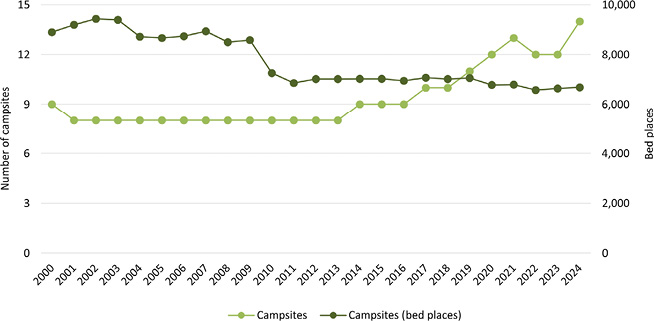
Campsites represent a significant component of accommodation facilities and total accommodation capacity in the Lake Neusiedl region (Fig. 5). The development indicates a gradual return to popularity of camping tourism in this region, which has been gaining in attractiveness in recent years as a form of leisure time spent in direct contact with nature. With a total bed capacity of more than 6,500 places, the region is characterised by its relatively extensive accommodation possibilities.
Source: own work, STATcube Austria.
Source: own work based on data from http://data.statistik.gv.at, STATcube Austria.
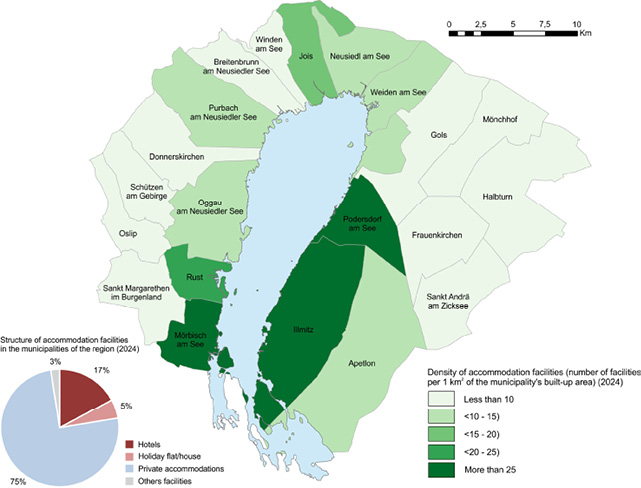
The spatial distribution of accommodation facilities (Fig. 6) shows that the largest concentration of facilities is located in the municipalities of Mörbisch am See, Podersdorf am See, Illmitz, and Rust. These are long-standing, popular tourist destinations offering a wide range of accommodations, high-quality services, and an attractive environment close to the lake. Areas with a medium concentration of accommodation (e.g., Jois, Apetlon, Neusiedl am See, or Weiden am See) have a significant but less concentrated accommodation offer. Peripheral municipalities (e.g., Oslip, Schützen am Gebirge, Halbturn, and others) have a low density of accommodation facilities, complementing the region’s offer with potential for rural tourism. The map clearly shows that a few key locations dominate the tourist offer of the Lake Neusiedl region. At the same time, the rest of the area has a lower concentration of accommodation facilities.
Source: own work, STATcube Austria.
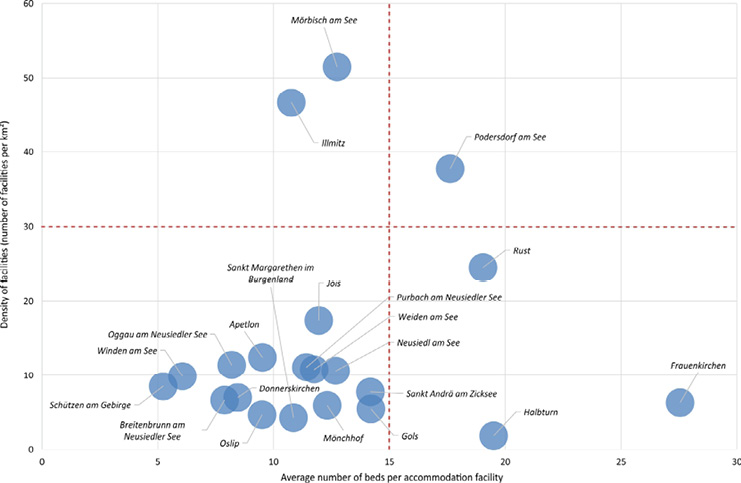
To further understand and identify the spatial infrastructure of accommodation facilities that play a key role in the regional tourism of the Lake Neusiedl communities, we conducted a comparative analysis. This analysis is based on two primary parameters: the density of accommodation facilities (the number of facilities per square kilometre) and the average number of beds per facility. To organise and identify the typical profiles of the municipalities more clearly, we divided them into four main quadrants using two auxiliary lines (Fig. 7).
High density and high capacity of accommodation facilities
Podersdorf am See is located in this quadrant and represents the most important tourist centre of the region. It is characterised not only by a high number of facilities per sq. km but also by a higher average capacity of facilities. This location is likely to offer a wide range of services and accommodations in larger facilities such as hotels, apartment houses, or larger guesthouses.
High density of accommodation facilities, low capacity of accommodation facilities
There are municipalities such as Mörbisch am See and Illmitz, which have a higher number of smaller facilities in a small area. These are likely to be municipalities with well-developed private accommodation.
Low density of accommodation facilities, high capacity of accommodation facilities
Frauenkirchen exemplifies the characteristics of this quadrant, characterised by a low number of facilities and a high average capacity. The situation suggests the presence of fewer, larger facilities, such as hotels or wellness complexes. These venues may focus on a specific tourism niche, such as spa or conference tourism.
Low density of accommodation facilities, low capacity of accommodation facilities
Most of the municipalities in the study region, such as Schützen am Gebirge, Oggau am Neusiedler See, Donnerskirchen, or Breitenbrunn am Neusiedler See, belong to this group. These localities have a scattered and rather marginal tourist importance, with a small number of facilities that provide only a limited bed capacity. These are probably complementary destinations that play a supporting role in the stronger tourist centres.
4.2. Analysis of visitor numbers and seasonality in the Lake Neusiedl region
In the next part of the empirical analysis, we will focus in more detail on the study of visitor numbers and seasonality in the Lake Neusiedl region. This section aims to identify key trends in visitation to the area and its adjacent communities, examine the impact of seasonal fluctuations, and provide a comprehensive view of the dynamics of tourism in this crucial location.
Figure 8 illustrates the evolution of two key tourism indicators in the Lake Neusiedl region over the time horizon 2000 to 2024 – namely, the number of arrivals and the number of overnight stays. Apart from the noticeable decline in both indicators during the COVID-19 pandemic period, it is notable that the overall long-term growth trend has been more pronounced for the number of arrivals than for the number of overnight stays. These dynamics suggest that Lake Neusiedl is a destination primarily visited by day-trippers or visitors who prefer shorter stays.
An interesting detail is the comparison of the share of the Lake Neusiedl region in the total number of visitors to Burgenland. While in 2000, the share of arrivals was 47%, by 2024, it fell to 38%, indicating a gradual decline in its relative importance within county-wide tourism. Nevertheless, the absolute figures confirm an increase in visitor arrivals also in the Lake Neusiedl region, but with a more moderate dynamics compared to other parts of Burgenland.
A similar trend can be observed in the indicator for the number of overnight stays. While in 2000, the share of the Lake Neusiedl region in the total number of overnight stays in Burgenland was 50%, by 2024, it is expected to decrease to 38%. This difference suggests that although the number of overnight stays around Lake Neusiedl has exhibited a relatively stable trend, other parts of Burgenland have experienced a more significant increase in this indicator.
Our analysis examined the individual contributions of municipalities to overall visitor numbers, aiming to identify local disparities and dominant tourism centres (Fig. 9). Podersdorf am See stands out as the most significant tourist centre, accounting for over 30% of all tourist arrivals. Frauenkirchen and Rust also hold important positions, and together with Podersdorf, they concentrate over half of the region’s total tourist demand. Ilmitz, Mörbisch am See, and Neusiedl am See are also notable, each attracting over 5% of visitors in the analysed year. The remaining municipalities show significantly lower figures, with eight of them not even reaching a 1% share of visitors.
A similar trend also dominates the overnight stays indicator, where Podersdorf am See even occupies a more prominent position. This municipality is the dominant tourist destination within the region, generating almost 33% of all overnight stays in 2024, thus significantly outperforming the other municipalities. Rust and Frauenkirchen followed, and these three municipalities together accounted for more than half of the total number of overnight stays in the region. At the other end of the range were municipalities such as Schützen am Gebirge, Sankt Margarethen im Burgenland, and Winden am See, which played a marginal role in the regional accommodation sector.
In the next part of the analysis, we will examine the occupancy rates in the Lake Neusiedl region and relate this data to the previous study on visitor numbers. The aim is to gain a more comprehensive understanding of the efficiency of utilising the existing accommodation infrastructure in the context of observed tourist demand in the region.
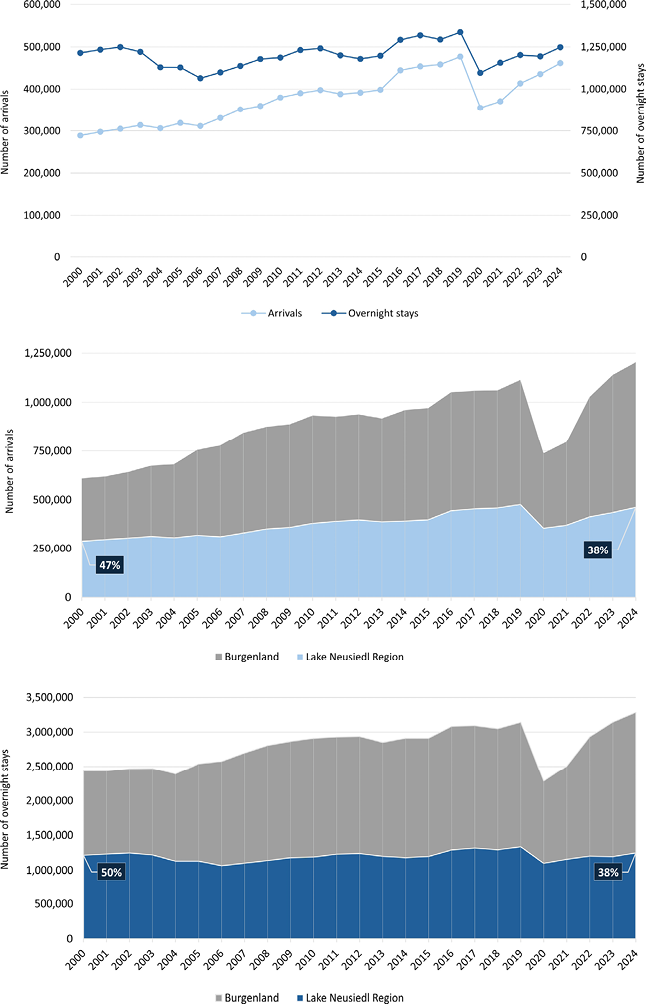
Source: own work, STATcube Austria.
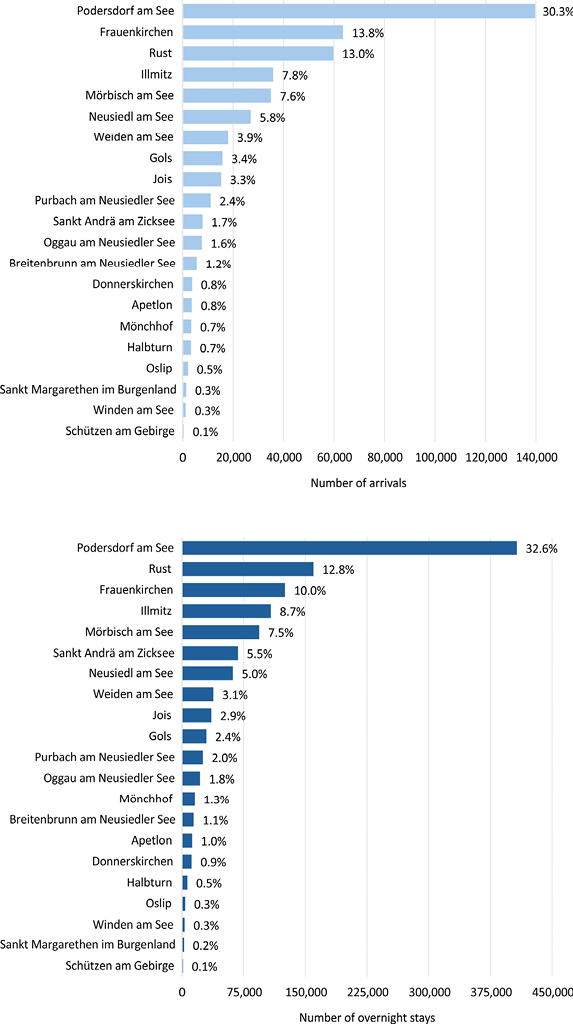
Source: own work, STATcube Austria.
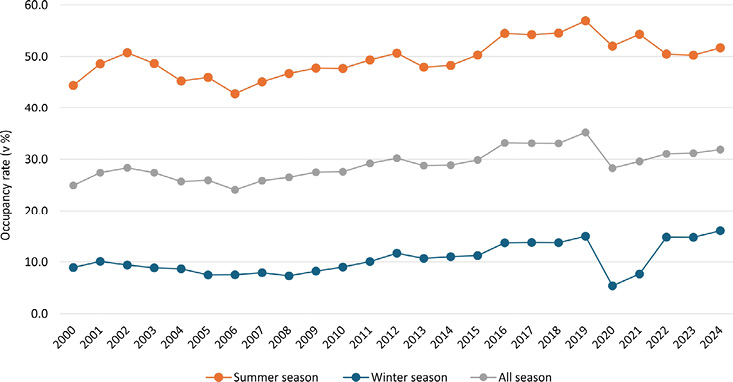
Source: own work, STATcube Austria.
Figure 10 details the long-term trend in occupancy rates (accommodation capacity utilization), expressed as a percentage, over three key timeframes: the summer season (April to September), the winter season (October to March), and the year-round average (covering all months of the year). This breakdown enables a comprehensive assessment of seasonal fluctuations and overall accommodation utilisation during the period under review.
The summer season has long shown the highest occupancy rate of accommodation facilities. The highest rates were recorded in 2018 and 2019, just before the pandemic, which suggests the strong position of summer tourism in the region – especially in connection with natural attractions such as Lake Neusiedl, cycling routes, and cultural events. The year 2020 saw a slight drop in occupancy rates, a direct consequence of the extensive restrictions on tourism imposed by the COVID-19 pandemic. In the following years, a gradual recovery is evident; however, the region’s occupancy levels have not yet returned to pre-pandemic levels and currently remain above 50%.
The overall occupancy rate, expressed as an annual average, has shown a gradual increase since 2000 (from about 25% in 2000 to about 35% in 2019 before the pandemic). This trend is indicative of the region’s growing popularity as a year-round tourist destination. The winter season typically exhibits the lowest occupancy rate of accommodation facilities in the long term, indicating the significant seasonality of tourism in the region. After 2010, a slight but steady increase can be observed, which may be related to the development of wellness facilities, spas, or cultural and gastronomic offerings outside the primary summer season.
The occupancy rate (Fig. 11) represents the percentage of accommodation capacity utilised in the individual municipalities of the region, separately for the summer and winter seasons, as well as for the year-round average.
Podersdorf am See has the highest occupancy rate during the summer season and has long maintained its position as one of the region’s key tourist destinations thanks to its attractive offer of summer recreation, beaches, and water sports.
During the winter season, Frauenkirchen and Sankt Andrä am Zicksee have the highest occupancy rates, highlighting the importance of well-developed wellness and spa tourism in these locations, such as the St. Martins Therme & Lodge. The increased occupancy in the adjacent municipalities may indicate that visitors use these locations primarily for accommodation near the aforementioned thermal spas.
Frauenkirchen and Sankt Andrä am Zicksee have the highest year-round occupancy rates, and their year-round occupancy rates even exceed those of Podersdorf am See, which is primarily popular during the summer season. This fact once again confirms the year-round attractiveness of these two municipalities, likely due to their offerings of wellness and spa services.
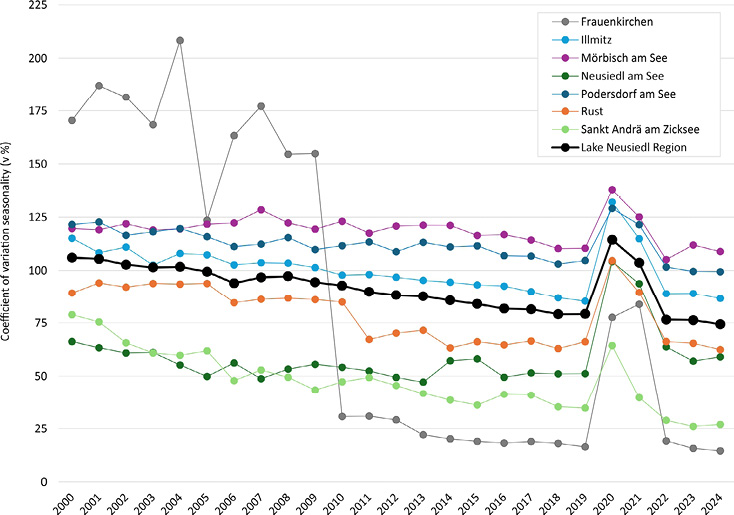
In the final part of our analysis, we examined the seasonality of the Lake Neusiedl region in more detail (Fig. 12). To quantify and understand seasonal fluctuations in visitation, we used a measure of variability, specifically the coefficient of variation, applied to the overnight visitation data. This method enabled us to objectively assess the magnitude of seasonal variation across the region. High values indicate an intense concentration of visitation in a limited period (usually the summer season), while lower values indicate a more balanced pattern of visitation throughout the year. In the analysis, we included not only the average for the entire Lake Neusiedl region but also data from selected municipalities that are currently experiencing the highest visitation. This comparison enables a more detailed examination of the differences in seasonal patterns between the most popular localities and the overall regional average. For individual municipalities, the seasonality coefficient should show a decreasing trend. This indicates a gradual levelling out of the differences in visitation between the strong summer and weaker winter seasons, which contributes to more stable year-round capacity utilisation and revenues.
The entire Lake Neusiedl region shows a gradual slight decrease in the seasonality coefficient of variation. This is also a positive trend in terms of long-term sustainability and levelling out differences in visitor arrivals between months. It signals an effort to diversify the offer and to attract visitors also outside the traditional summer peak.
Sankt Andrä am Zicksee is currently showing a positive trend, as evidenced by a decreasing seasonality coefficient. A similar positive trend was also observed in the past in Neusiedl am See and Rust, but after some time, the decline in their coefficient stabilised. In the case of Frauenkirchen, this trend of levelling off was particularly pronounced after 2010, which can be attributed to the development of year-round attractive wellness and spa tourism cantered on St. Martin’s Therme & Lodge. The construction of this modern complex was completed, and the first phases were opened, creating new attractions for winter and year-round visitors to the Frauenkirchen region and its surroundings. By contrast, Mörbisch am See exhibits the most pronounced seasonality among the surveyed sites, with coefficient of variation values often exceeding 125%. This high seasonality is primarily due to its popularity for summer cultural events, particularly the well-known opera festival on the lake, which heavily concentrates on overnight stays in a limited number of summer months.
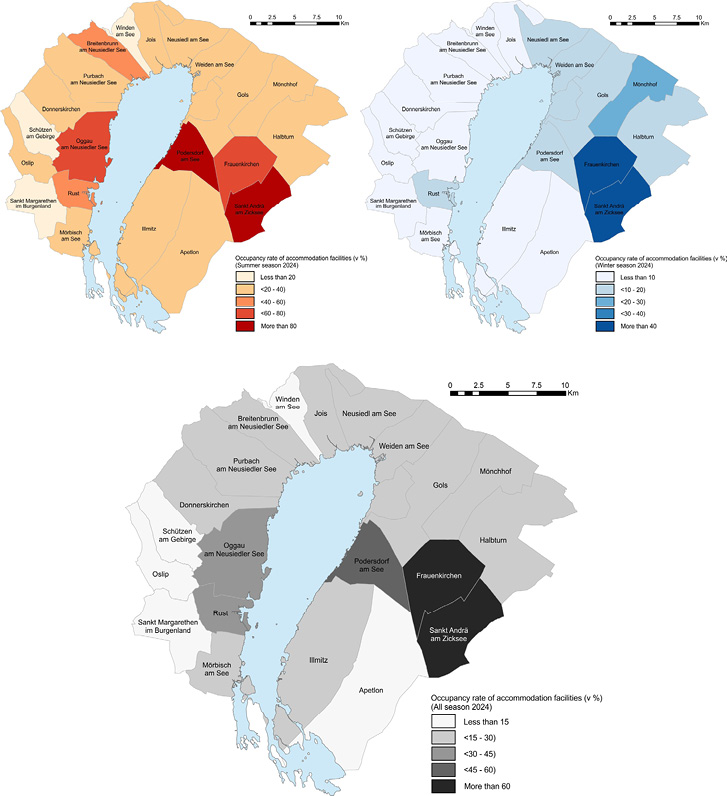
Source: own work based on data from http://data.statistik.gv.at, STATcube Austria.
Source: own work, STATcube Austria.
5. Conclusions
Tourism is one of the most important economic sectors that supports the development of local communities and the preservation of natural and cultural heritage. The Lake Neusiedl region, a UNESCO World Heritage Site, is an excellent example of this link. Its appeal lies in its unique combination of characteristics: it is the westernmost steppe lake in Eurasia, with a rich biodiversity that represents a cultural landscape created by a diverse ethnic composition. In addition, there is a rich archaeological, architectural, and ethnographic heritage. It is this unique combination that attracts visitors from all over the world and creates essential opportunities for tourism development (UNESCO World Heritage Centre, 2020).
The primary objective of this paper was to examine the development and current state of tourism in the Lake Neusiedl region, focusing on three key areas: accommodation facilities, visitor arrivals, and seasonality.
The development of the number of accommodation facilities in the region has shown that, although Lake Neusiedl remains one of the main tourist areas in Burgenland, its share of the total accommodation capacity has decreased slightly. The structure of accommodation facilities in the region reveals an interesting trend: although private accommodations account for a significant portion of all providers, hotels dominate in terms of total capacity. At the same time, these smaller private facilities suggest a strong location for family tourism and a personalised approach, which can be an advantage in the future if properly promoted. The analysis revealed different trends in accommodation facilities: while in some municipalities (e.g., Winden am See) the number of private accommodations is growing, in others (Neusiedl am See) there is a shift from hotels to private accommodations, and in Podersdorf am See and Illmitz there is an overall decline. Camping tourism is becoming popular again in the Lake Neusiedl region, as evidenced by a total capacity of more than 6,500 beds, making it a significant component of accommodation options. As interest in camping tourism increases, so does the demand for quality infrastructure and services that can meet the diverse and demanding requirements of tourists (O’Neill et al., 2010). The spatial distribution of accommodation facilities is unequal – it is mainly concentrated in municipalities such as Podersdorf am See, Illmitz, Mörbisch am See, and Rust, which are thus profiled as the main tourist centres of the region. Other municipalities, especially those outside the area, have a complementary role, with the potential to develop specialised forms of tourism, such as agro-tourism, rural tourism, or spa tourism. According to Sallay et al. (2016), municipalities and smaller towns in the region cooperate instead of competing with each other. This cooperation is essential for the development of the whole area, as the region is not a typical agglomeration, but rather a network of peer municipalities. Together, they can provide all the necessary functions for residents and tourists while effectively protecting their heritage.
A comparison of the density of accommodation facilities and their average capacity shows that Podersdorf am See is notable as the most comprehensively equipped municipality – it offers not only a high number of facilities but also a higher capacity. Other municipalities, such as Frauenkirchen, are characterised by fewer facilities but high capacity, indicating the presence of more extensive hotel and wellness complexes. These differences between the municipalities create a varied structure of the tourist offer that can appeal to different target groups of visitors. It appears that the intensity of accommodation in specific areas of the studied region or country is closely correlated with the tourist attractiveness of that place (Bełej, 2022). The study by Navrátil et al. (2012) highlights that an alternative methodology is necessary for a detailed analysis of the distribution of accommodation facilities. Instead of relying on conventional statistical data, they propose to create their own geocoded database of different types of accommodation facilities. With such a database and a suitable methodology, it would be possible to reveal the specificities of the distribution of accommodation facilities and their spatial structure within the different municipalities in a given region.
The second part of the analysis focused on visitation and seasonality. Northern Burgenland, in particular, has a tradition of tourism, where the largest number of tourists is concentrated each year. The central and southern parts of the region have developed more intensively in recent years, but their growth rate is still slower than in the north (Lukic and Filipovic, 2019). Trends in the number of arrivals and overnight stays indicate that, although absolute visitor numbers in the region are increasing slightly, their relative weight within the entire state of Burgenland is decreasing. The distribution of visitors among the municipalities revealed the dominance of Podersdorf am See, which accounts for more than a third of all arrivals and overnight stays. Rust, Frauenkirchen, and Ilmitz also maintain a strong position. Conversely, many smaller municipalities have only a marginal share, indicating a concentration of tourism in a few strong locations. It will be important for further development to consider how this demand can be extended to less exposed areas.
Based on the findings, seasonality in the Lake Neusiedl region can be characterised as single-peaked, which is also typical for Mediterranean destinations. According to Butler and Mao (1997), this pattern is characteristic of places where tourism is primarily influenced by sun and warm weather, resulting in a distinct peak season concentrated in the summer months.
In terms of occupancy rates, a significant seasonal difference was identified. The summer months represent the peak season, while the winter period is significantly weaker in terms of capacity utilisation. Exceptions are Frauenkirchen, and Sankt Andrä am Zicksee, which have higher year-round occupancy rates due to spa and wellness services. The evolution of the seasonality coefficient of variation suggests that in some municipalities, the differences between the main (summer) and secondary (winter) seasons are gradually levelling off. This trend is particularly noticeable in the spa areas, where the year-round offer reduces the dependence on the summer season. On the contrary, municipalities that mainly focus on cultural summer events (Mörbisch am See) and active outdoor recreation (Ilmitz, Podersdorf am See) exhibit the most pronounced seasonality. The problem of seasonality in tourism has been intensively researched in the academic environment, focusing mainly on methodological aspects. As the literature shows, authors are constantly trying to develop new and more sophisticated methods to measure and analyse it (Grossi and Mussini, 2021; Duro, 2016; Fernández-Morales, 2003).
Overall, the Lake Neusiedl region still holds a powerful position within Austrian tourism but faces several challenges – especially in the areas of more even development of the offer concentrated in other municipalities of the region, reducing seasonal fluctuations, and preserving the cultural heritage within the framework of ecotourism. The key to sustainable development will be to support smaller municipalities, increase the attractiveness of off-peak seasons, and preserve the natural and cultural heritage that makes the region so special. The results of this study can serve as a basis for strategic tourism planning and inspire the development of a balanced and long-term sustainable tourism model in the Lake Neusiedl region.
Acknowledgments. This article was funded by the Project VEGA 1/0252/23 Spatial systems resilience – its factors, differentiation and consequences.
Autorzy
REFERENCES
BEDEIAN, A. G. and MOSSHOLDER, K. W. (2000), ‘On the use of the coefficient of variation as a measure of diversity’. Organizational Research Methods, 3 (3), pp. 285–297. https://doi.org/10.1177/109442810033005
BEŁEJ, M. (2022), ‘The spatial heterogeneity of the different types of accommodation with the use of POI data’. GIS Odyssey Journal, 2 (1), pp. 113–127.
BUTLER, R. W. (2001), ‘Seasonality in tourism: Issues and implications’, [in:] BAUM, T. and LUNDTORP, S. (eds), Seasonality in Tourism, Pergamon Press, London, pp. 5–21.
BUTLER, R. and MAO, B. (1997), ‘Seasonality in tourism: problems and measurement’, [in:] MURPHY, P. (ed.), Quality Management in Urban Tourism, Wiley, Chichester, pp. 9–23.
COOPER, C. (2006), ‘Lakes as tourism destination resources’, [in:] HALL, C. M. and HÄRKÖNEN, T. (eds), Lake tourism: An integrated approach to lacustrine tourism systems, 32, Channel view publications, pp. 27–42.
CSAPLOVICS, E. (2019), ‘The reed belt of Neusiedler See’, Österreichische Wasser-und Abfallwirtschaft, 71, pp. 494–507. https://doi.org/10.1007/s00506-019-00622-2
DEHEYN, D. D., HAEUSELMANN, P., BURSCHIL, T., FABBRI, S., FIEBIG, M., GASPERL, W., ... and HEINE, E. (2025), ‘Interdisciplinary investigations of a pristine alpine lake in Austria: The Lake Altaussee Monitoring Program (LAMP)’, Total Environment Advances, 14, 200124. https://doi.org/10.1016/j.teadva.2025.200124
DOKULIL, M. T., TEUBNER, K., JAGSCH, A., NICKUS, U., ADRIAN, R., STRAILE, D., ... and PADISÁK, J. (2010), The impact of climate change on lakes in Central Europe, pp. 387–409. Springer. https://link.springer.com/chapter/10.1007/978-90-481-2945-4_20
DUDA-GROMADA, K., BUJDOSÓ, Z. and DAVID, L. (2010), ‘Lakes, reservoirs and regional development through some examples in Poland and Hungary’, GeoJournal of Tourism and Geosites, 5 (1), pp. 16–23.
DURO, J. A. (2016), ‘Seasonality of hotel demand in the main Spanish provinces: Measurements and decomposition exercises’, Tourism Management, 52, pp. 52–63. https://doi.org/10.1016/j.tourman.2015.06.013
DURO, J. A. and TURRIÓN-PRATS, J. (2019), ‘Tourism seasonality worldwide’, Tourism Management Perspectives, 31, pp. 38–53. https://doi.org/10.1016/j.tmp.2019.03.010
EUROSTAT, Glossary: Net occupancy rate, Statistics Explained, https://ec.europa.eu/eurostat/statistics-explained/index.php?title=Glossary:Net_occupancy_rate [accessed on: 20.02.2025]
FERNANDEZ-MORALES, A. (2003), ‘Decomposing seasonal concentration’, Annals of Tourism Research, 30 (4), pp. 942–956. https://doi.org/10.1016/S0160-7383(03)00090-2
FERRANTE, M., MAGNO, G. L. L. and DE CANTIS, S. (2018), ‘Measuring tourism seasonality across European countries’, Tourism Management, 68, pp. 220–235. https://doi.org/10.1016/j.tourman.2018.03.015
FURGAŁA-SELEZNIOW, G. and JANKUN-WOŹNICKA, M. (2021), ‘Tourism impact on the shore zone of lakes: a case study of four lakes of Mrągowo lakeland’, Polish Journal of Natural Sciences, 36 (2), pp. 179–196. https://doi.org/10.31648/pjns.7292
GAUSTER, J., HARTWIG, L. and PFAFFENBICHLER, P. (2020), ‘Sustainable cycle and eco-tourism in the national park Neusiedler See–Seewinkel’. https://doi.org/10.13140/RG.2.2.32902.60482
GEORGE, G. (2009), ‘The impact of climate change on European lakes’, [in:] The Impact of Climate Change on European Lakes, pp. 1–13, Dordrecht: Springer Netherlands.
GOFFI, G., OSTI, L., NAVA, C. R., MAURER, O. and PENCARELLI, T. (2021), ‘Is preservation the key to quality and tourists’ satisfaction? Evidence from Lake Garda’, Tourism Recreation Research, 46 (3), pp. 434–440. https://doi.org/10.1080/02508281.2020.1795591
GROSSI, L. and MUSSINI, M. (2021), ‘Seasonality in tourist flows: Decomposing and testing changes in seasonal concentration’, Tourism Management, 84, 104289. https://doi.org/10.1016/j.tourman.2021.104289
HACKL, P. and LEDOLTER, J. (2023), ‘A Statistical Analysis of the Water Levels at Lake Neusiedl’, Austrian Journal of Statistics, 52 (1), pp. 87–100. https://doi.org/10.17713/ajs.v52i1.1444
HERZIG, A. and DOKULIL, M. (2001), ‘Neusiedlersee – ein Steppensee in Europa’, [in:] DOKULIL, M., HAMM, A. and KOHL, J. G. (eds), Ökologie und Schutz von Seen, Facultas, Wien, pp. 401–415.
KARAMUSTAFA, K. and ULAMA, S. (2010), ‘Measuring the seasonality in tourism with the comparison of different methods’, EuroMed Journal of Business, 5 (2), pp. 191–214. https://doi.org/10.1108/14502191011065509
KRABOKOUKIS, T. and POLYZOS, S. (2024), ‘Analyzing the tourism seasonality for the Mediterranean countries’, Journal of the Knowledge Economy, 15 (2), pp. 8053–8076. https://doi.org/10.1007/s13132-023-01129-8
KROPF, B., SCHMID, E. and MITTER, H. (2021), ‘Multi-step cognitive mapping of perceived nexus relationships in the Seewinkel region in Austria’, Environmental Science & Policy, 124, pp. 604–615. https://doi.org/10.1016/j.envsci.2021.08.004
KRUKOWSKA, R. and ŚWIECA, A. (2018), ‘Tourism function as an element of regional competitiveness’, Polish Journal of Sport and Tourism, 25 (2), pp. 32–43. https://doi.org/10.2478/pjst-2018-0012
LUKIĆ, M. and FILIPOVIĆ, D. (2019), ‘Landscape evaluation for the purposes of ecotourism-case study of Burgenland’, [in:] Proceedings of the 27th International Conference” Ecological Truth and Environmental Research-EcoTER’19”, Bor, pp. 511–518, Bor: University of Belgrade-Technical faculty Bor.
MEGERLE, H. and EBERLE, D. (2005), ‘Environmental and landscape planning in areas of high utility diversity – Challenges, conflicts and solution strategies for the problem with the example of the Bodensee area’, Raumforschung und Raumordnung – Spatial Research and Planning, 63 (5), pp. 351–359. https://doi.org/10.1007/BF03183095
MITTER, H. and KROPF, B. (2025), ‘Strategies for combating climate extremes in a semi-arid region in Austria’, Journal of Environmental Management, 386, 125821. https://doi.org/10.1016/j.jenvman.2025.125821
NATIONALPARK NEUSIEDLER SEE – SEEWINKEL (2021), ‘EIN PLAN DER VERBINDET Managementplan Nationalpark Neusiedler See – Seewinkel 2021–2031’, Illmitz: Nationalpark Neusiedler See–Seewinkel.
NAVRÁTIL, J., ŠVEC, R., PÍCHA, K. and DOLEŽALOVÁ, H. (2012), ‘The location of tourist accommodation facilities: A case study of the Šumava Mts. and South Bohemia tourist regions (Czech Republic)’, Moravian Geographical Reports, 20 (3), pp. 50–63.
O’NEILL, M. A., RISCINTO-KOZUB, K. A. and VAN HYFTE, M. (2010), ‘Defining visitor satisfaction in the context of camping oriented nature-based tourism – the driving force of quality!’, Journal of Vacation Marketing, 16 (2), pp. 141–156. https://doi.org/10.1177/1356766710364541
PETROVSZKI, J., SZILASSI, P. and ERŐS, T. (2024), ‘Mass tourism generated urban land expansion in the catchment of Lake Balaton, Hungary – analysis of long-term changes in characteristic socio-political periods’, Land Use Policy, 142, 107185. https://doi.org/10.1016/j.landusepol.2024.107185
POMUCZ, A. B. and CSETE, M. (2015), ‘Sustainability assessment of Hungarian lakeside tourism development’, Periodica Polytechnica Social and Management Sciences, 23 (2), pp. 121–132. https://doi.org/10.3311/PPso.7506
PRÖBSTL-HAIDER, U., HÖDL, C., GINNER, K. and BORGWARDT, F. (2021), ‘Climate change: Impacts on outdoor activities in the summer and shoulder seasons’, Journal of Outdoor Recreation and Tourism, 34, 100344. https://doi.org/10.1016/j.jort.2020.100344
PUCZKO, L. and RATZ, T. (2000), ‘Tourist and resident perceptions of the physical impacts of tourism at Lake Balaton, Hungary: Issues for sustainable tourism management’, Journal of Sustainable Tourism, 8 (6), pp. 458–478.
SAILER, C. L. and MARACEK, K. (2019), ‘Lake Neusiedl – an overview’, Österreichische Wasser-und Abfallwirtschaft, 71, pp. 483–493. https://doi.org/10.1007/s00506-019-00621-3
SALLAY, Á., MIKHÁZI, Z., MÁTÁ, K., FÓRIS, E. D., KOVÁCS, K. F., VALÁNSZKI, I. and KOLLÁNYI, L. (2016), ‘The Role of Small Towns in a Potential Ecoregion through the Example of Fertő/Neusiedlersee Cultural Landscape’, European Countryside, 8 (3), pp. 278–295. https://doi.org/10.1515/euco-2016-0020
SCHRÖDER, J. (2024), ‘Exploring Geotourism in Lake Constance: A Qualitative Study of Expert Insights’, Science International Empirical Review, 2 (1), pp. 59–71. https://doi.org/10.52514/sier.v2i1.34
SOJA, G., ZÜGER, J., KNOFLACHER, M., KINNER, P. and SOJA, A. M. (2013), ‘Climate impacts on water balance of a shallow steppe lake in Eastern Austria (Lake Neusiedl)’, Journal of Hydrology, 480, pp. 115–124. https://doi.org/10.1016/j.jhydrol.2012.12.013
ŠILHÁNKOVÁ, V. and PONDĚLÍČEK, M. (2013), ‘Cestovní ruch a ochrana přírody na Neziderském jezeře porovnání rakouského a maďarského přístupu’, Scientific papers of the University of Pardubice. Series D, Faculty of Economics and Administration, 26 (1).
TEUBNER, K., LAZOWSKI, W. and ZECHMEISTER, T. (2022), ‘Lake Neusiedl and Seewinkel: a hotspot area of long-term ecological research in the Danube River Basin’, Danube News, 24 (45), pp. 16–19.
TOLOTTI, M., GUELLA, G., HERZIG, A., RODEGHIERO, M., ROSE, N. L., SOJA, G. ... and TEUBNER, K. (2021), ‘Assessing the ecological vulnerability of the shallow steppe Lake Neusiedl (Austria-Hungary) to climate-driven hydrological changes using a palaeolimnological approach’, Journal of Great Lakes Research, 47 (5), pp. 1327–1344. https://doi.org/10.1016/j.jglr.2021.06.004
TOURISMUSVERBAND NORDBURGENLAND (2024), ‘Pannonischer Weitblick’, Neusiedl am See: Neusiedler See Tourismus GmbH.
TUOHINO, A. and LÓRÁNT, D. (2012), ‘Global problems, local solutions: the case of lake tourism development’, Tourism Today, pp. 134–150.
UNESCO WORLD HERITAGE CENTRE (2000), ‘Documentation for the nomination of the Fertö/Neusiedlersee Cultural Landscape’, UNESCO. Vienna: Austrian Federal Ministry of Education and Cultural Affairs, Budapest: Hungarian National Ministry of Cultural Heritage, https://whc.unesco.org/en/list/772/
VERGORI, A. S. (2017), ‘Patterns of seasonality and tourism demand forecasting’, Tourism Economics, 23 (5), pp. 1011–1027. https://doi.org/10.1177/1354816616656418
WEISS, S., ZUKRIGL, V., FLEISCHANDERL, R., SCHNETZER, N., SUSKE, W., ZECHMEISTER, T., SOJA, A.-M., KINNER, P., ZÜGER, J., KNOFLACHER, M. and SOJA, G. (2013), WP 6.2.3. Leitlinie für nachhaltiges seenmanagement im klimawandel – Neusiedler See, Naturschutzbund Burgenland & AIT Austrian Institute of Technology GmbH.
WOLFRAM, G., BOROS, E., BLASCHKE, A. P., CSAPLOVICS, E., HAINZ, R., KIRÁLY, G., KOVÁCS, R., KRÁMER, T., MAYER, R., NAGY, A., PANNONHALMI, M., RIEDLER, P., ZESSNER, M., VASS, I. and ZOBOLI, O. (2020), Water Management Plan for Lake Neusiedl. Applied hydrological and basic limnological investigations of the project REBEN – Reed Belt Neusiedler See/Fertő (Interreg-Projekt AT-HU 2014-20), Technical report for the Amt der Burgenländischen Landesregierung, Abt. 5 – Baudirektion, and Észak-dunántúli Vízügyi Igazgatóság. Vienna–Budapest–Győr.
WOLFRAM, G., DERI, L. and ZECH, S. (eds) (2014), Strategiestudie Neusiedler See – Phase 1, Studie im Auftrag der Osterreichisch-Ungarischen Gewasserkommission. Wien–Szombathely.
WRBKA, T., HAINZ-RENETZEDER, C., KUTTNER, M., HERMANN, A., BRANDENBURG, C.,ZIENER, K., ALLEX, B., LIEBL, U., CZACHS, C., KONKOLY GYURÓ, É., TIRÁSZI, Á., BALÁZS, P. and BACSÁRDI, V. (2012), ‘Biodiversity and Ecosystem Services as scientific foundation for the sustainable implementation of the Redesigned Biosphere Reserve «Neusiedler See»’, Vienna. doi: https://doi.org/10.1553/bioserv-neusiedler-see
ZIMMERMANN-TIMM, H. and TEUBNER, K. (2021), ‘Folgen der Grundwassersenkung am Beispiel des Neusiedlers See Seewinkel (Burgenland, Österreich)’, [in:] LOZÁN, J. L., BRECKLE, S. W., GRAßL, H. and KASANG, D. (eds), Warnsignal Klima: Boden und Landnutzung, pp. 142–149.
DATA
Statistics Austria Open.data, http://data.statistik.gv.at [accessed on: 15.11.2024].
The Statistical Office of Austria (STATcube Austria), http://www.statistik.at [accessed on: 20.02.2025].