
Mapping the geographical imbalance in space syntax research
Abdelbaseer A. MOHAMED  *
*
Abstract. Imagine a scientific world in which researchers everywhere have equal opportunities to publish and gain recognition. Far from being an exception, space syntax research is shaped by structural inequalities that privilege Northern institutions and epistemologies. While existing bibliometric reviews broadly map the field, they overlook how selective indexing structures global visibility. Drawing on 2,323 Web of Science–indexed space syntax articles, this review examines publication growth, citation impact, and journal landscapes across regions. The findings show that although research activity is expanding globally, particularly in Asia, citation impact remains concentrated in the United States and the United Kingdom. Elite Northern journals dominate the field, while Southern scholarship largely circulates in less visible venues, reinforcing enduring geographical imbalances in knowledge production.
Key words: space syntax, bibliometrics, geographical inequality, citation impact, structural invisibility.
1. Introduction
The study of urban form and spatial configuration is crucial for understanding human mobility, accessibility, and social interaction in cities. Space syntax has emerged as a widely adopted analytical framework in this domain, with applications spanning urban planning, architecture, and transportation research (Hillier, 1996; van Nes and Yamu, 2021; Vaughan et al., 2025). Over the past decades, the increasing availability of computational tools and large-scale spatial datasets has further strengthened its relevance, enabling researchers to explore complex patterns of urban connectivity and social dynamics (Yamu et al., 2021).
Bibliometric analyses offer a systematic approach to mapping scientific knowledge, identifying influential authors and institutions, and uncovering patterns of collaboration and thematic development (Aria and Cuccurullo, 2017; Zupic and Čater, 2015). Prior bibliometric work in space syntax includes comprehensive reviews such as Mohamed and van der Laag Yamu (2023), which cover publication trends, productive authors and institutions, research fronts, and conceptual structures from 1976 to 2023. Additional studies have employed text mining approaches to analyse conference papers, examining the thematic evolution, development and relationships of concepts within the field of space syntax (Babbu, 2023; Krenz et al., 2023; Meng and Zhang, 2025; Mohamed, 2025). While these reviews have shed light on the general growth and intellectual structure of space syntax research, they have not explicitly focused on regional disparities, structural citation imbalances, or the interplay between productivity and impact across geographic regions.
Understanding these regional differences is crucial because knowledge production and scientific recognition are often unequally distributed globally. Some regions, such as North America and Europe, dominate the field in terms of both publications and citations, whereas others remain underrepresented. Such disparities can have important implications for the diffusion of space syntax methods, access to research networks, and the global visibility of locally relevant studies.
To systematically evaluate these inequalities, this study focuses on journal publications indexed in the Web of Science (WoS). Unlike conference papers, which are unevenly indexed and vary in peer-review standards, WoS journals provide standardised bibliometric data – including author affiliations, citations, and metadata – allowing robust cross-regional comparisons. By relying on WoS, this study can effectively reveal structural imbalances in knowledge production and citation practices and evaluate the effects of collaboration networks.
Accordingly, this review article aims to fill a gap in the literature by examining regional differences, collaboration networks, and the relationship between productivity and impact in space syntax research. Specifically, we investigate the following research questions:
- What are the temporal trends in space syntax publications and citations across regions?
- How do productivity and citation impact vary between regions, and which regions are underrepresented?
- How do collaboration networks shape knowledge production and dissemination in the field?
By addressing these questions, this study contributes a novel, geographically sensitive perspective to the bibliometric analysis of space syntax research, complementing prior reviews and offering insights into inequalities in global knowledge production.
2. Data and methods
2.1. Data
The study is based on 2,415 documents retrieved from the Web of Science (WoS) Core Collection on 5 December 2025. WoS was selected as the primary data source due to its high-quality, standardised, and well-curated metadata, which are essential for reliable bibliometric analysis, particularly with regard to consistent affiliation information and cited references (Gandia et al., 2019; Singh et al., 2021). The dataset was compiled using search terms related to “space syntax” and “spatial syntax,” applied to titles, abstracts, author keywords, and Keywords Plus, without restrictions on publication year, language, or document type. Of the total records, 2,315 publications (95.9%) are in English.
The dataset encompasses a diverse range of document types. Journal articles dominate with 1,790 publications, followed by conference proceedings papers (405), early access articles (58), review articles (36), and publications with multiple document-type labels (34). Smaller contributions include book chapters (32), editorial materials (18), book reviews (12), meeting abstracts (8), and books (5), while rare types (e.g., retracted publications, corrections, news items, letters, and data papers) represent a marginal share. For the analysis, only journal articles, conference proceedings, early access articles, review articles, and publications with multiple labels were included, reflecting substantive research outputs; other types were excluded due to their limited number and non-research focus. Duplicate records were removed, and bibliographic fields – particularly author names, country, and institutional affiliations – were standardised. The dataset provides a comprehensive overview of the space syntax literature, enabling bibliometric, thematic, and citation analyses. The final analysed dataset included 2,323 publications.
Bibliographic metadata for each record includes publication year, journal title, volume, author names, affiliations, corresponding author, country, abstract, keywords, cited references, and citation counts.
2.2. Methods
Bibliometric analysis was employed to investigate the global structure, temporal dynamics, and spatial inequalities in the field of space syntax research (Donthu et al., 2021). Publication output was aggregated by country, region, and year to analyse geographical concentration and long-term trends. Country-level publication counts were calculated using full counting, in which each publication is counted once for each country represented among the authors’ affiliations. For example, if a paper has three authors – two from China and one from the USA – it is counted once under China and once under the USA. Consequently, the sum of country counts may exceed the total number of publications. Case study cities were identified through the systematic extraction of city names from titles, abstracts, and keywords, and then geocoded to map the spatial distribution of the empirical focus.
Inequality in knowledge production and academic recognition was assessed using Lorenz curves and Gini coefficients, calculated at the country level for both publication output and citation counts. These measures quantify the degree of concentration in scientific activity and impact.
To analyse the developmental trajectory of the field, annual publication counts were fitted to a logistic growth model, enabling the identification of the phases of emergence, rapid expansion, and maturation (Aria and Cuccurullo, 2017). Model performance was assessed using the coefficient of determination (R²).
International collaboration patterns were examined through country-level co-authorship networks, where nodes represent countries and edges represent co-authored publications. Network visualisation was used to identify central actors and core–periphery structures.
Citation trends were analysed by aggregating annual citation counts by country and region. To assess the relationship between productivity and impact, total publications were plotted against total citations at the country level, and a linear regression model was used to evaluate their association.
Finally, journal-level analysis was conducted by examining publication output across the ten most productive journals in the field. A journal-by-region matrix was constructed to assess how publication venues contribute to the geographical stratification of space syntax research.
3. Results
3.1. Global structure and inequality in space syntax knowledge production
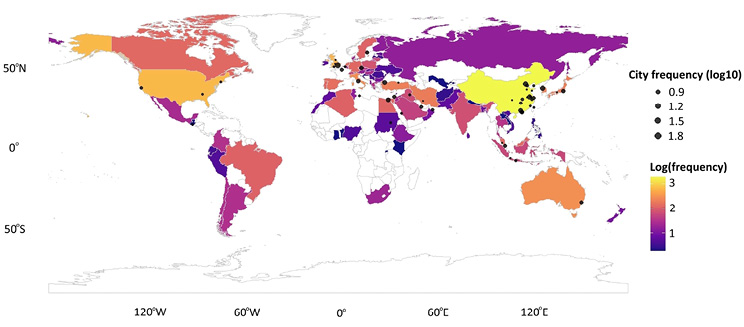
The dataset contains 2,244 authors, with 1,042 unique first-author institutions. Figures 1-3 highlight a highly uneven global structure of knowledge production in space syntax research. The geographical distribution of publications reveals an extreme concentration of research activity in a small number of countries (Fig. 1). The United States (665 articles) and the United Kingdom (606 articles) form the historical core of the field, while China (1,917 publications) emerges as a dominant contemporary producer (country counts reflect full counting, as described in the Methods). In contrast, large parts of Africa and Latin America appear as extensive “data blank spots,” indicating near-total absence from formal knowledge production. European and Chinese cities dominate the discourse (dot circles), with London alone mentioned 69 times, more than any other city. Other frequently mentioned cities include Nanjing (49), Beijing (35), Seoul (35), and Istanbul (26). While some cities from the Global South, such as Wuhan (7) and Baghdad (5), appear on the map, they are relatively underrepresented given their urban scale, complexity, and demographic importance.
Source: own work.
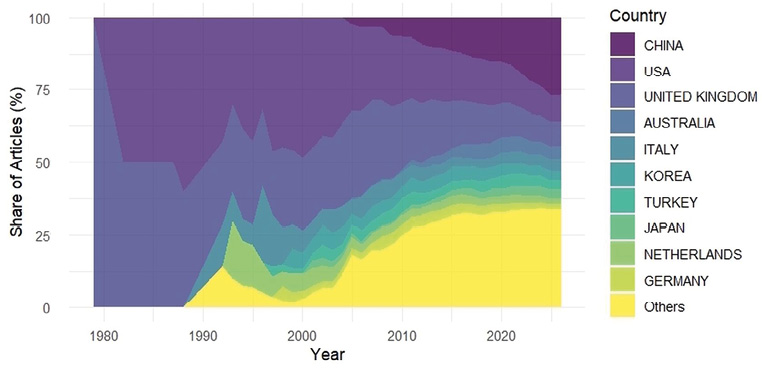
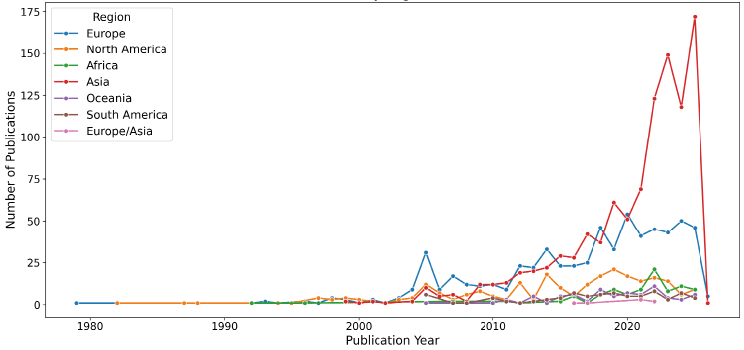
Temporal trends reinforce this finding. Historically, the United States and the United Kingdom accounted for a disproportionately large share of global output (Fig. 2). From around 2010 onward, China’s share increased rapidly and now represents the single largest national contribution. However, this shift reflects a redistribution within the upper tier of producing countries rather than a broad-based global diffusion of research capacity. While North America and Europe dominated publication output for several decades, Asia has experienced an exponential surge in recent years, surpassing both regions in output volume (Fig. 3). However, this apparent diversification in production does not eliminate structural inequality, as contributions from Africa and South America remain marginal throughout the entire period of analysis.
Source: own work.
Source: own work.
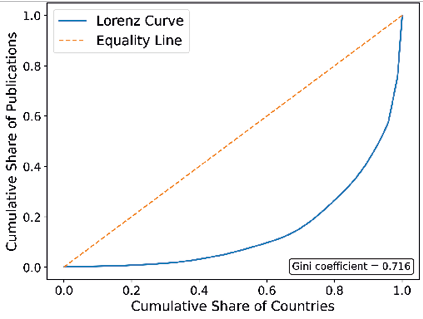
This pattern is quantified in Fig. 4, which presents the Lorenz curve of publications by country. The resulting Gini coefficient of 0.716 indicates extreme inequality, with a small hierarchical elite of countries responsible for the vast majority of published research. Rather than a broadly distributed global field, space syntax exhibits a sharply stratified structure in which participation is highly concentrated.
Source: own work.
3.2. Disciplinary growth and the consolidation of hierarchy
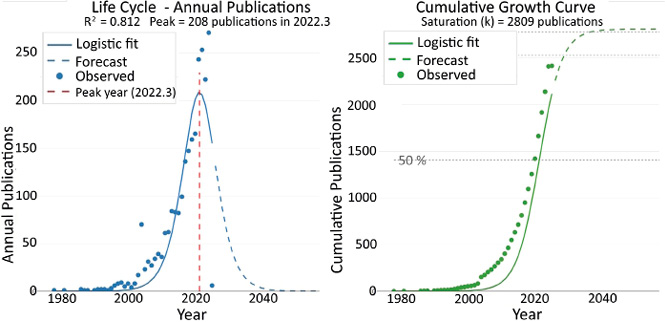
The life cycle of space syntax research traces how its growth trajectory has reinforced, rather than dissolved, existing hierarchies. Annual publication output fitted with a logistic growth model (R² = 0.812) is presented in Fig. 5 (left). Following a prolonged phase of slow expansion, the field entered a period of rapid exponential growth before reaching a peak of approximately 208 publications in 2022. Recent flattening of the curve suggests that space syntax has entered a mature stage of disciplinary development. The cumulative growth curve, with a saturation point (K) of 2,809 publications, is presented in Fig. 5 (right).
Source: own work.
The inflection point marks the transition from a niche methodological approach to an institutionalised research field embedded across architecture, planning, and urban studies. Importantly, this consolidation phase coincides with the entrenchment of dominant producing countries, indicating that early leadership translated into long-term structural advantage.
3.3. Global collaboration networks and core–periphery dynamics
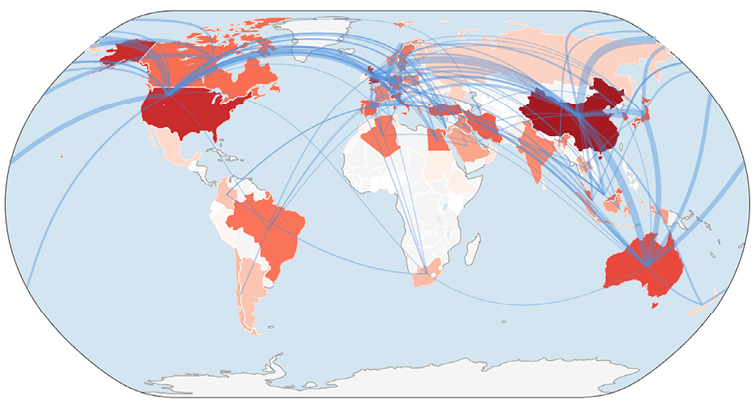
The global collaboration network of space syntax research through international co-authorship links is visualised in Fig. 6. The map reveals a dense and highly centralised network dominated by a small number of countries, primarily China, North America, and Western Europe. For instance, China has 37 links with the USA and 31 with the United Kingdom. These regions form interconnected “power nodes” characterised by repeated and reciprocal collaborations.
In contrast, much of the Global South remains weakly connected – or entirely excluded – from these networks. For example, Iran exhibits only a single collaborative link with Germany and has no recorded connections with either the United States or the United Kingdom. The absence of strong collaborative ties constrains opportunities for knowledge exchange, co-authorship, and visibility, thereby reinforcing a persistent core–periphery structure. Consequently, the collaboration network operates as a mechanism through which existing hierarchies in knowledge production are reproduced and stabilised over time.
Source: own work.
3.4. Citation trend
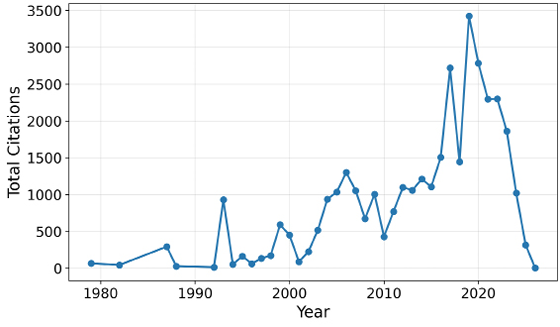
Inequalities in space syntax research are even more pronounced in citation patterns than in publication output. The annual citation count over time reveals a sharp increase after 2015, with a peak of nearly 3,500 citations around 2020 (Fig. 7). This growth substantially outpaces the expansion of publication output, indicating cumulative advantage effects whereby already visible and established research attracts disproportionate recognition. The most cited countries are the United States (7,314 citations), the United Kingdom (6,529), China (5,966), and Italy (1,777). By contrast, the least cited countries include Nigeria (zero citations), the Philippines (one citation), Morocco (one citation), and Pakistan (three citations).
Source: own work.
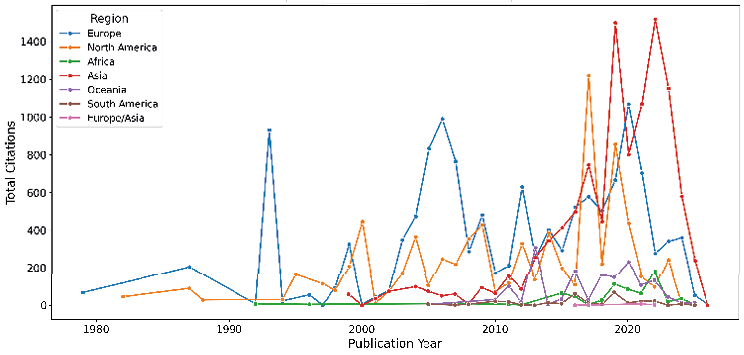
Regional citation trajectories further underscore this imbalance (Fig. 8). North America and Europe have dominated citation counts for decades, reflecting their early institutional leadership and central positioning within the field. Asia has seen a notable increase in citations in recent years, coinciding with its growing publication volume. In contrast, Africa and South America remain at near-zero citation levels throughout the entire period, indicating persistent marginalisation and exclusion from global circuits of academic recognition.
Source: own work.
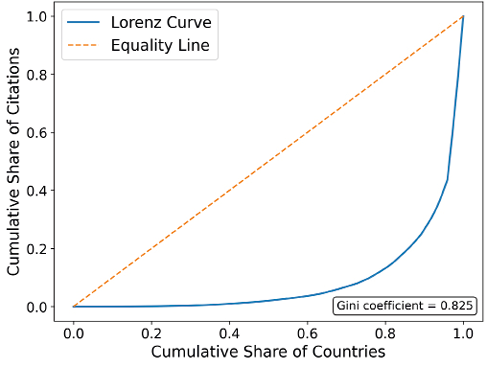
Compared with the Lorenz curve for publications by country, the Lorenz curve for total citations is more strongly bowed (Fig. 9), indicating higher inequality in citations (Gini = 0.825) than in publications (Gini = 0.716). This pattern shows that citations – and the symbolic capital they confer – are concentrated in fewer countries than scientific output. Such extreme concentration underscores how the global reward system in space syntax research disproportionately directs recognition toward a small set of countries, primarily located in the Global North.
Source: own work.
3.5. Productivity versus impact: Unequal returns to knowledge production
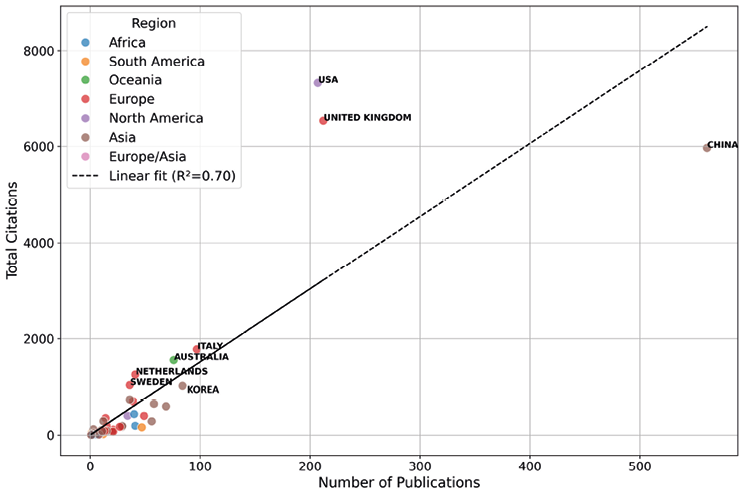
Figure 10 plots total publications against total citations by country, with a linear fit explaining a substantial proportion of the variance (R² = 0.70). The United States and the United Kingdom lie significantly above the fitted line, indicating that they receive disproportionately high citation counts relative to their publication volume. These countries benefit from high impact density, reflecting entrenched visibility and centrality within the global knowledge network.
China, despite being the most prolific producer of space syntax research, lies below the fitted line. This indicates that its rapidly expanding output has not yet translated into equivalent citation impact. The decoupling of productivity and influence highlights structural asymmetries in how scientific contributions are evaluated and rewarded within the field.
Source: own work.
3.6. Journal gatekeeping and the institutionalisation of inequality
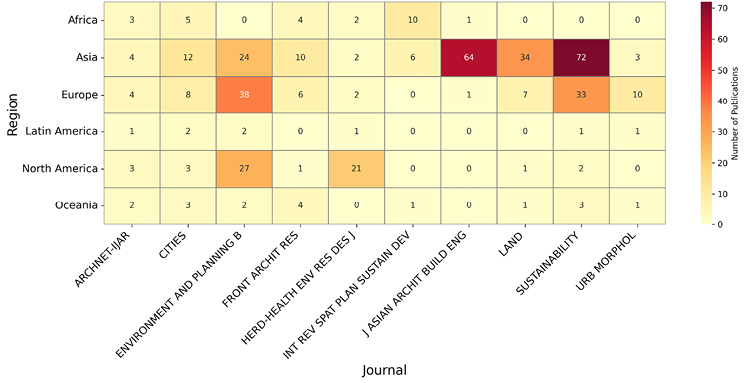
Figure 11 examines how journal landscapes contribute to the institutionalisation of geographical inequality. It presents a heatmap of publications by region across the top ten journals in the field. European scholars dominate long-established, high-prestige journals, such as Environment and Planning B: Urban Analytics and City Science, which serve as a key outlet for symbolic accumulation and disciplinary authority.
By contrast, Asian scholars are disproportionately represented in journals such as Sustainability, which has become a major outlet for space syntax research in recent years. While this diversification expands publication opportunities, it also reflects a stratified journal ecosystem in which emerging regions are more likely to publish in newer or broader-scope journals that may carry different levels of prestige and citation potential.
Source: own work.
4. Discussion
This study employed bibliometric and network-based analyses to investigate the global structure of knowledge production and citation in space syntax research, with a particular focus on geographical imbalance and inequality. By combining growth models, collaboration networks, inequality metrics, and journal-level analysis, the study aimed to identify not only where space syntax research is produced but also how scientific recognition is distributed and what mechanisms may account for persistent disparities. Given the increasing global diffusion of space syntax methods, the analysis focused on the extent to which recent growth has been accompanied by convergence between regions of the Global North and Global South.
The findings situate these inequalities within the broader developmental trajectory of the field. Space syntax has followed a clear life-cycle pattern, evolving from a niche methodological approach into a mature research domain exhibiting signs of saturation. Comparable logistic growth trajectories have been observed in other specialised scientific domains, where early institutionalisation plays a decisive role in shaping long-term disciplinary hierarchy domains (Bettencourt et al., 2008; Bornmann and Mutz, 2015). In the case of space syntax, the early dominance of the United States and the United Kingdom appears to have translated into durable advantages in publication output, citation impact, and journal presence. This pattern is consistent with prior bibliometric research demonstrating how early entry into a field generates cumulative advantages through editorial influence, training traditions, and network centrality (Merton, 1968; Wagner et al., 2019).
While this historical perspective helps explain the emergence of hierarchical structures, their contemporary geographical expression is evident in publication patterns. Growth in space syntax research has not been spatially uniform. Asia – driven primarily by China – has experienced a rapid expansion in publication output since around 2010, whereas large parts of Africa and Latin America remain almost entirely absent from the literature. Similar forms of selective globalisation have been documented in urban studies and planning research, where methodological and theoretical frameworks circulate globally but are produced and validated in a limited number of locations (Parnell and Robinson, 2012; Watson, 2014). The persistence of “data blank spots” in space syntax research suggests that barriers to participation extend beyond methodological accessibility and are likely related to institutional capacity, language dominance, and unequal access to high-visibility publication venues.
These structural barriers are well documented in the broader literature on global knowledge production. Limited research funding, restricted access to academic journals, and the dominance of English continue to marginalise scholars from the Global South (Oztig, 2024). Language barriers are particularly acute, as publishing in international journals requires not only linguistic fluency but also mastery of specialised academic discourse and disciplinary conventions. Such constraints shape not only who can publish, but also whose work is recognised and cited (Mur-Dueñas, 2019).
The inequality metrics reported in this study provide quantitative confirmation of these dynamics. The Lorenz curve for publications by country reveals a level of concentration comparable to that found in other highly stratified scientific fields (Albarrán et al., 2011). More importantly, the even higher concentration observed in citation distributions confirms that symbolic capital is more unevenly distributed than scientific output itself. Citation and authorship patterns, therefore, reflect not only scholarly activity, but also whose voices are heard and legitimised within academic discourse (Bassiouney, 2024; Bassiouney and Muehlhaeusler, 2017). This finding aligns with previous findings, which show that citation systems tend to amplify existing hierarchies rather than correct them (Hicks et al., 2015; Leydesdorff and Wagner, 2009). In space syntax research, countries with modest output but long-standing institutional authority receive disproportionately high levels of recognition, while emerging producers face lower citation returns.
A comparison of productivity and impact further clarifies these dynamics. Although China now produces the largest number of space syntax publications, its citation impact per paper remains lower than that of the United States and the United Kingdom. Similar mismatches between output and influence have been reported in other bibliometric studies focusing on rapidly expanding scientific systems (Chen and Leydesdorff, 2014; King, 2004; Leydesdorff and Wagner, 2009; Zhou and Leydesdorff, 2006). These studies suggest that citation impact depends not only on volume but also on factors such as journal placement, international visibility, and embeddedness within dominant epistemic communities. These findings indicate that increased productivity alone is insufficient to overcome historically entrenched hierarchies in recognition.
International collaboration is often regarded as a key mechanism for enhancing scientific impact, and the results confirm its importance in the field of space syntax research. Collaboration networks are densely structured around countries in North America, Western Europe, and East Asia, reflecting the highly centralised nature of global scientific cooperation (Gonzalez-Brambila et al., 2013). Rather than serving as a compensatory mechanism for countries in the Global South, collaboration appears to reproduce existing inequalities. Its benefits are largely captured by actors already positioned within central networks, suggesting that collaboration alone is unlikely to reduce disparities unless its structure and terms are fundamentally reconfigured.
Journal-level analysis further illustrates how these inequalities are institutionalised. The concentration of European and North American authors in long-established, high-prestige journals mirrors patterns observed in other fields, where editorial boards and reviewer communities tend to reflect existing power structures (Peters and Ceci, 1982; Smith et al., 2014). The prominence of Asian scholars in newer or broader-scope journals suggests a diversification of outlets, but also points to a stratified publishing landscape in which not all journals confer equal symbolic value. This finding supports arguments that journals function not merely as dissemination platforms, but as active gatekeepers in the construction of disciplinary authority.
Despite the persistence of these structural asymmetries, emerging initiatives point toward possible pathways for change. Multilingual publishing platforms and translation collectives have begun to challenge linguistic barriers and expand access to international scholarly communication (Langum and Sullivan, 2020; Tikly, 2024). Scaling up such efforts could help democratise knowledge production and foster greater epistemic diversity within space syntax research. Building a more inclusive field requires expanding the disciplinary canon, diversifying authorship, and rethinking how knowledge is cited, valued, and disseminated. This also entails recognising contributions from the Global South, even when methodologies or theoretical orientations diverge from dominant paradigms (Martins, 2020; Mohamed and van der Laag Yamu, 2023).
More equitable forms of international collaboration are equally crucial. Rather than reinforcing existing hierarchies, collaborative arrangements should prioritise meaningful co-authorship, multilingual engagement, and the recognition of diverse epistemologies. Methodologically, integrating computational techniques with ethnographic and participatory approaches can enrich space syntax research by grounding formal analysis in lived experience and local context. Such pluralism has the potential not only to broaden empirical coverage but also to challenge prevailing assumptions about what constitutes valid and impactful knowledge.
Institutional actors play a central role in enabling these transformations. Funding bodies and journal publishers can contribute by waiving publication fees for authors from the Global South, supporting multilingual dissemination, and diversifying editorial boards and reviewer pools. Without sustained institutional commitment at these levels, efforts to address epistemic inequality are likely to remain fragmented and uneven.
Several limitations of this study must be acknowledged. First, bibliometric indicators may inadequately capture research that is locally oriented, practice-based, or published in non-indexed outlets. As has been widely discussed in the literature, such indicators tend to privilege English-language publications and internationally oriented research agendas (Hicks et al., 2015; Sarewitz and Pielke, 2007). These biases are likely to disproportionately affect countries in the Global South, where research may be more closely aligned with local planning challenges than with international academic debates. Second, the macro-level approach adopted here does not capture national or institution-specificities that may explain exceptional performance in certain contexts. Future research could benefit from combining bibliometric analysis with qualitative investigation of institutional strategies, editorial practices, and collaboration dynamics.
5. Conclusion
This study demonstrates that the globalisation of space syntax research has been accompanied by persistent, and in some cases intensifying, inequalities in knowledge production and scientific recognition. While publication output has expanded rapidly and new regions – particularly in Asia – have become major contributors, citation impact, collaboration networks, and journal hierarchies remain strongly concentrated in a small number of countries. These findings suggest that convergence in output does not necessarily imply convergence in influence.
The results underscore the significance of path dependency in shaping the development of scientific fields. Early institutional leadership in space syntax has yielded long-term benefits that continue to shape collaboration, visibility, and recognition. Overcoming these dynamics is likely to require sustained investment, the development of critical research masses, and greater inclusivity in editorial and collaborative practices.
From a policy perspective, the findings suggest that countries with relatively small scientific communities may benefit from focusing resources on building strong, coherent research clusters in specific fields, rather than dispersing efforts across multiple areas. At the same time, international collaboration remains an important strategy; however, its effectiveness depends on researchers’ ability to access central networks and maintain strong links with domestic institutions. Finally, the distinction between academic impact and societal relevance should remain central to evaluations of research performance, particularly in regions where space syntax research may contribute more directly to addressing local urban challenges than to accumulating international citations.
Autorzy
REFERENCES
ALBARRAN, P., CRESPO, J. A., ORTUÑO, I. and RUIZ-CASTILLO, J. (2011), ‘The skewness of science in 219 sub-fields and a number of aggregates’, Scientometrics, 88 (2), pp. 385–397. https://doi.org/10.1007/s11192-011-0407-9
ARIA, M. and CUCCURULLO, C. (2017), ‘Bibliometrix: An R-tool for comprehensive science mapping analysis’, Journal of Informetrics, 11 (4), pp. 959–975. https://doi.org/10.1016/j.joi.2017.08.007
BABBU, A. H. (2023), ‘Mapping space syntax as a computational tool: A bibliometric analysis’, Journal of Engineering Science and Technology Review, 16 (6), pp. 82–89. https://doi.org/10.25103/jestr.166.10
BASSIOUNEY, R. (2024), ‘The politics of writing and reading: An Arabic sociolinguistics perspective [Journal of Arabic Sociolinguistics]’, International Journal of the Sociology of Language, 289–290, pp. 53–58. https://doi.org/10.1515/ijsl-2024-0131
BASSIOUNEY, R. and MUEHLHAEUSLER, M. (2017), ‘Cairo: The linguistic dynamics of a multilingual city’, [in:] SMAKMAN, D. and HEINRICH, P. (eds), Urban sociolinguistics: The city as a linguistic process and experience, Routledge.
BETTENCOURT, L. M. A., KAISER, D. I., KAUR, J., CASTILLO-CHAVEZ, C. and WOJICK, D. E. (2008), ‘Population modeling of the emergence and development of scientific fields’, Scientometrics, 75 (3), pp. 495–518. https://doi.org/10.1007/s11192-007-1888-4
BORNMANN, L. and MUTZ, R. (2015), ‘Growth rates of modern science: A bibliometric analysis based on the number of publications and cited references’, Journal of the Association for Information Science and Technology, 66 (11), pp. 2215–2222. https://doi.org/10.1002/asi.23329
CHEN, C. and LEYDESDORFF, L. (2014), ‘Patterns of connections and movements in dual-map overlays: A new method of publication portfolio analysis’, Journal of the Association for Information Science and Technology, 65 (2), pp. 334–351. https://doi.org/10.1002/asi.22968
DONTHU, N., KUMAR, S., MUKHERJEE, D., PANDEY, N. and LIM, W. M. (2021), ‘How to conduct a bibliometric analysis: An overview and guidelines’, Journal of Business Research, 133, pp. 285–296. https://doi.org/10.1016/j.jbusres.2021.04.070
GANDIA, R. M., ANTONIALLI, F., CAVAZZA, B. H., NETO, A. M., LIMA, D. A. DE, SUGANO, J. Y., NICOLAI, I. and ZAMBALDE, A. L. (2019), ‘Autonomous vehicles: Scientometric and bibliometric review’, Transport Reviews, 39 (1), pp. 9–28. https://doi.org/10.1080/01441647.2018.1518937
GONZALEZ-BRAMBILA, C. N., VELOSO, F. M. and KRACKHARDT, D. (2013), ‘The impact of network embeddedness on research output’, Research Policy, 42 (9), pp. 1555–1567. https://doi.org/10.1016/j.respol.2013.07.008
HICKS, D., WOUTERS, P., WALTMAN, L., DE RIJCKE, S. and RAFOLS, I. (2015), ‘Bibliometrics: The Leiden Manifesto for research metrics’, Nature, 520 (7548), pp. 429–431. https://doi.org/10.1038/520429a
HILLIER, B. (1996), Space is the machine: A configurational theory of architecture, Cambridge University Press.
KING, D. A. (2004), ‘The scientific impact of nations’, Nature, 430 (6997), pp. 311–316. https://doi.org/10.1038/430311a
KRENZ, K., PSARRA, S. and NETTO, V. M. (2023), ‘Mapping the conceptual system of an urban theory and its evolution: A text analysis of space syntax conference papers over 20 years’, Urban Morphology, 27 (2), Article 2. https://doi.org/10.51347/UM27.0014
LANGUM, V. and SULLIVAN, K. P. H. (2020), ‘Academic writing, scholarly identity, voice and the benefits and challenges of multilingualism: Reflections from Norwegian doctoral researchers in teacher education’, Linguistics and Education, 60, 100883. https://doi.org/10.1016/j.linged.2020.100883
LEYDESDORFF, L. and WAGNER, C. (2009), ‘Is the United States losing ground in science? A global perspective on the world science system’, Scientometrics, 78 (1), pp. 23–36. https://doi.org/10.1007/s11192-008-1830-4
MARTINS, A. (2020), ‘Reimagining equity: Redressing power imbalances between the global North and the global South’, Gender and Development, 28 (1), pp. 135–153. https://doi.org/10.1080/13552074.2020.1717172
MENG, D. and ZHANG, J. (2025), ‘The evolution of space syntax over the past two decades: Evidence from China’, Journal of Asian Architecture and Building Engineering, 24 (5), pp. 4606–4624. https://doi.org/10.1080/13467581.2024.2399739
MERTON, R. K. (1968), ‘The Matthew Effect in Science: The reward and communication systems of science are considered’, Science, 159 (3810), pp. 56–63. https://doi.org/10.1126/science.159.3810.56
MOHAMED, A. A. (2025), ‘Using BERTopic modelling to map the evolution of space syntax research’, Land Use Policy, 157, 107639. https://doi.org/10.1016/j.landusepol.2025.107639
MOHAMED, A. A. and VAN DER LAAG YAMU, C. (2024), ‘Space Syntax has Come of Age: A Bibliometric Review from 1976 to 2023’, Journal of Planning Literature, 39 (2), pp. 203-217. https://doi.org/10.1177/08854122231208018
MUR-DUEÑAS, P. (2019), ‘The experience of a NNES outer circle novice scholar in scholarly publication’, [in:] HABIBIE, P. and HYLAND, K. (eds), Novice Writers and Scholarly Publication: Authors, Mentors, Gatekeepers, pp. 97–115, Springer International Publishing. https://doi.org/10.1007/978-3-319-95333-5_6
OZTIG, L. I. (2024), ‘IR and the Global South: Revising Obstacles to a Global Discipline’, Global South Review, 5 (2), Article 2. https://doi.org/10.22146/globalsouth.89891
PARNELL, S. and ROBINSON, J. (2012), ‘(Re)theorizing Cities from the Global South: Looking Beyond Neoliberalism’, Urban Geography, 33 (4), pp. 593–617. https://doi.org/10.2747/0272-3638.33.4.593
PETERS, D. P. and CECI, S. J. (1982), ‘Peer-review practices of psychological journals: The fate of published articles, submitted again’, Behavioral and Brain Sciences, 5 (2), pp. 187–195. https://doi.org/10.1017/S0140525X00011183
SAREWITZ, D. and PIELKE, R. A. (2007), ‘The neglected heart of science policy: Reconciling supply of and demand for science’, Environmental Science and Policy, 10 (1), pp. 5–16. https://doi.org/10.1016/j.envsci.2006.10.001
SINGH, V. K., SINGH, P., KARMAKAR, M., LETA, J. and MAYR, P. (2021), ‘The journal coverage of Web of Science, Scopus and Dimensions: A comparative analysis’, Scientometrics, 126 (6), pp. 5113–5142. https://doi.org/10.1007/s11192-021-03948-5
SMITH, M. J., WEINBERGER, C., BRUNA, E. M. and ALLESINA, S. (2014), ‘The Scientific Impact of Nations: Journal Placement and Citation Performance’, PLOS ONE, 9 (10), e109195. https://doi.org/10.1371/journal.pone.0109195
TIKLY, L. (2024), Transforming knowledge and research for just and sustainable futures: Towards a new social imaginary for higher education (Nos. 33; ED-2024/WP-33/1; Education, Research and Foresight: Working Papers, p. 13), UNESCO, https://unesdoc.unesco.org/ark:/48223/pf0000390388 [accessed on 24.12.2025].
VAN NES, A. and YAMU, C. (2021), Introduction to Space Syntax in Urban Studies, Springer International Publishing. https://doi.org/10.1007/978-3-030-59140-3
VAUGHAN, L., PEPONIS, J. and DALTON, R. C. (eds) (2025), Space Syntax: Selected papers by Bill Hillier, UCL Press. https://doi.org/10.14324/111.9781800087712
WAGNER, C. S., WHETSELL, T. A. and MUKHERJEE, S. (2019), ‘International research collaboration: Novelty, conventionality, and atypicality in knowledge recombination’, Research Policy, 48 (5), pp. 1260–1270. https://doi.org/10.1016/j.respol.2019.01.002
WATSON, V. (2014), ‘African urban fantasies: Dreams or nightmares?’, Environment and Urbanization, 26 (1), pp. 215–231. https://doi.org/10.1177/0956247813513705
YAMU, C., VAN NES, A. and GARAU, C. (2021), ‘Bill Hillier’s legacy: Space syntax—A synopsis of basic concepts, measures, and empirical application’, Sustainability, 13 (6), 3394. https://doi.org/10.3390/su13063394
ZHOU, P. and LEYDESDORFF, L. (2006), ‘The emergence of China as a leading nation in science’, Research Policy, 35(1), pp. 83–104. https://doi.org/10.1016/j.respol.2005.08.006
ZUPIC, I. and ČATER, T. (2015), ‘Bibliometric methods in management and organization’, Organizational Research Methods, 18 (3), pp. 429–472. https://doi.org/10.1177/1094428114562629