
Halfway between London and ankara: the role of migration in the global integration of Budapest

Abstract. Budapest’s global city network integration determines its future social and economic development regarding every related dimensions. This position is based on its international labour market flows in a specific way. While unskilled labour provides essential but changeable resources, highly skilled labour has much higher added value and create liveable social and cultural environments. Local regulation tries to balance domestic market needs and deeper economic integration by eliminating low skilled workers in vain according to existing experiences. Their spatial concentration, deeper integration and the diversified sources of immigration both contribute to Budapest strengthening global city connectedness. Our aim is to show and analyse these processes.
Key words: global Budapest, international migration, globalisation, contest of cities, international labour markets.
1. Introduction
In the contemporary global urban competition scene (Bertaud 2018; Koudela, 2024) labour markets play a crucial role (Wills et al., 2010). Understanding international labour market integration needs an analytical approach by separating the two opposing segments of the market, the low skilled labourers and the highly skilled professionals and the ways in which they develop their networks (Hüwelmeier, 2015) and alter the environments. Our first aim is to differentiate these immigrant groups in Hungary by analysing the work permits issued to foreign nationals.
| brak danych | 2013 | 2014 | 2015 | 2016 | 2017 | 2018 |
|---|---|---|---|---|---|---|
| GDP PPP (million EUR) | 175 246,1 | 181 808,3 | 189 772,5 | 191 046,8 | 198 616,2 | 212 322,8 |
| Population | 9,895,250 | 9,850,217 | 9,815,858 | 9,779,652 | 9,739,857 | 9,713,655 |
| Foreigners | 141,357 | 140,536 | 145,968 | 156,606 | 151,132 | 161,809 |
| brak danych | 2019 | 2020 | 2021 | 2022 | 2023 |
|---|---|---|---|---|---|
| GDP PPP (million EUR) | 224 620,3 | 219 806,3 | 238 893,7 | 264 995,2 | 282 349,5 |
| Population | 9,700,272 | 9,689,376 | 9,651,461 | 9,610,403 | 9,599,744 |
| Foreigners | 180,773 | 199,957 | 194,491 | 202,525 | 226,267 |
Source: own work based on HCSO 21.1.1.4. Value of gross domestic product in HUF, EUR, USD, and in purchasing power parity https://www.ksh.hu/stadat_files/gdp/en/gdp0004.html; HCSO 22.1.1.1. Main indicators of population and vital events https://www.ksh.hu/stadat_files/nep/en/nep0001.html; HCSO 22.1.1.23. Foreign citizens residing in Hungary by country of citizenship and sex https://www.ksh.hu/stadat_files/nep/en/nep0023.html data.
In the case of Budapest, it is also important to separate traditional migrations, which can be interpreted in different historical and cultural contexts and explained by different foreign policy and policy strategies, strictly speaking, from the migration industry. While the former primarily refers to the economy and economic geography and foreign policy context affecting Hungarians beyond the border (Péti et al., 2021; Rusu, 2010), it also includes immigrants from neighbouring countries, who were prompted by different reasons and driven by different goals in different eras, even though later regulation facilitated it by similar means. While in the years following the Revolution of 1989, cross-border commuter immigration was due to higher wages, the cross-border resettlement (Berceanu et al., 2023) of the past decade could also be attributed to low real estate prices in Hungary. In part, even the immigration of highly qualified people from EU member States can be classified here, but the appearance of guest workers filling the labour market gap, the impact of investor visas, and the highly qualified immigration from more distant countries associated with global value chain integration are fundamentally different. At the same time, their characteristics and globalisation effect partially coincide with the effects caused by the influx of skilled workers from the EU and third countries, so the precise demarcation is difficult, since the migration industry can only be placed purely in theory within the framework of supply and demand. Our second research question aims to scrutinise the geographical changes of source countries among the migration influxes over the years examined.
| brak danych | 2013 | 2014 | 2015 | 2016 | 2017 | 2018 |
|---|---|---|---|---|---|---|
| GDP PPP (million EUR) | 75 372,87 | 62 361,73 | 57 243,73 | 51 589,03 | 55 467,55 | 49 694,69 |
| Population | 799,282 | 801,738 | 806,199 | 805,733 | 801,943 | 801,218 |
| Foreigners | 60,535 | 61,219 | 67,253 | 72,136 | 72,945 | 76,824 |
| brak danych | 2019 | 2020 | 2021 | 2022 | 2023 |
|---|---|---|---|---|---|
| GDP PPP (million EUR) | 46 302,45 | 41 993,27 | 40 717,87 | 39 366,13 | 37 296,4 |
| Population | 803,939 | 802,837 | 790,343 | 782,132 | 782,385 |
| Foreigners | 85,089 | 91,540 | 86,930 | 88,251 | 97,470 |
Source: own work based on Eurostat Regional gross domestic product by NUTS 2 region – million EUR https://ec.europa.eu/eurostat/databrowser/view/tgs00003/default/table?lang=en; HCSO 22.1.2.1. Resident population by sex, county and region https://www.ksh.hu/stadat_files/nep/en/nep0034.html; HCSO 22.1.2.17. Foreign citizens residing in Hungary by county and region https://www.ksh.hu/stadat_files/nep/en/nep0050.html data.
All of this has an impact on employment and migration, and through this also on the position within the global city network. Guest workers in such an isolated and limited situation also create a kind of institutionalisation, they perpetuate the necessary products of the migration industry (Matuszczyk and Bujarczuk, 2024): language schools, grocery stores, restaurants, social and legal institutions, trade unions, and other activities that support their stay. An integration of this kind clearly comes with risks of wider economic and social impact. Our third goal is to discuss how Hungarian regulation intends to avoid the inherent tension between facilitating economic utilisation and limiting social integration (Bal et al., 2024). For this reason, to explore the geographical distribution of immigrants is also important. The loudly communicated dispersal of isolated and closed working communities suggest easiness in elimination, however, concentration in a large city might come with unintentional consequences within the Hungarian social fabric.
In the case of highly educated immigrants, a close social network is not common, they typically move along business networks (Girling, 2024), so they do not create ethnic or other local communities, and they are not characterised by the institutionalisation observed at the other pole, but they are also connected to the global situation of the city by an institution on their side (e.g., elite clubs, elite schools or any high-quality service (Czerska-Shaw and Kubicki, 2023)), which is also an environment-shaping factor, and this increases the host city’s competitiveness for human capital. Since their work represents significantly greater added value, in their case global integration is created by the host markets: they are needed, so their involvement is a direct market interest, which is supported by the locality (including the city administration and the companies present in the given city). The fifth goal of this study is to understand how the highly skilled workers and professionals create creative environments, alter the image of Budapest in the global labour market scene and contribute to its competitiveness along with it?
While in the case of the first group, immigrants themselves transform the city for their own benefit, in the case of the latter, the city transforms itself for the benefit of immigrants. From the point of view of global integration – which is the overarching and main objective of the article – the latter traditionally follows transnational corporate structures, and this determines the global situation of the given city; conversely, cities themselves do everything to integrate in order to attract globally mobile human capital. As a result, individual decisions are valued, labour market factors are overridden by the characteristics of the locality, and the highly qualified workforce begins to take control. In this regard, in addition to the policy environment and the role of the state, local actors are becoming increasingly stronger – assuming that local and national interests and regulations do not conflict. The impact of market competition on the city ranges from meeting direct needs (construction of housing estates) to increasing general competitiveness (cultural or environmental development).
The role of the urban environment has now become decisive with digital development, the increasing value of remote work and a general generational change in values, one of its best-known contexts being the creative class and the mobility and spatial competition associated with it. All of this, in addition to the mobility occurring in the corporate structure, also enhances the role of individual decisions on the international scene, which creates a specific market situation. Eventually, all these changes can contribute to move Budapest forward from its decade-long stagnating global position.
In order to achieve our goals and find answers to the questions, we follow the theoretical framework set by Saskia Sassen, we analyse the current regulations and data on immigration and foreign labour provided by the Hungarian Central Statistical Office and the National Employment Service, referring the spatial distribution to demographic variables and their changes over the discussed period. The results of the analysis follows the chronological changes in market regulations, while discussion adds those new insights that connect our perspective to the fields of immigration studies.
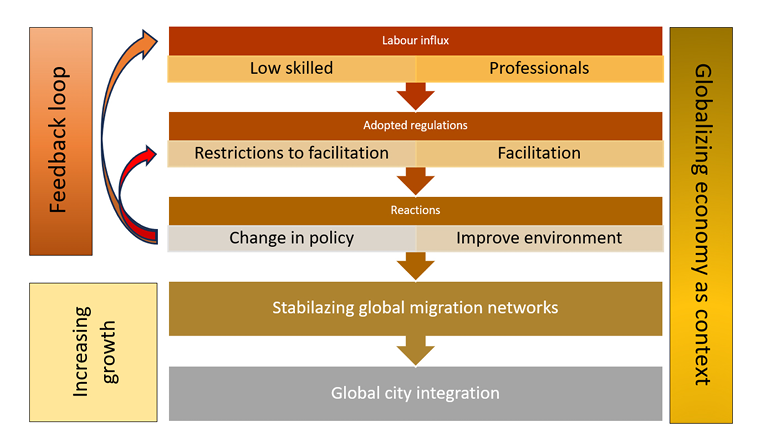
Source: own work.
2. Theoretical background
Today, one of the universally accepted dimensions of globalisation is the flow of labour (Amin, 2008), that is, in addition to the internationalisation of capital flow and trade, the broadening of the international markets of labour and liberalisation of labour market relations. The most important spatial system of this is the network of global cities – our main theoretical framework – we describe in the following. The extent to which a city is connected to the international labour markets clearly determines its global position. In 1986, John Friedmann saw the prominent role of world cities in migration based on the world system approach. The developed economy of the core countries creates concentration and hubs, so production and services in these areas both have the highest labour market demand, which the domestic markets are unable to replace. This approach is based not only on Friedmann and Wallerstein’s (2004) centre-periphery model, but also on Piore’s (2001) dual workforce approach.
Immigration, which is inevitable for growth (Borjas, 2021; De Haas, 2021), creates huge socio-territorial tensions (Brunarska, 2022), territorial and class segmentation in the city, and different migration policies are formed to deal with them. In this view, immigration takes a macroeconomic approach; it stems from the contradiction between expansion supported by growing economic competition and the limited resources of domestic labour markets, and the whole process is typically limited to low-skilled people. As a result, only the declining demand associated with the modernisation of the domestic economy and the forced adaptation of the remaining masses cause some development (Friedmann, 1986).
For Saskia Sassen, migrant economic networks represent one of the defining dimensions of the international networks of cities. According to her, along with the shrinking role of the state, global cities are becoming strategic centres of global capital and transnational labour. All this creates trans-local communities and identity and a new form of “citizenship” and strengthens the power of local actors, although Sassen does not ignore the immigration of a large mass of unskilled labour as a factor that polarises income and employment. In regards of identities, a 2023 study (O’Brien et al., 2023) show how migrants get stigmatised by rural native people. Sassen’s most important theoretical contribution is perhaps the formation of transnational networks. In addition to stabilising international labour market relations, political, cultural, and even criminal networks are also formed, which – apart from the latter – have a positive effect on economic activity. The most important driving force behind this process is communication and the result is spatially spreading social networks, which leads to the formation of international nodes (Sassen, 1991, 2005). It is only an endowment that large cities, which for historical reasons already play a central role, largely (but not necessarily) serve as the basis for these nodes that play a new role.
However, none of them distinguish the role of education in differential integration between global cities. Sassen also writes only in general about the outstanding importance of migration, raising it to the same level as international capital flows, and only emphasising the importance of locality. Even though she considers the highly educated to be the defining stratum of post-industrial society and urbanity, she assigns them a prominent role in gentrification and social segmentation. While Friedmann’s and Piore’s approaches are demand-based, Sassen’s principle is based on supply, and she characterises local markets with a split in consumption. The increase in the number of immigrants in global cities leads to the flourishing of small producers who can effectively compete with large retail chains and supermarkets because consumers are unable to pay those prices and find their specific needs. This market segment has a very low return, which leads to an increase in demand for additional low-wage labour. We also have comparable knowledge of the urban development of recently emerged destination countries due to immigration in Central Europe (Křížková and Ouředníček, 2020).
This logic still reminds us of Piore’s argument, although the subject is not the company wage structure and the domestic labour market supply constraints, but the specific needs and demand force of guest workers employed on one or two-year contracts who otherwise do not wish to integrate. Both aspects can be relevant in Hungary, especially in Budapest, which is the primary focus of bipolar immigration. Employers will certainly not be able to satisfy all emerging needs in the long term, the remaining existing and then newly emerging needs will create market gaps to which the supply will respond.[1]
All this does not necessarily imply a shift to the illegal employment or the informal economy, even though the example of Poland shows this (Korys and Weinar, 2005). Conversely, the global criminal networks introduced by Saskia Sassen logically follow from the concept of global city networks, and immigration is often included in such a context in political rhetoric, real data do not prove its existence (Samers, 2002). The same is true for the mass marginalisation that, in principle, necessarily appears on the labour market. Although both the dual labour market and the global city hypothesis assume all this effect from cheap and massive vulnerable foreign labour; according to experience, the decreasing efficiency of state labour regulation, the growing market power of concentrated retail, and the increasing competition caused by cheap imported goods play at least as much a role (Stanford and Vosko, 2004).
Although professionalisation is characteristic of most global cities, there is little evidence of the proletarianisation raised as a central point by Sassen and that polarisation is a necessary consequence of the perpetuation of low-skilled immigration (Hamnet, 2021). In fact, the whole migration industry and the issue of global cities are in a peculiar situation. Although it is a central element of the global city concept, and countless theoretical works related to it have been published in the last three decades (Findlay et al., 1996; Cohen et al., 2022; Yamamura, 2022), there is no longer such an abundance of empirical analyses. The lack is particularly acute when it comes to the dual nature of labour market flows, the mass of low-educated people and the related polarisation, labour market dependence, and the connection between the added value of the highly-educated and the positioning of the value chain or the investor environment, which were also determining motives from the beginning (Friedmann and Wolff, 1982; Sassen, 1988), or the related economic policy.
3. Methodology and data
The goals of the study:
- Our first aim is to differentiate these immigrant groups in Hungary by analysing the work permits issued to foreign nationals.
- Our second research question aims to scrutinise the geographical changes of source countries among the migration influxes over the years examined.
- Our third goal is to discuss how Hungarian regulation intends to avoid the inherent tension between facilitating economic utilisation and limiting social integration (Bal et al., 2024).
- For this reason, to explore the geographical distribution of immigrants is also important.
- The fifth goal of this study is to understand how the highly skilled workers and professionals create creative environments, alter the image of Budapest in the global labour market scene and contribute to its competitiveness along with it.
We consider the development of the number and proportion of unskilled and highly skilled workers, as well as the prospects for changes in the related policy. For this, we use the annual time series data of the National Employment Service (NES) and the Hungarian Central Statistical Office (HCSO), as well as the relevant policy regulators and guidelines for the indicated period, which are the Government decree 445/2013. (XI. 28.) on the authorisation of the employment of third-country nationals in Hungary based on a non-consolidated application procedure, on exemption from the licensing obligation, on the cooperation of the labour centre of the capital and county government office in the combined application procedure, and on the notification of the employment of third-country nationals who can be employed in Hungary without a permit in Hungary, and compensation of wages, and also the Government decree 462/2023. (X. 5.) on emergency measures for the protection of Hungary’s labour market and population (HG, 2013; HG, 2023). The examination and temporal overview of the source countries of international migration, the socio-economic composition, the territorial distribution of immigrants and the related regulations enables the dynamic monitoring of Budapest’s global position from the perspective of international labour flows.
Data derived from the Hungarian Central Statistical Office (HCSO) database and the National Employment Service (NES) is purely descriptive and contain only numbers. For our purposes we combined the different data sources, selected and arranged data by indicators relevant to the research goals, i.e., the territorial, educational, and occupational differences in immigrant stocks and flows. We also calculated population rates and rates within different proportions of immigrant groups, however, the characteristics of the available data has not enabled the calculation of trend indicators, constraining us to interpret changes within the set of time series alone and interpret prospects out of them. Available data provided by the HCSO and NES limits our understanding of the migration related urban development phenomena, still helps us to understand the capital city’s global labour market integrations process to achieve our goals, by revealing a dominant dimension “of coordination of complex economic activities at a global scale” (Bourdeau-Lepage, 2007, p. 1).
4. Results
4.1. The role of migration in Budapest’s global position
The regional functional concentration in Hungary is a historical fact that determines the economic and social spatial structure of the entire country. Due to its population and economic predominance, and its domestic and foreign economic role, Budapest Primate City far exceeds that of any other city in the country. Its predominant role in domestic economic geography partly determines its global urban position from the outset. However, it is not necessary that the prominent national role of the capital city and the country’s role in the international economic system move along the same path, and especially not that they strengthen each other.
Based on the production services and their connection to the global network, Globalization and World Cities (GaWC) classified Budapest in the gamma category in the 1990s, while by the beginning of the 2000s it was already in the beta + category and has occupied the same position ever since (more precisely fluctuated between beta and alpha –). This clearly shows that the capital’s international role changed radically in the first decade after 1990, Budapest became an environment where labour market embeddedness was accompanied by an increase in the number of foreign direct investments and corporate centres. The stock of FDI in Hungary increased nearly eightfold in the 1990s and quadrupled again in the following decade, decreased somewhat after 2012 (UNCTAD, 2018, 2019), then started to increase again after 2017 (HCSO, 4.21).
In 2000, the number of enterprises with foreign interests in Hungary was 26,634, the majority of which, as of ten years later, operated in Budapest. However, in the decade following 2013, the composition of companies with foreign interests in Hungary changed sharply. Among enterprises employing between 10 and 249 people, the foreign share has decreased by more than 6 per cent since 2010, but it has increased to the same extent among enterprises employing 250 or more people (OPTEN, 2021; HCSO, 2020a). In the field of high-level business services, by the 2010s, Budapest had risen to third place in the Central European region, after Warsaw and Vienna, (Döbrente, 2018), according to Lisa Bourdeau-Lepage (2007), its global functions had lagged behind Prague ten years earlier. Although Budapest’s financial controlling and central role declined somewhat in the 2000s, it began to take shape in the two decades following the fall of Communism in 1989 as a whole (Gál, 2015).
After the turn of the millennium, the growth of the role of other centres in addition to Budapest, mainly in Western Hungary, induced a significant shift in foreign capital investments, but this did not fundamentally change the process of Budapest’s integration into the global city network. Regarding immigrants, the majority of them currently come from outside Europe for employment purposes and settle in Budapest. Between 2000 and 2023, the number of immigrating citizens of Asian countries increased from 2,217 to 37,720 in Hungary, but the number of American and African citizens, which were relatively small in the 1990s, also increased by two or three times respectively; while the number of citizens of European countries, despite some fluctuations, decreased in the same period (HCSO, 22.1.1.28.). 82 per cent of Chinese immigrants live in Budapest (Irimiás, 2009). The number of immigrants from Asia and Africa shows a particularly high growth, behind which education is an important factor. Between 2010 and 2020, the number of foreign students in higher education increased from 15,000 to 32,000 (HCSO, 2021).
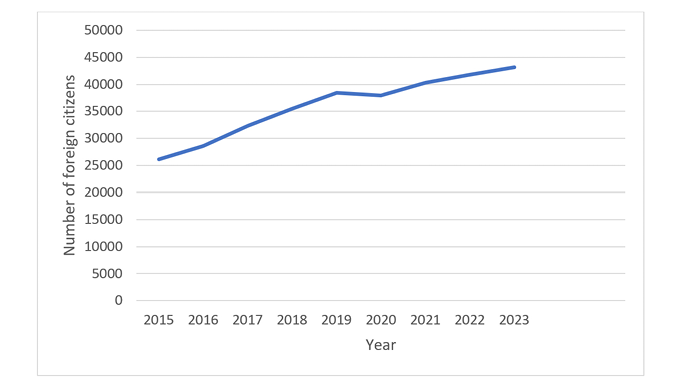
Source: own work based on HCSO 22.1.1.28 data.
Higher education has played and may continue to play a prominent role in the labour markets, on the one hand, because the perspective of university students studying in Hungary is fundamentally changed by the time they spend here, and, on the other, because they are entitled to undertake internships during their student status (HG, 2013). The added value generated by foreign students studying in Hungary to the national economy is significant. The most important factor is studentification, which covers the impact of consumption on the market. However, the impact of this on regional development is different, and it is not surprising that Budapest also has the greatest weight here (Császár et al., 2023, Alpek et al., 2022). In addition, the social role of university students and their impact on the locality coincides with that of the social group generally regarded as the creative class, the university plays a prominent role as the social base of the creative economy (Florida, 2005, p. 151). The majority of foreign students who come to Hungary live and study in Budapest, which contributes to its prominent role both domestically and regionally.
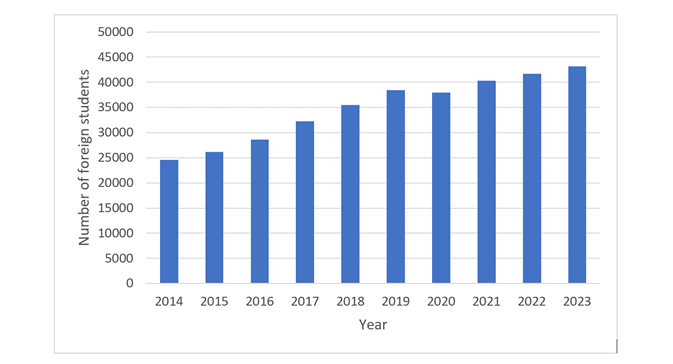
Source: own work based on HCSO (2019, 2020a, 2021, 2023, 2024) data.
4.2. Budapest’s global role in relation to foreign workers
After 2004, the conditions for employment in Hungary changed for the employees of the countries that joined the EU at the time, the permit requirement was abolished, the reporting obligation remained. As of 1 January 2008, the license requirement was completely/partially abolished in the case of several European Union Member States. After joining the EU, Hungary’s role in the regional labour market decreased, and the number of issued permits and notifications also fell. The ten-year period after 2013 was therefore characterised by the stabilisation of regulation, in which the change of the regional role and the spatial reorganisation of the labour market integration can be clearly separated. In 2013, workers from non-EU and non-neighbouring countries already accounted for nearly 60 per cent of the domestic foreign labour market, most of them from East Asian countries, half from China (NES, 2013).
| Counties/Years | 2016 | 2017 | 2018 | 2019 |
|---|---|---|---|---|
| Budapest | 8,678 | 12,051 | 26,852 | 36,551 |
| Pest | 775 | 1,629 | 7,190 | 11,472 |
| Baranya | 64 | 123 | 265 | 254 |
| Bács-Kiskun | 1,173 | 712 | 2,760 | 3,903 |
| Békés | 539 | 781 | 1,029 | 867 |
| Borsod-Abaúj-Zemplén | 739 | 1,343 | 2,345 | 2,445 |
| Csongrád | 534 | 672 | 1810 | 1,748 |
| Fejér | 396 | 631 | 3902 | 4,788 |
| Győr-Moson-Sopron | 284 | 455 | 2330 | 2,814 |
| Hajdú-Bihar | 303 | 254 | 562 | 1,060 |
| Heves | 96 | 163 | 671 | 1,169 |
| Komárom-Esztergom | 659 | 697 | 3,126 | 3,872 |
| Nógrád | 72 | 164 | 489 | 582 |
| Somogy | 65 | 292 | 1,106 | 1,208 |
| Szabolcs-Szatmár-Bereg | 531 | 177 | 485 | 1,761 |
| Jász-Nagykun-Szolnok | 200 | 463 | 4,043 | 4,690 |
| Tolna | 124 | 132 | 467 | 576 |
| Vas | 466 | 615 | 2,351 | 1,411 |
| Veszprém | 396 | 247 | 2,692 | 3,538 |
| Zala | 752 | 725 | 2,721 | 3,744 |
| All | 16,846 | 22,326 | 67,196 | 88,453 |
Source: own work based on NES (2016, 2017, 2018, 2019) data.
By 2020, Budapest had become dominant (68.5 per cent) in the employment of foreigners. The weight of Budapest has increased tremendously compared to 2019 and the previous years: in 2019, only 31.6 per cent of declared foreign citizens were in Budapest. In 2022, 48.4 per cent of all employees with valid permits were employed in the Hungarian capital. The second largest number of foreign nationals with valid permits worked in the Pest county, where 14.2 per cent of all foreign workers with valid permits were registered. National data show a trend-like increase in the proportion of the highly educated.
| brak danych | 2013 | 2014 | 2015 | 2016 | 2017 | 2018 | 2019 | 2020 | 2021 | 2022 | 2023 |
|---|---|---|---|---|---|---|---|---|---|---|---|
| Elementary or less | 4,485 40,7 |
1,454 31,1 |
1,550 29,6 |
1,664 26,4 |
2,454 26,5 |
13,274 35,7 |
5,655 44,0 |
7,890 51,8 |
10,788 46,4 |
16,904 51,8 |
25,059 59,4 |
| Vocational school, vocational training | 2,283 20,7 |
895 19,2 |
857 16,3 |
970 15,4 |
1,663 17,9 |
2,296 6,2 |
2,050 14,5 |
1,362 9,0 |
2,227 9,6 |
2,268 7,0 |
3,052 7,3 |
| Vocational secondary school | 585 5,3 |
334 7,2 |
362 6,9 |
359 5,7 |
809 8,7 |
947 2,5 |
841 5,9 |
682 4,5 |
911 3,9 |
957 2,9 |
953 2,3 |
| Secondary School | 329 3,0 |
148 3,2 |
201 3,8 |
244 3,9 |
502 5,4 |
880 2,4 |
764 5,4 |
725 4,8 |
1,101 4,7 |
1,704 5,2 |
1,673 4,0 |
| Technical school | 61 0,6 |
57 1,2 |
68 1,3 |
65 1,0 |
160 1,7 |
430 1,2 |
189 1,3 |
114 0,7 |
517 2,2 |
336 1,0 |
909 2,2 |
| University (Bachelor and Master) | 1,951 17,7 |
1,347 28,8 |
1,701 32,4 |
2,260 35,9 |
3,293 35,5 |
3,969 10,7 |
3,613 25,4 |
3,993 26,3 |
6,943 29,8 |
8,603 26,4 |
8,321 19,8 |
| Other and unknown | 1,319 12,0 |
436 9,3 |
506 9,6 |
741 11,8 |
393 4,2 |
15,384 41,4 |
534 3,8 |
466 3,1 |
791 3,4 |
1,888 5,8 |
2,196 5,2 |
| All | 11,013 100 |
4,671 100 |
5,245 100 |
6,303 100 |
9,274 100 |
37,180 100 |
14,234 100 |
15,233 100 |
23,278 100 |
32,660 100 |
42,163 100 |
Source: own work based on NES (2013–2023) data.
In 2020, most workers reported by employers (13,410) came from Ukraine[2]. In 2022 and 2023, most of the reported workers came from the Philippines. In the notice published in the Official Bulletin of the Minister of Foreign Affairs and Trade No. 42 (29 July 2022), 15 countries are listed from which employment can be obtained through a qualified lending company without a labour market examination. In the case of countries outside of Europe, the number of workers coming in from countries in East Asia (e.g., Vietnam, South Korea) has been increasing for years as a result.
| brak danych | 2015 | 2016 | 2017 | 2018 | 2019 | 2020 | 2021 | 2022 | 2023 | 2024 |
|---|---|---|---|---|---|---|---|---|---|---|
| Hungary | 145,968 | 156,606 | 151,132 | 161,809 | 180,773 | 199,957 | 194,491 | 202,525 | 226,267 | 250,912 |
| Working | 39,058 | 41,618 | 38,648 | 47,924 | 66,660 | 77,905 | 71,297 | 74,193 | 85,311 | 100,818 |
| Budapest | 67,253 | 72,136 | 72,945 | 76,824 | 85,089 | 91,540 | 86,930 | 88,251 | 97,470 | 113,964 |
| Working | 19,226 | 20,705 | 19,943 | 23,027 | 29,410 | 32,714 | 30,740 | 31,031 | 36,131 | 46,361 |
| Bp. / Hun. % | 46,0 | 46,0 | 48,3 | 47,5 | 47,1 | 45,8 | 44,7 | 43,6 | 43,1 | 45,4 |
| Working, Bp. / Hun % | 49,2 | 49,8 | 51,6 | 48,0 | 44,1 | 42,0 | 43,1 | 41,8 | 42,4 | 46,0 |
Source: own work based on HCSO 22.1.2.18 data.
The strengthening of the role of rural employers temporarily played a role in the reduction of the prominent role of Budapest. In addition, in the period 2020–2023, the impact of the COVID-19 pandemic (Reid et al., 2021) was felt in the reduction of national numbers. Nevertheless, the data for 2024 already show an increase in the number of workers and the attractiveness of Budapest.
5. Discussion
5.1. The possible and necessary role of migration policy in the globalisation of Budapest
In Hungarian migration policy efforts, the issue of asylum and immigration for the purpose of employment must be separated. While the position against refugees basically serves internal and party-political goals, even when it contains the rejection of the EU framework regulation, policy aspirations are primarily guided by the wishes of the market regarding the employment of foreigners in Hungary. In the present case, we are concerned with the latter, so the selective approach must be interpreted within this. The number of unskilled immigrants aiming to satisfy the high domestic demand is increasing, neither they nor employers currently demand their integration, the policy tries to prevent its possible spontaneous mechanisms with traditional isolation (territorial, employment and legal, such as banning family reunification and settlement). Based on the lessons of European failures in the 20th century (e.g., German Gastarbeiter programs), this strategy has become quite common, it usually covers territorial and workplace restrictions, and in extreme cases it can mean practices that conflict with employment or even personal rights. (For minority and women’s rights see: Cioran et al., 2023; Freedman, 2008; Radowicz, 2021). There are no such extremes in Hungary, and the three-year residence limit without forced departure can be considered particularly long in international comparison. The added value of their activities contributes directly to the performance of the domestic economy.
However, a closer relationship can develop between immigrants and the receiving social environment and/or other elements of the locality (local regulators, markets, and institutions) along the lines of the previously formulated mechanisms. There is an observed process of spontaneous institutionalisation of this, through markets created by the newly developing demand, through supporting institutions created by necessity, and there are also processes resulting from possibly exaggerated restrictions (see Slovenian example for securitisation (Malešič, 2017)). In South Korea, manual labourers forced into trainee roles have limited opportunities to change jobs, but Vietnamese workers have typically responded by simply breaking their contractual obligations and moving to an area where the control of employment conditions is less strict or less controllable, such as catering or housework. After Taiwan, in 2012, Korea was also forced to exclude Vietnam from the range of immigration countries, given that most of those who overstayed their visas and worked illegally or left their jobs were among them (Koudela, 2016).
On the other side are the highly educated and the investors. Compared to the former, they represent a smaller group, and in most countries their immigration situation is more favourable (visa, residence, employment, auxiliary provisions). In 2007, the law regulating entry from the third world entered into force in Hungary, which made it possible to settle for investment purposes. In 2013, the so-called Settlement Hungarian State Bonds, of which originally 250,000 euros (raised to 300,000 euros per applicant in 2015) had to be purchased in order to apply for a settlement permit (EMN, 2014). The bond itself could be purchased by companies that issued securities with a maturity of at least five years and held such bonds for at least 5 years at the nominal value above. It was, therefore, a kind of investor visa, 85 per cent of which were purchased by Chinese investors. Over the course of four years (suspended in 2017), 6,538 foreigners received settlement permits as investors and 13,300 immigrants received Hungarian settlement permits for family reunification (Koudela, 2018).
Highly qualified employees arrive as managers and professionals of multinational companies operating in Hungary on the one hand, and university students on the other as a result of the increasing internationalisation of Hungarian higher education. In the case of the latter, the domestic regulatory environment is only slowly adapting to the changing circumstances, but an EU regulation currently allows them to start work during their higher education studies in Hungary (Bisztrai et al., 2020). Of course, the possibility exists, especially if it is not only regulated at the state level.
The current regulation basically prioritises three groups, with the fact that employment is not tied to a permit. (Otherwise, licensing is linked to an examination of the Hungarian labour supply, which is supplemented by a rule on the number of employees). And the three areas, by definition, indicate preferences. The work permit exemption for a third-country national who has been employed in Hungary for at least eight years and a close relative who has lived together in Hungary for at least five years follows a fairly common principle of family reunification.
As of 1 August 2015, a person who can be employed as a public employee does not need a permit to work in the framework of a public employment relationship. This section essentially gave the opportunity to non-Hungarian citizens of the surrounding countries. Of course, in the case of EU member states, the free flow of labour is guaranteed from the outset, so here we are mostly talking about Ukraine and Serbia. In 2013, 558 more immigrants arrived from Ukraine, by 2022 this number had already increased to 14,941, and in 2023 it dropped again to 4,273. In the case of Serbia, we cannot speak of numbers of this magnitude.
In 2010, it became clear that the network of contacts of immigrants from Ukraine is the most extensive in Hungary (Meszmann and Fedyuk, 2019), even surpassing that of Hungarians across the border. In the host country, this is the most important context for the success of integration and the avoidance of isolation. In addition, immigrants from other, more distant countries, such as Vietnamese and Chinese, have also successfully built up their relationship system both in Hungary and with the sending country (Örkény and Székelyi, 2010; Morcanu, 2021). Their network of contacts here was mostly organized from their own ethnic group and determined by personal (relative, friendly) relationships, apart from the Arab immigrants, who had many Hungarians in their network.
The employment of a specific group of foreign workers is only subject to notification. As of 1 January 2009, EEA citizens and their family members can be classified here. Therefore, the employment of foreign workers only needs to be announced, the labour market situation is not examined.
In 2013, the largest group of people with valid notifications came from Romania, followed by Slovakia, and far behind them were Poland, Germany, and the United Kingdom. In 2015, 11,729 people were reported to be employed, most of them coming from Romania, Slovakia, the United Kingdom, Italy, and Germany. From 2016, Ukraine became the dominant source country among the reported workers, the background of which is the government decree published on 30 April 2016, which allowed the employment of nationals of neighbouring third countries without a permit. In 2022 and 2023, the largest number of notified workers came from the Philippines, more than from neighbouring EU Member States, including Romania and Slovakia. The increase in the number of Filipino workers coming to Hungary is the result of the announcement of the Minister of Foreign Affairs and Trade published in July 2022. The notice names 15 countries from which foreign nationals can be employed without a labour market examination through qualified lending companies (together with neighbouring Ukraine and Serbia, their total number is 17). As a result of the facilitation, the number of workers from the Philippines, Kazakhstan, and Kyrgyzstan also increased.
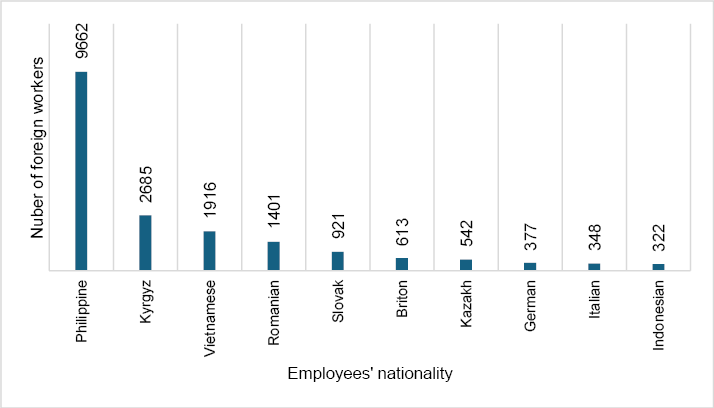
Source: own work based on NES (2023) data.
The third beneficiary group, i.e., those to whom the permit must be issued without an examination of the labour market situation, are internationally recognised third-country nationals invited by higher education institutions, scientific research institutions, and public cultural institutions, who perform educational, scientific or artistic work for more than 10 working days per calendar year (HG, 2013). The text of the decree is also clear here: if the added value of the activities of the highly qualified is outstanding, the direct economic return is high, this segment of the incoming workforce must, therefore, be clearly supported.
The impact of the highly educated on locality is perhaps the most important from the point of view of globalisation. Since we are primarily talking about circular migration, and since Budapest is also the most attractive destination for foreign workers, we do not have to count on the environment-shaping and isolating nature characteristic of closed groups, but on the homogenising and standardising form, which is a constantly changing place of residence and workplace, but with a high characteristic of a purposeful innovative group that prefers high-level services and a creative milieu (Levitt, 1998). For intellectuals and highly educated people employed by multinational companies, Budapest may have a special charm and unique features, but this does not change the system of expectations that they represent in their consumption habits. A 2019 research showed this exactly, 89 per cent of highly qualified circular immigrants worked in Budapest, 57 per cent were the employees of a multinational company, and 83 per cent did intellectual work (Cseh Papp et al., 2019).
Although most of them worked for multinational companies, they typically found their jobs through advertising or personal contact, which is particularly important as it shows the signs of the formation of transnational networks, replacing traditional corporate-driven labour flows. Their network of contacts in Hungary is extensive, and a significant part does not come from their own environment (ethnicity, workplace). Almost half of them already had a Hungarian friend before their trip, and still have or have made one after their arrival. No wonder their integration and satisfaction are high.
6. Conclusions
Labour market processes cover many risk factors, e.g., illegal employment, non-contractual wages, overemployment, which are confirmed by numerous international experiences. All of this is accompanied by an increase in the local influence of immigrant groups: an increase in market demand (for specific products and services), institutionalisation (representation of interests, local media) and the strengthening of informal contact networks. And this affects the relevant area and its integration into the global city network, in our case Budapest. Institutionalization makes the connection between the sending and the receiving area even closer, both through retail markets created by specific demand (or even supply) and by organisations that support employment or integration. Trade unions already address potential immigrant workers in the sending countries, thereby increasing trust and a sense of security, thus strengthening immigration. The advertising activity of state-supported intermediary companies (Hegyeshalmi, 2017) has a similar effect, until finally the process of labour migration, or more precisely, circulation, becomes permanent.
In November 2023, the related policy regulation added a general value approach (HG, 2023) and a quota (MED, 2023). Further regulations may tighten the requirements of companies specialising in recruitment, thereby causing either the above-mentioned or other abuses, distorting effects (e.g., disproportionate financial burdens of guest workers) or further travel (reducing the risk of another EU country), and strengthening the role of the immigration police. This answers our third question, which was how Hungarian regulation intended to avoid the inherent tension between facilitating economic utilisation and limiting social integration. The simplifications, such as the three permit exemptions from the beginning of the transformation of the legal environment and the subsequent simplifications, show a clear market-following logic and the direction of stimulating immigration. This is also confirmed by the statements made by the Hungarian government in 2023. Parallel to the increase in the net debt of foreign direct investment, we can expect a further increase in the number of highly educated people and a growing fluctuation – despite the decrease in the number of companies. Labour market tension and demand in general continue to increase. This process would be particularly strengthened by increasing the role of activities with higher added value, in the field of planning, design and research. There is no need to go into detail about the influencing demographic processes in Hungary and Europe.
Changes in regulations and their prevailing facilitating nature indicate rather proactive characteristics in Hungary resulting in a market-dominated industry-policy scene with emerging international labour connectedness for Budapest. The two segments, the low-skilled guest workers and the highly skilled professionals, can help the integration of Budapest into global city networks in different ways. Our first goal was to differentiate these immigrant groups in Hungary. In the case of the latter, the strengthening of the role of decisions based on individual preferences must also be considered. The movement of the highly educated is no longer determined by wage differences on the labour market. The urban milieu has become a key factor, the definition of which is a great challenge even in theory, but it certainly goes beyond the material (salary, infrastructure, business environment, and services) components. Overall, the liveable urban environment is the closest measurable and available dimension to it. In the previous tables, the central role of Budapest in the geographical distribution of migrant workers in Hungary was shown, which was our fourth goal. According to the rankings of the Economist Intelligence Unit, Budapest has been the most liveable city in Eastern Europe for a decade now, beating Prague, Warsaw, and Bratislava (EIU, 2023). Budapest’s international competitiveness in this area shows a regional advantage, which has a positive effect on the increase in the number of highly qualified foreign workers, and in the direction of the capital’s global integration, which contributes to the fifth goal of the article.
At the same time, the integration of the Hungarian capital into the global city network is shifting from its former western orientation to the east in its labour segment. Upon entering the European Union, the primary destination of the outgoing labour force was London and the area between Budapest and London, and the incoming highly qualified labour force came to Budapest mainly from Western Europe. Today, immigration in both segments comes mainly from the east, for various reasons this area extends from Ukraine to the Philippines, and Ankara is at the centre of the economic diplomatic relations that have developed in the last decade. This is the result of the second purpose outlined earlier. Compared to Budapest, the two cities are located roughly the same distance and in opposite directions, which vividly illustrates this orientation process.
| brak danych | 2013 | 2014 | 2015 | 2016 | 2017 | 2018 | 2019 | 2020 | 2021 | 2022 | 2023 |
|---|---|---|---|---|---|---|---|---|---|---|---|
| Elementary or less | 2,756 34,7 |
2,331 26,4 |
4,030 35,7 |
3,578 33,9 |
5,606 42,9 |
17,255 54,2 |
22,980 55,6 |
10,267 48,4 |
7,435 50,0 |
7,667 52,2 |
12,635 55,1 |
| Vocational school, vocational training | 1,249 15,7 |
1,737 19,7 |
2,055 18,2 |
1,385 13,1 |
1,230 9,4 |
3,204 10,1 |
4,613 11,1 |
2,539 12,0 |
768 5,2 |
630 4,3 |
943 4,2 |
| Vocational secondary school | 691 8,7 |
823 9,3 |
897 8,0 |
818 7,8 |
882 6,8 |
3,524 11,1 |
5,561 13,5 |
3,889 18,3 |
921 6,2 |
696 4,7 |
2,600 11,3 |
| Secondary School | 473 6,0 |
647 7,3 |
702 6,2 |
708 6,7 |
901 6,9 |
1,146 3,6 |
1,388 3,4 |
662 3,1 |
813 5,5 |
1,031 7,0 |
2,153 9,4 |
| Technical school | 0 0,0 |
0 0,0 |
0 0,0 |
0 0,0 |
0 0,0 |
– – |
– – |
– – |
– – |
– – |
– – |
| University (Bachelor and Master) | 2,684 33,8 |
3,129 35,4 |
3,506 31,1 |
3,940 37,3 |
3,709 28,4 |
5,648 17,7 |
5,390 13,0 |
2,851 13,5 |
3,218 21,6 |
4,549 31,0 |
4,521 19,8 |
| Other and unknown | 84 1,1 |
162 1,8 |
89 0,8 |
124 1,2 |
728 5,6 |
1,035 3,3 |
1,403 3,4 |
987 4,7 |
1,715 11,5 |
118 0,8 |
65 0,3 |
| All | 7,937 100 |
8,829 100 |
11,279 100 |
10,553 100 |
13,056 100 |
31,812 100 |
41,335 100 |
21,195 100 |
14,870 100 |
14,691 100 |
22,917 100 |
Source: own work based on NES (2013–2023) data.
Autorzy
REFERENCES
ALPEK B. L., CSÁSZÁR M. Z., TÓTH, Á. D. and CZIMRE, K. (2022), ‘Impacts of the international students’ consumption expenditures on the national economy in Hungary, 2020’, Regional Statistics, 12 (4), pp. 176–199. https://doi.org/10.15196/RS120408
BAL, M., ARADI, E. and YERKES, M. A. (2024), ‘«Keep Europe for the Europeans». The Role of Threat Perceptions and Intergroup Contact for Explaining Attitudes towards Immigrants in Hungary’, Central and Eastern European Migration Review, 13 (1), pp. 89-107. https://doi.org/10.54667/ceemr.2024.08
BERCEANU, I.-C., POPA, N. and CRETAN, R. (2023), ‘Towards a regional crossover model? The roles played by spatial vicinity and cultural proximity among ethnic minorities in an East-Central European borderland’, Journal of Urban and Regional Analysis, 15 (2), pp. 159–190, https://www.ceeol.com/search/article-detail?id=1197404 [accessed on: 01.05.2025].
BERTAUD, A. (2018), Order without Design: How Markets Shape Cities, Cambridge: The MIT Press. https://doi.org/10.7551/mitpress/10671.001.0001
BIELER, A., LINDBERG, I. and PILLAY, D. (eds), (2015), Labour and the Challenges of Globalization: What Prospects For Transnational Solidarity? London: Pluto Press. https://doi.org/10.2307/j.ctt18fs4tb
BISZTRAI, M., KOVÁCS, E., KOVÁTS, A. and VADASI, V. (2020), Folyamatos ideiglenesség: migráns munkavállalók helyzete Magyarországon, A munka és a társadalmi igazságosság. Budapest: Friedrich-Ebert-Stiftung.
BORDEAU-LEPAGE, L. (2007), ‘Advanced services and city globalization on the Eastern fringe of Europe’, Belgeo. Revue belge de géographie, 8 (1), pp. 133–146. https://doi.org/10.4000/belgeo.11703
BORJAS, G. (2019), Immigration and Economic Growth, Cambridge, MA: National Bureau of Economic Research, http://www.nber.org/papers/w25836.pdf [accessed on: 01.05.2025].
BRUNARSKA, Z. (2023), ‘Exposure to Immigration and Sense of Socio-Territorial Belonging: Evidence from Russia’, Problems of Post-Communism, 70 (4), pp. 416–426. https://doi.org/10.1080/10758216.2022.2062385
CIORAN, A. J., Creţan, R., Voiculescu, S. and Doiciar, C. (2024), ‘COVID-19 crisis, Romanian Roma migrant women, and the temporary geographies of lockdown in the Spanish home’, Area, 56, e12910. https://doi.org/10.1111/area.12910
COHEN, N., FOGELMAN, T. and LEBUHN, H. (2022), ‘Making cities through migration industries: Introduction to the special issue’, Urban Studies, 59 (11), pp. 2161–2178. https://doi/10.1177/00420980221094709
CSÁSZÁR, Z., TARÓSSY, I., DOBOS, G., VARJAS, J. and ALPEK, L. (2023), ‘Changing geopolitics of higher education: economic effects of inbound international student mobility to Hungary’, Journal of Geography in Higher Education, 47 (2), pp. 285–310. https://doi/full/10.1080/03098265.2022.2045572
CSEH PAPP, I., BILAN, S. and DAJNOKI, K. (2019), ‘Globalization of the labour market – Circular migration in Hungary’, Journal of International Studies, 12 (2), pp. 182–200. https://doi.org/10.14254/2071-8330.2019/12-2/11
CZERSKA-SHAW, K. and KUBICKI, P. (2023), ‘Detecting Urban Resilience. Foreign Residents’ Perceptions and Experiences of Public Services in a Globalising City: A Case Study of Krakow’, Central and Eastern European Migration Review, 12 (1). https://doi.org/10.54667/ceemr.2023.08
DE HAAS, H. (2021), ‘A theory of migration: the aspirations-capabilities framework’, Comparative Migration Studies, 9 (1), 8. https://doi.org/10.1186/s40878-020-00210-4
DÖBRÖNTE, K. (2018), ‘A közép-európai városok pozíciója a magas szintű üzleti szolgáltatók lokációs döntéseiben’, Területi Statisztika, 58 (2), pp. 200–219. https://doi.org/10.15196/TS580204
FINDLAY, A. M., LI, F. L. N., JOWETT, A. J. and SKELDON, R. (1996), ‘Skilled International Migration and the Global City: A Study of Expatriates in Hong Kong’, Transactions of the Institute of British Geographers, 21 (1), p. 49. https://doi.org/10.2307/622923
FLORIDA, R. L. (2005), Cities and the creative class, New York: Routledge.
FREEDMAN, J. (2008), ‘Women, Migration and Activism in Europe’, Amnis, 8, https://doi.org/10.4000/amnis.604
FRIEDMANN, J. (1986), ‘The World City Hypothesis’, Development and Change, 17 (1), pp. 69–83. https://doi/10.1111/j.1467-7660.1986.tb00231.x
FRIEDMANN, J. and WOLFF, G. (1982), ‘World city formation: an agenda for research and action’, International Journal of Urban and Regional Research, 6 (3), pp. 309–344. https://doi/10.1111/j.1468-2427.1982.tb00384.x
GÁL, Z. (2015), ‘Development of international financial centres in Central and Eastern Europe during transition period and crisis. The case of Budapest’, Studia Regionalne i Lokalne, 2 (60), pp. 53–80. https://doi.org/10.7366/1509499526003
GIRLING, R. (2024), ‘Global Embeddedness: Situating Migrant Entrepreneurship within an Asymmetrical, Global Context’, Central and Eastern European Migration Review, 13 (1). https://doi.org/10.54667/ceemr.2024.02
GLOBAL LIVEABILITY INDEX (2023), Report. Economist Intelligence Unit. https://www.eiu.com/n/campaigns/global-liveability-index-2023/ [accessed on: 01.05.2025].
HAMNETT, C. (2021), ‘The changing social structure of global cities: Professionalisation, proletarianisation or polarisation’, Urban Studies, 58 (5), pp. 1050–1066. https://doi/10.1177/0042098020940556
HCSO (2008), ‘A nemzetközi vándorlás fõbb folyamatai Magyarországon’ (Main trends in international migration in Hungary), Statisztikai Tükör, 2 (177), pp. 1–5, https://www.ksh.hu/docs/hun/xftp/stattukor/nemzvand.pdf [accessed on: 01.05.2025].
HCSO (2019), ‘Oktatási adatok, 2018/2019 (előzetes adatok)’, (Education data, 2018/2019 (preliminary data), 2018, December 21, Statisztikai Tükör, pp. 1–2, https://www.ksh.hu/docs/hun/xftp/idoszaki/oktat/okt1819.pdf [accessed on: 01.05.2025].
HCSO (2020a), ‘Külföldi irányítású vállalkozások Magyarországon’, (Foreign-controlled enterprises in Hungary), 2020, https://www.ksh.hu/docs/hun/xftp/idoszaki/kulf_irany_vall/2020/index.html [accessed on: 01.05.2025].
HCSO (2020b), ‘Oktatási adatok, 2019/2020 (előzetes adatok)’, (Education data, 2019/2020 (preliminary data)), Statisztikai Tükör, 1–2, https://www.ksh.hu/docs/hun/xftp/idoszaki/oktat/oktatas1920.pdf [accessed on: 01.05.2025].
HCSO (2021), ‘Felsőoktatás’ (Higher education), 2020/2021, https://www.ksh.hu/docs/hun/xftp/idoszaki/oktat/felsooktatas2021/index.html [accessed on: 01.05.2025].
HCSO (2023), ‘Oktatási adatok, 2022/2023 (előzetes adatok)’, (Education data, 2022/2023 (preliminary data)), https://www.ksh.hu/s/kiadvanyok/oktatasi-adatok-2022-2023-elozetes-adatok/index.html [accessed on: 01.05.2025].
HCSO (2024), ‘Külföldi hallgatók száma országok szerint Felsőoktatási intézmények’ (Number of foreign students by country Higher education institutions), https://statinfo.ksh.hu/Statinfo/index.jsp [accessed on: 01.05.2025].
HCSO 4.21. Külföldi közvetlentőke-befektetés (Foreign direct investment), https://www.ksh.hu/ffi/4-21.html [accessed on: 01.05.2025].
HCSO 22.1.2.18. A Magyarországon tartózkodó külföldi állampolgárok a tartózkodás célja, vármegye és régió szerint, január 1 (Foreign citizens staying in Hungary by purpose of stay, county and region, January 1), https://www.ksh.hu/stadat_files/nep/hu/nep0051.html [accessed on: 01.05.2025].
HCSO 22.1.1.28. A bevándorló külföldi állampolgárok az állampolgárság országa szerint (Immigrant foreign nationals by country of citizenship), https://www.ksh.hu/stadat_files/nep/hu/nep0028.html [accessed on: 01.05.2025].
HEGYESHALMI, R. (2017, January 26), Ukrán vendégmunkásokat csábít a kormány Magyarországra (The government is luring Ukrainian guest workers to Hungary), http://index.hu/gazdasag/2017/01/26/ukran_vendegmunkasokat_csabit_a_kormany_magyarorszagra/ [accessed on: 01.05.2025].
HG (Hungarian Government) (2013), 445/2013. (XI. 28.) Korm. rendelet a harmadik országbeli állampolgárok magyarországi foglalkoztatásának nem összevont kérelmezési eljárás alapján történő engedélyezéséről, az engedélyezési kötelezettség alóli mentességről, a fővárosi és megyei kormányhivatal munkaügyi központjának az összevont kérelmezési eljárásban való szakhatósági közreműködéséről, valamint a Magyarországon engedélymentesen foglalkoztatható harmadik országbeli állampolgárok magyarországi foglalkoztatásának bejelentéséről, és a munkabér megtérítéséről (Government decree on the authorization of the employment of third-country nationals in Hungary based on a non-consolidated application procedure, on exemption from the licensing obligation, on the cooperation of the labour centre of the capital and county government office in the combined application procedure, and on the notification of the employment of third-country nationals who can be employed in Hungary without a permit in Hungary, and compensation of wages), https://net.jogtar.hu/jogszabaly?docid=a1300445.kor [accessed on: 01.05.2025].
HG (Hungarian Government) (2023), A Kormány 462/2023. (X. 5.) Korm. rendelete Magyarország munkaerőpiacának és lakosságának védelmét szolgáló veszélyhelyzeti intézkedésekről (Government decree on emergency measures for the protection of Hungary’s labour market and population), https://njt.hu/jogszabaly/2023-462-20-22 [accessed on: 01.05.2025].
HÜWELMEIER, G. (2015), ‘From «Jarmark Europa» to «Commodity City.» New Marketplaces, Post-Socialist Migrations, and Cultural Diversity in Central and Eastern Europe’, Central and Eastern European Migration Review, 4 (1), pp. 27–39, http://www.ceemr.uw.edu.pl/vol-4-no-1-june-2015/articles/jarmark-europa-commodity-city-new-marketplaces-post-socialist [accessed on: 01.05.2025].
IRIMIÁS, A. (2009), ‘Az új kínai migráció – a Budapesten élő kínai közösség’ (The new Chinese migration – the Chinese community living in Budapest), Statisztikai Szemle, 87 (7–8), pp. 828–847, https://www.ksh.hu/statszemle_archive/2009/2009_07-08/2009_07-08_828.pdf [accessed on: 01.05.2025].
KORYS, P. and WEINAR, A. (2005), ‘Poland’ [in:] NIESSEN, J. and SCHIBEL, Y. (eds), Immigration as a labour market strategy – European and North American Perspectives, Migration Policy Group. pp. 129–158.
KOUDELA, P. (2017), ‘A japán migrációs politika kihívásai’ (The challenges of Japanese migration policy), Külügyi Szemle, 16 (2), pp. 51–70.
KOUDELA, P. (2018a), Migráció és politika Kelet-Ázsiában (Migration and Politics in East Asia), Budapest: Cepoliti Kiadó.
KOUDELA, P. (2018b), ‘A ki- és bevándorlás története Magyarországon a rendszerváltástól napjainkig’ (The history of emigration and immigration in Hungary from the regime change to the present day), [in:] PÓSÁN, L., VESZPRÉMY, L. and ISASZEGI, J. (eds), Migráció a kora középkortól napjainkig, Budapest: Zrínyi Kiadó, pp. 438–467.
KOUDELA, P. (2024), ‘Good stories overwrite creativity: the three eras of city competition’, Creativity Studies, 17 (2), pp. 395–406. https://doi.org/10.3846/cs.2024.16671
Křížková, I. and Ouředníček, M. (2020), ‘Immigrant internal migration in a new destination country: Do immigrants suburbanise in Czechia and why?’, Popul Space Place, 26, 2326. https://doi.org/10.1002/psp.2326
LEWITT, P. (1998), ‘Social Remittances: Migration Driven Local-Level Forms of Cultural Diffusion’, International Migration Review, 32 (4), pp. 926–948. https://doi/10.1177/019791839803200404
MALEŠIČ, M. (2017), ‘The securitisation of migrations in Europe: The case of Slovenia’, Teorija in praksa, 54 (6), pp. 947–968.
MASSEY, D. S., ARANGO, J., HUGO, G., KOUAOUCI, A., PELLEGRINO, A. and TAYLOR, J. E. (1993), ‘Theories of International Migration: A Review and Appraisal’, Population and Development Review, 19 (3), p. 431. https://doi.org/10.2307/2938462
MATUSZCZYK, K. and BOJARCZUK, S. (2024), ‘The evolution of the migration industry – how have employers been supported in sourcing their workforce?’, Labor History, pp. 1–18. https://doi.org/10.1080/0023656X.2024.2340611
MED (Ministry of Economic Development) (2023), GFM közlemény (HÉ 2023/57.) a 2023-ban Magyarországon munkavállalási engedéllyel foglalkoztatható harmadik országbeli állampolgárok legmagasabb számáról. (MED announcement (HÉ 2023/57.) on the maximum number of third-country nationals who can be employed with a work permit in Hungary in 2023), https://jogkodex.hu/doc/9585553 [accessed on: 01.05.2025].
MESZMANN, T. T. and FEDYUK, O. (2019), ‘Snakes or Ladders? Job Quality Assessment among Temp Workers from Ukraine in Hungarian Electronics’, Central and Eastern European Migration Review, 8 (1), pp. 75–93. https://doi.org/10.17467/ceemr.2019.03
NES (Nemzeti Foglalkoztatási Szolgálat) (2023), Külföldiek foglalkoztatása Magyarországon 2013–2023. (Employment of foreigners in Hungary 2013–2023), https://nfsz.munka.hu/tart/stat_kulfoldiek [accessed on: 01.05.2025].
O’Brien, K., Baker, C. N., Bush, S. A., Elliot, M. and Wolf, K. J. (2024), ‘Exploring Identities of Extension Faculty and Educators as Science Communicators’, Journal of Applied Communications, 108 (1), pp. 1–15. https://doi.org/10.4148/1051-0834.2529
OPTEN (2021), Már 8 éve meredeken csökken a külföldi érdekeltségű cégek aránya Magyarországon (For 8 years now, the proportion of companies with foreign interests in Hungary has been falling sharply), (2021, July 21), OPTEN, https://www.opten.hu/kozlemenyek/mar-8-eve-meredeken-csokken-a-kulfoldi-erdekeltsegu-cegek-aranya-magyarorszagon [accessed on: 01.05.2025].
ÖRKÉNY, A. and SZÉKELYI, M. (2010), ‘Hat migráns csoport összehasonlító elemzése’ (Comparative analysis of six migrant groups), [in:] ÖRKÉNY, A. and SZÉKELYI, M. (eds), Az idegen Magyarország-Bevándorlók társadalmi integrációja, Budapest: ELTE Eötvös Kiadó. MTA ENKI. pp. 49–97.
PÉTI, M., SZABÓ, L., OBÁDOVICS, C., SZABÓ, B. and CSÉCSI, D. (2021), ‘Analyzing Ethnocentric Immigration through the Case of Hungary – Demographic Effects of Immigration from Neighboring Countries to Hungary’, Journal of Ethnic and Cultural Studies, 8 (4), pp. 128–153. https://doi.org/10.29333/ejecs/857
PIORE, M. J. (2014), ‘The Dual Labor Market: Theory and Implications’ [in:] GRUSKY, D. (ed.), Social Stratification, Class, Race, and Gender in Sociological Perspective, New York: Routledge.
RADOWICZ, J. (2021), ‘Searching for the Best Way of Integration. Migrant Women in Europe’, Studia Europejskie – Studies in European Affairs, 3, pp. 39-57. https://doi/10.33067/SE.3.2021.3
REID, A., RONDA‐PEREZ, E. and SCHENKER, M. B. (2021), ‘Migrant workers, essential work, and COVID‐19’, American Journal of Industrial Medicine, 64 (2), pp. 73–77. https://doi/10.1002/ajim.23209
RUSU, I. (2011), ‘Migration in Hungary: historical legacies and differential integration’, [in:] CARMEL, E., CERAMI, A. and PAPADOPULOS, T. (eds), Migration and welfare in the new Europe: Social protection and the challenges of integration, Bristol: Policy Press. https://doi.org/10.1332/policypress/9781847426444.003.0009
SAMERS, M. (2002), ‘Immigration and the Global City Hypothesis: Towards an Alternative Research Agenda’, International Journal of Urban and Regional Research, 26 (2), pp. 389–3402. https://doi.org/10.1111/1468-2427.00386
SASSEN, S. (1988), The Mobility of Labor and Capital: A Study in International Investment and Labor Flow, Cambridge University Press. https://doi.org/10.1017/CBO9780511598296
SASSEN, S. (1991), The Global City: New York, London, Tokyo, Princeton: Princeton University Press.
SASSEN, S. (2005), ‘The Global City: Introducing a Concept’, The Brown Journal of World Affairs, 11 (2), pp. 27–43.
STANFORD, J. and VOSKO, L. F. (eds), (2004), Challenging the Market: The Struggle to Regulate Work and Income, Montreal and Kingston, Montreal and Kingston: McGill-Queen’s University Press.
UNCTAD United Nations. World Investment Report 2018 and 2019. Investment and new industrial policies, paper delivered at the conference titled ‘United Nations Conference on Trade and Development’, Geneva: United Nations.
WALLERSTEIN, I. (2004), World-systems analysis: An introduction, Durham and London: Duke University Press.
WILLS, J., DATTA, K., EVANS, Y., HERBERT, J., MAY, J. and MCILWAINE, C. (2015), Global Cities At Work: New Migrant Divisions of Labour, Pluto Books. https://doi.org/10.2307/j.ctt183p9sr
YAMAMURA, S. (2022), ‘From global city makers to global city-shapers: Migration industries in the global city networks’, Urban Studies, 59 (11), pp. 2234–2254. https://doi/10.1177/00420980221087927
FOOTNOTES
- 1 Both industrial decentralisation and urban sprawl resulted in higher socio-economic integration of the Pest county agglomeration to Budapest, increasing its metropolitan area function. Other constraints might be also interesting, e.g. the use of English among the population in general and the MNC environments in particular. The former shows a significant growth in census data since 1990, the latter goes hand in hand with their increasing role in the domestic market.
- 2 In 2022, 3,744 permits were issued to Ukrainians, exempted from labour market testing, on the basis of Government Decree 445/2013 (28.XI.). In 2023, 2,080 permits were issued to Ukrainian citizens exempted from labour market testing, on the basis of Government Decree 445/2013 (28. XI.). (Source: NES 2022; NES 2023).