It Is Not Our Problem: Socio-Politics at the Olympic Museum in Lausanne
 https://orcid.org/0000-0001-8796-2736
University of Lodz
e-mail: timothy.bridgman@uni.lodz.pl
Abstract. This research examines how the Olympic Museum in Lausanne addresses sociopolitical issues occurring at past Olympic Games in its permanent exhibitions. It provides a background on the previous Olympic political policy and the Olympic Stakeholder theory, implying the existence of a sociopolitical arena in Olympic sport, then identifies exhibits within the museum that convey overtly sociopolitical messages. Themed observational evidence taken from two separate museum visits is used to provide the basis of a claim that the museum has increased the recognition of the Olympic Games as a sociopolitical arena. Yet, an interview with the museum did not confirm this finding, as, instead, the museum sought to distance itself from both the subject matter and academic research. The conclusion offers an explanation of the museum’s actions in terms of the denial of political responsibilities and the rejection of the concept of the politics of display.
Keywords: Olympic Museum Lausanne, International Olympic Committee, Olympic Games, sociopolitical arena, sport heritage, public sport history, the museum politics of display, political proxy
To nie nasz problem: socjo-polityka w Muzeum Olimpijskim w Lozannie
Streszczenie. Artykuł analizuje, w jaki sposób Muzeum Olimpijskie w Lozannie odnosi się w swoich stałych ekspozycjach do kwestii społeczno-politycznych występujących podczas wcześniejszych igrzysk olimpijskich. Przedstawia tło wcześniejszej polityki olimpijskiej oraz teorii interesariuszy olimpijskich, sugerując istnienie społeczno-politycznej areny w sporcie olimpijskim, a następnie identyfikuje eksponaty w muzeum, które przekazują treści wyraźnie społeczno-polityczne. Tematyczne obserwacje zebrane podczas dwóch oddzielnych wizyt w muzeum stanowią podstawę twierdzenia, że muzeum w większym stopniu zaczęło uznawać igrzyska olimpijskie za arenę społeczno-polityczną. Jednak wywiad przeprowadzony z przedstawicielami muzeum nie potwierdził tego wniosku, ponieważ instytucja ta starała się raczej zdystansować zarówno od samej tematyki, jak i od badań akademickich. W zakończeniu zaproponowano wyjaśnienie działań muzeum w kategoriach zaprzeczania odpowiedzialności politycznej oraz odrzucenia koncepcji polityki ekspozycji.
Słowa kluczowe: Muzeum Olimpijskie w Lozannie, Międzynarodowy Komitet Olimpijski, Igrzyska Olimpijskie, arena społeczno-polityczna, dziedzictwo sportowe, publiczna historia sportu, muzealna polityka ekspozycji, pełnomocnik polityczny
Introduction
The Olympic Museum in Lausanne, Switzerland, is the largest sports museum dedicated to the greatest international multi-sport event in history. The museum was conceived and built during the International Olympic Committee (IOC) presidential term of Juan Antonio Samaranch, who first began supporting the collection and exhibition of historical evidence on the Olympic Games in the 1980s (Müller, 1993). On 23 June 1993, a permanent Olympic Museum opened on the day of the 99th anniversary of the founding of the IOC and one day before the commencement of the IOC’s 100th Session. The three-floor museum is situated in a picturesque park overlooking Lake Geneva on Ouchy Quay.
Twenty years later, the original Olympic Museum underwent a major renovation completed in December 2013, and it was this museum that could be experienced up until the end of the Paris Olympic Games in August 2024. For the 2013 renovation, the museum started its “rebirth with a strategic paper … encompassing 107 pages with around 300 possible ideas for the future of the museum” (Wacker, 2014: 18). The overarching idea was agreed that “the purpose of The Olympic Museum is to help people understand and share the ‘Olympic idea’ over and above celebrating the Games themselves, and to highlight the Games’ contribution to the societies of yesterday, today and tomorrow” (Press Kit for the Opening of the Museum, 2013, as cited in Wacker, 2014: 3). President Samaranch further explained this reasoning in a statement by expressing that “the very term ‘museum’ should also be dusted off; and the designation ‘visitor’ should be rendered more dynamic and replaced by a word such as ‘participant’, or even ‘explorer’” (Samaranch, 1991: 62). While most museums traditionally focused on the past, the renovated Olympic Museum was to be fixed on offering a vision for a better future and becoming a contemporary educational environment designed to “observe and outline cultural developments” by asking “questions about socio-cultural phenomena” (Wacker, 2014: 17). To achieve this goal, it would be necessary for the museum to address the many various sociopolitical issues surrounding the Olympic Games, which would provide a difficult challenge for the museum’s curators, as political interference at past events has represented some of the Games’ lowest points, yet overcoming these obstacles has also been one of the main sources for growing and solidifying their future strength (Boykoff, 2017; Cottrell, Nelson, 2011).
Operationally, the Olympic Museum in Lausanne sits as an integral part of the Olympic Foundation for Culture and Heritage (OFCH), established in 2011 by the IOC to manage its cultural assets, with the OFCH Director, currently Angelita Teo, holding a senior member position within the IOC executive administration. Traditionally, the Olympic Museum in Lausanne’s running costs were subsidised from IOC profits with about one-quarter of its budget covered by the Museum revenues from entrance fees, royalties, shop, restaurant, and sponsors (Chappelet, 2008). Geographically located outside the IOC’s main headquarters in the Olympic House, Vidy, Lausanne, the Museum has enjoyed moderate autonomy in curatorial decisions (Chappelet, 2008) while always remaining under the oversight of the OFCH and the Culture and Olympic Heritage Commission. This relationship positions the Museum as a cultural department of the IOC, with the additional responsibility of running the Olympic Museums Network (OMN), i.e. a global network of 37 member museums across the world, with the purpose of ensuring that all Olympic museums remain compliant with the regulations and ethics of the International Council of Museums (ICOM) (Olympic Museum – Olympic Museum Network, 2025).
This study asks if the Olympic Museum in Lausanne is successful in its intention of introducing visitors to the complex sociopolitical arena of the Olympic Games. To answer this research question, the study examines the Museum’s inclusion and representations of key sociopolitical moments at past Olympic events as displayed in the Museum’s permanent exhibitions. It hypothesises that as the Olympic Museum is situated in a fixed location and with static exhibitions curated with cultural hindsight, it might be possible to achieve this goal, unlike during an Olympic competitive event, where unforeseen circumstances involving the host, the participants, and the global political environment change every time.
Theoretical background
In recent academic literature, the study of sports heritage within museums has often highlighted the difficulties in preserving and presenting sport, with scholars criticising sports museums, emphasising how such institutions frequently prioritise commodification, branding, and simplified historical description over deeper societal reflection (Appel, 2015; Brabazon, 2006). Within this literature, football club museums in England, both at the national level and at the club level, are singled out for not adequately addressing complex regional, minority, and gender issues, failing to acknowledge or recognise that sport also serves to structure our communities as an “organizing function in identity politics” (Brabazon, 2006: 47). Appel even argues that many sports museums may even fail to meet the International Council of Museums (ICOM) definition of a museum (Appel, 2015), which states “A museum is a non-profit, permanent institution in the service of society and its development, open to the public, which acquires, conserves, researches, communicates and exhibits the complex regional, minority, and gender issues, so failing to acknowledge or recognise that tangible and intangible heritage of humanity and its environment for the purposes of education, study and enjoyment” (Internationaler Museumsrat, 2017: 29).
For this reason, the intersection of sport history and the public’s engagement in sport heritage has become a growing area of academic inquiry, with some scholars advocating for sport historians to engage more with public sport history (Kossouth, Adams, 2013), while others call for museum curators to engage more with academic researchers (Moore, 2013) or point out the need to form partnerships if either wishes to engage diverse audiences (Reilly, 2015). All of these studies, published in reputable sport history journals, eventually arrive at a similar conclusion: that while museums excel in collections management and audience communication, they may lack the depth of academic knowledge required to contextualise exhibits within broader societal and cultural frameworks. Reilly summarises the gap that requires bridging in the following way: “Little is understood about the role and value of sporting heritage, and sporting collections are rarely used to inform historical study” (Reilly, 2015: 1778).
In Daryl Adair’s seminal article titled “Where the Games Never Cease: The Olympic Museum in Lausanne” (2004), the contention over the differing objectives in how sports museums should portray the past can be seen in two excerpts taken from the Olympics’ in-house produced subscription magazine titled Olympic Review. Firstly, a comment from Francoise Zweifel, the Director of Olympic Museum from 1998 to 2003, is provided: “The museum cannot be understood as something apart from the IOC. The museum forms a part of the IOC because it is at the service of the Olympic Family… our priority is to fulfil the educational objectives of the IOC” (Palacios, 1995, cited in Adair, 2004: 55–56). Then a citation from Simon Hudson, sports tourism academic researcher, criticises this with the claim that “[t]he Olympic Museum is museologically strong but intellectually weak. It does not encourage discussion of today’s great [sporting] controversies – money; the growing pre-eminence of black athletes; athletics and national prestige; the definition of ‘physical fitness’; the meaning, if any, of the ‘Olympic spirit’” (Editor, 1996, cited in Adair, 2004: 61). These clearly show the museum’s predicament at hand, namely – should the museum conform to its owner’s or historian’s requests, and is it possible to do both?
The IOC and their sports mega-event (SME), the Olympic Games, can be defined as a specific type of international organisation known as a Sports International Non-Government Organisation (SINGO). A SINGO is an international organisation overseeing global sports activities that was not established by intergovernmental agreement, but, rather, is a not-for-profit organisation independent of governmental entities, yet operating transnationally in its activities (Allison, Tomlinson, 2017). The world’s two largest SINGOs are the IOC and the Fédération Internationale de Football Association (FIFA), both of which function on a worldwide scale, able to transcend national and global systems due to their enormous public and state support (Allison, Tomlinson, 2017). In the case of the Olympics, the IOC allocates the Games to a new host city every four years, which then forms an organising committee to execute the event. In a perfect world, the location and year would be irrelevant as the Olympic Charter provides rules and regulations to create a level playing field across all areas of sport, politics, human rights, and more. The Olympic Charter’s Rule 50(2) clearly states the following: “No kind of demonstration or political, religious or racial propaganda is permitted in any Olympic sites, venues or other areas” (Olympic Charter: In Force as from 30 January 2025: 94).
In the official IOC documentation, one can trace the origins of the IOC policy on politics in Olympic sports from the 1950s up until the opening of the Olympic Museum in 1993. As the 1968 Mexico City Games approached, the then IOC President Avery Brundage (1952–1972) sent a personal correspondence to the United States Olympic Committee, stating the following: “Any demonstrations or irregularities of any kind that will interfere with the dignity of the Games will not be tolerated” (Brundage, 1968a). This was said in the firm belief that “if participation in sport is to be stopped every time the politicians violate the laws of humanity, there will never be any international contests” (Brundage, 1968b). The next IOC President, Lord Killanin (1972–1980), declared in official correspondence that “the Olympic Games are a sports field and not a political arena” (International Olympic Committee, 1976), asserting great confidence in his supposition that “the Olympics do surpass all political and ideological barriers” (Ecker, 1996: 113). Then, when Juan Antonio Samaranch took over as the IOC President (1980–2001), a definite change could be seen as he describes the IOC in official correspondence as “‘a nonpolitical voluntary body’ […] which has ‘the heavy task and responsibility of forming a bridge’ between two worlds” (Minutes of the 88th Session of the International Olympic Committee (Los Angeles, 25–26 July 1984), claiming that this is possible as “the Olympic movement has become the largest social force of the modern world” (Samaranch, 1983).
The time of the completion and opening of the 2013 renovation exactly aligns with the end of the following IOC President, Jacques Rogge’s, term in power from 2001 to 2013. Unlike Samaranch, who had experience in domestic politics and international political relations, Rogge possessed no such prior experience, instead coming from a background as a top-level athlete and an orthopaedic surgeon. In 1998, Rogge would publicly warn the Sidney organising committee of the Olympic Games in the run-up to Sydney Olympics that the Games “would not be abused or utilized by normal political discussion” (cited in Jeffery, 1998), only then to declare at the 2008 Beijing Olympics that “the events in Tibet are a matter of great concern to the IOC”, while maintaining the Olympic Games served as a “catalyst for change, not a panacea for all ills” (cited in News Agencies, n.d.). In Helen Jefferson Lenskyj’s The Olympic Games: A Critical Approach, the author devotes an entire chapter to the claim that “sport and politics don’t mix” in order to try to resolve where exactly the IOC stands on the issue of socio-politics and sport (2020).
The sociopolitical arena is the area in which SINGOs, the state government, and civil society interact and combine. The term ‘sociopolitical arena’ can be found originating within the field of the corporate stakeholder modelling theory, as illustrated in the 2002 book titled Redefining the Corporation: Stakeholder Management and Organizational Wealth (Post et al., 2002). In this volume, the authors explain the category as follows: “In addition to being located within a resource field and an industry structure, the firm is also located within a social and political environment that includes individuals, groups, and interests that contribute to, and/or bear the risk of, its wealth-generating activities”, and these outer stakeholders can include “governments, local communities and citizens, and relevant private and voluntary organizations” to whom “it can no more ignore these stakeholders than it can operate without resources or ignore the features of its industry structure” (Post et al., 2002: 55). They conclude by emphasising that corporate organisations must realise that they also exist as stakeholders in a larger society and “that they need to preserve the integrity of physical and social systems as a basis for their own continued existence” (Post et al., 2002: 92).
To apply the concept of the sociopolitical arena to the Olympic Games, numerous stakeholder models have been created to explain the main parties and their interests within the Olympic system. In 2010, Chappelet and Swiss sports governance researcher Michaël Mrkonjic first introduced the thematic categories of salience and legitimacy into the Olympic stakeholder model (Chappelet, Mrkonjic, 2010). In 2013, Chappelet then partnered with Canadian social responsibility researcher Milena Parent to create the first Olympic stakeholder model to identify and define the sociopolitical area in Olympic sports as a part of the Olympic system. The model is shown below.
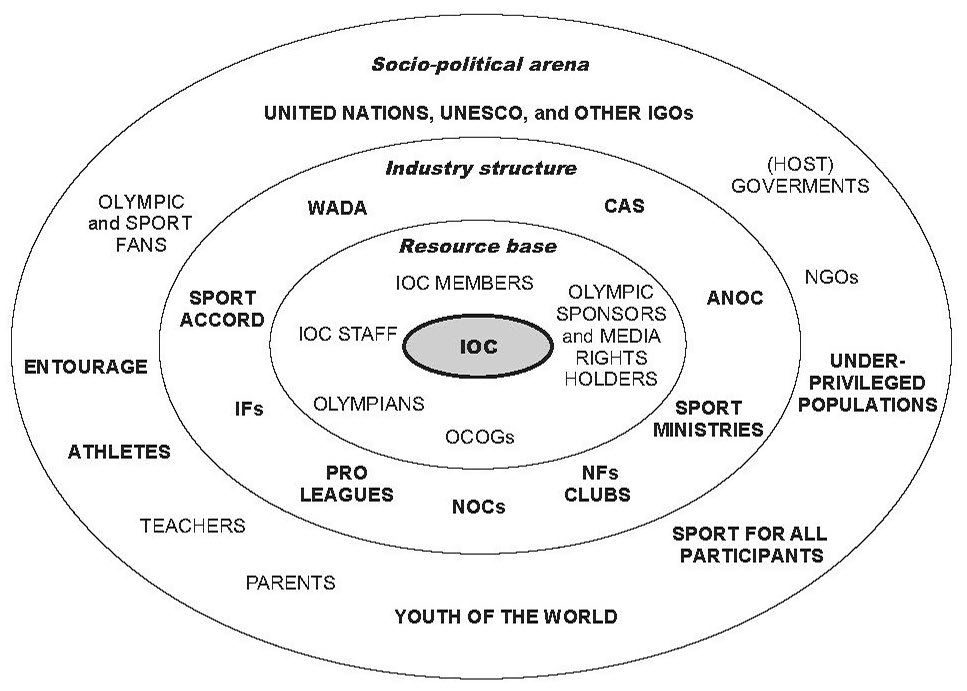
Within Parent and Chappelet’s sociopolitical arena, influence can be exerted from both directions, with the IOC’s top-down policies influencing society and bottom-up civil movements impacting governance, and state governments constantly getting into the mix. Detachment from the sociopolitical arena is something that can also be pursued by both the IOC and individuals, such as athletes. In these cases, there is a rejection of the sociopolitical arena in favour of focusing on the task at hand of competitive sport only.
Museum field visits
The research challenge for this paper was to examine the overtly sociopolitical exhibits contained within the Olympic Museum’s permanent exhibitions as a means to identify the IOC’s policy on sport and politics. To achieve this goal, field observations were conducted during two visits to the Olympic Museum in Lausanne. The methods used to collect data were based on thematic direct observation documented through note-taking and photography. A structured approach using pre-selected themes was used to identify exhibits holding sociopolitical significance. These themes were based on the researcher’s prior knowledge of socio-politics at the Games and included: US Black civil rights, armed conflicts, refugees and asylum seekers, national identity, gender parity, and Indigenous peoples’ claims. The sociopolitical items identified within this study included sculptures, signs, displays, and multimedia presentations. The study did not include exhibits within temporary exhibitions, décor within the restaurant area, or items available for purchase within the gift shop.
Field visit 1: 21–22 April 2023
As visitors enter the museum complex, they must first walk through the Olympic Park. The Olympic Park is a sculpture park housing a collection of works and the Olympic Cauldron with the Olympic Flame. After entering the building’s main entrance, the visitor is guided up a grand spiral staircase to begin their tour of the museum, starting on Level 1, ‘The Olympic World’, representing the museum’s first and most important permanent exhibition. This floor attempts to provide background on the Olympic movement, stretching back from ancient times to the modern day. Upon completion of Level 1, the visitor then descends to Level 0, ‘The Olympic Games’, which is the floor dedicated to competitive sports events and the participating athletes, equipment, and technologies. Upon completion of this floor, the visitor finally descends to the basement on Level –1, ‘The Olympic Spirit’, where the Olympic athletes get the opportunity to tell their stories through personal testimonies, interactive exercises, and exhibits detailing the athletes’ involvement in the Games.
When a visitor first enters the Olympic Park, they may do so from three directions on one of four paths. The main path connecting the quayside to the building’s main entrance is called the Olympic Steps. These are steps with the names of people who have lit the Olympic cauldron and include steps for ‘1996 ATLANTA M. Ali’, ‘2000 SYDNEY C. Freeman’, and ‘2020 TOKYO N. Osaka’. For those wishing to take a gentler route to entrance, a winding path is also provided up from the quay where visitors can see exhibits such as ‘Young Girl With a Ball 1989, Fernando Botero (COL), 1932’, or there is an asphalt road at the back of the building where we immediately encounter the sculpture ‘Non-Violence [1980], Bronze copy made 1997, Carl Fredrik Reutersward [Swe]’, or from the (metro) side where ‘Haida Olympic Totem Pole [2009] – Jim Hart [Can] – a symbol of Canadian First Nations indigenous culture’ is the first exhibit seen. All these exhibits can stimulate reflection on the sociopolitical connections between sport and politics. The Ali, Freeman, Osaka steps are to remind us of the ongoing racial discrimination in the world, the Young Girl with Ball is about promoting the inclusion of women in sport from a young age; the Non-Violence statue of a twisted gun is a copy of an artwork placed outside the UN building in New York to commemorate the assassination of John Lennon; and the totem pole emphasises the indigenous people’s claims over their lands as well as bringing back memories of the opening ceremonies at Montreal 1976 and Sydney 2000. It should be noted that the totem pole and twisted gun are both positioned in the most remote locations in the park, as far away from the main building as possible.
As visitors enter into the opening exhibition on Level 1 – ‘Olympic World’ – they will encounter exhibits on the ancient Olympic Truce ‘Ekecheiria’ that suspended all regional conflicts over the period of the Games (Syrigos, 2009), the first ever Olympic flag (the five-ring logo representing the continents and now brand copyrighted), the Olympic torches exhibition (including the torches held by Mohamad Ali, Cathy Freeman, and Naomi Osaka), the Olympic Opening and Closing Ceremonies display (containing fun and festivities from over the years but nothing on the controversies such as the Parade of Nations in Moscow 1980), and, finally, the Olympic Timeline/Fresco: 1896–2014 (with the briefest mention of Tommie Smith and John Carlos for Mexico City and their Black Power salute in 1968). If there are any sociopolitical messages contained on Level 1, they are buried deep within the contexts of the exhibits that instead exist to tell the story of the Olympic Games’ development in its own separate world. Level 0 – ‘Olympic Games’ – adopts a similar approach as here one can find various items associated with the athletes such as a running shoe belonging to Jesse Owens (US) from the controversial Berlin 1936 Games now remembered as the Nazi Olympics or Hitler’s Games (Berlin Stories, 2016), a Jersey belonging to the unified Korean ice hockey team (KOR) from the 2018 PyeongChang Game’s attempts to reunify the two Koreas (Neto, n.d.), and a tennis racket used by Naomi Osaka (JPN), who at the time of the Tokyo 2020+1 was one of the most prominent supporters of the Black Lives Matter movement (Jiwani, 2020). All these artefacts were obtained directly from the athletes at the time of the occurrence, and the sociopolitical meanings behind them have not been overtly pointed out in the displays but left up to the visitors to realise and decode.
The Level –1 ‘Olympic Spirit’ exhibition is different and is the zone where socio-political issues are addressed and where visitors finally encounter the complex interplay between sport, politics, and the outside world. Level –1 contains the overtly political items: War Between the Sons of Light and the Sons of Darkness – Eli Ilan (ISR), Bronze, a memorial statue for the Munich Massacre in 1972; the actual (Olympic) Truce Wall relocated from London 2012, which was signed by the athletes in support of the Olympic Truce initiative; the Olympic Truce Video booth, where one can learn more about the relaunch of the modern version of the ancient Olympic armistice in 1992/4; a copy of ‘Olympic Korean Peninsula Declaration’ and a photograph of the Koreas marching under the same flag at the Opening Ceremony that both served as initiatives to improve relations between the two Koreas at PyeongChang 2018; and the Refugee Team Video booth with an explanatory video of Refugee Team initiative started in Rio 2016. Level –1 is the most remote floor of the museum and these exhibits have been placed in the remotest locations within the Museum, with the War Between the Sons of Light and the Sons of Darkness sculpture placed arguably in the darkest and most isolated corner of the museum, and the Olympic Truce and Refugee Team videos in self-contained viewing booths where even the official audio guides must be turned off. Level –1 is at the end of the whole museum experience, clearly requesting visitors to first collect all the background information needed before proceeding onto the final complex issue of interpreting the sociopolitical arena and Olympic sports.
Field visit 2: 29 August 2024
Upon the first visit in 2023, the researcher experienced the museum’s permanent exhibitions in a form closely related to its original 2013 renovation. On the 2024 visit, while the Olympic Park and Level 0 remained nearly identical, Level 1 – ‘Olympic World’ – which is the main exhibition, had undergone a major update with many items previously in other areas now relocated into the new exhibition and with other existing displays being updated.
MOVED OR UPDATED
- War Between the Sons of Light and the Sons of Darkness (previously Level –1):
- This bronze work by Eli Ilan (ISR) commemorates this unprecedented drama. “HOSTAGE-TAKING IN MUNICH 1972. In the early hours of 5 September, a Palestinian group succeeded in gaining access to the Olympic Village (70 blocks and several bungalows). Having avoided police surveillance, the terrorists took several members of the Israeli team hostage. Before being neutralised (five were killed, the other three captured), the terrorists executed all their 11 hostages. During the operation, a German policeman was also killed. The sports competitions were halted for 34 hours before being resumed. Since then, the security of the Village and the athletes had been a major concern for the host cities” (text from item sign).
- Truce Wall, London 2012 (previously Level –1):
- “Since 1993, in partnership with the UN, the Member States are called upon at the UN General Assembly to respect the Truce during the Games” (text from item sign), with athletes and officials in the Olympic Village being invited to show their support by signing a Truce Wall. This is the Truce Wall from the London 2012 Games, containing signatures from many of the athletes participating in the event.
- Olympic Torches Display (updated):
- We can now watch Mohamad Ali and Cathy Freeman light the Olympic cauldron, as both are singled out for special mention. There is also a photograph of the first Olympic Refugee team from Rio 2016 hung up as part of this display, linked to the display’s main theme. “Torch carried by Anjelina Nadai LOHALITH and signed by the ten members of the Refugee Olympic Team” (text from item sign).
- Olympic Opening and Closing Ceremonies Display (updated):
- “Every ceremony is an opportunity for dazzling performances orchestrated by the greatest talents of the day. The magical event is nevertheless scrupulously regulated because it has to comply with a very precise protocol laid down by the Olympic Charter” (text from display sign). This display is the last one on Level 1, and upon leaving, all visitors must walk directly past a male mannequin wearing an orange/pink latex catsuit and a feather boa. No details are provided on the outfit, but it is definitely an artistic creation endorsing the inclusion of LGBT+ into the Games.
NO CHANGE
the Ekecheiria information Display;
the First Olympic flag;
the Olympic Timeline/Fresco (except for recent Games).
Museum interview
To confirm the accuracy and integrity of reading the changes made to the museum exhibitions, it was necessary to obtain an interview with a senior member of staff at the Olympic Museum Lausanne. For this, a one-hour online interview was conducted with Exhibitions & Programmes Senior Manager Anne-Cecile Jaccard on 30 September 2024. The interviewer was not permitted to record the interview but was allowed to take notes. A summary of the key issues covered by the interviewer is provided below:
Q1. There are many exhibits and displays with sociopolitical associations both inside and outside of the museum. Please, can you explain the museum’s curation policy on the politics of sport and the Games?
The interviewee emphasised that two issues needed to be cleared up immediately: 1) The museum does not use the ‘political activism’ phrase in relation to any museum display or exhibit; 2) No sociopolitical agendas have ever affected the selection or positioning of any item (including the Truce Wall, the refugee team display, or the Munich Massacre statue).
Q2. So does the Olympic Museum accept the claim that the Olympic Games exhibitions exist within a larger sociopolitical area?
The museum regards the Olympic Games as possessing a separate and unique story, and so seeks to convey this story by obtaining Olympic artefacts directly from the time and place of the Olympic events. For example, the interviewee explained that while Tommie Smith and John Carlos have been included in the Olympic Timeline Fresco for 1968, there is no further mention of them, simply because the museum has been unable to obtain artefacts from the authentic time and place of the occurrence of their most well-known actions.
Q3. Is the museum under an obligation to support the sociopolitical initiatives conceived and promoted at past and present Olympic Games?
The interviewee explained that the museum functions independently of the IOC and host organising committees. When further asked about the significance of the Canadian First Nations totem pole situated in the Olympic Park, the interviewee explained how the Olympic Park was not owned by the museum, but by the city of Lausanne, which grants permission to exhibit items. This item was included, as the eagle sitting on top of the pole has the Olympic rings carved onto its chest and was in its current position after being relocated due to problems with ants.
Q4. Please explain the Museum’s curation policy for the new Level 1 update. Many of the most important sociopolitical items from the remotest floor, Level –1, have been moved into prominent positions on the museum’s main exhibition floor. Is this in any way related to the increased importance given to socio-politics at the recent Paris 2024 Games?
The interviewee confirmed that the museum’s current main exhibition has been updated, but they do not consult with any host organising committee before making such updates. In 2024, upon the closure of the 2024 Paris Olympics, work began on updating Level 1 – ‘Olympic World’ – and the exhibitions seen by the researcher on 29 August 2024 were part of a larger restructuring where the space currently used for temporary exhibitions is due to become incorporated into Level 1 and Level –1 ‘The Olympic Spirit’ was closed to be transformed into a new temporary exhibition space.
(A.-C. Jaccard, personal communication, 30 September 2024)
In response to all the issues raised above, the interviewee made it openly clear that the role of the museum was defined solely as updating the historical story of Olympic Games events, and she strongly recommended that all visitors should take a guided tour or audio tour to experience a correct and accurate version of this story. The Museum’s priority and focus was given to promoting the authentic ‘origin story’ for every item in exhibitions, and not to develop any contextual sociopolitical stories that can become associated or attached with an item. All items’ meanings lie within that object at the time of its creation and appearance at the Games, and all the plurality of meanings should be avoided, as it is the museum’s role to preserve an authentic, single, and original meaning. No recognition or acknowledgement of any influence of any sociopolitical issues was given at any time.
At this point, the reader should be informed that the interviewee had consented to the interview only after considerable persuasion. The researcher originally requested an interview via e-mail, but they received a standard response that the museum does not give interviews to academic researchers. Next, the interviewer approached the Olympic Studies Centre (OSC) staff directly while on a research visit to Lausanne, who then contacted the museum and arranged a date/time, which was cancelled on the day without notice. The OSC staff then continued to pursue the museum on the researcher’s behalf, and the final interview took place online one month later.
An analysis of the museum interview
Whereas the materials observed by the researcher during the two field visits provided observational evidence that the Olympic Museum was now prioritising sociopolitical issues in its main exhibition, the interviewee wished to firmly dissociate the museum from any such conclusion in favour of more neutral IOC policy and values. At the time of the occurrence, and following their reluctance to provide an interview, this left the researcher both confused and frustrated with a feeling of being brushed off. For a long time afterwards, the researcher remained unable to justify or explain the museum’s response in what amounted to a blanket refusal to engage in outside academic research. Over time, however, the researcher has now come to understand the interviewee’s words in the context of two theoretical concepts: political proxies and the politics of display.
Scott R. Jedlicka (2018) describes mega-SINGOs such as the IOC as “the fulcrum on which the relationship between ‘sport and politics’ rests”, emphasising that they not only “manage international sport (as a discrete set of activities) but also coordinate external stakeholder interactions with international sport (as a social phenomenon)” (Jedlicka, 2018: 290). From such a perspective, it is largely accepted that state governments should step away from becoming involved in SMEs, and national politicians should accept the Olympic Law within their state. This sets up the scenario where nations in a political conflict could end up competing against each other in an Olympic event that claims to be depoliticised yet serves as a grudge match with the Games as a conduit through which to fight out a proxy war. Proxy wars are “conflicts in which a third party intervenes indirectly in a pre-existing war in order to influence the strategic outcome” when the two sides in conflict wish to “avoid engaging in direct, costly, and bloody warfare” (G. Brown et al., 2018: 1112). This was particularly evident during the Cold War, when both Eastern and Western nations used the Games to signify global superiority through results in the medal tables or even boycotting each other’s Games (Kobierecki, 2020). It is according to this same logic that George Orwell famously described sport in his 1945 essay “The Sporting Spirit” as “war minus the shooting” (Orwell, 1945).
With this, the IOC has a great global political responsibility passed over to it in the world’s collective hope that sport can unite under a common collective goal. However, it is never just that simple, and academic theorists in the politics of display in museums openly acknowledge that there will always be much more than meets the eye to the inclusion of political exhibits displayed in any museum. As Sharon Macdonald succinctly explains, for museum exhibits “politics is, therefore, a matter of (often implicit) negotiation: a dynamic power-play of competing knowledges, intentions and interests” (Macdonald, 1998b: 3) that should be accepted and not avoided. In the closing chapter (“Afterword: From war to debate”) of the book of collected articles entitled The Politics of Display: Museums, Science, Culture, the author/editor concludes: “Political worlds in which knowledges are situated are complex and multivalent, and populated not only by ambitions and plans but also by materials and other, maybe conflicting, beliefs and positionings, including those of ‘the public’ (or, better, ‘publics’)” (Macdonald, 1998a: 198).
SINGOs, such as the IOC, provide fascinating anomalies for researchers, as SME owners are unique among INGOs “in that they have what amounts to a monopoly on that which they regulate” (Bowersox, 2016: 258). However, while the Olympic Museum can consider itself a part of a separate world, additionally it should be recognised as part of the cultural arm of the IOC that is also inherently located within a larger sociopolitical arena. This is shown in Parent and Chappelet’s (2013) ‘The Olympic Stakeholder View from 2013’, where the IOC, the host, and the sponsors are within ‘Resource Base’; IGOs, teachers, olympic and sport fans are contained within ‘Socio-political arena’; and olympians or athletes are included in both. The Olympic stakeholder modelling theory emphasises the need for the IOC to acknowledge this dual role as both a SINGO and a cultural institution, which have both become openly manifest in the exhibits held within the Olympic Museum in Lausanne. That being said, the museum has chosen to adopt a different approach.
Conclusion
For the Paris 2024 Games, the policy on athlete sociopolitical expression changed to allow free comment in all but five moments: the opening and closing ceremonies, medal ceremonies, during competition, and within the Olympic Village. However, for the first time, the IOC permitted mixed areas such as press centres, press conferences, interviews, team meetings, traditional or digital media, social networks, as well as pre-competition moments where athletes could express sociopolitical agendas “under certain conditions” (Muñana, 2024). The researcher thought they had observed evidence to suggest that a similar policy had been adopted in the 2024 update of the main exhibition floor in the Olympic Museum in Lausanne, but this was denied by the Museum.
The Olympic Museum may have a point. It is necessary to remember that at the time, “during their heyday, athletes such as Muhammad Ali, Tommie Smith, and John Carlos were loathed by the American mainstream” (L.E.C. Brown, Foxx, 2021: 55), and much of the general public remains against sports celebrities overstepping their “boundaries of expertise” (Darnell, 2012: 16), but that was also the main point of this research. The researcher wished to test whether the Olympic Museum, located in a fixed location, with static exhibitions curated with cultural hindsight, would have a better chance of acknowledging their existence within a sociopolitical arena than during a live SME. However, following the interview, one can assume that a SINGO, such as the IOC, “should find it easier to get involved in international relations if focused on their main area of interest – the ‘apolitical’ sport” (Kobierecki, 2022: 323).
Back in 1993, on the day of the Museum’s opening, Professor Norbert Müller from the University of Mainz in Germany was asked to deliver a key speech entitled “Why an Olympic Museum?” (published in the Olympic Review in July/August 1993), where he explained the importance of understanding the recognition that the museum provides a record of the Games’ continuous goal to include “emancipatory developments, some deliberate, some forced” (Müller, 1993: 310). This seems to also be recognised by the IOC’s policy enabling mixed areas for athlete sociopolitical expression, by the OSC’s assistance in continuing to support this research, and by the Museum in their choice of positioning key sociopolitical exhibits in their 2024 main exhibition update.
However, the reality appears to be that rather than embracing the sociopolitical arena, the Olympic Museum would prefer to avoid all discussions on the subject, or – even better – disengage and then pass it on. By not acknowledging socio-politics and not cooperating with academic researchers, the museum is, in effect, withdrawing from further research into integrating the corporate stakeholder modelling theory into its curatorial practices and handing over sociopolitical responsibilities onto another proxy – the visiting public. For any academic researcher wishing to study the museum as an educational institution on the intersection of sport, politics, and culture, caution should be exercised regarding the wild goose chase of seeking direct collaboration. Instead, it is recommended that further research should focus on cooperation with the OSC and on interviews with museum visitors in order to provide further evidence to support or disprove claims for the existence of an Olympic sociopolitical arena as claimed in Olympic stakeholder models.
Acknowledgements
I am grateful to Professor Michał Kobierecki, University of Lodz, for his help and assistance with this research, whose articles titled “Sport at the World Expo. Analysis of sports diplomacy at the non-sporting event” (Kobierecki, 2023) and “Public diplomacy and nation branding in action: Swiss Embassy’s participation in the Night of Museums Event in Warsaw” (Kobierecka, Kobierecki, 2023) provided the foundations of the methodological for this work.
Authors
Bibliography
Adair, D. 2004. Where the Games Never Cease: The Olympic Museum in Lausanne, Switzerland. In B.W. Ritchie, D. Adair (eds.), Sport Tourism: Interrelationships, Impacts and Issues (pp. 46–76). Clevedon, England & Buffalo, US: Channel View Publications. https://doi.org/10.2307/jj.29308465.7
Allison, L., Tomlinson, A. 2017. Understanding International Sport Organisations: Principles, Power and Possibilities. Oxon, England & New York, US: Routledge. https://doi.org/10.4324/9781315743875
Appel, H.H. 2015. ‘Proper Museum’ or Branding Platform? Club Museums in England. Soccer & Society 16(2–3), pp. 294–306. https://doi.org/10.1080/14660970.2014.961376
Berlin Stories. 2016. 3 August. https://www.commonwealmagazine.org/berlin-stories
Bowersox, Z. 2016. Naming, Shaming, and International Sporting Events: Does the Host Nation Play Fair? Political Research Quarterly 69(2), pp. 258–269. https://doi.org/10.1177/1065912916636238
Boykoff, J. 2017. Protest, Activism, and the Olympic Games: An Overview of Key Issues and Iconic Moments. The International Journal of the History of Sport 34(3–4), pp. 162–183. https://doi.org/10.1080/09523367.2017.1356822
Brabazon, T. 2006. Playing on the Periphery: Sport, Identity and Memory. Oxon, England & New York, US: Routledge. https://doi.org/10.4324/9780203099100
Brown, G., McLean, I., McMillan, A. 2018. The Concise Oxford Dictionary of Politics and International Relations (Vol. 1). Oxford University Press. https://doi.org/10.1093/acref/9780199670840.001.0001
Brown, L.E.C., Foxx, D. 2021. The Changing Face of Black Athlete Activism. In R. Magrath (ed.), Athlete Activism – Contemporary Perspectives (pp. 55–64). London, England: Routledge. https://doi.org/10.4324/9781003140290-6
Brundage, A. 1968a. Warning about US Black Civil Rights Protests [with newspaper clippings] [Copy to Douglas F. Roby, IOC, & A.A.U David A. Matlin]. 31 July. IOC Historical Archives (C-J01-1968/004).
Brundage, A. 1968b. Statement Issued by Mr. Avery Brundage President of the International Olympic Committee [Cable to International Press]. 15 August. IOC Historical Archives (Circulaires).
Chappelet, J.-L. (with Kübler-Mabbott, B.). 2008. The International Olympic Committee and the Olympic System: The Governance of World Sport. Oxon, England & New York, US: Routledge. https://doi.org/10.4324/9780203893173
Chappelet, J.-L., Mrkonjic, M. 2010. The Salience of the IOC’s Stakeholders. 10 October. International Federation of Scholarly Associations of Management.
Cottrell, M.P., Nelson, T. 2011. Not Just the Games? Power, Protest and Politics at the Olympics. European Journal of International Relations 17(4), pp. 729–753. https://doi.org/10.1177/1354066110380965
Darnell, S.C. 2012. Paying the Price for Speaking Out: Athletes, Politics and Social Change. International Council of Sport Science and Physical Education Special Bulletin 63. https://dro.dur.ac.uk/9943/
Ecker, T. 1996. Olympic Facts and Fables: The Best Stories from the First Century of the Modern Olympics. Mountain View, CA: Tafnews Press.
International Olympic Committee 1976. Recognition of NOC is Not Political Recognition [Letter to Members of the International Olympic Committee, International Federations, Organising Committee for the Games of the XXIst Olympiad, Canadian Secretary of State for External Affairs [CC], President of the Canadian Olympic Association [CC], Republic of China Olympic Committee [CC], & NOC members of the IOC Tripartite Commission [CC]]. 1 July. IOC Historical Archives (Circulars).
Internationaler Museumsrat (ed.). 2017. ICOM Code of Ethics for Museums. Paris, France: ICOM.
Jedlicka, S.R. 2018. Sport Governance as Global Governance: Theoretical Perspectives on Sport in the International System. International Journal of Sport Policy and Politics 10(2), pp. 287–304. https://doi.org/10.1080/19406940.2017.1406974
Jeffery, N. 1998. Grandstanding: The Pollies’ Event. Australian, 28 January.
Jiwani, R. 2020. Naomi Osaka Resumes Stellar Rise at 2020 US Open. 13 September. https://www.olympics.com/en/news/naomi-osaka-us-open-2020-victory-career-black-lives-matter-facemasks
Kobierecka, A., Kobierecki, M.M. 2023. Public Diplomacy and Nation Branding in Action: Swiss Embassy’s Participation in the Night of Museums Event in Warsaw. Place Branding and Public Diplomacy 20, pp. 204–217. https://doi.org/10.1057/s41254-023-00306-5
Kobierecki M.M. 2020. Sports Diplomacy: Sports in the Diplomatic Activities of States and Non-State Actors. Lanham, US: Lexington Books. https://doi.org/10.5040/9781978728493
Kobierecki, M.M. 2022. Politics of the Group Draws in Football. The Case of Restricted Team Clashes. International Journal of Sport Policy and Politics 14(2), pp. 321–336. https://doi.org/10.1080/19406940.2022.2028879
Kobierecki, M.M. 2023. Sport at the World Expo. Analysis of Sports Diplomacy at the Non-sporting Event. Place Branding and Public Diplomacy 19(4), pp. 413–425. https://doi.org/10.1057/s41254-023-00294-6
Kossuth, R., Adams, C. 2013. Reflections on Critical Sport History in the Museum: Opportunities and Challenges from a Local/Regional Project. Journal of Sport History 40(2), pp. 285–295. https://doi.org/10.5406/jsporthistory.40.2.285
Lenskyj, H. 2020. The Olympic Games: A Critical Approach. Bingley, UK: Emerald Publishing. https://doi.org/10.1108/9781838677732
Macdonald, S. 1998a. Afterword: From War to Debate? In S. Macdonald (ed.), The Politics of Display: Museums, Science, Culture (pp. 229–236). London, England & New York, US: Routledge Taylor & Francis Group.
Macdonald, S. 1998b. Exhibitions of Power and Powers of Exhibition: An Introduction to the Politics of Display. In S. Macdonald (ed.), The Politics of Display: Museums, Science, Culture. London, England & New York, US: Routledge Taylor & Francis Group.
Minutes of the 88th Session of the International Olympic Committee (Los Angeles 25th, 26th July 1984). 1984. International Olympic Committee. IOC Historical Archives (Sessions).
Moore, K. 2013. Sport History, Public History, and Popular Culture: A Growing Engagement. Journal of Sport History 40(1), pp. 39–55. https://doi.org/10.5406/jsporthistory.40.1.39
Müller, N. 1993. Why an Olympic Museum? Olympic Review July–August, pp. 308–310.
Muñana, G. 2024. Paris 2024: IOC Changes Rules on Athletes’ Opinions. 20 January. https://www.insidethegames.biz/articles/1143425/ioc-amends-rules-on-athletes-opinions
Neto, V. n.d. Olympic Spirit: The Story of Korea’s Unified Ice Hockey Team at the 2018 PyeongChang Winter Olympics. https://www.olympics.com/en/news/olympic-spirit-the-story-of-korea-s-unified-ice-hockey-team-at-the-2018-pyeongch
News Agencies. n.d. Rogge: “Olympics Will Bring Change”. https://www.aljazeera.com/sports/2008/3/23/rogge-olympics-will-bring-change
Olympic Charter: In Force as from 30 January 2025. 2025. International Olympic Committee. https://doi.org/10.13173/JOH.2025.2.030
Olympic Museum – Olympic Museum Network. 2025. 30 June. https://www.olympics.com/museum/collaborate/olympic-museums-network
Orwell, G. 1945. The Sporting Spirit. Tribune (British Socialist Weekly), December.
Parent, M.M., Chappelet, J.-L. 2013. Olympics, Social Responsibility and Stakeholders. In J.L. Paramio Salcines, K. Babiak, G. Walters (eds.), Routledge Handbook of Sport and Corporate Social Responsibility (pp. 209–220). London, England & New York, US: Routledge.
Post, J.E., Preston, L.E., Sachs, S. 2002. Redefining the Corporation: Stakeholder Management and Organizational Wealth. Stanford, US: Stanford University Press. https://doi.org/10.1515/9781503619692
Reilly, J. 2015. The Development of Sport in Museums. The International Journal of the History of Sport 32(15), pp. 1778–1783. https://doi.org/10.1080/09523367.2015.1108306
Samaranch, J.A. 1983. [No Title] The largest social force in the modern world [Letter]. 18 October, IOC Historical Archives (Circulars).
Samaranch, J.A. 1991. The Visitor as Explorer: A Message to the Readers of Museum from the President of the International Olympic Committee. Museum International 43(2), pp. 61–62. https://unesdoc.unesco.org/ark:/48223/pf0000088847
Syrigos, A. 2009. Olympic Truce: From Myth to Reality. In K. Georgiadis, A. Syrigos (eds.), Olympic Truce: Sport as a Platform for Peace (pp. 21–23). Athens, Greece: International Olympic Truce Centre. https://library.olympics.com/Default/doc/SYRACUSE/76256/olympic-truce-sport-as-a-platform-for-peace-ed-by-konstantinos-georgiadis-angelos-syrigos?_lg=en-GB
Wacker, C. 2014. The New Olympic Museum in Lausanne: Culture Meets Sports. Journal of Olympic History 22(1), pp. 16–18. https://library.olympics.com/Default/doc/SYRACUSE/2875497/the-new-olympic-museum-in-lausanne-culture-meets-sports-by-christian-wacker